-
-
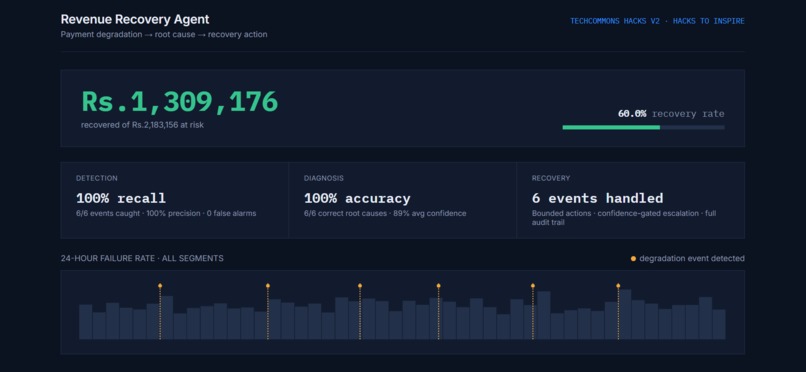
Dashboard 1
-
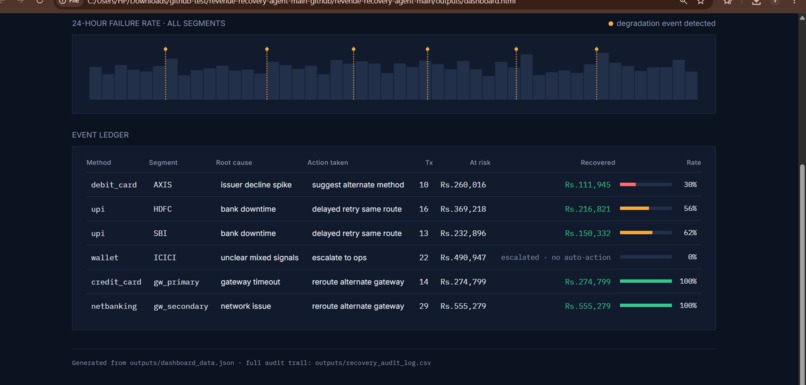
Dashboard 2
Inspiration
Payment failures rarely happen as one clean, obvious event. A payment gateway slows down. A bank's servers go down for twenty minutes. A card issuer starts declining transactions at an unusual rate. Every platform that processes online payments — a business, a college fest's ticketing system, a student marketplace app — loses real revenue to exactly this kind of silent failure, and by the time someone notices a dip on a dashboard, the money is already gone and the cause is cold. We wanted to see if that entire loop — noticing, understanding, and recovering — could be closed automatically, without turning into a black box nobody could trust with real money.
What it does
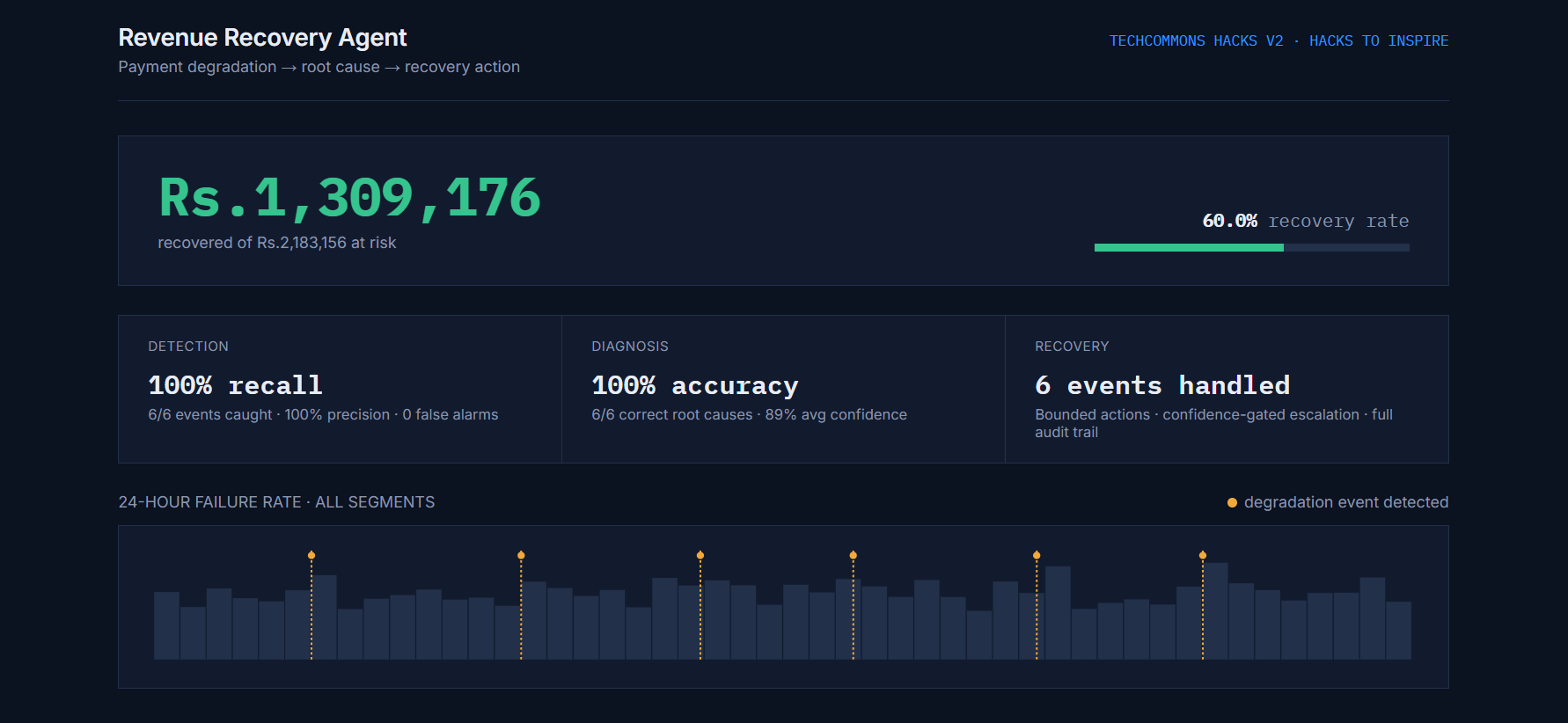
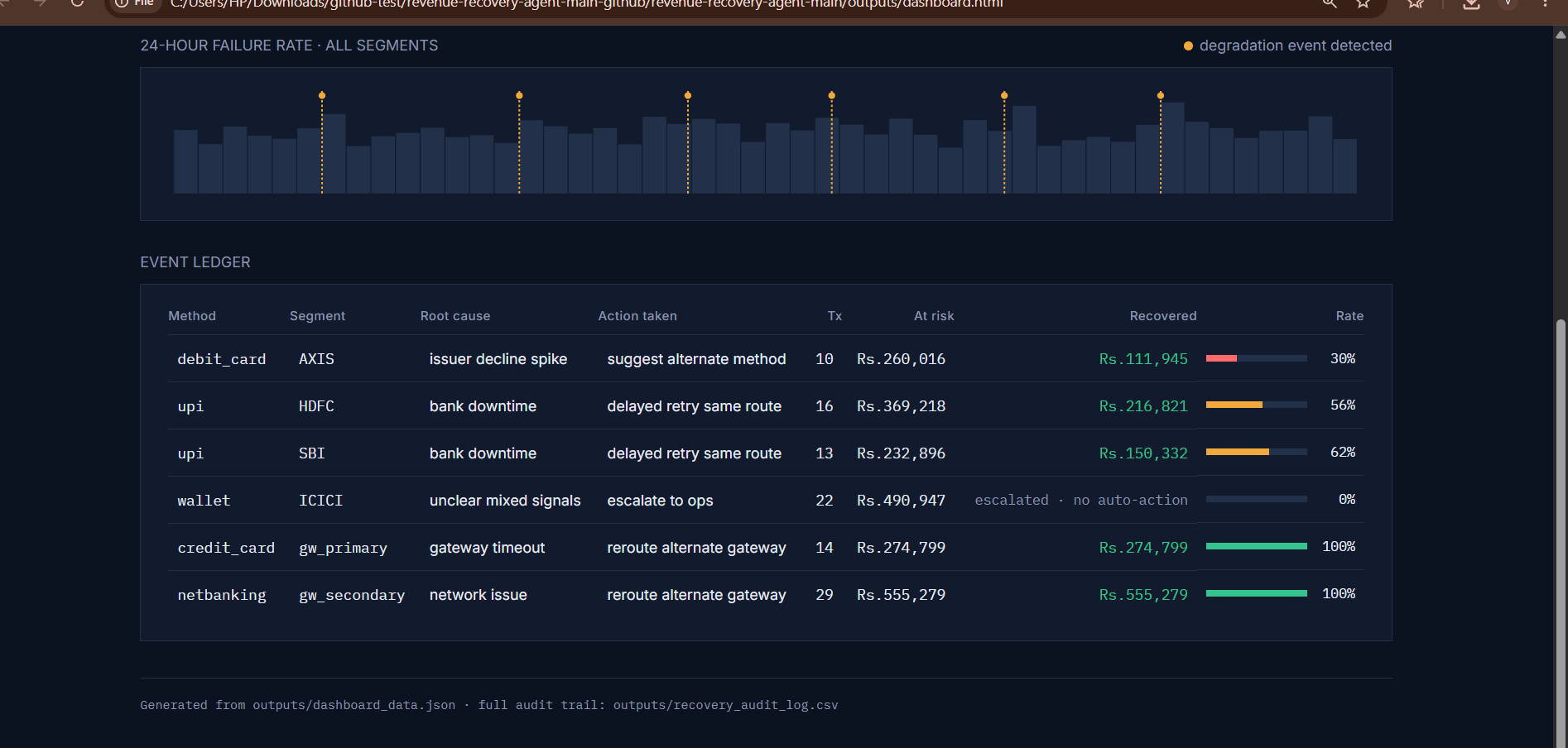
Revenue Recovery Agent is an autonomous pipeline that: Detects payment degradation in near real time — a statistical monitor watches failure rates per payment method, bank, and gateway, and flags when a specific segment's failure rate spikes well above its own normal baseline. Diagnoses the root cause — a rule-based classifier reads the failed transactions' error codes and latency patterns and votes on the most likely cause (gateway timeout, bank downtime, issuer decline spike, network issue), producing both an answer and a confidence score. Recovers the revenue with a bounded action matched specifically to that cause — rerouting a technical failure through an alternate gateway, delaying and retrying for a bank outage, nudging the customer toward an alternate payment method for a likely-genuine decline. Every action has hard stopping rules (capped retries, cooldowns) — and if the diagnosis confidence is too low, the system escalates to a human instead of guessing. Proves it worked — every detection, diagnosis, and recovery attempt is logged to a full audit trail, so nothing the system does is a black box. We validated it end-to-end against a synthetic 24-hour transaction stream (~43,000 payments) with six known degradation incidents secretly planted in it. The system achieved 100% detection recall and precision, 100% diagnosis accuracy, and recovered 60% of at-risk revenue automatically — correctly escalating the one deliberately ambiguous incident to a human instead of guessing.
How we built it
The pipeline is Python (pandas/numpy), structured as four sequential stages orchestrated by a single entry-point script: generate_data.py → detector.py → diagnoser.py → recovery_engine.py, plus a self-contained HTML/CSS dashboard for visualizing results. We deliberately chose explainable, rule-based and statistical methods over black-box machine learning at every stage: Detection uses a rolling-window two-proportion z-test comparing each segment's current failure rate against its own historical baseline — not a trained anomaly-detection model, since we had no labeled incident data and needed every flag to be justifiable in one sentence. Diagnosis uses a majority-vote over error codes, cross-checked against latency for consistency, rather than a trained classifier. Recovery uses a fixed policy table (root cause → bounded action) rather than a learned/reinforcement-learning policy, because taking a wrong automated action on real payments has real consequences — we didn't want a system "learning" that on live traffic. To test it honestly, we generated our own synthetic transaction data with known ground-truth incidents secretly injected — five clear-cut, and one deliberately ambiguous (mixed error signals, no dominant cause) to specifically test whether the system knows when not to act confidently.
Challenges we ran into
Getting this right took real, iterative debugging — not a clean first pass. Detection was badly broken at first. Our first version caught only 60% of real incidents while generating ten times more false alarms than true ones. We traced this to three separate bugs: our "normal" baseline failure rate was contaminated because it was computed from data that included the incidents themselves; our per-segment sample sizes were too small to be statistically meaningful; and testing thousands of segment/time-window combinations created a multiple-testing problem where false positives occurred by chance alone, even at a strict-looking threshold. We fixed each — a robust median-based baseline, higher transaction volume, and a persistence + statistically-justified threshold — and reached 100% recall and precision. Recovery logic had a subtler bug. Our engine initially let every recovery action retry up to three times uniformly. This inflated our "suggest alternate payment method" action's simulated recovery rate to a suspicious 70% — but retrying the exact same customer nudge three times isn't three independent chances at success the way a technical retry is. We made retry limits action-specific, and the number dropped to a far more believable 30%. A bug our own diagnoser caught. The diagnoser cross-checks latency against its claimed root cause as a sanity check. It flagged one genuine event with only 70% confidence because the latency didn't match — which led us to discover a naming bug in our own synthetic data generator (one bank-downtime error code wasn't tagged for high latency like its sibling code was). Fixing the generator brought that event's confidence to 100%.
Accomplishments that we're proud of
100% detection recall and precision, 100% diagnosis accuracy, measured against a real, known answer key — not just plausible-looking output. A system that knows when not to act. The confidence-gated escalation path is the accomplishment we're most proud of: when diagnosis confidence on our deliberately ambiguous test event came out at just 36%, the system correctly refused to auto-act on ₹4.9 lakh and escalated to a human instead. A system that only claims success when it's actually confident is more trustworthy than one that always says it worked. Catching our own mistakes rather than hiding them. Multiple times during the build, a suspiciously good-looking number turned out to be a real bug, and we traced each one back to its actual root cause instead of just re-tuning until the output looked nice.
What we learned
Explainability is a design constraint, not an afterthought. Choosing statistical/rule-based methods over ML from the start meant every single decision the system made could be justified in one sentence — which mattered far more once we were building the audit trail and confidence gating than raw predictive power would have. A good-looking number is a reason to dig deeper, not stop. Several of our biggest bugs were hiding behind results that looked fine at first glance (a 70% recovery rate, a "detected" event) until we checked them against ground truth or basic sanity logic. The multiple-testing problem is easy to miss and easy to create. Running one statistical test is simple to reason about; running thousands of them (across many segments and time windows) silently changes the odds of a false alarm, and we had to explicitly account for that rather than trusting a single-test threshold.
What's next for Revenue Recovery Agent
Replace the empirically-tuned detection threshold with a formal multiple-testing correction (Bonferroni or false-discovery-rate control) so it doesn't rely on having seen known incidents in advance. Validate against real (anonymized) transaction data instead of synthetic data, to test the pipeline against noisier, less clean real-world failure patterns. Extend the diagnoser to detect correlated failures across multiple related segments at once (e.g., a bank going down affecting several payment methods simultaneously), rather than treating each segment independently. Build a lightweight live-monitoring mode (rather than batch analysis) so the agent could run continuously against a real transaction stream.

Log in or sign up for Devpost to join the conversation.