-
-
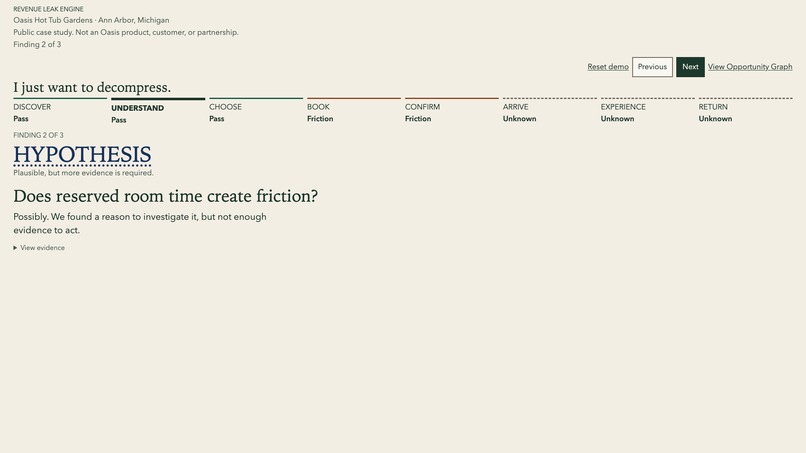
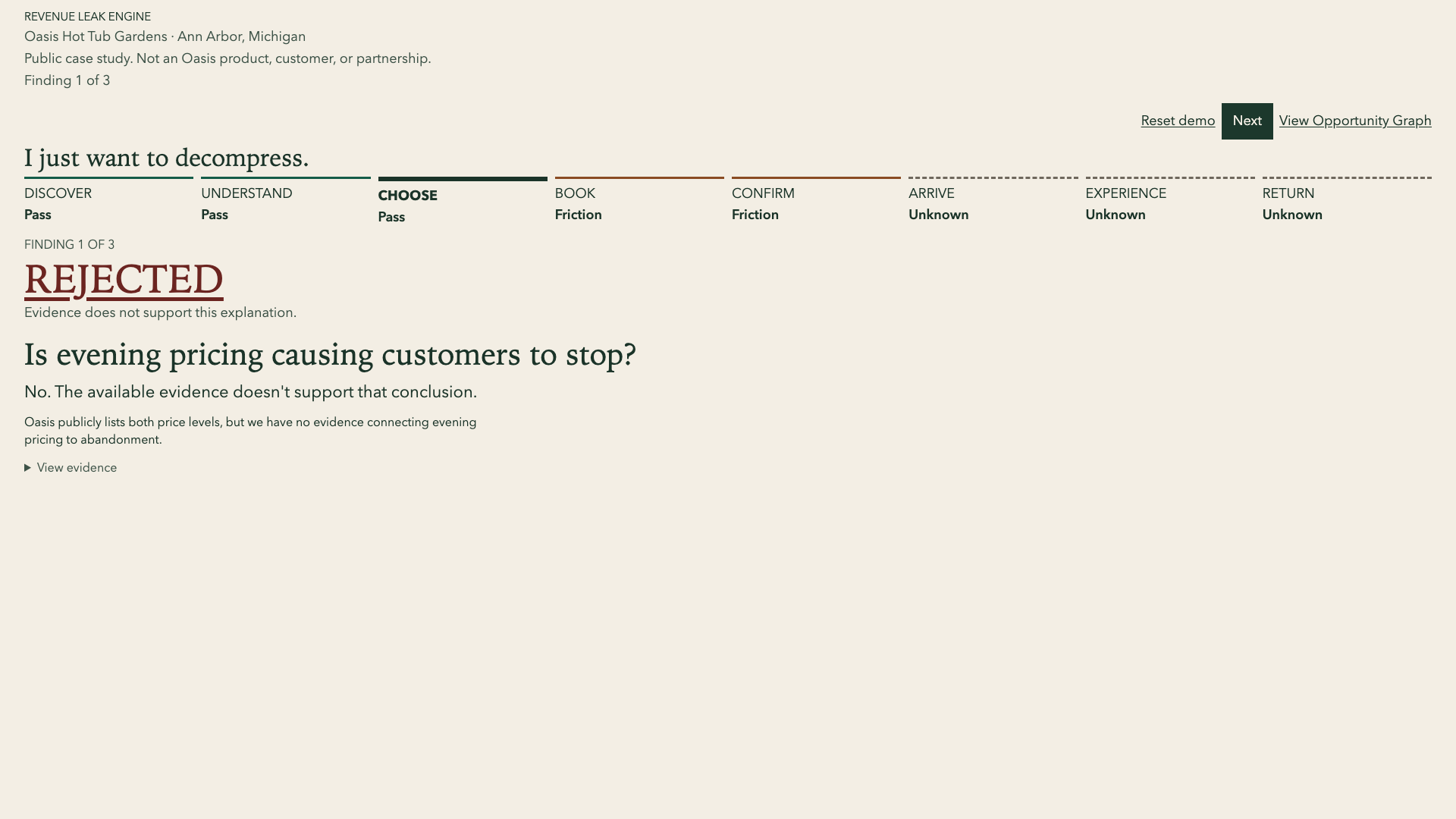
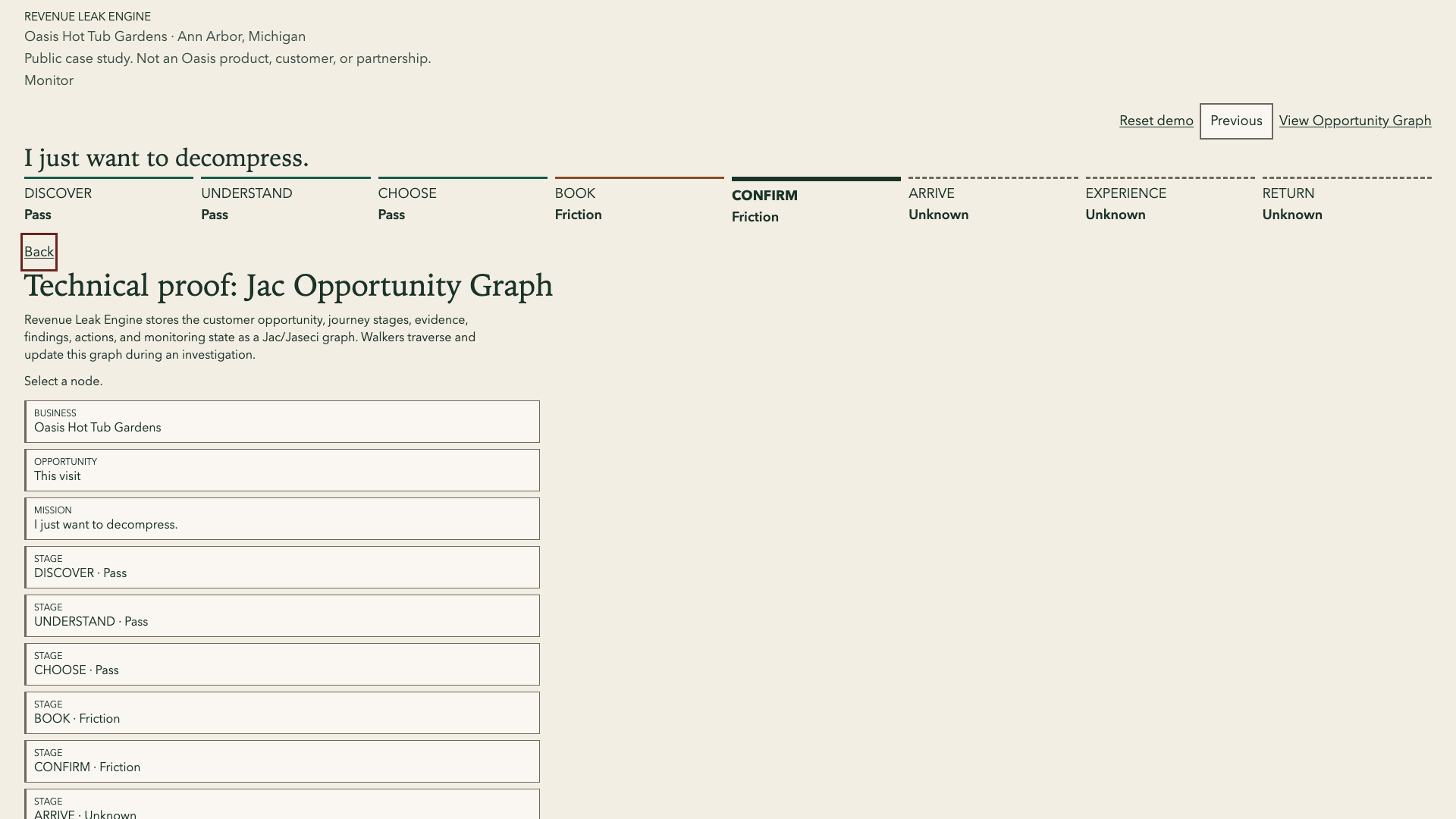
But it doesn't automatically trust its own conclusions. Here, evening pricing is rejected because the evidence doesn't support it.
-
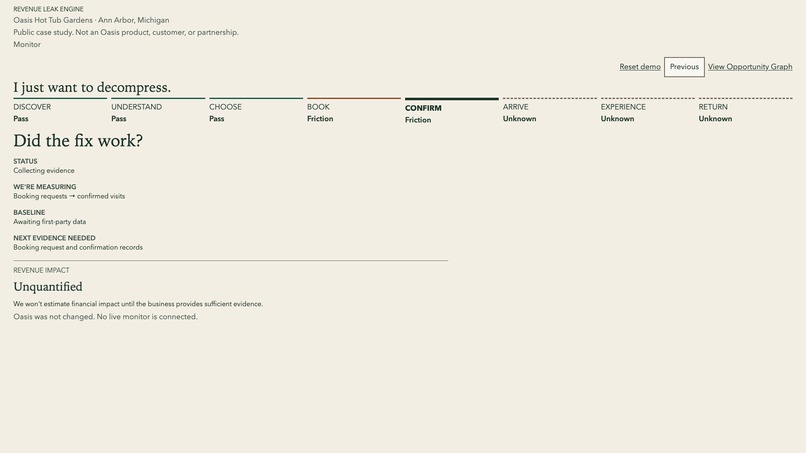
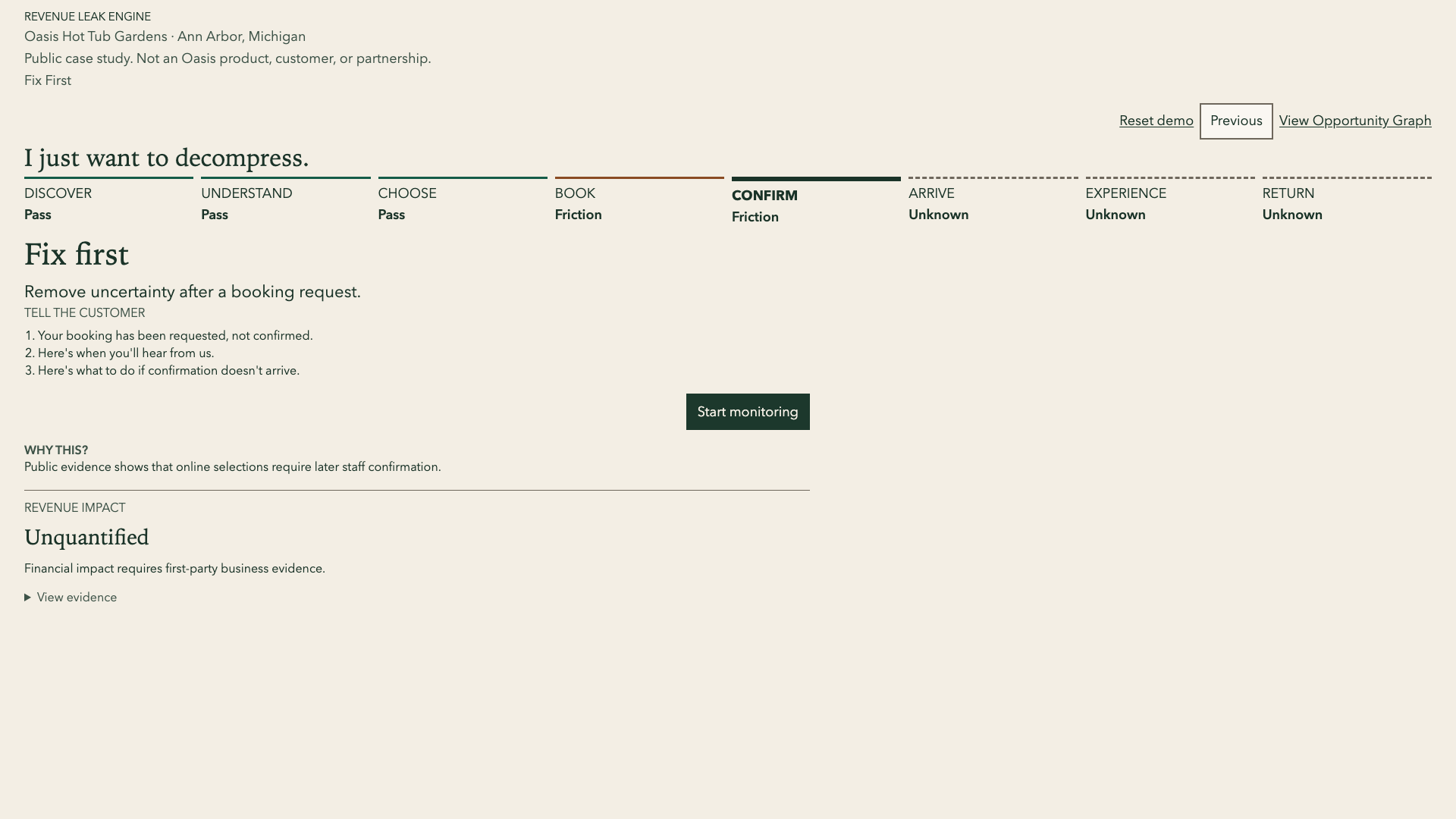
The owner gets one thing to fix first instead of another dashboard full of guesses.
-
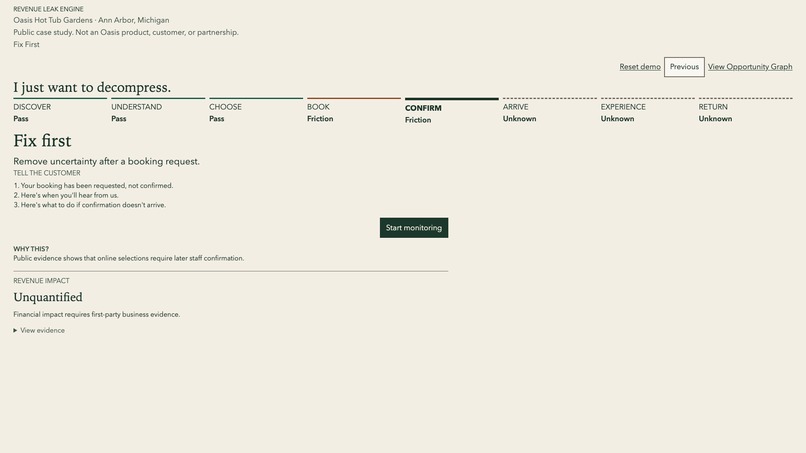
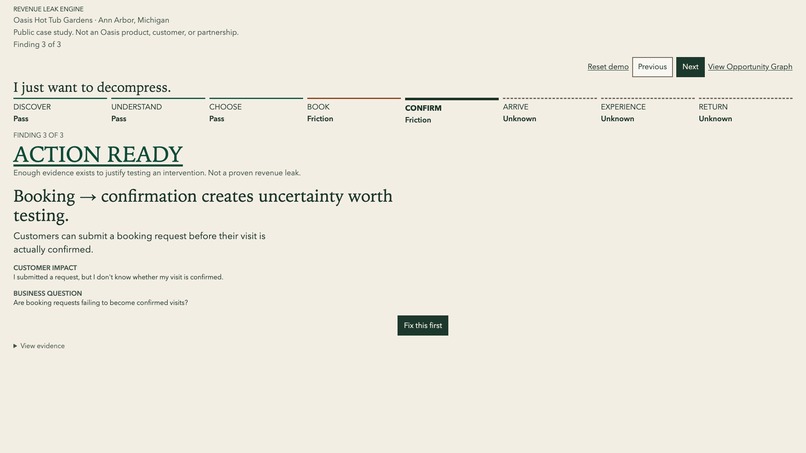
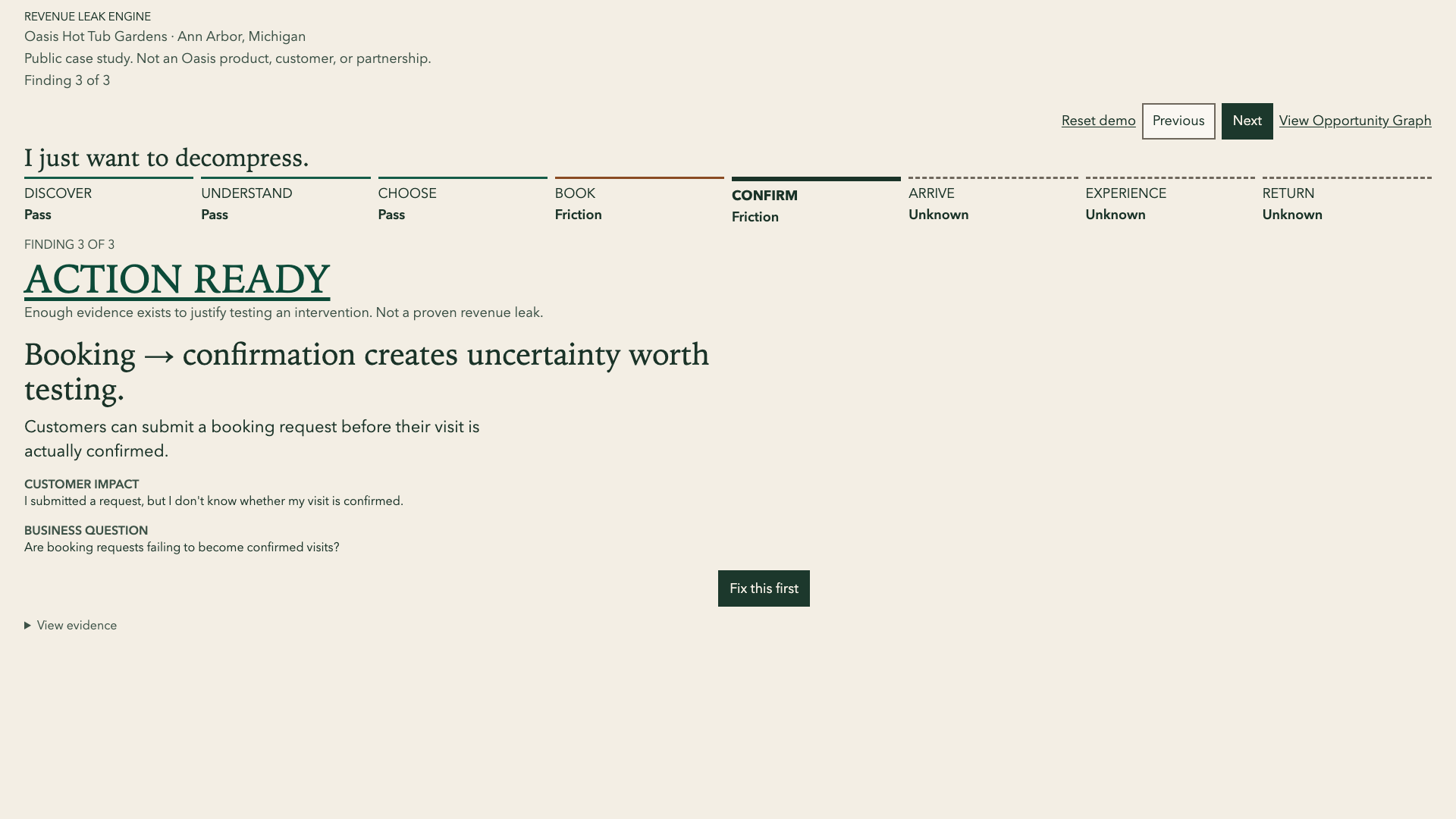
Booking to confirmation has enough evidence to test, so it becomes action ready.
-
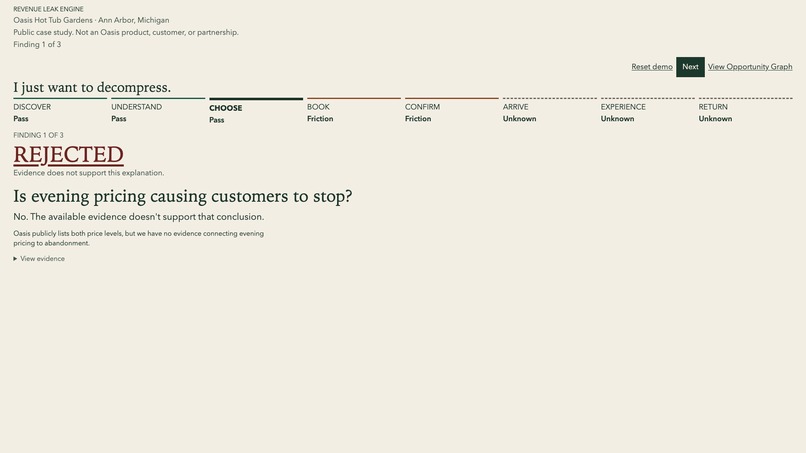
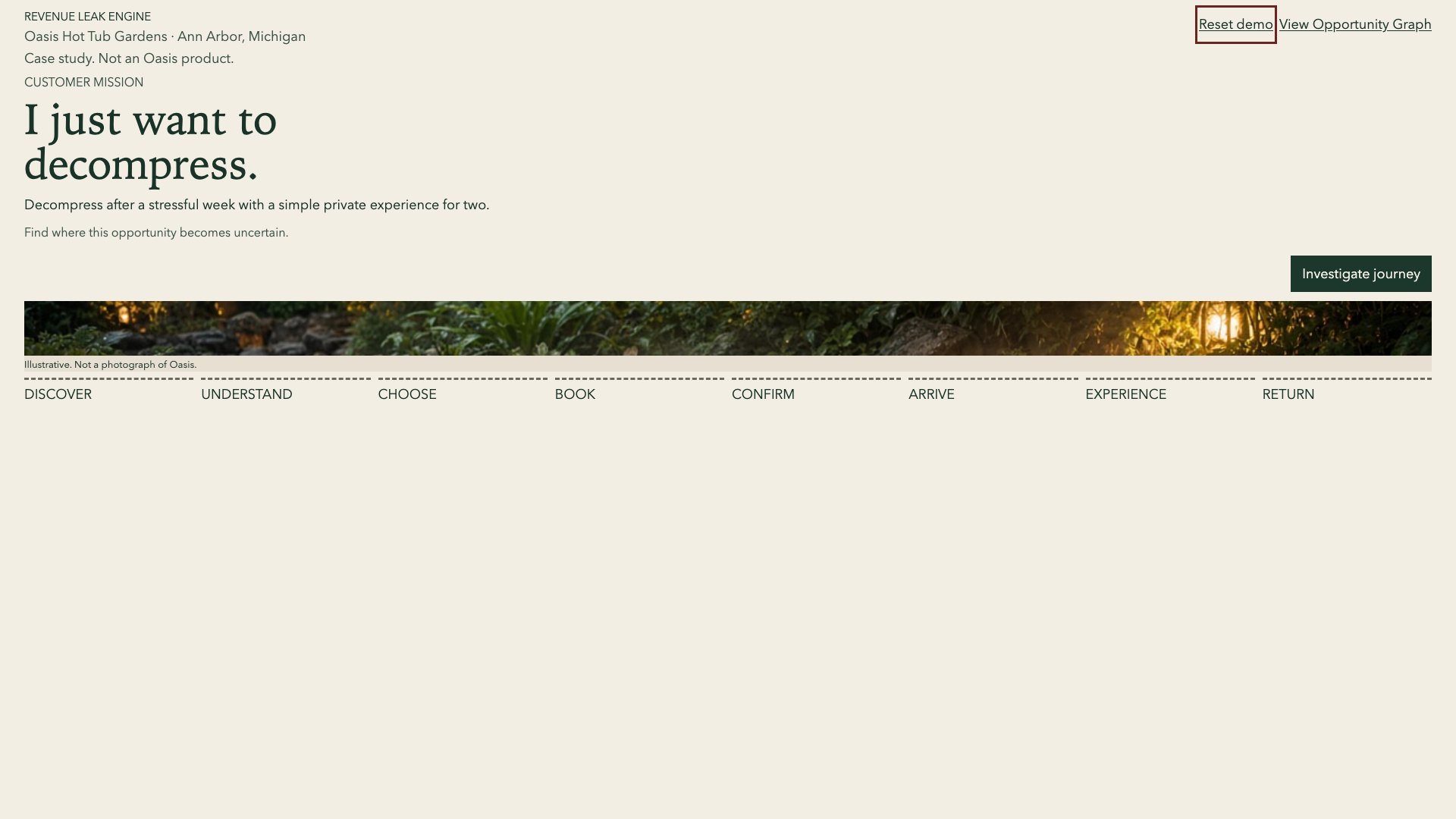
Revenue Leak Engine follows that customer opportunity through the business journey and finds where progress becomes uncertain.
-
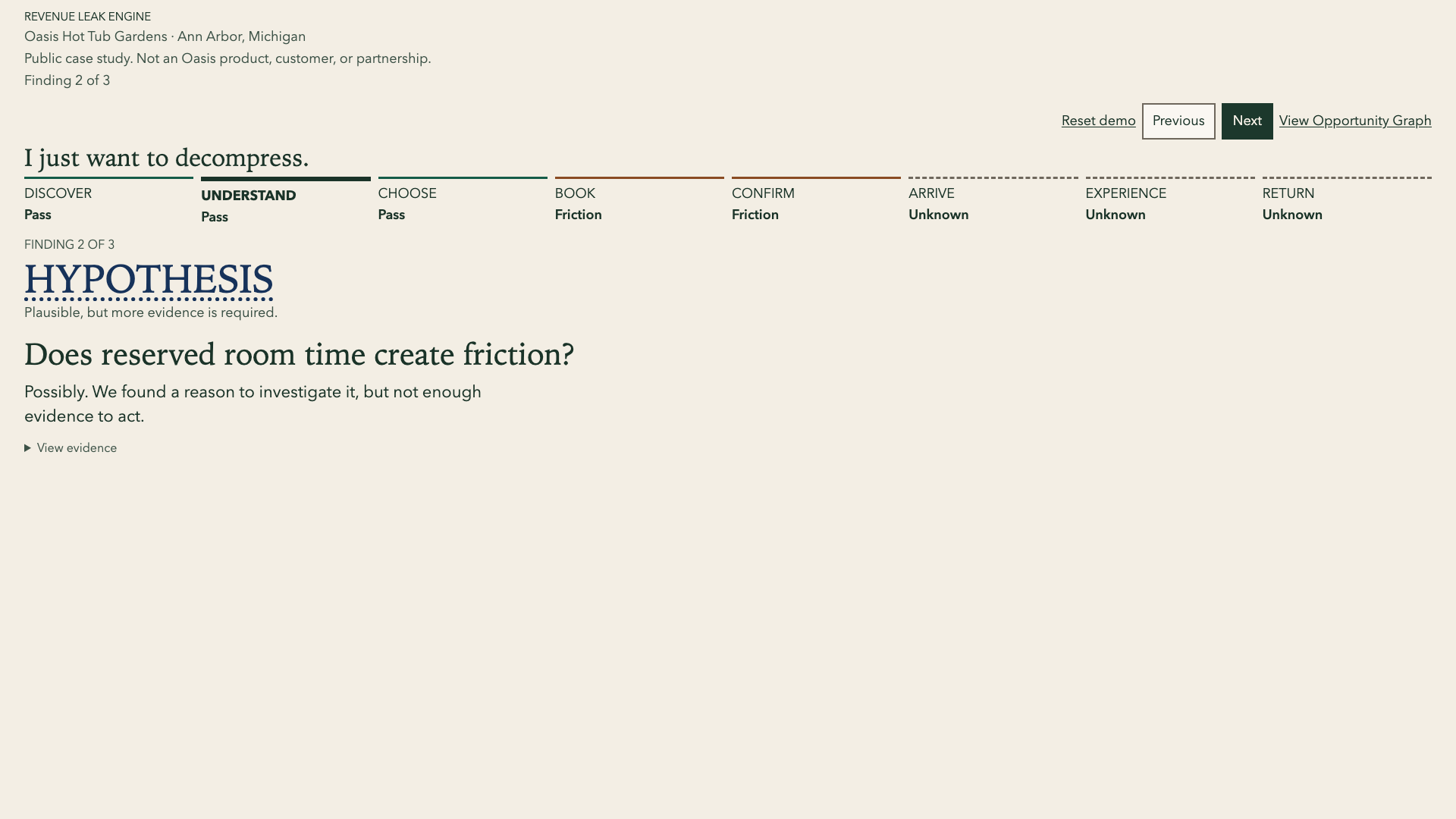
Room time remains a hypothesis because there isn't enough evidence to act.
-
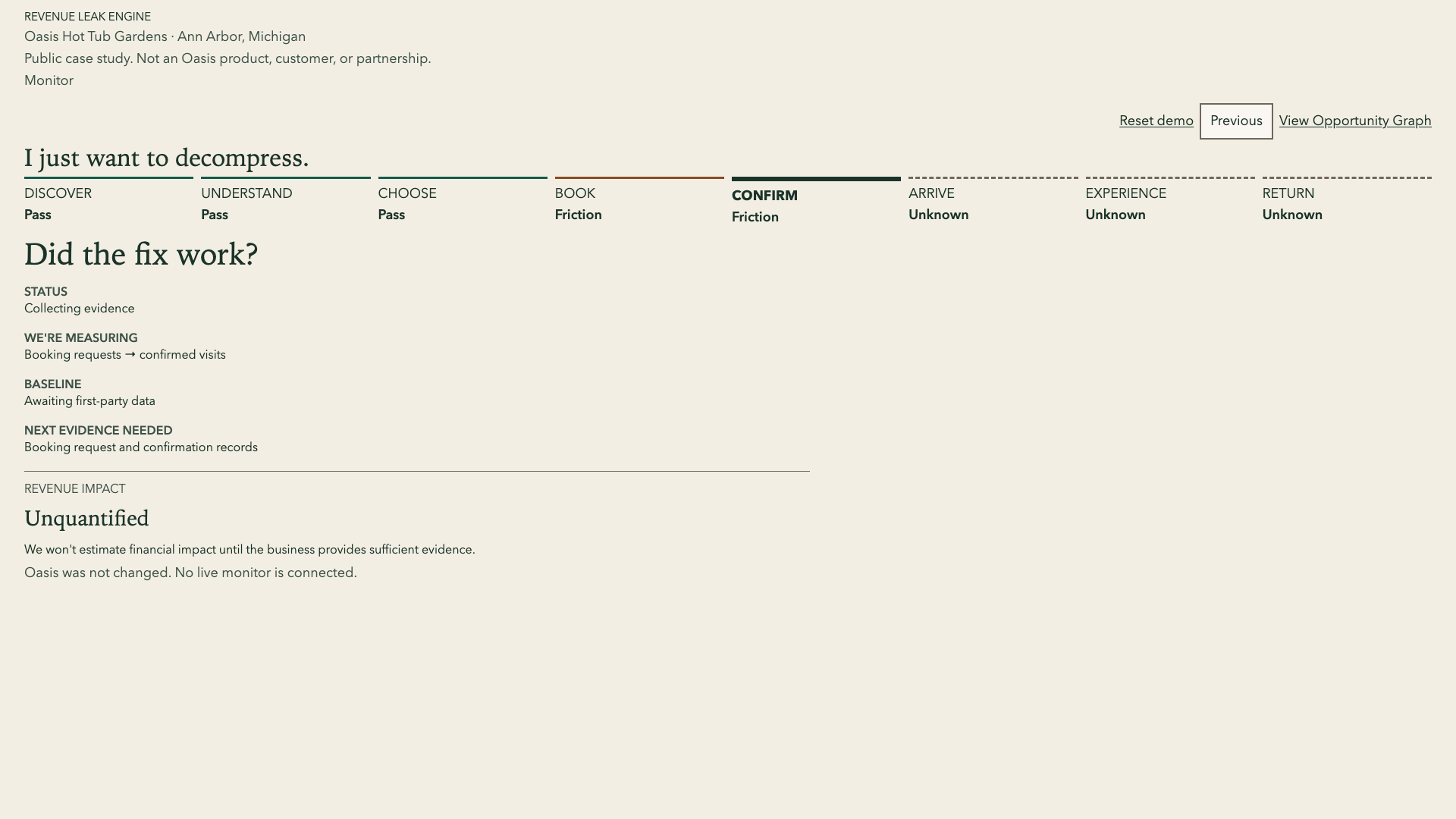
Then we measure whether it worked. Without first-party evidence, revenue stays unquantified.
-
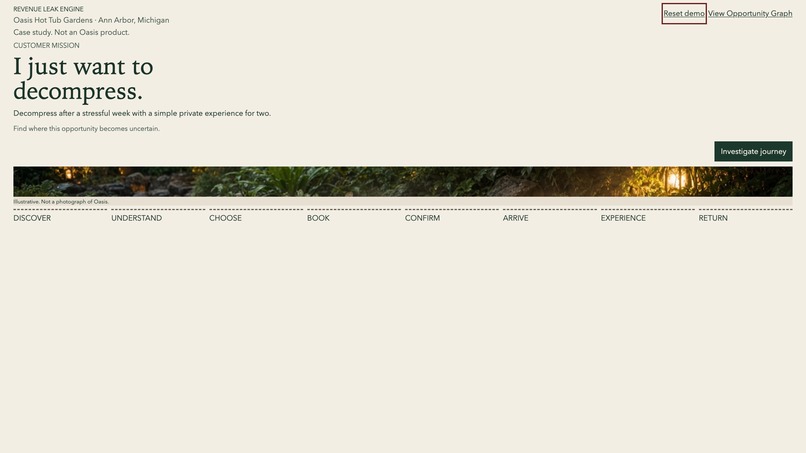
Imagine you've had a long week. You don't want another task. You just want to decompress.
Problem
A person trying to set a simple local visit can lose the thread when the next step is uncertain. They wanted to decompress. They did not want a research project.
The owner then sees a request that never became a visit and has no single explanation of where that opportunity stopped.
Solution
Revenue Leak Engine is an investigation of one customer opportunity. Evidence stays attached to the stage it belongs to. A weak finding can be rejected. One surviving finding becomes a single test, Fix First. Monitoring starts at collecting evidence and does not invent an improvement.
Local impact
The case is Oasis Hot Tub Gardens in Ann Arbor, Michigan. Internal Oasis business information in this demo is synthetic. It was not provided by Oasis.
Washtenaw County had 8,322 employer establishments in 2023 (U.S. Census County Business Patterns, via Health for All Washtenaw). That is every paid-employee establishment, not Oasis.
Baymard, updated September 22, 2025: 17% of US online shoppers have abandoned an order because checkout was too long or complicated. That is ecommerce checkout, not appointment booking and not Oasis.
No customer interview is claimed. Revenue impact is unquantified.
How it works
Mission, opportunity, journey, evidence, skeptic, Fix First, monitor.
The Skeptic rejects the evening-price finding, keeps room time as a hypothesis, and marks one confirmation finding action-ready. Fix First is one sentence to test at the moment of request: the visit is not confirmed yet.
How Jac is used
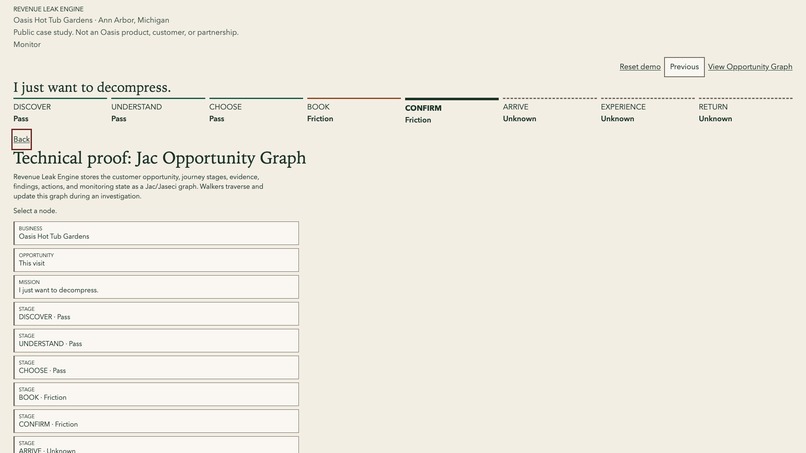
The investigation is a Jac graph. Walkers mutate it: undercover_walk, market_walk, ops_walk, skeptic_operator_walk, and start_monitoring. reset_demo returns eight unknown stages. Measured implementation share: 40.0% Jac.
Skeptic
IBM is not part of this submission. The Skeptic step uses deterministic rules.
Data disclosure
Simulated confirmation state is labeled Demonstration only. Not provided by Oasis. Public observations were read from oasishottubs.com on 2026-09-27.
Future
A local pilot would replace the simulated handoff with first-party confirmation counts, then monitoring, then possible distribution through SBDCs and chambers. That distribution is not built.
Built With
- jac
- jaseci
- python
- react
- typescript
