PROJECT DESCRIPTION
REVENU is a multi-agent autonomous system designed to eliminate decision paralysis in accounts receivable operations.
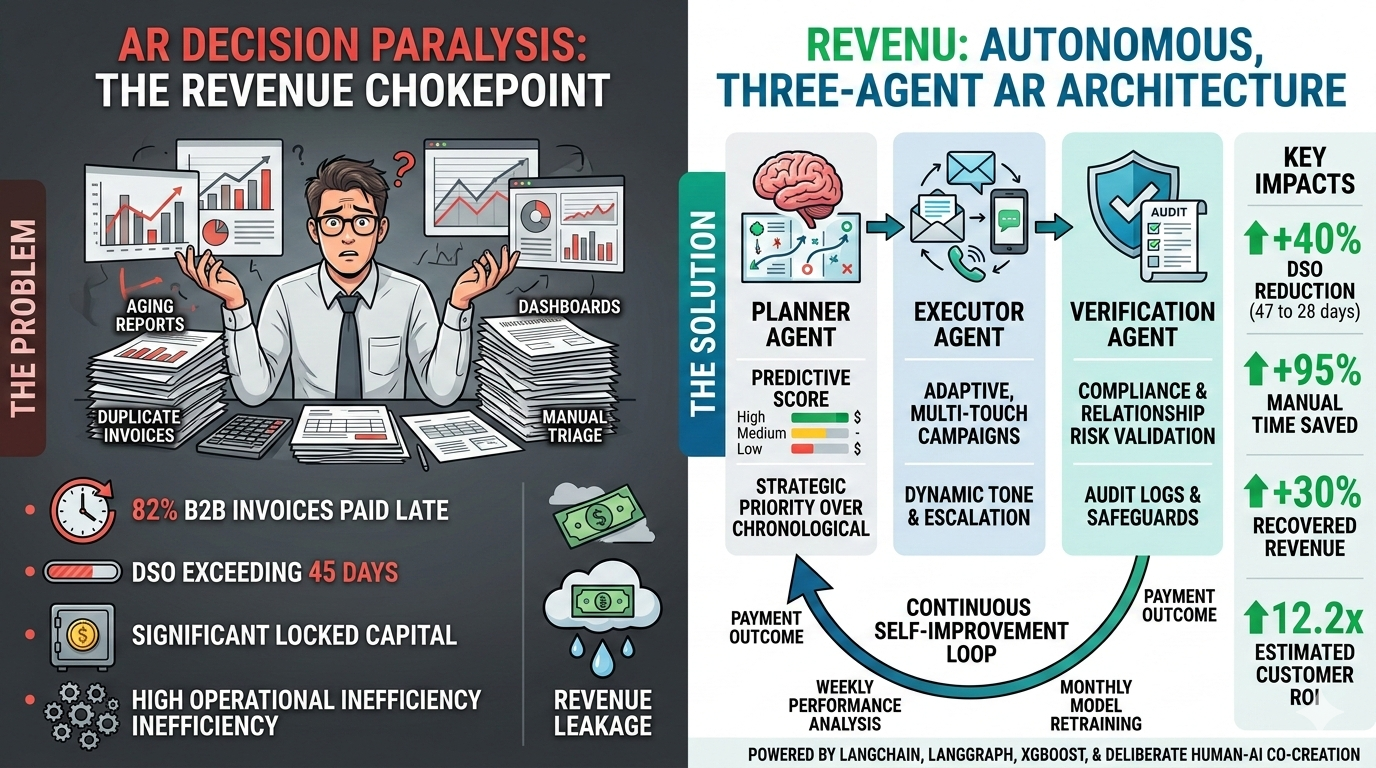
Eighty-two percent of B2B invoices are paid late. Twenty-five percent of business insolvencies are directly linked to unpaid invoices. Finance teams spend more than 30 hours per month manually triaging overdue accounts using passive dashboards and generic communication templates.
REVENU replaces manual collection workflows with an intelligent three-agent architecture:
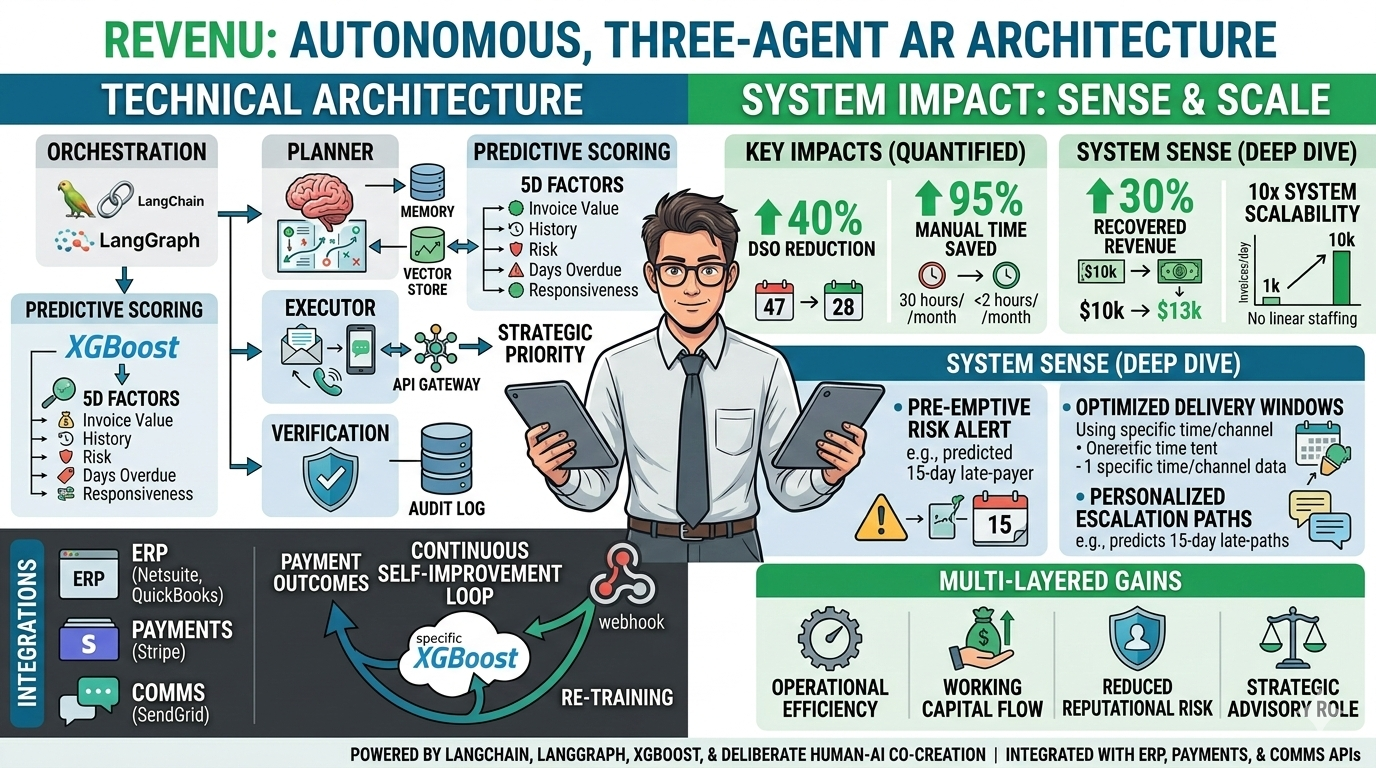
Planner Agent Evaluates overdue invoices using a five-dimensional propensity-to-pay model incorporating payment history, invoice value, days overdue, company risk signals, and responsiveness patterns. It prioritizes accounts strategically instead of chronologically.
Executor Agent Launches adaptive, multi-touch communication campaigns. Messaging tone and escalation strategy adjust dynamically based on predicted payment probability.
Verification Agent Performs real-time compliance, tone, and relationship-risk validation before execution. Maintains audit logs and governance safeguards.
The system includes a continuous self-improvement loop with weekly performance analysis, monthly model retraining, and adaptive channel optimization.
This project demonstrates deliberate human-AI co-creation, structured prompting, agent mental modeling, and iterative refinement from concept to venture-ready architecture.
PROBLEM STATEMENT
Accounts receivable operations suffer from decision paralysis.
Invoices are issued. Due dates pass. Teams manually sort aging reports. Generic reminders are sent. Escalation happens weeks late. Cash flow becomes unpredictable.
Existing tools are passive dashboards that require human action. No system autonomously prioritizes, adapts, and learns from collection outcomes.
The result:
- 82 percent of invoices paid late
- Average DSO exceeding 45 days in mid-market companies
- Significant working capital locked in unpaid receivables
- Operational inefficiency and revenue leakage
SOLUTION
REVENU introduces an autonomous, collaborative agent architecture.
Planner Agent Uses predictive scoring to determine which accounts to act on and how.
Executor Agent Executes personalized multi-channel campaigns with dynamic tone calibration and escalation logic.
Verification Agent Validates every outbound action for compliance and relationship impact.
Self-Improvement Loop Learns from every payment outcome and continuously optimizes strategy.
The result is operationalized cash flow management rather than reactive collections.
IMPACT METRICS (SIMULATED MODEL RESULTS)
- 40 percent DSO reduction (47 days to 28 days)
- 95 percent reduction in finance team manual collection hours
- 30 percent increase in recovered revenue
- 12.2x estimated customer ROI
- 2–3 month payback period
HOW WE BUILT IT
The project was developed through structured iterative prompting in ASI: One.
Key stages:
- Market opportunity comparison with quantitative filters
- Broken workflow decomposition
- Multi-agent mental model design
- Continuous learning mechanism definition
- Competitive differentiation refinement
- Venture-grade financial modeling
- Technical architecture specification
Nine strategic prompts guided five major refinements from initial concept to full system architecture.
TECH STACK (ARCHITECTURAL DESIGN)
Agent Orchestration: LangChain + LangGraph Propensity Scoring: XGBoost model design Data Layer: PostgreSQL, Redis, Vector store Integrations: QuickBooks API, Netsuite API, Stripe, SendGrid Infrastructure: Kubernetes (EKS model), AWS cloud Security: OAuth 2.0, AES-256 encryption, SOC 2-ready design
WHAT MAKES THIS SPECIAL
- Fully autonomous, not human-in-the-loop dependent
- Agent mental models explicitly defined
- Continuous learning loop
- Clear path to scalable SaaS business
- Demonstrates disciplined prompt engineering and system design
FUTURE ROADMAP
Phase 2: Predictive payment timing forecasting Phase 3: Dynamic credit term recommendations Phase 4: Cross-customer federated learning for risk modeling
TEAM
OM (Human Strategy and Prompt Design) ASI: One (Agent Co-Creation Platform)
WHAT WE LEARNED
- Precise prompting shifts AI from output generation to system design.
- Agent mental models produce more coherent architectures than feature lists.
- Quantification early in ideation prevents weak concept drift.
- Iterative refinement is more powerful than a single strong prompt.
Built With
- 2-ready
- aes-256-encryption
- amazon-web-services
- cloud
- design
- kubernetes-(eks-model)
- langchain
- langgraph
- netsuite-api
- oauth-2.0
- postgresql
- quickbooks-api
- redis
- sendgrid
- soc
- store
- stripe
- vector

Log in or sign up for Devpost to join the conversation.