-
-
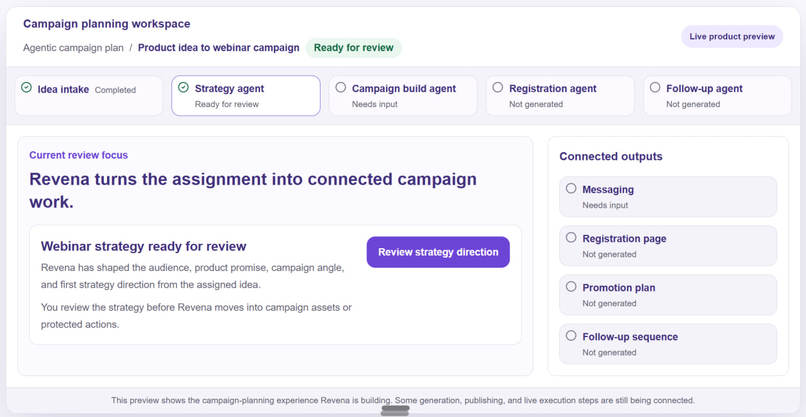
Revena Dashboard
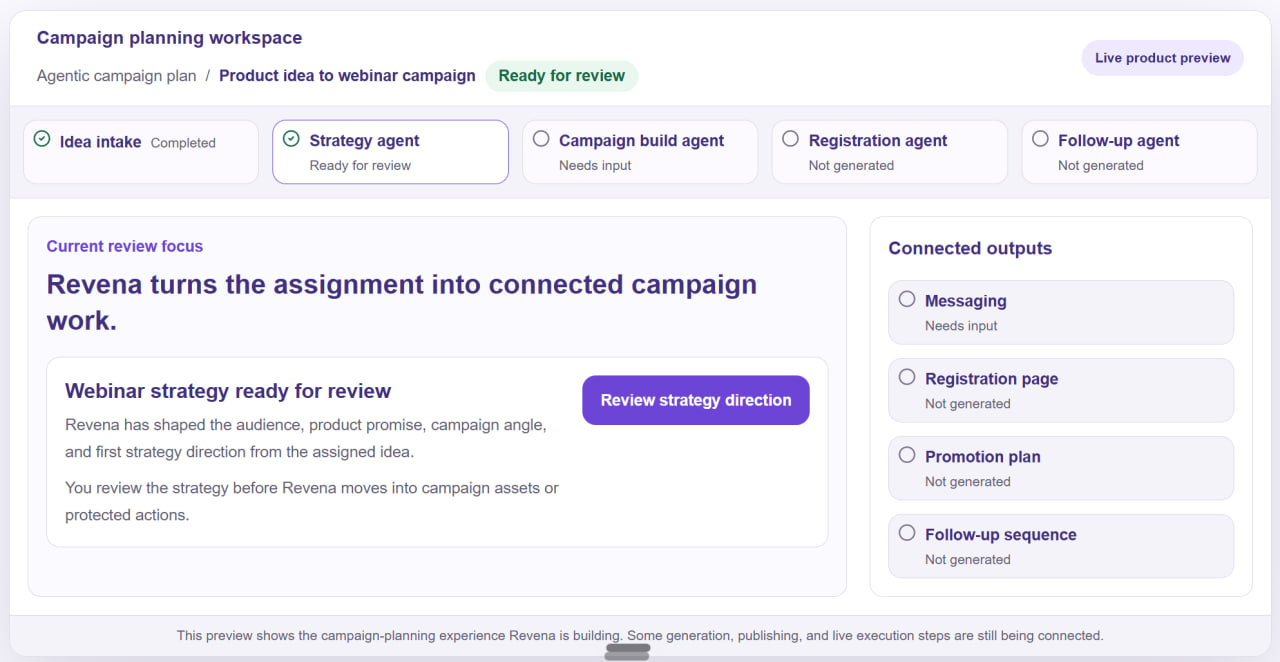
Inspiration
Revena was inspired by more than five years of experience planning and executing webinar campaigns for coaches, consultants, and entrepreneurs.
When I discovered OpenAI Build Week, my first idea was to build an all-in-one business management platform for small business owners. Before committing to it, I asked ChatGPT to recommend project ideas based on my experience. One of the suggestions was a webinar growth copilot, and that immediately connected with my background.
As a marketing professional, I have managed webinar campaigns end to end, including live webinars with more than 10,000 attendees and another with approximately 8,000 attendees. I have worked across strategy, messaging, registration, promotion, webinar delivery, sales, and follow-up.
That experience became the foundation for Revena.
What it does
Revena is an agentic webinar campaign platform for coaches, consultants, creators, entrepreneurs, and businesses that want to sell an offer through a webinar.
A user simply describes what they want to sell and who it is for. Revena then helps transform that idea into a connected webinar campaign by:
- analysing the offer
- identifying missing information
- asking relevant discovery questions
- developing the webinar strategy
- calculating the revenue model
- creating promotional assets
- preparing registration-page content
- structuring the webinar delivery
- creating follow-up sequences
- requesting approval before important actions
- updating affected campaign assets when information changes
The goal is for Revena to do the campaign work, not simply give the user more tasks.
How we built it
I am a non-technical builder with a background in marketing, so I began by planning the product thoroughly with ChatGPT.
I used ChatGPT to create and refine the product requirements, MVP specification, user flow, UI plan, technical stack, development plan, data model, API contract, AI orchestration specification, and QA plan.
I then used Codex with GPT-5.6 to build the application.
I created a specialised development-agent team consisting of:
- an Orchestration Agent
- a Backend Engineer Agent
- a Frontend Engineer Agent
- a UI/UX Design Agent
- a QA Engineer Agent
- a Technical Writer Agent
Each agent had a reusable role-based skill and a Revena-specific instruction file defining its responsibilities, boundaries, quality standards, and completion criteria.
I worked mainly through the Orchestration Agent, which broke tasks down and routed them to the appropriate development agent.
Revena also includes four internal runtime agents:
- Revena Orchestrator
- Discovery and Strategy Agent
- Campaign Build Agent
- Webinar Delivery and Follow-Up Agent
The main technologies used include:
- Next.js and TypeScript
- Tailwind CSS and customised shadcn/ui
- Supabase for database and authentication
- OpenAI Responses API
- OpenAI Agents SDK
- Vercel
- Inngest
- Sentry
- PostHog and Vercel Analytics
- Git and GitHub
Challenges we ran into
One major challenge was the UI. The first version worked, but it looked too much like a generic SaaS dashboard. I had to rethink the application shell, typography, colour usage, campaign dashboard, landing page, and idea-intake experience.
Another challenge was usage limits. I exhausted my included Codex usage and additional credits before completing every planned improvement. I then had to take over some tasks manually, including Git operations, deployment checks, and debugging.
Coordinating multiple agents was also challenging. They all had to work from the same project documents, terminology, schemas, and boundaries without interfering with one another or another project.
Finally, while the four internal agents were created, some end-to-end workflows still require further testing and refinement.
Accomplishments that we're proud of
I am proud of how quickly Revena moved from an idea to a working MVP.
Without a traditional coding background, I was able to:
- turn my webinar experience into a software product
- create a complete product and technical specification
- build a multi-agent development workflow
- develop a full Next.js application
- implement authentication and database infrastructure
- create four internal runtime agents
- build campaign planning, discovery, strategy, approval, and workspace flows
- deploy the application
- redesign the interface after reviewing the first version
The project showed me how domain expertise and AI development tools can work together effectively.
What we learned
The biggest lesson was that building with AI still requires structure.
Clear product documents, strong agent roles, explicit boundaries, acceptance criteria, testing, and human review all had a major effect on the quality of the result.
I also learned the importance of token and context efficiency. Working with multiple agents can consume usage quickly, so context should be limited, approved outputs should be reused, and unnecessary regeneration should be avoided.
Most importantly, I learned that creating agents is only one part of an agentic product. The orchestration, tools, approvals, state management, guardrails, and failure handling around those agents are equally important.
What's next for Revena
The next step is to recruit 5–10 pilot users who already use, or want to use, webinars to sell products and services.
Their feedback will help validate:
- the discovery questions
- the usefulness of the strategy
- the quality of the campaign assets
- the clarity of the approval flow
- the reliability of the internal agents
After the pilot, I plan to improve the agent workflows, refine campaign output quality, strengthen onboarding and publishing, and work toward converting the first pilot users into paying customers.
Built With
- chatgpt
- codex
- next.js
- openai
- supabase
- vercel

Log in or sign up for Devpost to join the conversation.