-
-
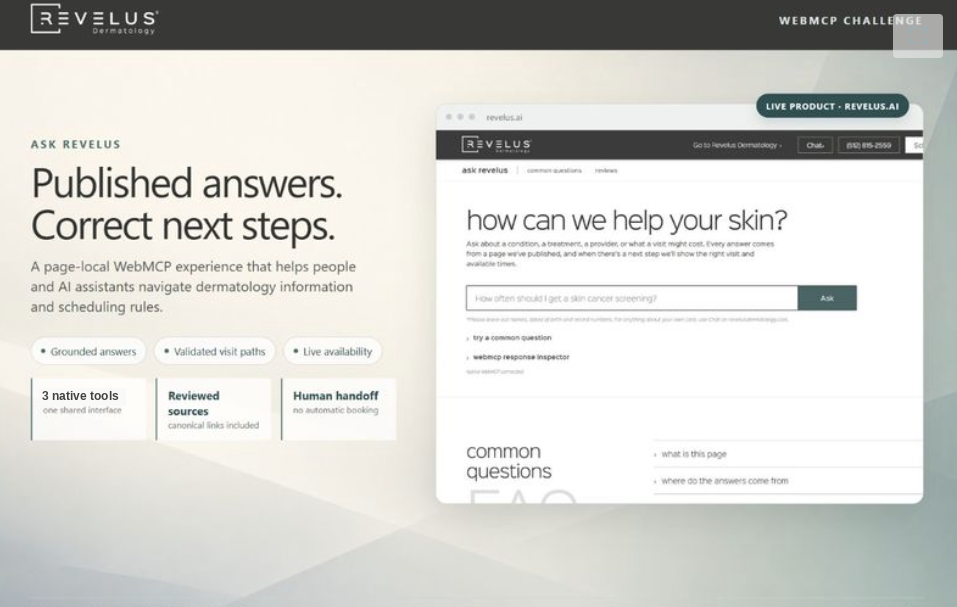
Ask Revelus turns everyday dermatology questions into grounded answers, validated next steps, and live scheduling options.
-
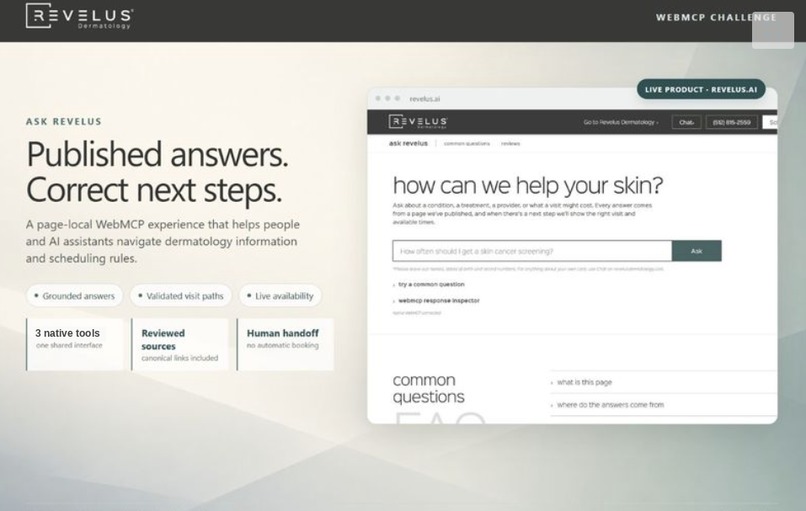
Revelus.ai turns patient questions into grounded answers, validated visit paths, and live scheduling options.
-
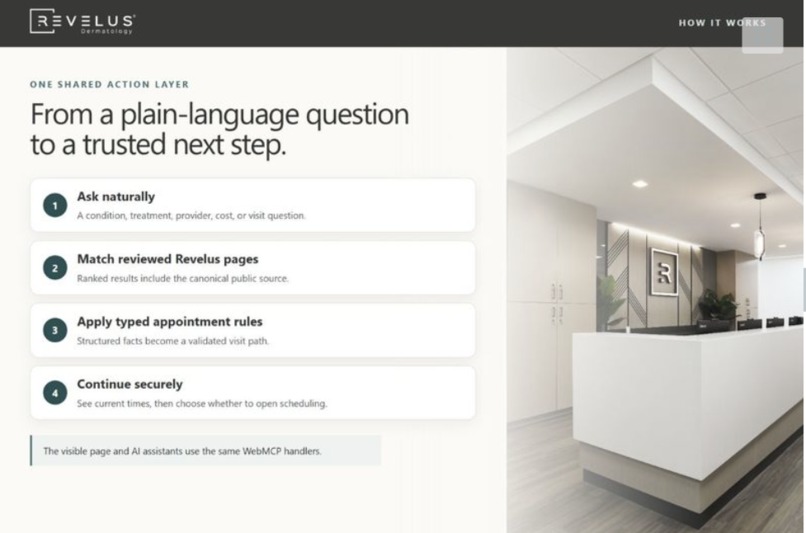
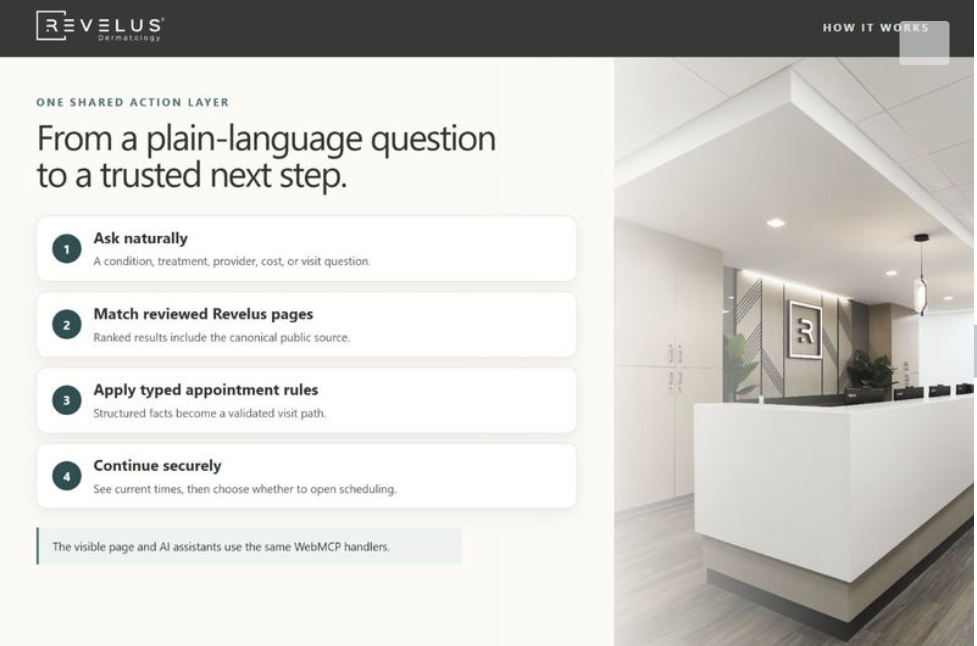
One shared WebMCP layer connects plain-language questions to reviewed content, typed routing, and secure scheduling.
-
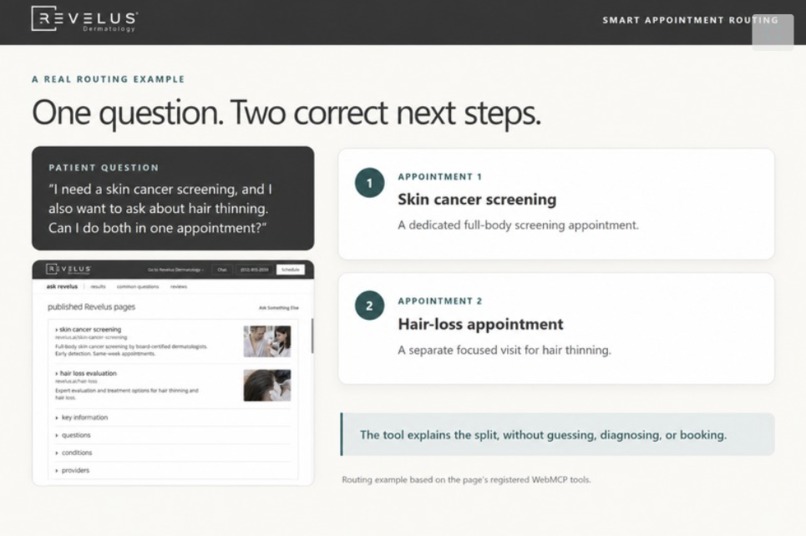
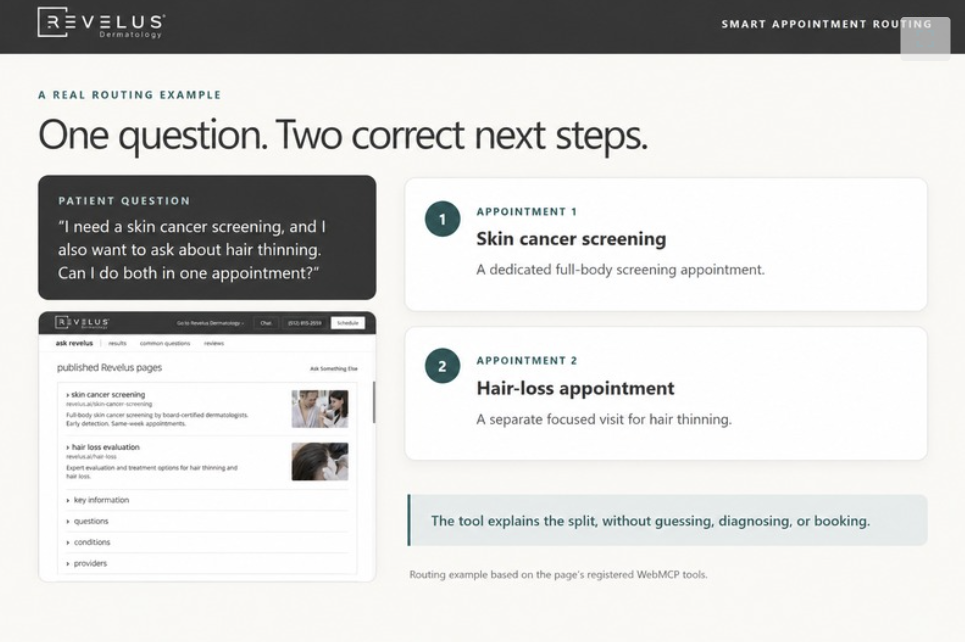
One question can require two visits. Revelus.ai applies practice rules to return the right next step for each concern.
-
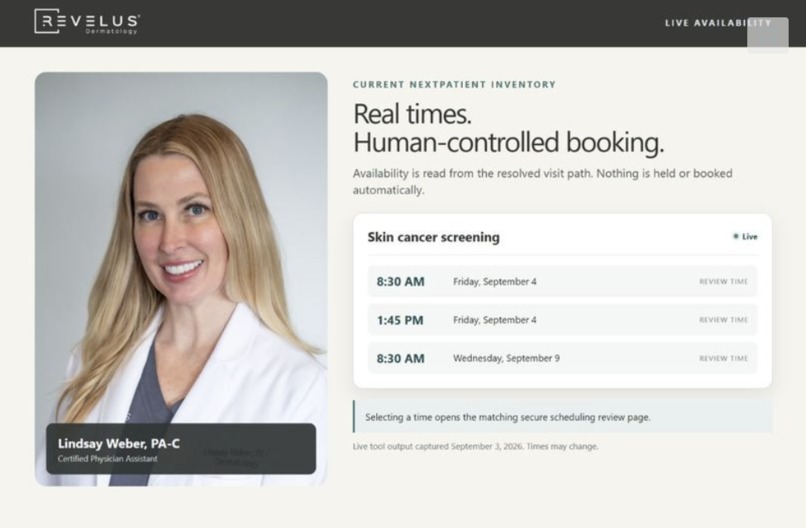
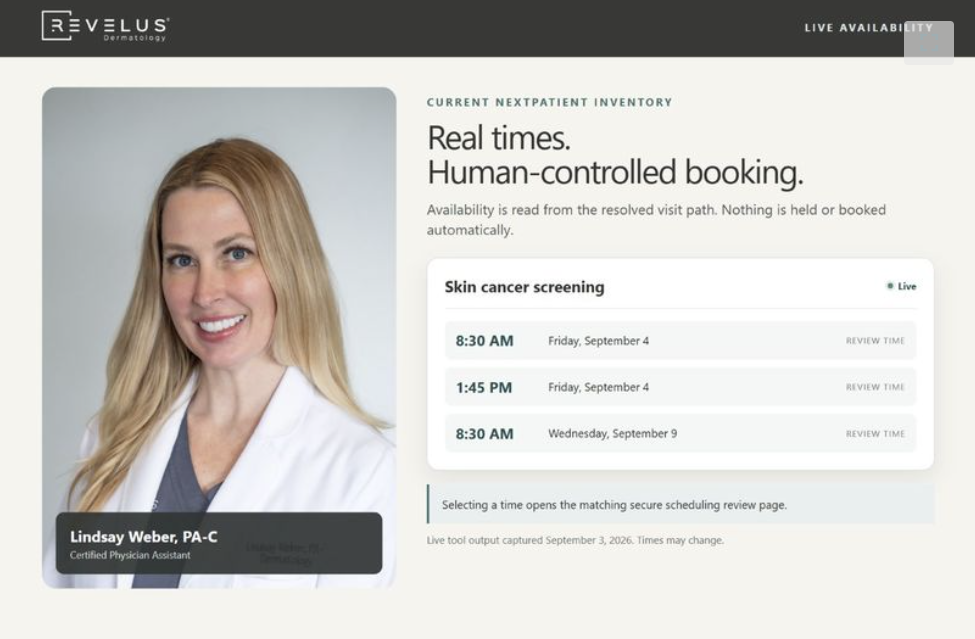
Live provider times come from current scheduling inventory, while patients remain in control of the final booking.
-
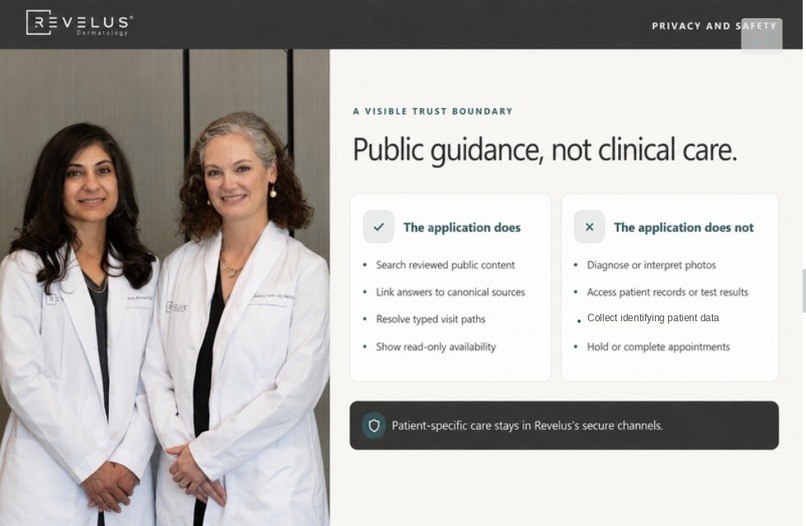
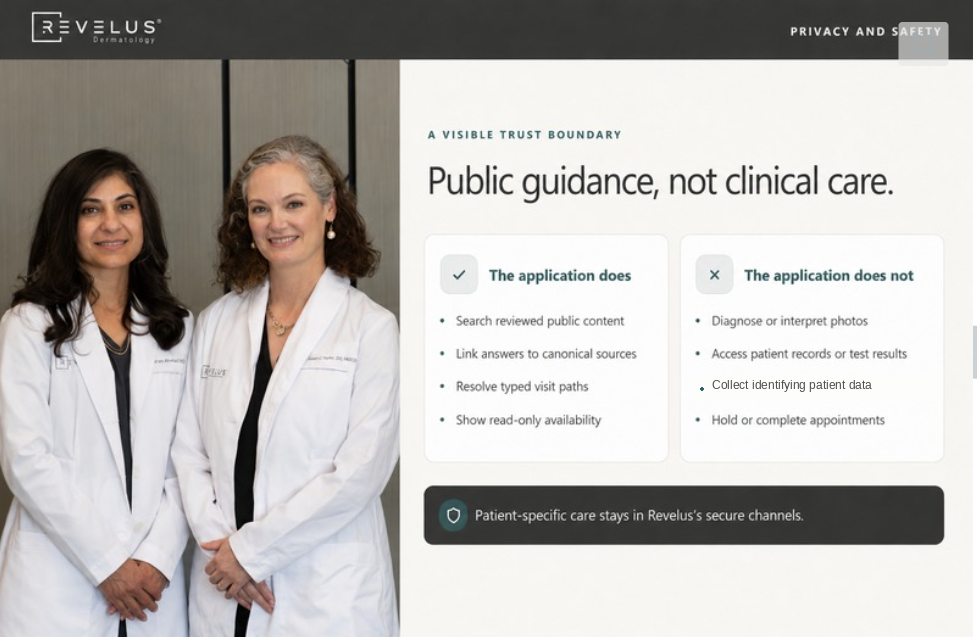
Public guidance stays separate from clinical care, private records, identifying data, and automated booking.
-
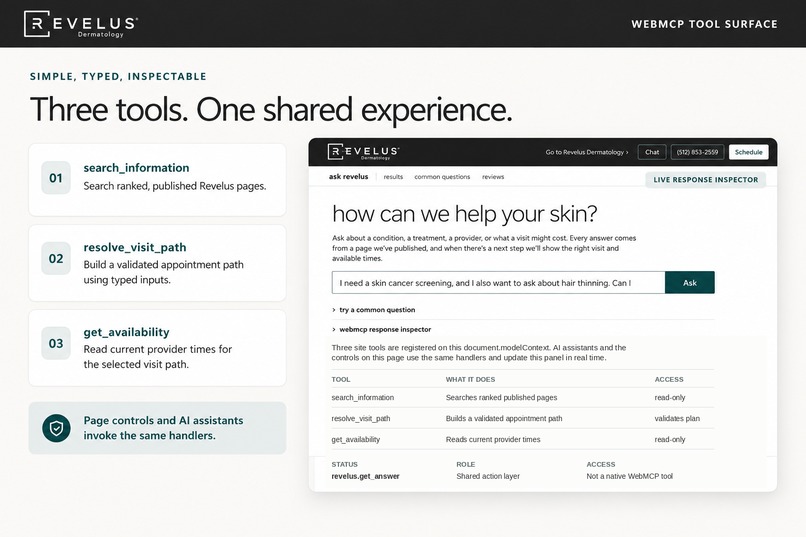
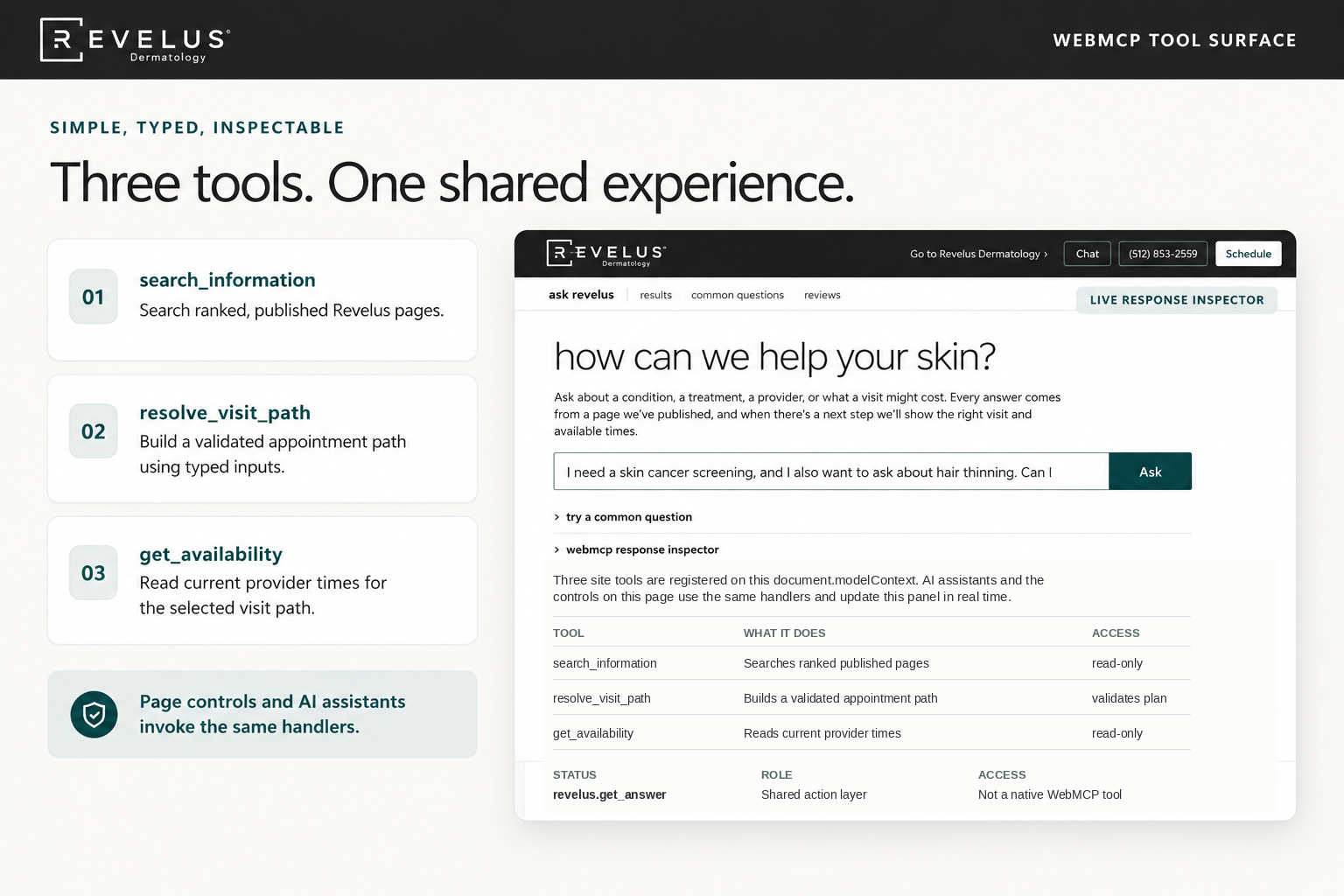
Three native WebMCP tools share one action layer for search, visit routing, and current availability.
-
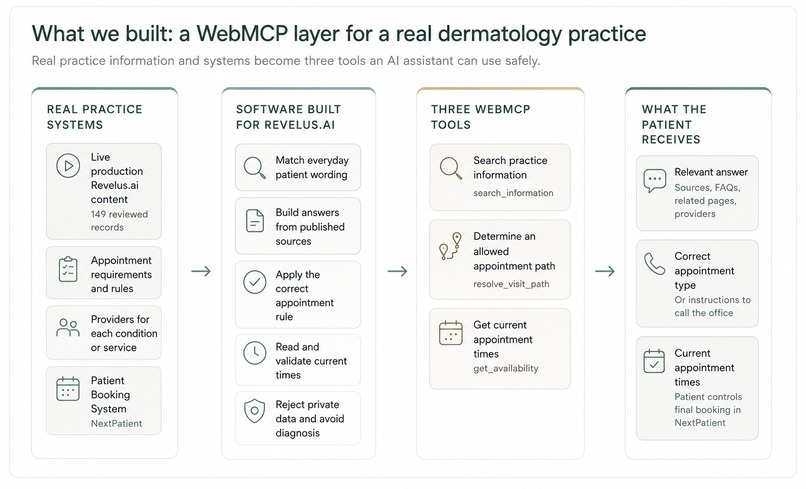
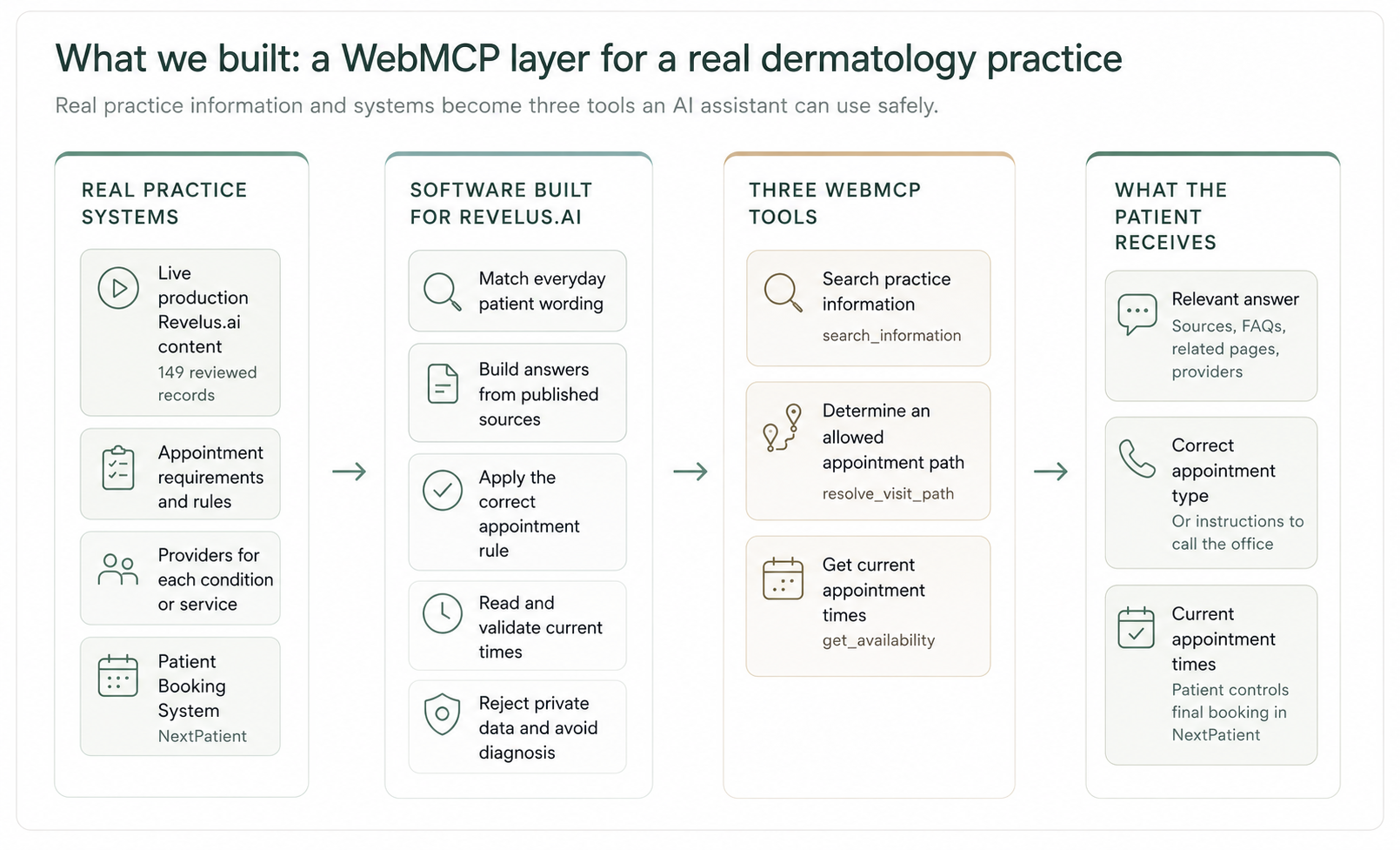
Revelus.ai connects reviewed practice information, routing rules, and live availability through a focused WebMCP layer.
-
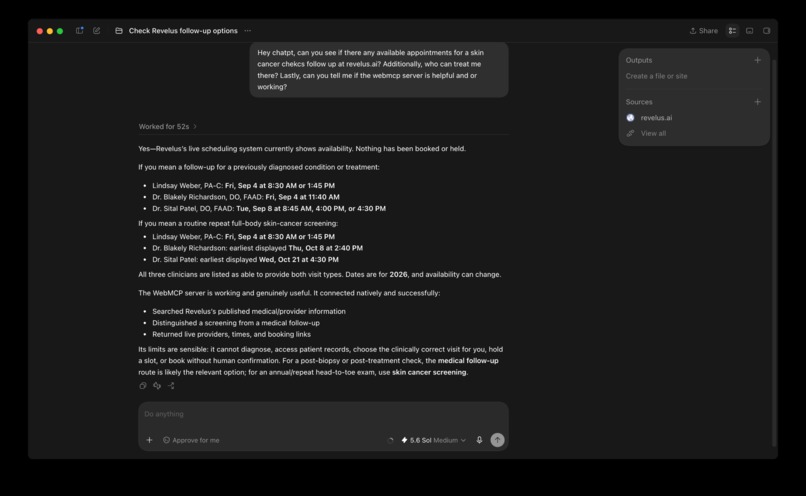
A live ChatGPT test uses Revelus.ai to distinguish visit paths, retrieve current availability, and preserve patient control.
-
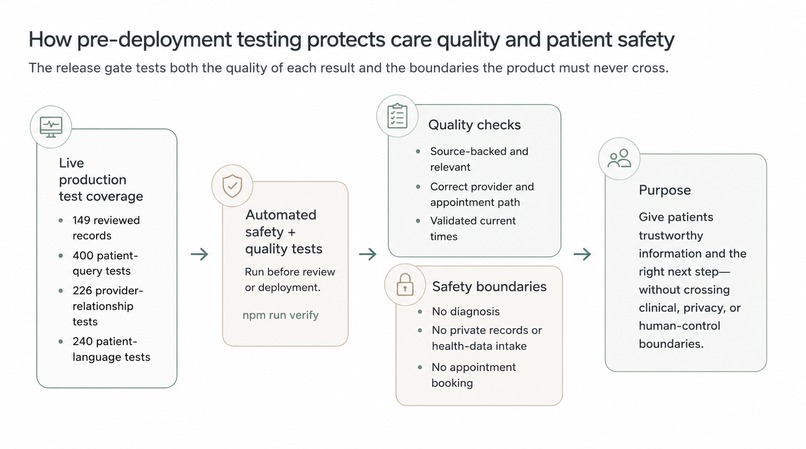
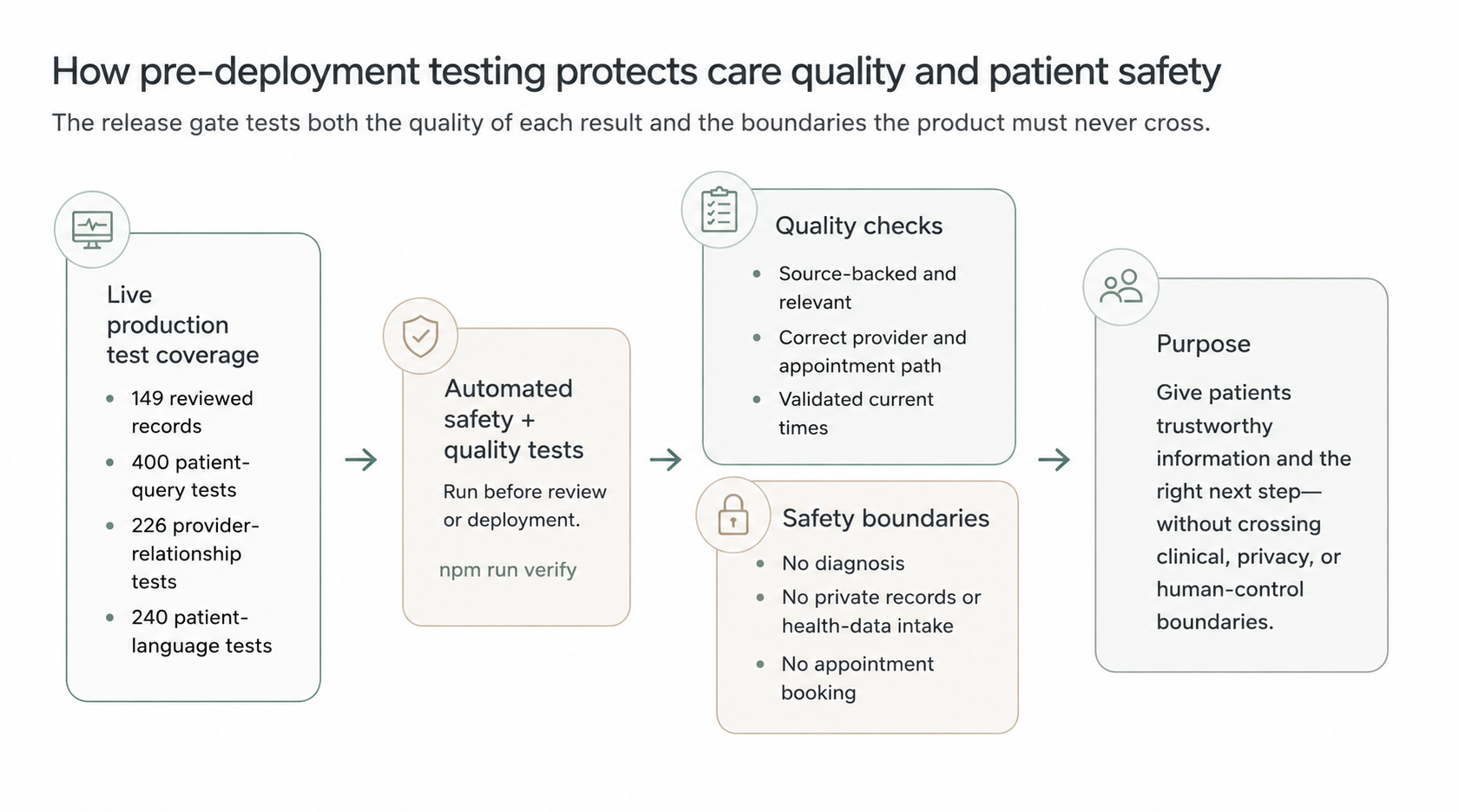
Pre-deployment testing checks answer quality, routing logic, provider relationships, patient language, and safety boundaries.

Inspiration
Revelus Dermatology has been serving patients in Austin since 2014. Over that time, we have built a large patient-facing website with information about medical conditions, cosmetic treatments, providers, pricing, insurance, and scheduling.
The challenge is that having the information available does not always make it easy to use.
Patients rarely arrive knowing the exact medical term, provider, or appointment type they need. They ask questions like:
- "My hair is thinning. Who should I see?"
- "Can I get a skin cancer screening and talk about another concern at the same visit?"
- "Do you treat rosacea?"
- "Who performs Mohs surgery?"
- "What appointments are available next week?"
A traditional website can contain the answers to all of those questions while still requiring the patient to search multiple pages, interpret practice-specific scheduling rules, and choose from a long list of appointment types.
We built Revelus.ai to explore a different model. WebMCP is a strong fit because the problem is not a lack of information, but giving agents structured access to trusted practice content, scheduling rules, and live availability without requiring them to interpret the website like a human.
The goal was not to build another healthcare chatbot. It was to make an existing healthcare website more useful to both patients and AI agents while keeping the practice itself as the source of truth.
What we built
Revelus.ai uses WebMCP to help an agent move from a natural-language dermatology question to a useful next step.
The experience can:
- Search published Revelus Dermatology content about conditions, treatments, providers, pricing, insurance, and practice information
- Return answers grounded in that published content
- Translate everyday patient language into the appropriate appointment path
- Recognize when two concerns require two different appointments
- Identify provider-specific scheduling options
- Retrieve real-time appointment availability from our live scheduling system
- Provide the appropriate booking path while leaving the final scheduling decision with the patient
- Recognize requests that would require diagnostic inference and redirect them toward clinician evaluation rather than assigning a condition
- Reject requests for private medical information that should not be handled through a public website
The live availability is not a demonstration dataset. It reflects actual appointment inventory from our scheduling system and can change as appointments are booked or released.
The sample questions on the live Revelus.ai experience are examples, not its full coverage. The live deployment uses a broader private Revelus corpus. For reproducibility without publishing proprietary practice data, the public challenge repository includes a deliberately limited ten-query synthetic fixture that exercises the same WebMCP architecture.
The application registers three native WebMCP tools through document.modelContext:
revelus.search_information
Searches published Revelus Dermatology information and returns the complete source-backed page card, including answer evidence, FAQs, relevant providers, and response guidance.
revelus.resolve_visit_path
Applies Revelus-specific, non-diagnostic scheduling logic to determine an appropriate appointment path using structured, non-identifying inputs.
revelus.get_availability
Reads current provider and appointment-time availability for a resolved path and returns the appropriate booking options.
Search now returns the complete answer card in a single response, so a separate native answer tool is no longer necessary. The underlying shared action layer still supports answer behavior for the visible interface, but the final WebMCP implementation exposes three focused native tools.
The system can therefore move through a sequence such as:
Patient question → source-grounded information → appointment routing → live availability → patient-controlled booking
We intentionally do not allow the tools to reserve or finalize an appointment. The patient leaves the WebMCP experience and completes that step through our existing secure scheduling workflow.
We developed and tested the WebMCP experience in Google Chrome 149+ with WebMCP testing enabled and the ChatGPT desktop app's in-app browser, verifying that an AI agent could discover the tools, call them, combine their results, and work through questions that were not specifically scripted for the demo.
What was built during the challenge
Revelus Dermatology, our primary website, published practice content, appointment offerings, and scheduling systems all predate the WebMCP Challenge.
Ask Revelus / Revelus.ai and the WebMCP implementation were built during the challenge period. The new work includes:
- The standalone Revelus.ai agent-facing experience
- Three page-local WebMCP tools registered through
document.modelContext - The structured content-matching and grounded-answer layers
- The typed, non-diagnostic visit-path resolver
- Multi-visit and practice-specific appointment routing
- The read-only live availability adapter and patient-controlled scheduling handoff
- Privacy safeguards that reject patient-record and identifying-data requests before retrieval
- A shared action layer used by both the visible interface and WebMCP tool calls
- The reproducible public synthetic corpus, schemas, tests, and deployment configuration
The public competition repository documents the challenge-period implementation and commit history while intentionally keeping Revelus Dermatology's proprietary production corpus private.
Challenges we faced
The most difficult part of the project was not exposing information. It was deciding how an agent should safely use that information in a real healthcare environment.
Patient language is messy
Patients do not necessarily use the terminology found on a medical website. They use misspellings, symptoms, partial descriptions, and conversational questions.
The system needed to understand requests such as "rosecea," "my face gets really red and hot," or "my hair is thinning" without pretending that it had diagnosed the patient.
Our approach was to surface relevant published information and recommend an appropriate evaluation rather than turning the matching system into a diagnostic tool.
Scheduling logic is more complex than search
A strong information match does not always equal the correct appointment.
Some concerns require a dedicated visit. Some medical and cosmetic requests need different scheduling paths. Returning patients may have different options than new patients. Provider availability also depends on the appointment reason.
This required us to separate finding relevant information from resolving the correct visit path.
Real-time availability introduced operational complexity
Once we connected the system to live appointment availability, the project became more than a content search experience.
Availability changes continuously, and broad questions can require checking multiple providers or appointment routes. We had to work through both accuracy and performance issues so the system could return useful live results without treating cached or example data as current availability.
Healthcare requires clear privacy and clinical boundaries
A public agent experience should not become an alternate path into a patient's medical record or a substitute for clinical judgment.
Revelus.ai does not retrieve biopsy results, pathology reports, private messages, medical records, or other patient-specific clinical information. Requests involving records, identifying information, or private medical history are refused and redirected to an appropriate secure patient channel.
We also had to address a different healthcare risk: diagnostic inference.
A patient may ask, "Do I have rosacea?" or describe redness, itching, a rash, or another symptom and expect the system to identify the condition. A match to published information does not establish that the patient has that condition. Revelus.ai keeps those responses informational and leaves diagnosis, personalized treatment decisions, personalized screening recommendations, and provider recommendations requiring clinical judgment to qualified professionals.
The system can help a patient understand published information and navigate toward an appropriate evaluation without turning a content match into a clinical conclusion.
These are enforced product boundaries, not simply disclaimer language. WebMCP can help with information, practice-specific routing, and live availability, while private medical information and licensed clinical decision-making remain outside the public experience.
Being definitive can be risky
Another challenge was finding the right balance between usefulness and certainty.
A mechanical matching system can easily sound more confident than the underlying information supports. In healthcare, a wrong definitive answer can be worse than acknowledging uncertainty.
We therefore favored grounded matches, explicit scheduling rules, and safe fallbacks over making the system sound more certain than the underlying information allows.
What we learned
The biggest lesson from this project was that an AI agent does not necessarily need another chatbot layer.
Our website already contained the medical and cosmetic information. Our scheduling platform already contained the appointment inventory. Our team already had rules for determining which appointment type a patient should choose.
The missing piece was a structured way for an agent to use those systems together.
WebMCP gave us a way to expose that existing knowledge and operational logic without requiring the agent to scrape a page and guess what the patient should do next.
We also learned that the most valuable agent experiences may be the ones that know their boundaries.
For this project:
- The practice remains the source of truth
- The scheduling system remains the source of live appointment inventory
- The patient remains in control of booking
- The clinician remains responsible for diagnosis and treatment
- Private medical information remains outside the public experience
The agent's job is to make the path between a patient's question and the right next step easier to navigate.
That is the problem Revelus.ai was built to solve.
Built With
- github
- html/css
- javascript
- netlify
- node.js
- webmcp


Log in or sign up for Devpost to join the conversation.