Inspiration
What if every donated computer could be evaluated fairly, consistently, and safely before deciding its future?
That question inspired ReuseFlow.
Through the FUSE Society Blueprint 2026 hackathon and its partnership with Free Geek, I became interested in the role technology refurbishment plays in extending device lifespans and improving digital access.
Electronics reuse involves more than simply repairing old computers. Teams must evaluate hardware condition, estimate repair costs, consider the value of refurbished devices, identify safety hazards, and protect information stored on donated equipment.
These decisions can become challenging when technicians and volunteers are working with limited time, varying experience levels, and incomplete device information.
I saw an opportunity to design a lightweight decision-support system that could make refurbishment triage more consistent and transparent without replacing human expertise.
ReuseFlow was created around one principle: technology should help people make better decisions, not make sensitive decisions without them.
What it does
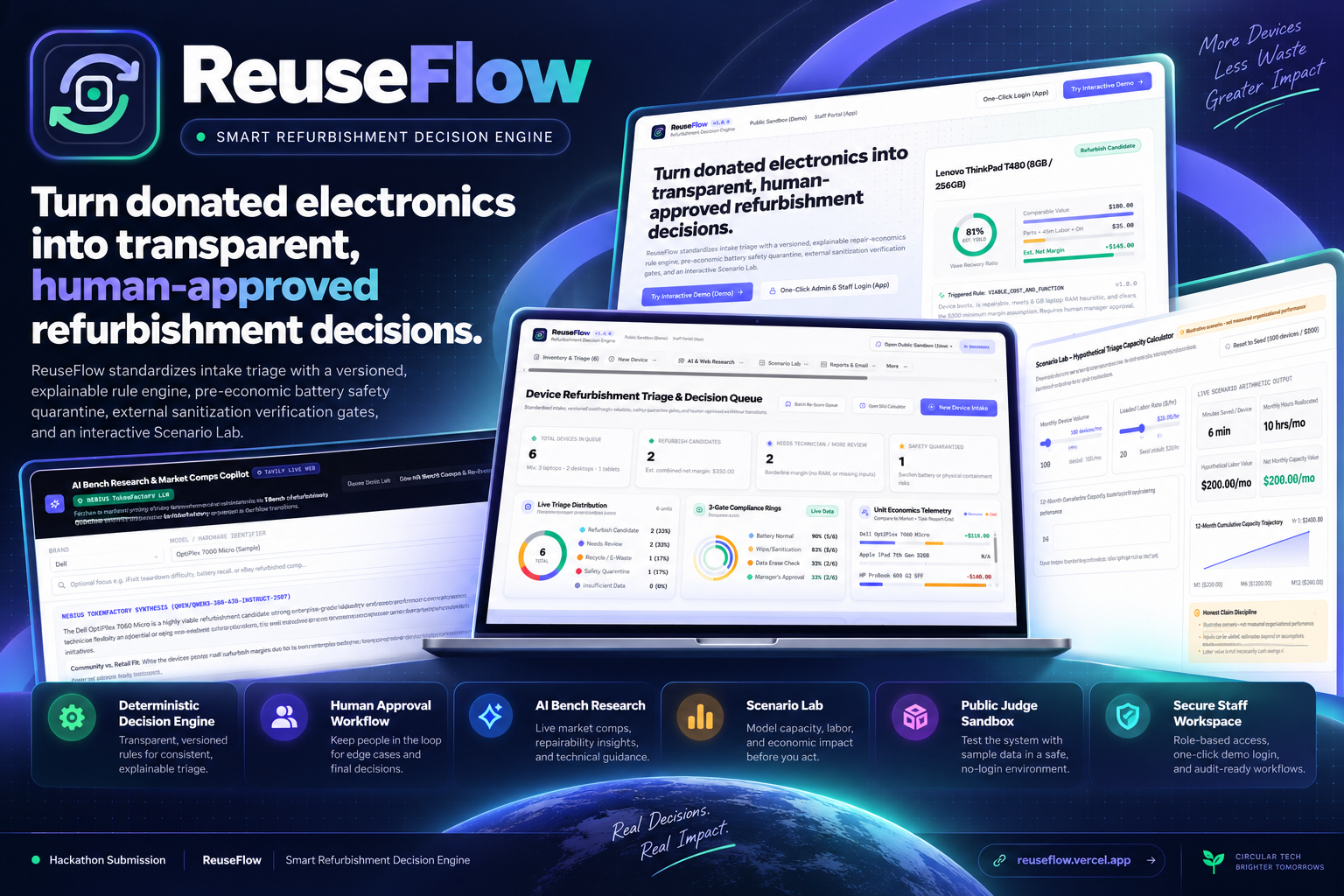
ReuseFlow is a functional, AI-assisted refurbishment decision-support platform that helps electronics reuse teams evaluate donated laptops, desktops, and tablets.
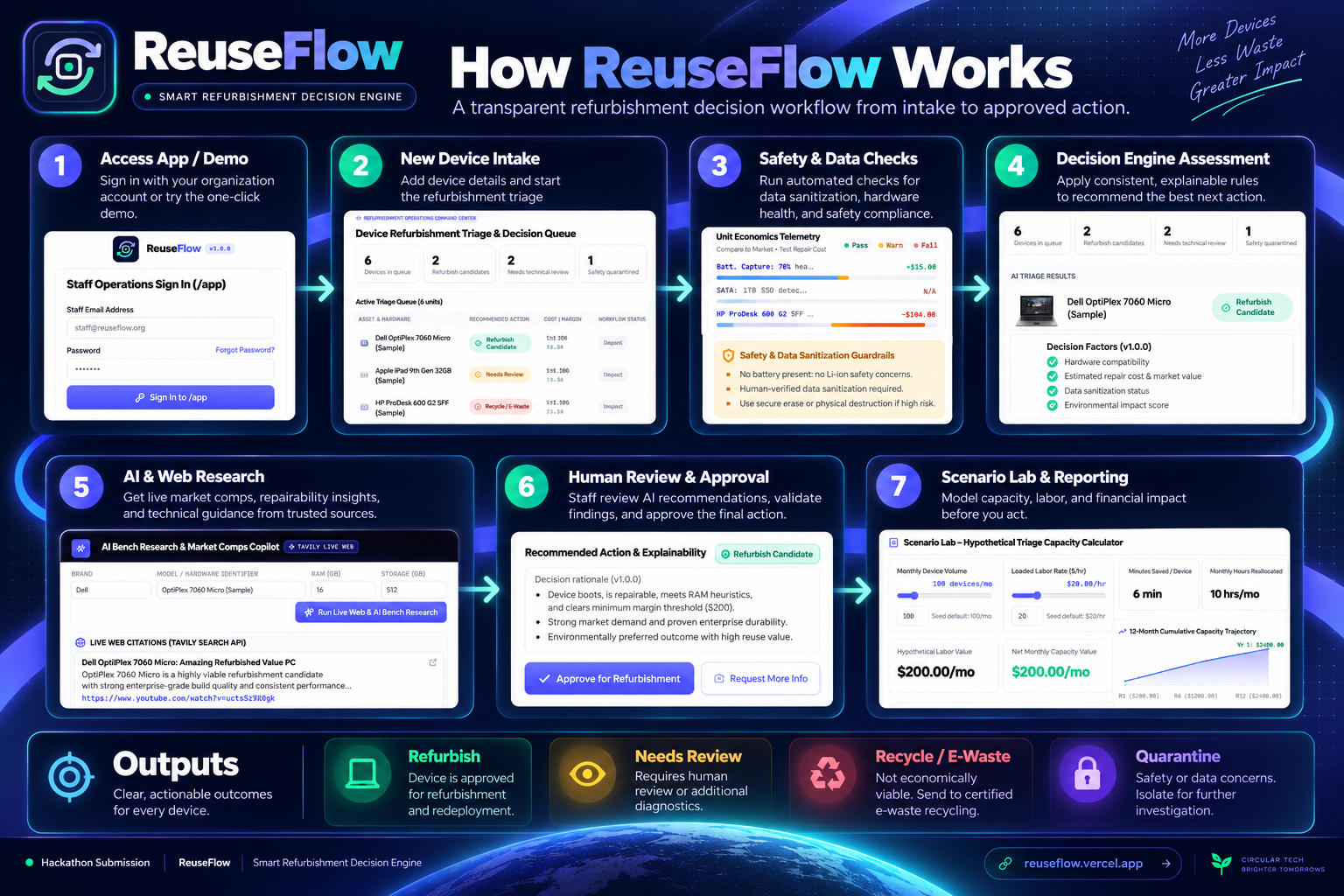
Instead of relying entirely on manual calculations, disconnected spreadsheets, and individual judgment, the platform provides a structured workflow that connects device assessment, repair economics, safety checks, research, and human approval.
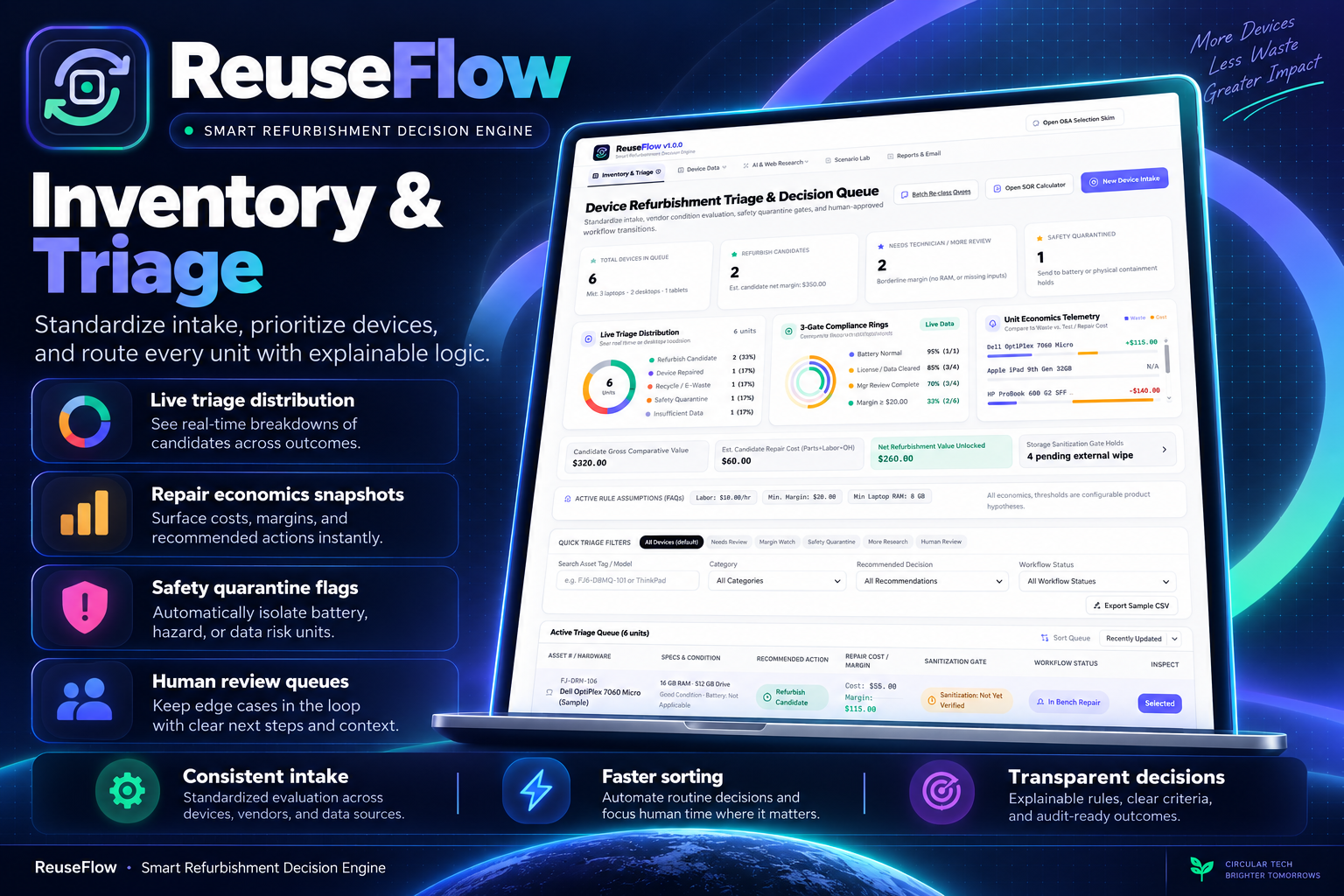
1. Smart Device Intake and Inventory Triage
Technicians can register devices by entering hardware specifications, functional condition, battery safety information, storage details, and estimated repair requirements.
The inventory dashboard provides visibility into devices awaiting assessment, refurbishment candidates, review requirements, and safety quarantines.
2. Explainable Refurbishment Decision Engine
At the heart of ReuseFlow is a deterministic, versioned rules engine that evaluates repair feasibility and estimated financial viability.
It calculates:
Estimated Net Margin = Comparable Device Value − (Parts Cost + Labor Cost + Overhead)
The engine produces actionable recommendations, including:
- Refurbish Candidate: Potentially suitable for repair and reuse.
- Needs Human Review: Requires further investigation or judgment.
- Recycle / E-Waste Review: May not be economically practical to refurbish.
- Safety Quarantine: Requires isolation due to identified hazards.
- Insufficient Data: Critical information is missing.
Every assessment includes an explanation of the rules that triggered its recommendation.
3. Safety and Data Protection Guardrails
ReuseFlow prioritizes safety over economic value.
A swollen battery triggers an immediate quarantine recommendation, regardless of the device's potential resale value.
Devices containing storage media cannot complete certain workflow stages until an authorized person records verification of an external data-sanitization procedure.
The application does not wipe drives or certify data destruction. Instead, it provides workflow controls to support human accountability.
4. AI Bench Research and Market Comparisons
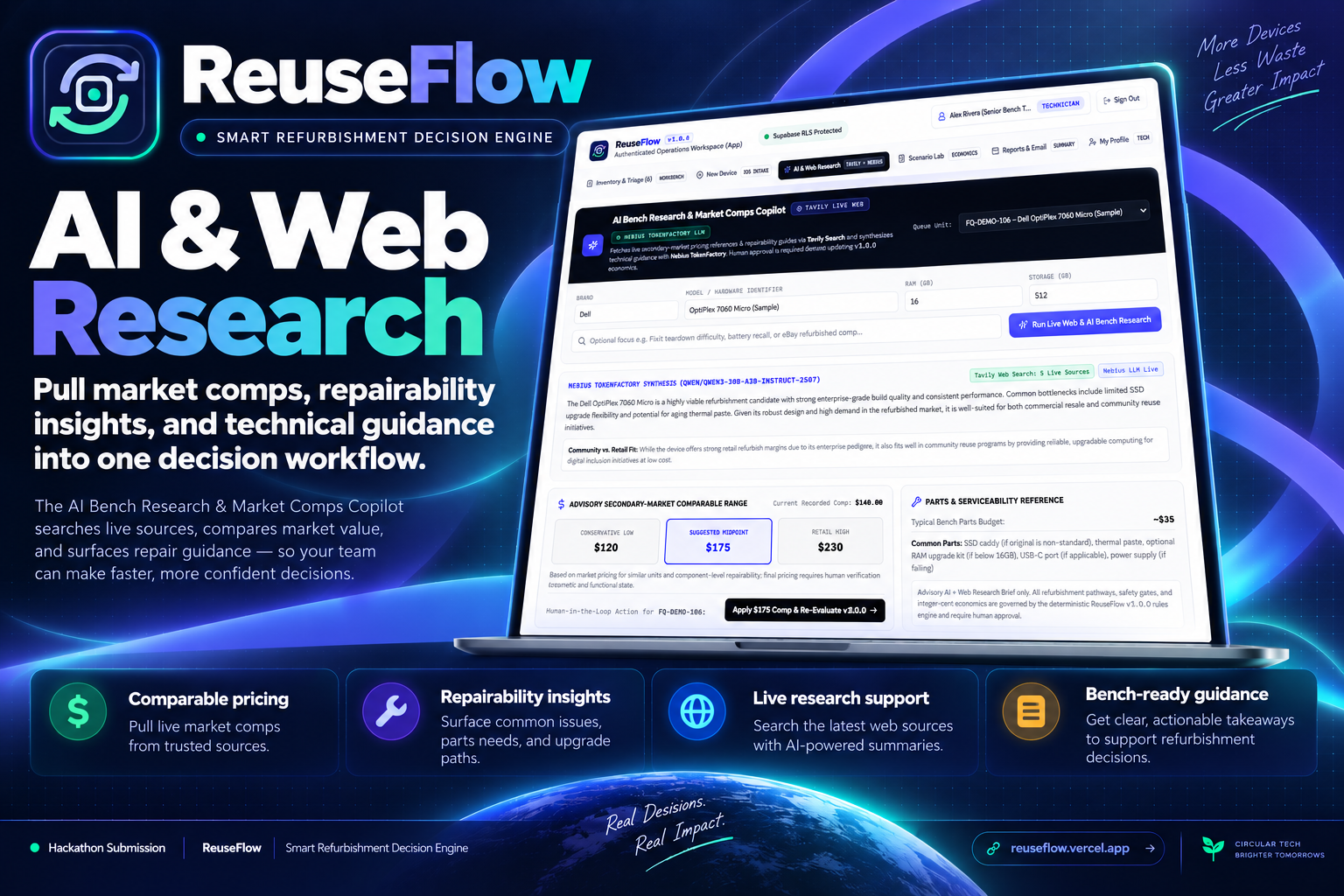
ReuseFlow integrates Tavily Search and Nebius TokenFactory to assist technicians with market research and hardware repairability information.
The AI research assistant can provide:
- Secondary-market pricing references.
- Common hardware faults and repair considerations.
- Potential replacement parts and upgrade paths.
- Technical summaries with supporting web sources.
AI-generated findings are advisory. A technician must review and explicitly confirm relevant information before it affects the deterministic assessment.
5. Scenario Lab and Operational Planning
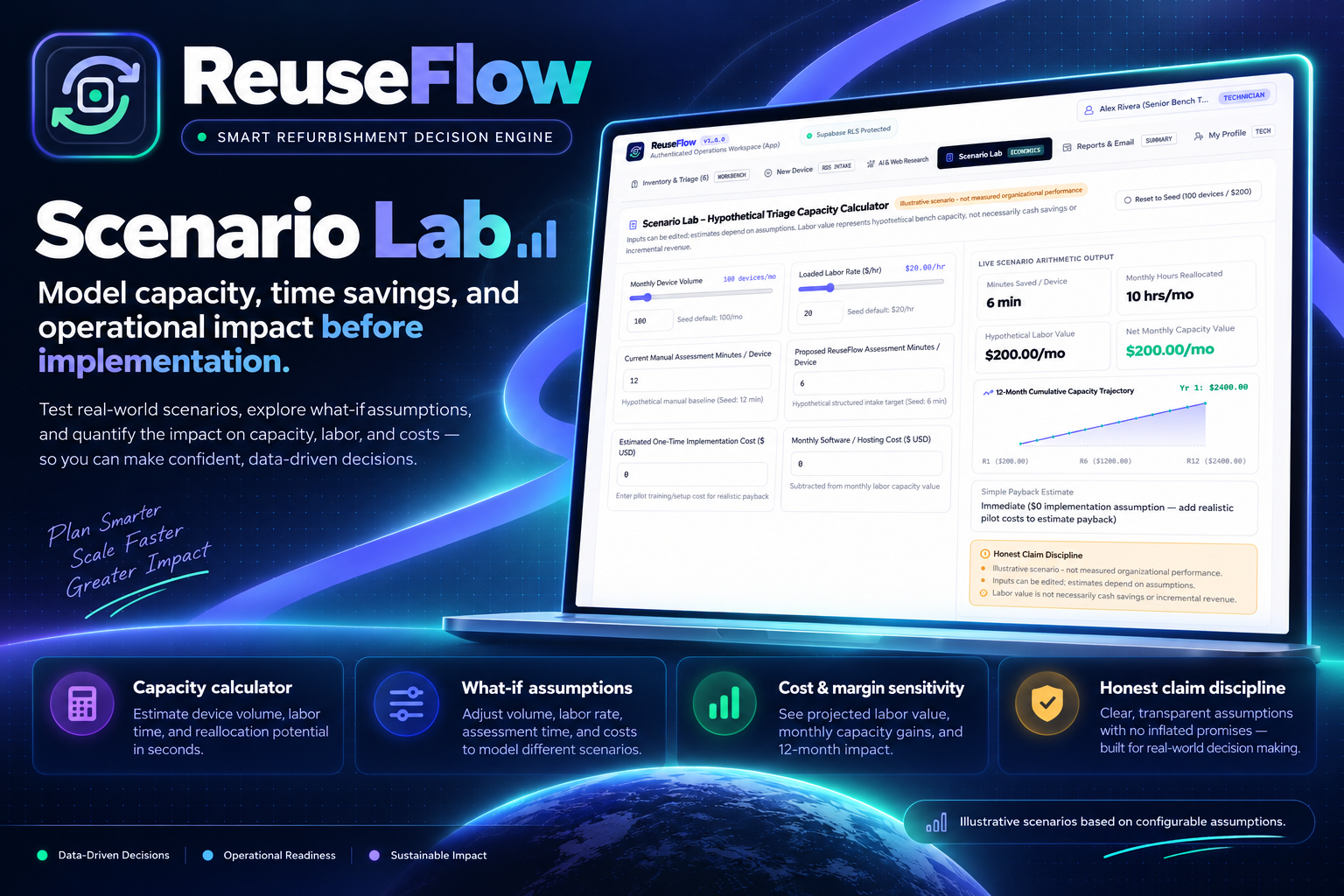
The interactive Scenario Lab helps organizations explore how standardized triage could influence operational capacity.
Users can adjust device volumes, labor costs, assessment times, implementation expenses, and ongoing software costs.
For example, in a purely hypothetical scenario, processing 100 devices per month while reducing assessment time from 12 to 6 minutes would free approximately 10 technician hours monthly.
At an assumed $20 hourly labor rate, that represents $200 per month in potential labor capacity value before operating costs.
These figures are illustrative assumptions, not measured savings or verified results from Free Geek.
6. Secure Staff Workspace
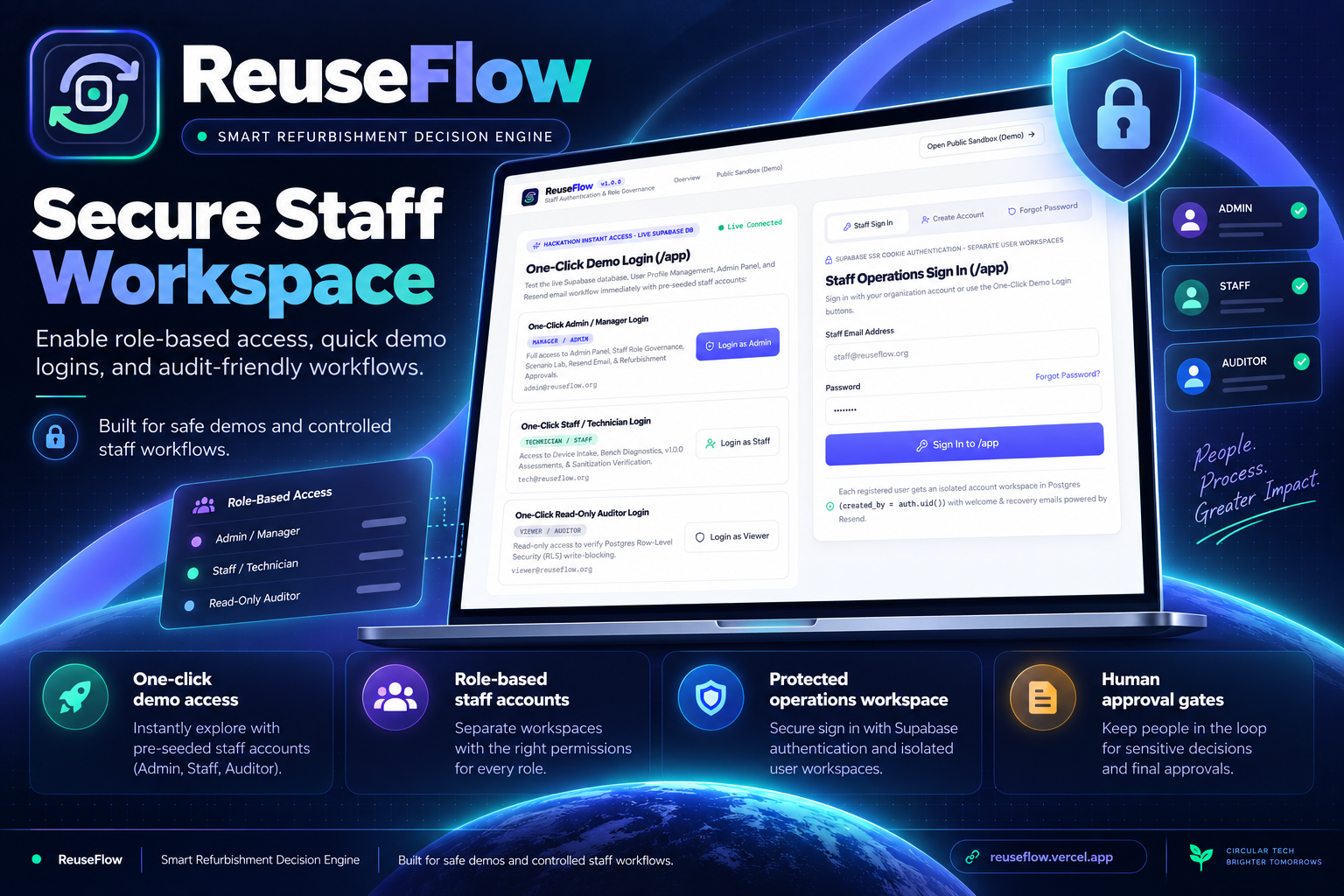
The authenticated application uses Supabase for database persistence, staff authentication, role-based permissions, and row-level data access controls.
Staff can access device workflows appropriate to their roles, while assessment histories and workflow events support accountability.
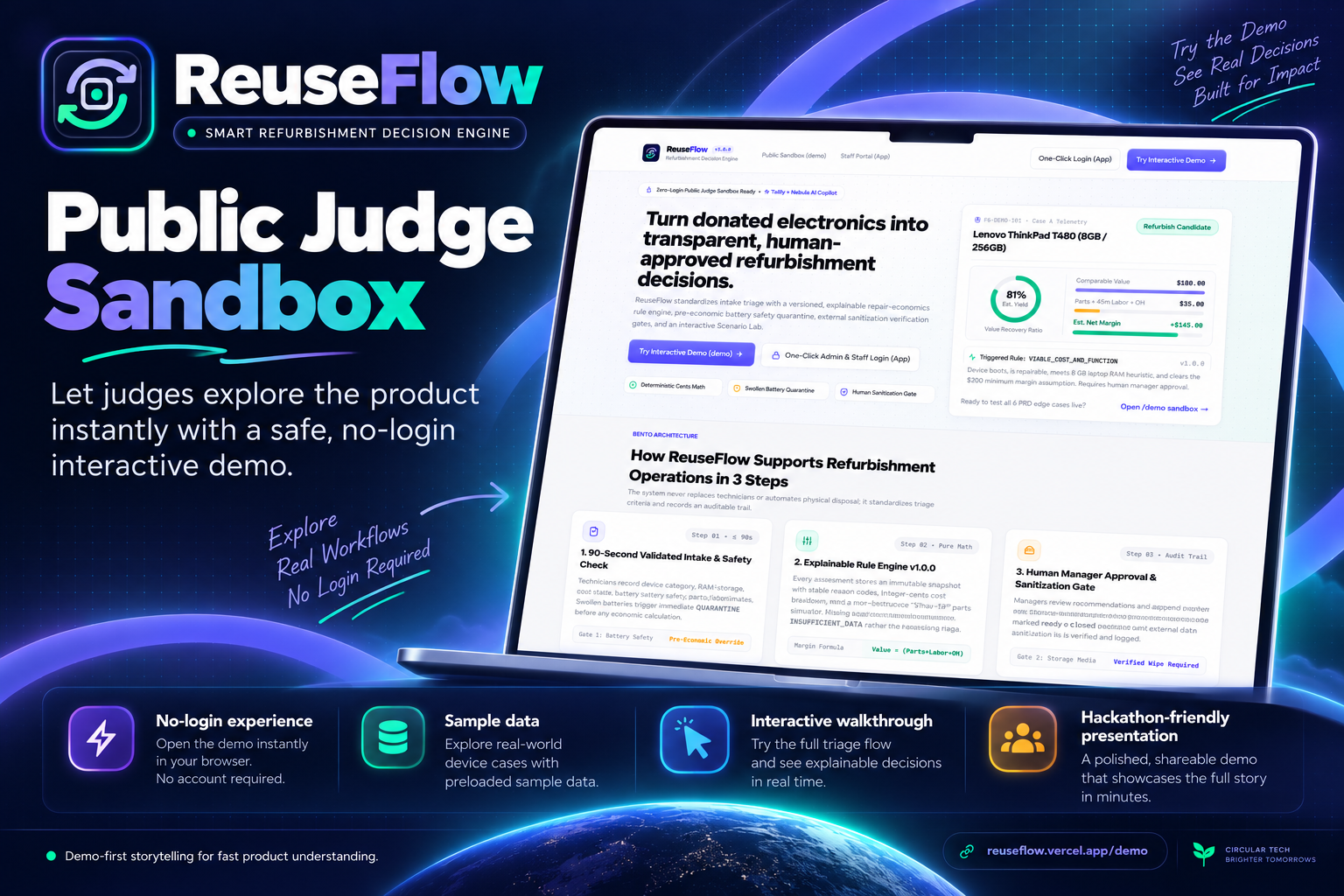
7. Public Interactive Demo
To make judging easy, ReuseFlow includes a public sandbox that requires no account or credentials.
Judges can explore six fictional device scenarios, inspect decision explanations, experiment with workflow permissions, and test the Scenario Lab without affecting production data.
Live demo: https://reuseflow.vercel.app/demo
How we built it
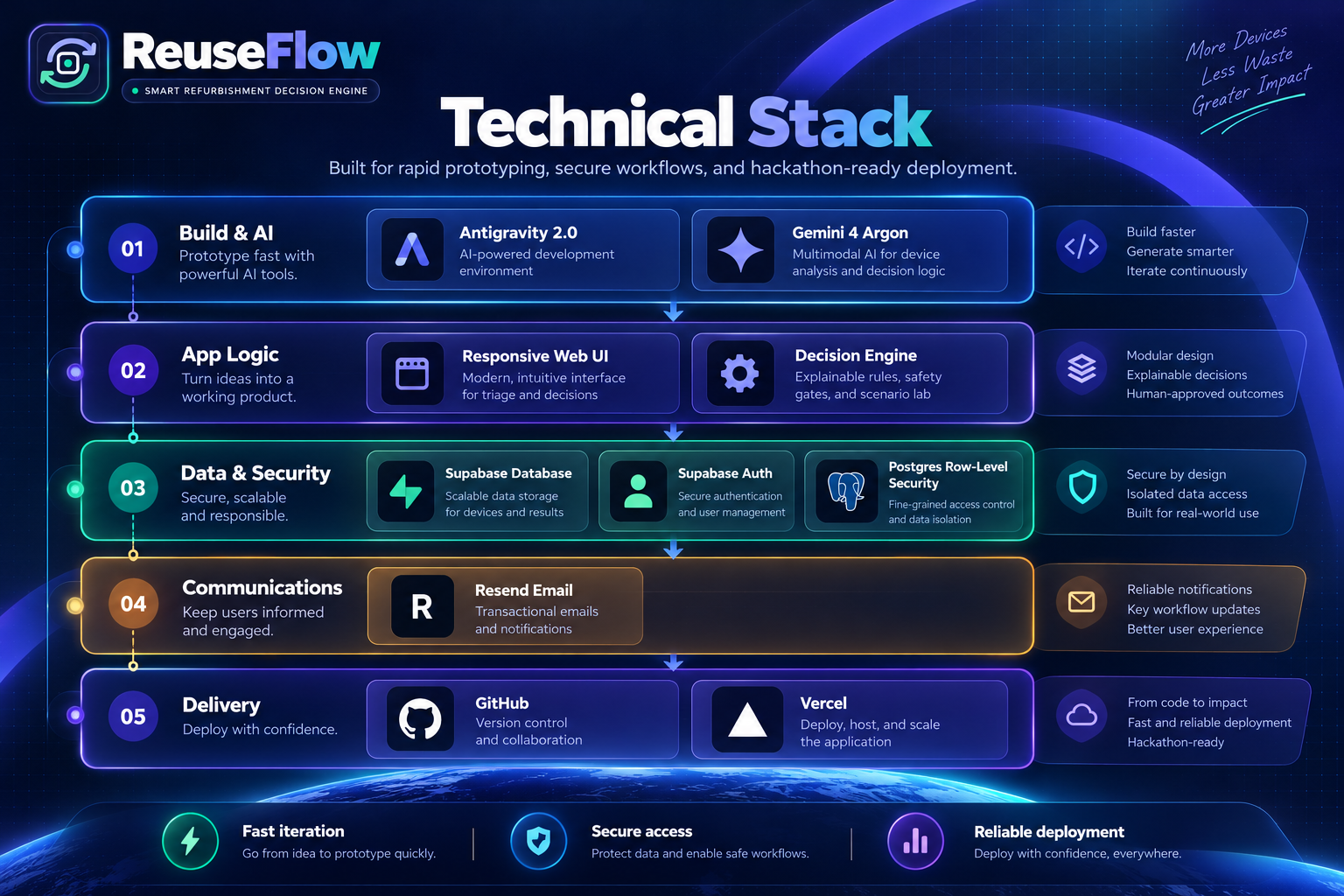
ReuseFlow was developed as a full-stack web application using an AI-assisted development workflow.
Frontend
The application uses Next.js 15, React 19, TypeScript, and Tailwind CSS v4.
The interface includes responsive dashboards, interactive data visualizations, device assessment forms, workflow panels, and financial modeling tools.
Decision Engine
The core refurbishment logic is implemented in deterministic TypeScript functions with Zod validation.
Financial values are processed in integer cents to avoid common floating-point rounding problems.
Versioned decision rules and explicit reason codes make outcomes explainable, reproducible, and testable.
Backend and Database
Supabase PostgreSQL provides persistence, authentication, and row-level security.
The authenticated application supports user-specific workspaces, controlled workflow transitions, and append-only records for assessments and audit events.
The public demonstration uses a separate browser-local data store containing fictional devices, allowing experimentation without modifying the live database.
Artificial Intelligence and Research
The AI Bench Research feature combines:
- Tavily Search API: Live web research and source references.
- Nebius TokenFactory: LLM-powered technical synthesis using a Qwen model.
These research features support technicians without overriding the deterministic decision engine or human approvals.
Email Integration
Resend supports transactional email workflows, account communications, and controlled operational summaries.
Development, Testing, and Deployment
I used Google Antigravity 2.0 with Gemini 4 Argon for AI-assisted development, code generation, debugging, and iteration.
I also used ChatGPT for product planning, documentation, writing assistance, and presentation preparation.
The project includes automated testing using Vitest and Playwright, with the source code hosted publicly on GitHub and the application deployed through Vercel.
Live application: https://reuseflow.vercel.app/
GitHub repository: https://github.com/malinikochar/reuseflow
The project is released under the GNU GPL v3.0 license.
Challenges we ran into
Balancing automation with human judgment
One of the biggest design challenges was determining which decisions software should automate and which should remain under human control.
An economically attractive device might still contain an unsafe battery or sensitive information.
To address this, I separated the automated assessment from the final operational decision and introduced explicit safety, sanitization, and approval gates.
Building a trustworthy decision engine
A black-box recommendation would be difficult for technicians to trust or challenge.
I designed the core assessment around transparent, versioned business rules with documented reasoning and reproducible calculations.
Missing data is treated as missing rather than silently converted into zero.
Handling financial calculations accurately
Repair margins depend on several cost components, and small calculation errors can change a borderline decision.
Using integer-cents arithmetic helped create consistent cost calculations and predictable results.
Integrating AI responsibly
Live web research can return incomplete or unreliable pricing information.
Rather than letting AI directly classify devices or modify stored assessments, I designed the research copilot as an advisory layer requiring source review and explicit human confirmation.
Separating the judge demo from the live application
I wanted judges to explore the project immediately without registration, but the authenticated workspace also needed controlled data access.
The solution was a browser-local public sandbox sharing the decision logic while keeping its fictional data separate from Supabase production records.
Delivering a complete prototype within hackathon constraints
The limited development window required prioritizing the most important workflow: intake, assessment, explanation, approval, and operational analysis.
This helped keep the prototype focused on a practical business problem rather than adding features without a clear operational purpose.
Accomplishments that we're proud of
1. Delivering a deployed, working application
ReuseFlow is more than a presentation or static prototype. It has a public interactive sandbox, authenticated workspace, explainable assessments, operational dashboards, and a deployed website.
2. Creating a transparent decision engine
The system explains why a device is considered suitable for refurbishment, requires review, or should be quarantined. Its decisions can be evaluated without relying on unpredictable AI responses.
3. Putting safety ahead of profitability
Battery quarantine and external data-sanitization verification are separate controls. A favorable financial margin cannot automatically bypass safety requirements.
4. Building six demonstrable edge cases
The public sandbox illustrates viable refurbishment, borderline specifications, battery hazards, negative repair margins, missing pricing information, and pending data sanitization.
This allows judges to test behavior beyond a single successful example.
5. Combining deterministic logic with AI research
ReuseFlow uses AI where it can help research uncertain information while preserving explainable and testable rules for core refurbishment decisions.
6. Making the business case measurable
The Scenario Lab converts operational assumptions into transparent capacity and cost projections instead of presenting unsupported savings claims.
7. Making the project accessible and open source
Judges can experience the application without logging in, and developers can inspect its implementation through the public repository.
What we learned
Building ReuseFlow reinforced several important lessons about software engineering and real-world business innovation.
Technology is most valuable when it solves a clearly defined operational problem. A focused tool that improves decision consistency can be more useful than a complicated system with unnecessary features.
Explainability matters as much as automation. People need to understand why a recommendation was made, particularly when safety, privacy, money, and environmental responsibility are involved.
AI and deterministic software have different strengths. AI is helpful for exploring information and summarizing research, while predictable rules are better suited to enforceable business logic and financial calculations.
Security and safety must be designed into the workflow. Authentication, data isolation, audit history, and mandatory review stages are fundamental requirements rather than optional enhancements.
Business assumptions need to remain visible. A hypothetical estimate of technician time saved is not the same thing as measured productivity improvement or realized financial savings.
Most importantly, I learned how to approach application development as both a technical and business-design challenge: identifying operational problems, comparing solutions, making implementation trade-offs, and creating a working prototype that can be tested.
What's next for ReuseFlow - Refurbishment Decision Engine
ReuseFlow is currently a hackathon MVP. The next goal would be to validate its usefulness with real refurbishment operators before considering production adoption.
Phase 1: Small-Scale Pilot
Propose a two-week period for workflow configuration and staff onboarding, followed by a four-week pilot at one refurbishment intake bench.
A possible pilot would involve two to three technicians, one manager, and approximately 100 devices.
Before the pilot, collect baseline information such as average intake time, repair yield, parts and labor costs, and existing safety procedures.
Phase 2: Measure Operational Outcomes
Evaluate the application using measurable indicators:
- Assessment time per device.
- Accuracy and consistency of triage recommendations.
- Percentage of devices requiring human rework.
- Repair margin estimates compared with actual outcomes.
- Completion of required safety and sanitization checkpoints.
- Technician feedback and software operating costs.
The project should only claim verified improvements after real-world testing.
Phase 3: Improve Integrations and Workflow
Potential improvements include barcode or QR-code asset tracking, compatibility with existing inventory tools, reusable repair knowledge, additional hardware diagnostics, and stronger reporting.
Future integrations with approved external data-erasure systems could record verified evidence of completion rather than relying only on manually entered status.
Phase 4: Extend Community Impact
With appropriate partner data, future versions could measure additional outcomes such as verified devices returned to service, equipment distributed to communities, and documented reuse outcomes.
Environmental benefits would be calculated using defensible methods rather than invented carbon-savings estimates.
Implementation and Sustainability
ReuseFlow's initial architecture uses common web development technologies and managed cloud services, reducing the need for custom infrastructure.
A realistic implementation budget would include software hosting, database and API usage, staff onboarding, maintenance, and ongoing operational support.
Before deployment, the organization would need to validate the decision thresholds, approval responsibilities, safety procedures, and financial assumptions against its actual operations.
The long-term goal is not to replace refurbishment specialists. It is to give them a more consistent, transparent, and accountable way to decide what happens to donated technology.
ReuseFlow's vision: More devices reused. Better-informed decisions. Less avoidable waste.
Built With
- 4
- antigravity
- argon
- auth
- css
- gemini
- github
- lucide
- nebius
- next.js
- playwright
- postgresql
- qwen
- react
- resend
- supabase
- tailwind
- tavily
- tokenfactory
- typescript
- vercel
- vitest
- zod

Log in or sign up for Devpost to join the conversation.