Inspiration
I have heard many stories from around the world about people experiencing deep emotional distress after losing a pet, a precious belonging, or contact with someone they love. These incidents stayed with me because losing something meaningful is not only a practical problem; it can also leave people feeling helpless, isolated, and unsure where to turn. Police, shelters, community groups, and social media can all provide valuable support, but information is often scattered across different channels. A possible sighting may appear in one group while an important update is posted somewhere else. I wanted to explore how technology could bring these fragmented efforts together and make it easier for communities to help one another safely. That motivation became Reunite, a privacy-first community search network. My hope is that Reunite can help communities coordinate searches, discover useful clues, and contribute to a more connected and caring society.
What it does
Reunite helps people coordinate searches for lost pets and precious belongings. Users can:
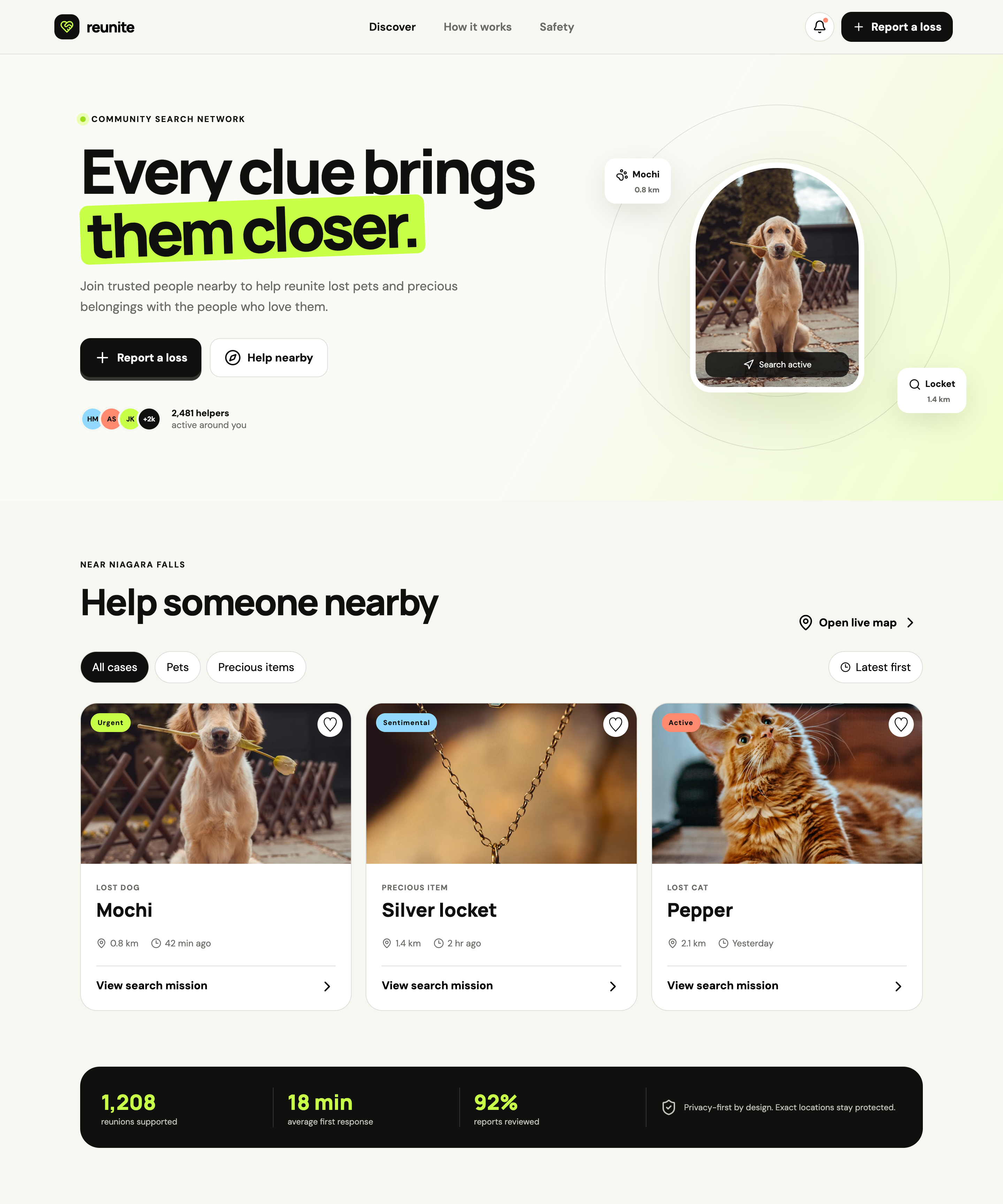
- Discover active search missions nearby.
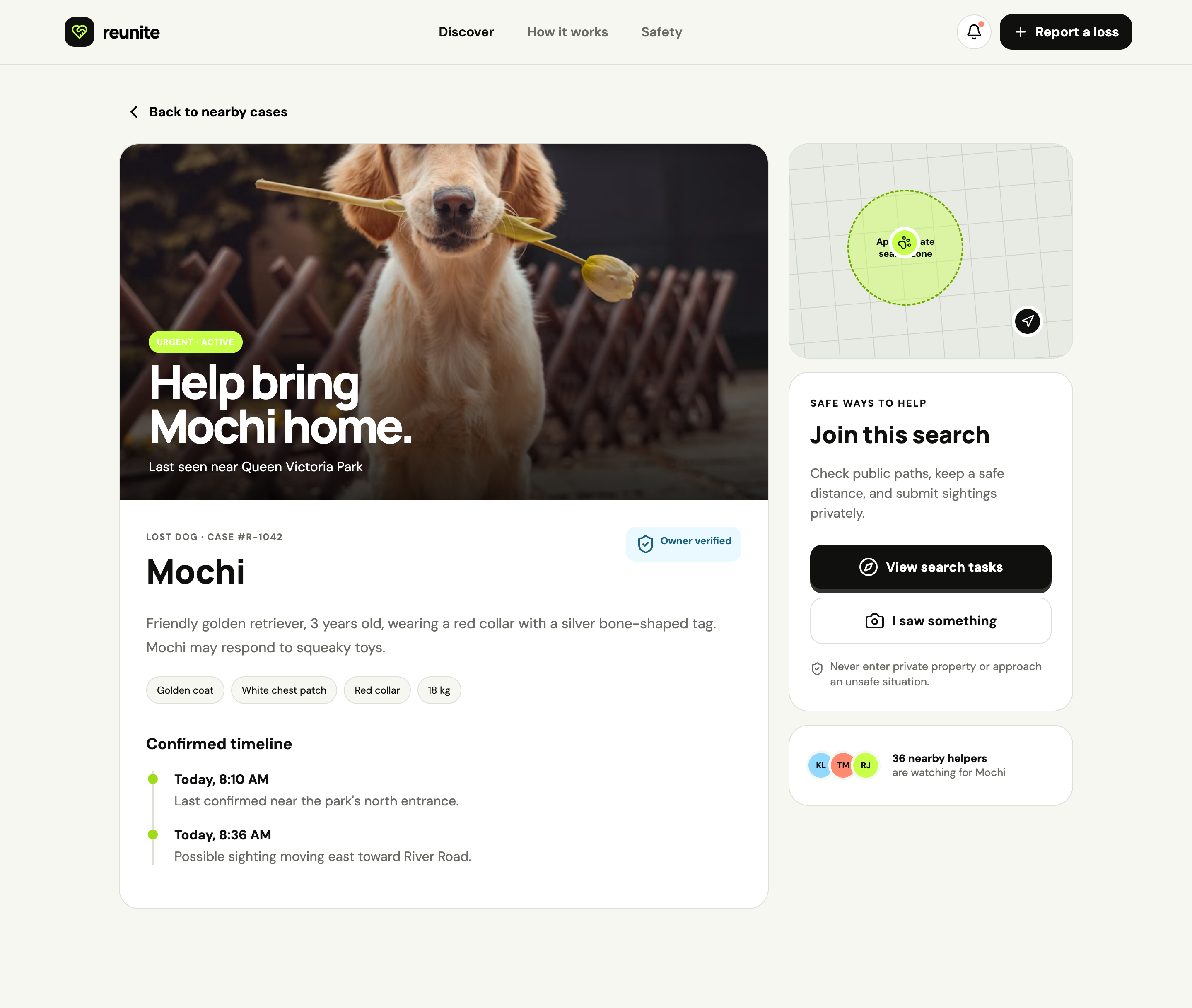
- Review important case details and safety guidance.
- Submit structured sighting reports.
- Share approximate search areas without exposing exact private locations.
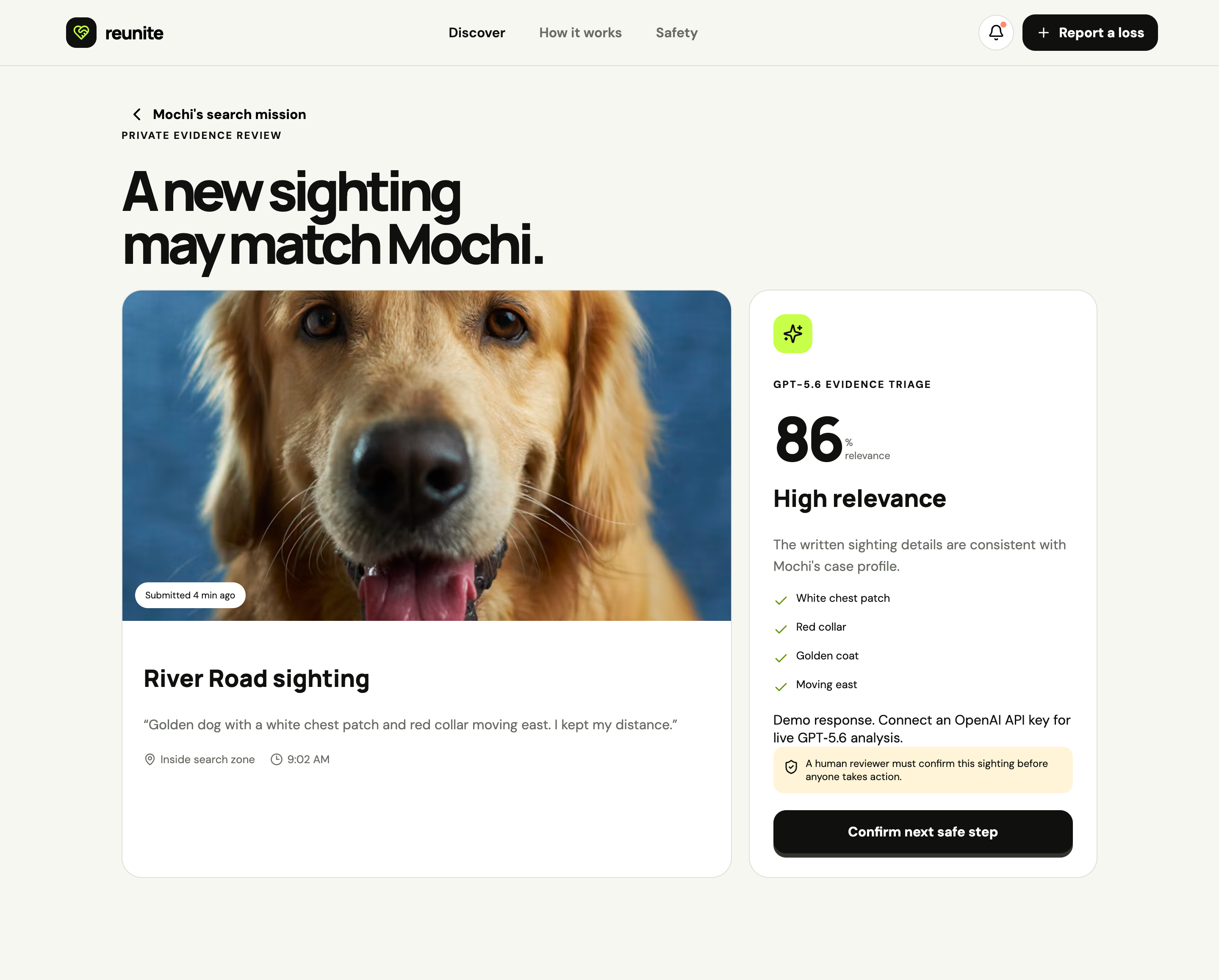
- Use AI-assisted evidence triage to organize incoming clues.
- Keep sensitive decisions under human review. The AI does not confirm an identity, make critical decisions, or direct volunteers to intervene. Instead, it compares a sighting with the case profile, identifies similarities and inconsistencies, highlights uncertainty, and suggests information that a human reviewer should verify. Missing-person functionality is intentionally reserved for future collaboration with verified organizations. Cases involving vulnerable people require stronger identity verification, moderation, safeguarding, access control, and cooperation with appropriate authorities.
How I built it
I created Reunite as a responsive web application using:
- Next.js and the App Router
- TypeScript
- OpenAI Responses API
- GPT‑5.6 for evidence organization and relevance analysis
- Zod for request validation
- Vercel for deployment
- GitHub for source control and public documentation
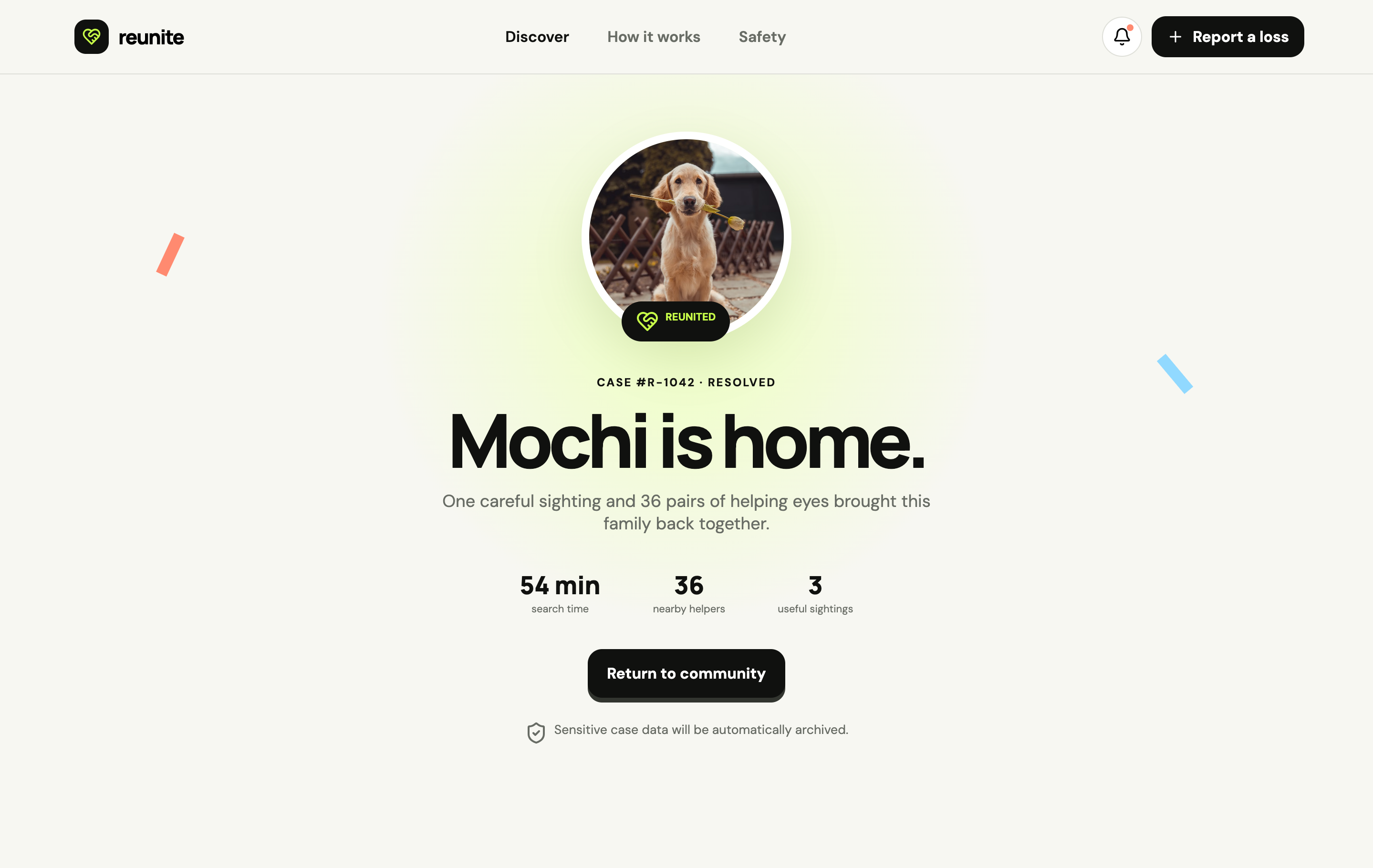
- Codex as my development collaborator I began by translating the original idea into a focused MVP. The first version concentrates on one complete journey: discovering a nearby case, opening its search mission, reviewing a sighting, and analyzing the evidence. The server-side API route receives structured case and sighting information, validates it, and sends it to GPT‑5.6. The model returns a structured assessment containing relevant matches, inconsistencies, uncertainty, a priority level, and recommended verification steps. The interface then presents that assessment for human review. The OpenAI API key remains on the server and is never exposed to the browser. The public deployment also includes a clearly labeled demonstration fallback so visitors can experience the complete workflow when live API quota is unavailable.
Challenges I faced
One major challenge was defining the boundary between helpful community coordination and unsafe public exposure. Sharing an exact location could endanger a missing pet, its owner, a vulnerable person, or a volunteer. Reunite therefore communicates approximate search zones and treats precise evidence as private information.
Another challenge was determining the appropriate role for AI. It would be irresponsible to let an AI system declare that a sighting is definitely the missing subject. I designed the AI feature as an evidence-triage assistant rather than an automated decision-maker. Its purpose is to organize information and support human judgment. I also encountered practical deployment challenges, including configuring environment variables, connecting the OpenAI API securely, handling invalid credentials and quota errors, and ensuring the project remained demonstrable when live API access was unavailable. These challenges led me to implement clearer error handling and a transparent demo mode. Finally, the original vision was much larger than what could responsibly be completed during a short build period. I had to reduce the scope while preserving the heart of the idea.
What I learned
Building Reunite taught me that a meaningful product is not defined only by the number of features it contains. Clear boundaries, privacy protections, and understandable user journeys can be just as important as technical complexity. I learned how to:
- Turn a broad social-impact idea into a focused MVP.
- Build a full-stack application with Next.js and TypeScript.
- Integrate the OpenAI Responses API through a protected server route.
- Request and validate structured AI output.
- Design graceful fallbacks for external service failures.
- Deploy a web application with GitHub and Vercel.
- Consider privacy, moderation, uncertainty, and human oversight from the beginning. Codex helped me transform my initial concept and visual references into an information architecture, safety model, responsive design system, working implementation, API integration, deployment process, and project narrative. It also helped me understand the code and improve my English throughout the development process.
Accomplishments I am proud of
I am proud that Reunite communicates its purpose through a polished and approachable interface while keeping safety visible throughout the experience. Instead of treating privacy as a future addition, the MVP makes protected locations, responsible reporting, uncertainty, and human review part of the core product. I am also proud that the project progressed from a personal idea into a deployed application with a public repository, a working end-to-end demonstration, and a realistic roadmap for responsible development.
What is next for Reunite
The next phase would replace sample data with a production database and introduce authenticated accounts, encrypted evidence storage, organization verification, moderation queues, audit logs, notifications, and approximate geospatial search. Future versions could also support partnerships with animal shelters, rescue organizations, community groups, and relevant authorities. Missing-person cases would only be introduced after consultation with safeguarding experts and implementation of strict verification and access controls. Reunite begins with a simple belief: when information is coordinated responsibly and communities are empowered to help safely, every clue can bring someone—or something precious—closer to home.
Built With
- codex
- gpt?5.6
- next.js
- openai-responses-api
- typescript
- vercel

Log in or sign up for Devpost to join the conversation.