-
-
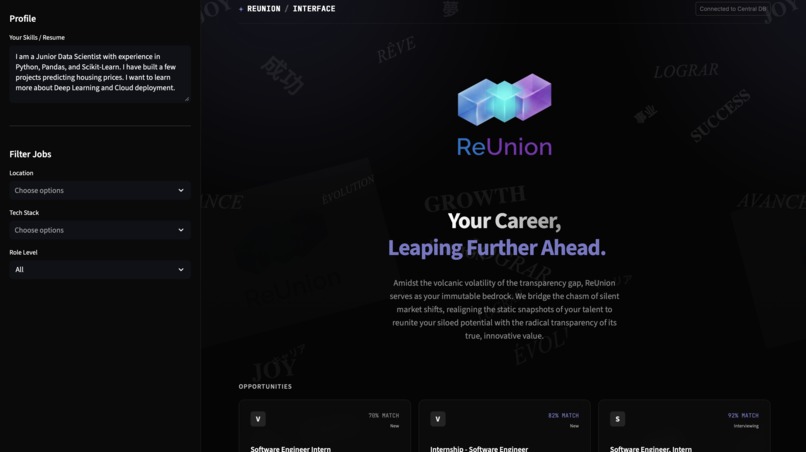
This is the front page of the user interface of ReUnion, featuring the logo, filter on the left and opportunities below.
-
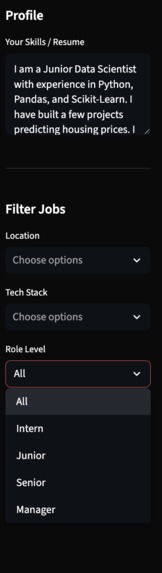
This is the block where users can type in their skills, strength, and etc. It also provides an advanced filter.
-
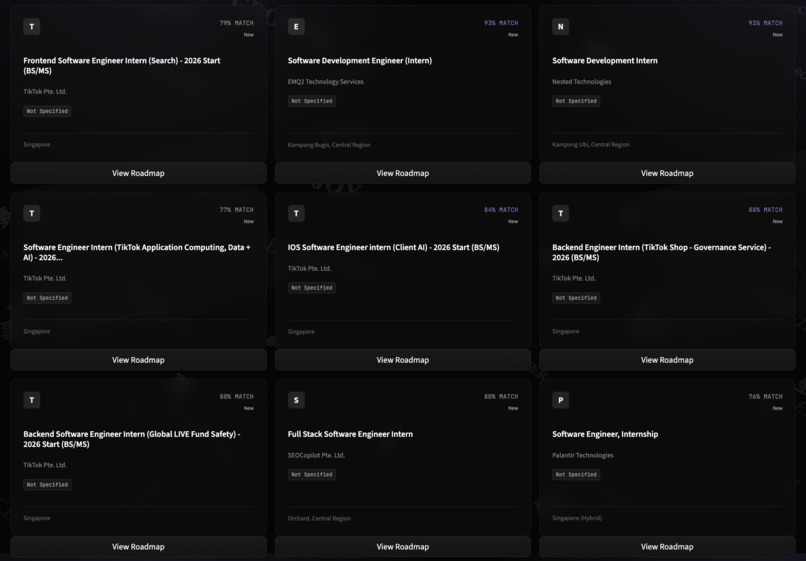
This is the section when you scroll the front page of ReUnion. Here, users can find various job opportunities with numerous labels.
-
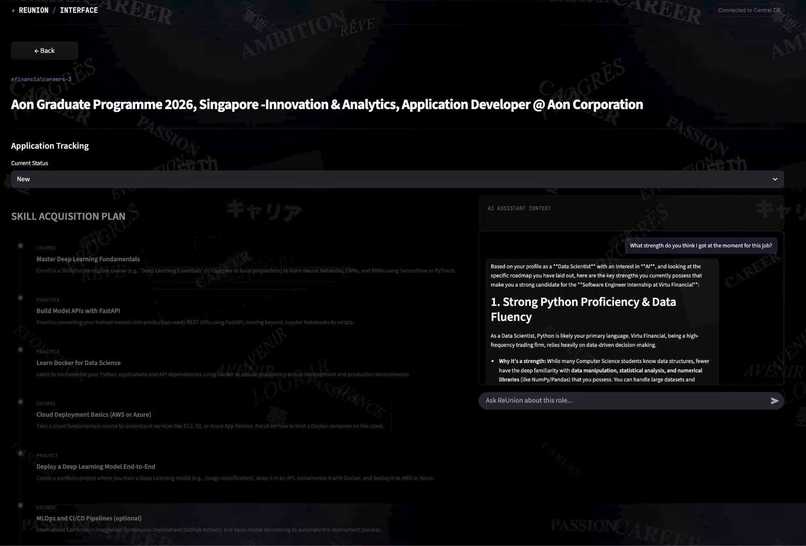
Click into the job opportunity, ReUnion provides an upskill roadmap on the left, an application tracking on top, as well as a 24/7 Chatbot.


ReUnion-Leaping Further Ahead
Inspiration
The inspiration for ReUnion emerged from a personal and collective frustration with the modern job search experience. As students and emerging professionals studying at Nanyang Technological University, we watched seniors who are fresh graduates submit hundreds or even thousands of applications into what felt like a "black hole"—a system where job requirements seemed to mysteriously expand while candidates remained in the dark about how to bridge the gap. We also observed that especially in the Singapore's context, which is a data-driven market, information asymmetry wasn't just an inconvenience; it was a structural barrier to effective job matching.
This lack of transparency wasn't just inefficient; it was fundamentally unfair.
This is why ReUnion was born, naturally brought to light to challenge conventions, to evolute mindsets, and to reshape the job market for new graduates. The metaphor of the volcanic island of La Réunion resonated deeply: in a landscape constantly reshaped by market forces, we wanted to build stable ground where talent and opportunity could meet with clarity and purpose. We are the pioneers in the best and worst of times, we are the flagships leading the innovation and change.
What it does
Built by 4 CCDS students from NTU, ReUnion is a unified Career Assistance Platform that transforms fragmented data into personalized roadmaps for employment:
Centralized Data:
We integrate multiple sources—including MyCareersFuture, Glassdoor, and SkillsFuture datasets—into a single intelligent platform.
Job Filtering & Transparent Requirements:
Every job listing is analyzed to explicitly surface required skills, qualifications, and constraints. Our hybrid search lets users filter by salary, location, role type, and technical stack.
Application Tracking:
Users are able to update their application status to the website within a unified dashboard to stay in tune with what is going around them and not lose track. This kind of service may provide a sense of belonging and community within the app, which truly assist and records growth.
Personalized Upskilling Roadmaps:
Using AI gap analysis, ReUnion generates step-by-step learning paths tailored to the individual's resume and target role. This kind of customer-oriented design specifies and resolves the needs of users by recommending specific SkillsFuture courses and subsidies.
Technical Stack Filters:
We extract technologies like Python, React, and AWS from job descriptions to enable precise, dynamic filtering.
Integrated Chatbot:
We also provide 24/7 guidance which is convenient for users to utilize at anytime and anywhere. The Chatbot we provide has strong context awareness and long-term attention, which can provide more related and accurate answers for specified cases.
In essence, ReUnion transforms fragmented career information into a coherent, personalized employment strategy—exactly as the problem statement challenges.
How we built it
We architected this solution by leveraging the massive extensibility of the modern Python ecosystem, orchestrating a symphony of high-performance libraries—including FastAPI for a robust asynchronous backend and Streamlit for a reactive, user-centric frontend. Our design philosophy centered on a strict modular architecture, where data ingestion, vectorization (via ChromaDB), and agentic logic (LangChain) operate as distinct, optimized kernels. This separation of concerns allowed us to optimize the "kernel" of our application—the RAG pipeline—for maximum retrieval speed and semantic accuracy, minimizing computational overhead. To further accelerate our velocity, we integrated state-of-the-art AI-augmented development workflows, specifically leveraging the Gemini CLI. This tool acted as a force multiplier, functioning as an intelligent infrastructure partner that streamlined complex file manipulations and real-time debugging. This symbiosis of human architectural vision and AI-driven execution allowed us to bypass typical development bottlenecks, delivering a production-grade, modular system within a timeframe where others are still configuring their environments.
Challenges we ran into
Our biggest hurdle was the initial lack of standardization, which turned our integration phase into a complex archaeological dig. We initially operated in silos—frontend and backend teams developing as sovereign states with zero diplomatic treaties on data contracts. What resulted was a classic "it works on my machine" tragedy where the original code ran flawlessly in isolation, but catastrophic incompatibilities emerged upon convergence.
We discovered multiple overlapping components performing identical logic but with slightly different implementations, variable names, and return types. Worse, we encountered "phantom conflicts" where different modules modified the exact same files in the exact same lines, dragging us into the deepest hole of programming: debugging race conditions and circular dependencies. We learned the hard way that standardization isn't bureaucracy; it's the lifeline that keeps a distributed system from collapsing under its own cognitive load. This forced us to halt feature development and dedicate significant time to refactoring the entire codebase into a unified, coherent architecture.
Accomplishments that we're proud of
We are immensely proud of delivering a sophisticated, full-stack enterprise solution within a timeline measured in mere hours, effectively condensing a typical multi-day engineering lifecycle into a high-intensity sprint. Our standout technical achievement lies in the seamless synthesis of heterogeneous data systems—bridging the gap between structured SQL persistence and unstructured document intelligence through cloud-native LLM inference. We successfully navigated the classic "integration hell" characteristic of complex multi-agent systems by establishing ad-hoc standardization protocols that turned schema conflicts into architectural coherence. It is the first time our team has integrated such a diverse array of deep-tech components—from vector stores to asynchronous API gateways—into a unified, crash-resistant platform. To surmount these integration challenges and deploy a fully functional, multi-source retrieval system while strictly adhering to a hyper-compressed schedule stands as a testament to our team's relentless adaptability, engineering precision, and successful collaborative synergy.
What we learned
The 24-hour pivot at TechFest was a defining moment for our team. We learned that being 'industry-ready' means more than writing clean code; it’s about the agility to rethink a product mid-sprint. Our collective growth was forged in the chaos of messy data and the precision of AI personalization. By aligning our work with Singapore’s job market infrastructure, we’ve gained the confidence and the technical maturity to tackle real-world complexity head-on
What's next for ReUnion
We'll iteratively refine UX and data pipelines, using AI to reconnect fragmented skills and opportunities. ReUnion will power smarter matching, personalized learning paths, and explainable recommendations, while prioritizing employer integrations, privacy-first controls, and measurable outcomes like interview and hire rates. By polishing details and responsibly applying AI, ReUnion reunites talent and opportunity at scale.


Log in or sign up for Devpost to join the conversation.