-
-
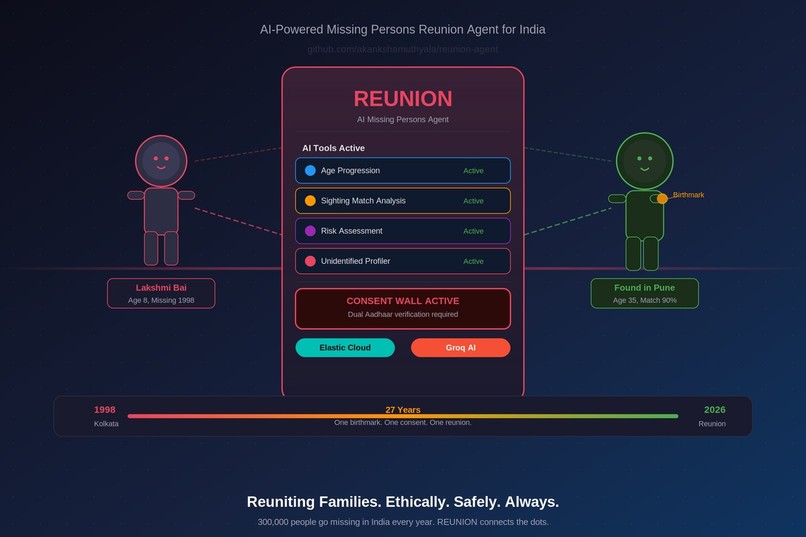
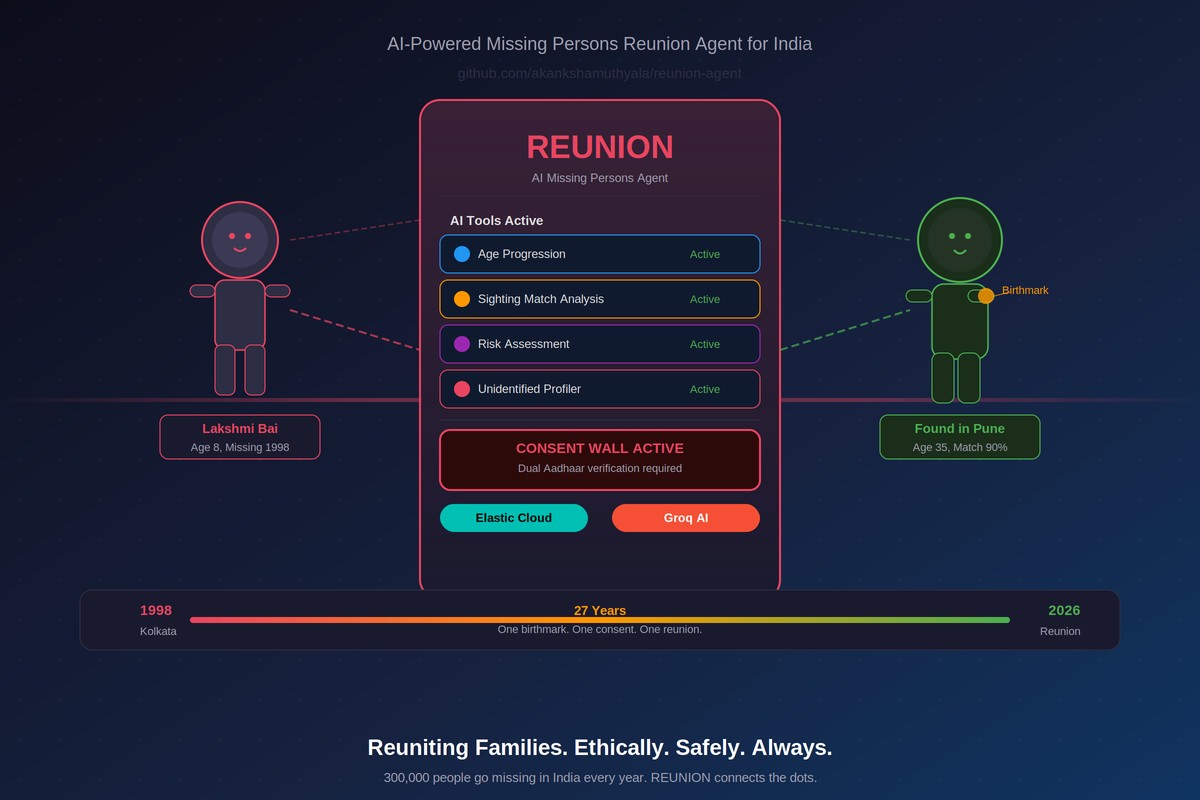
One birthmark. One consent wall. One reunion.
Inspiration
Every year, over 300,000 people go missing. Children separated at festivals. Women trafficked. Elderly wandering with dementia. Tribal communities with zero documentation who fall completely outside the system. Most are never found — not because the information doesn't exist, but because it is scattered across police stations, NGO databases, shelter homes, and WhatsApp groups — unconnected and unsearchable. We built REUNION because we believe technology should reunite families, not exploit them. And we believe that every reunion must begin with consent.
What it does
REUNION is an AI-powered missing persons reunion agent that:
- Searches a live Elastic Cloud index of missing person cases using full-text search across names, descriptions, locations, and distinguishing marks — with status filtering and field boosting
- Files new cases with Aadhaar identity verification and AI-powered risk assessment that flags urgency, trafficking risk, and recommended response tier
- Analyses sightings — AI scores confidence of a match between a sighting report and a case on file, with a live progress bar and matching feature breakdown
- Runs age progression — generates a forensic description of how a missing person likely looks today, with a visual timeline showing years elapsed
- Profiles unidentified persons — builds an identity profile from physical fragments, language clues, and cultural markers for persons who cannot identify themselves, then cross-references against the Elastic index
- Activates a consent wall — when confidence is ≥ 60%, REUNION requires independent Aadhaar verification and explicit consent from BOTH the searching family AND an NGO mediator before any contact information is shared
- Mediates reunion — contact details are shared only through the verified NGO, never directly, never unsafely
- Agent Chat — a conversational AI agent with live Elastic search integration and suggested questions for easy exploration ## How we built it Frontend: Streamlit — clean, fast, mobile-friendly UI with 8 pages, live Elastic stats on the home page, and color-coded status badges AI Layer: Groq API (llama-3.3-70b-versatile) — powers 4 AI tools:
- Forensic age progression with permanent identifier analysis
- Sighting match analysis with confidence scoring
- Risk assessment with urgency, trafficking risk, and tier recommendation
- Unidentified person profiler using language and cultural fragment analysis
Search and Data Layer: Elastic Cloud — the core of REUNION:
- reunion_cases index with 15 carefully crafted demo cases
- Multi-field full-text search with field boosting (name^3, description^2, distinguishing_marks^2)
- Nested sighting documents within each case
- Geo-point fields for location-based search
- Status-based filtering (active_search, matched_pending_consent, reunited, unidentified)
- Live case count displayed on home page dashboard
Security: Demo Aadhaar verification system with 4-tier role-based access Hosting: Streamlit Cloud — free, public URL, auto-deploys on every GitHub push Version Control: GitHub with MIT license
Challenges we ran into
- Gemini API quota in India — free tier quota is 0 for Indian accounts. We switched to Groq which works perfectly, is free, and is actually faster than Gemini for our use case.
- Elastic Serverless mode — does not allow shard/replica settings in index creation. Fixed by removing the settings block entirely and using the mappings-only API call.
- Git secret scanning — GitHub blocked pushes containing API keys in commit history. Solved by wiping git history completely using an orphan branch and recommitting clean.
- Streamlit form limitations — JS components cannot directly write into st.form fields. Solved by placing the GPS detection widget outside the form and passing values via session state.
- Python 3.14 on Streamlit Cloud — caused dependency issues. Fixed by specifying Python 3.11 in advanced settings. ## Accomplishments that we're proud of
- The consent wall — a genuine ethical innovation. No other missing persons tool in India requires dual verified consent before sharing contact information. This is what makes REUNION safe, not just functional.
- 4-tier access system — designed specifically for India's reality, from Aadhaar-linked urban users all the way to tribal communities with zero documentation and no digital identity
- 15 carefully crafted demo cases — each represents a real category of missing persons in India: child festival separation, trafficking, dementia wandering, tribal communities, unidentified railway persons, and reunited cases
- Full demo flow works end to end — search → 90% confidence match → consent wall → dual Aadhaar verification → reunion protocol with balloons
- GPS location detection — sighting reports auto-detect the reporter's location using browser GPS + OpenStreetMap reverse geocoding
- Live Elastic stats — home page pulls real-time counts from Elastic for total cases, active searches, pending matches, and reunited cases ## What we learned
- Ethical AI design is harder than technical AI implementation
- India's missing persons problem is not a data problem — it is a trust and consent problem. People don't report sightings because they don't know who will use the information or how
- Elastic's nested document structure is perfect for storing sighting history within case records — each case carries its full history
- The consent wall is not a barrier to reunion — it is what makes reunion safe and sustainable
- Groq's inference speed makes real-time AI analysis feel instant, which is critical for an emotional use case like this ## What's next for REUNION — AI Missing Persons Reunion Agent
- Real Aadhaar API integration — with UIDAI approval for production deployment
- TrackChild database integration — connect to India's national missing children database
- WhatsApp bot — file cases and report sightings via WhatsApp for low-literacy and rural users
- Multilingual support — 22 Indian languages for case filing and search
- NGO dashboard — dedicated case manager interface for NGO partners
- Photo-based matching — integrate face recognition for photo sighting matching
- State police integration — API connections to state missing persons portals
- Offline mode — PWA for field workers in low-connectivity areas

Log in or sign up for Devpost to join the conversation.