-
-
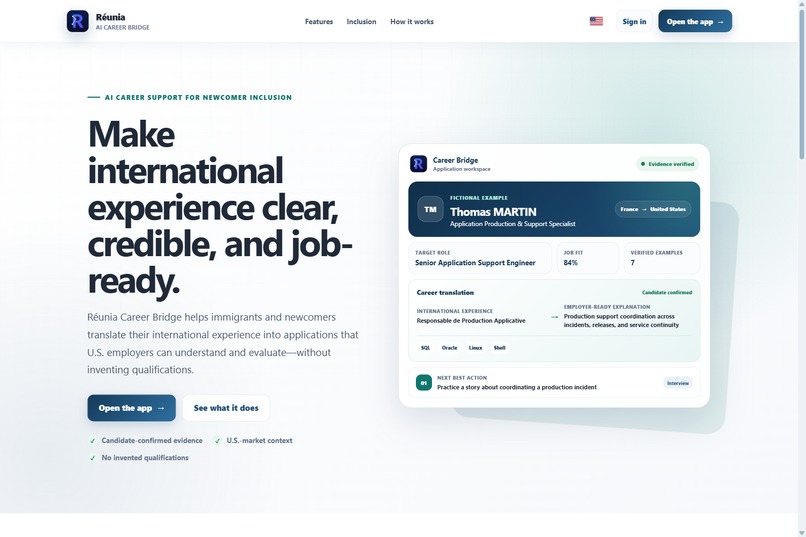
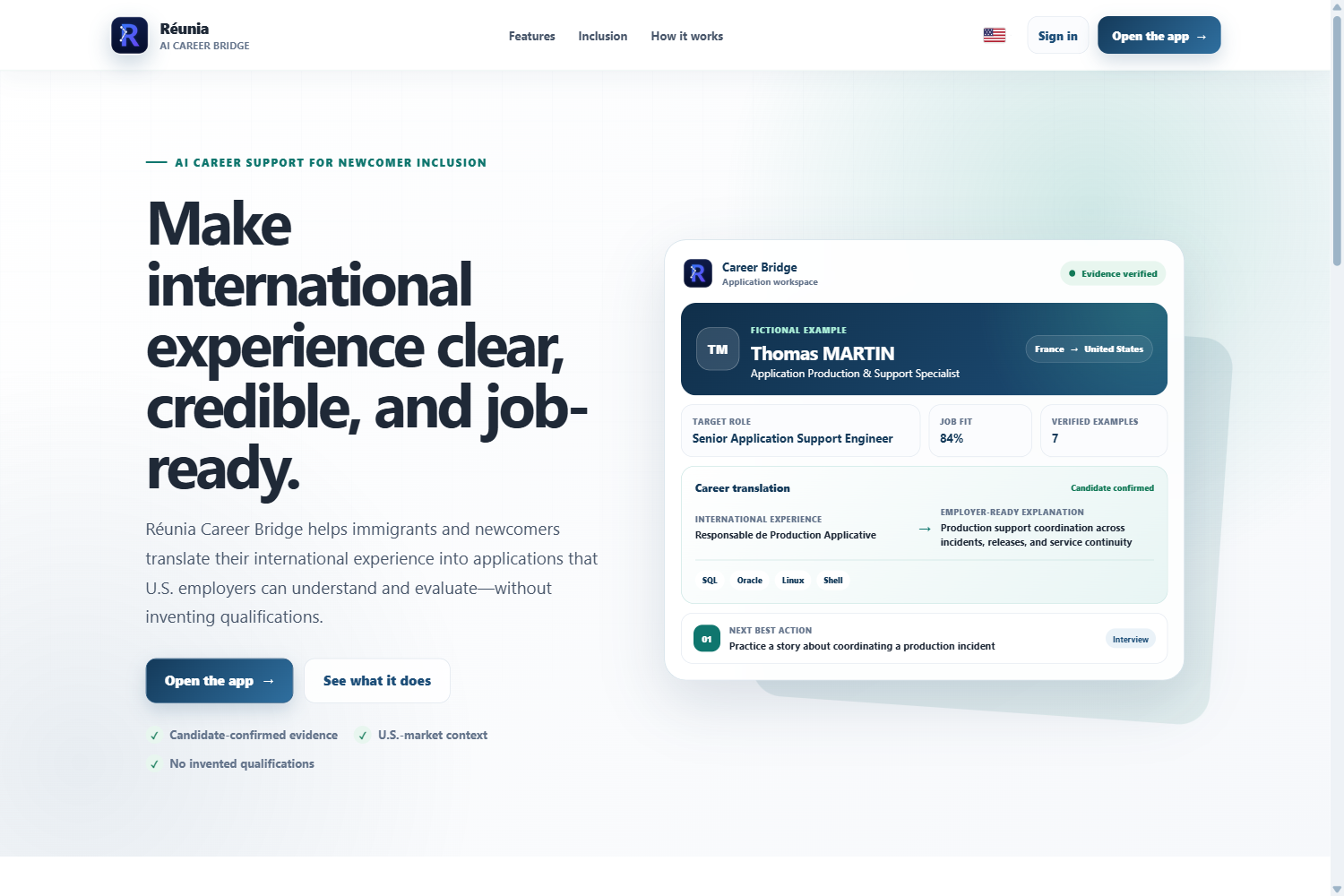
Homepage
-
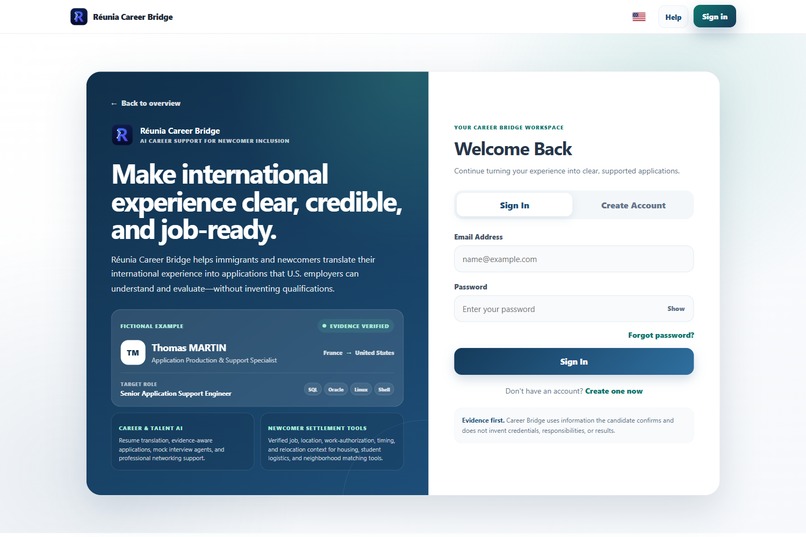
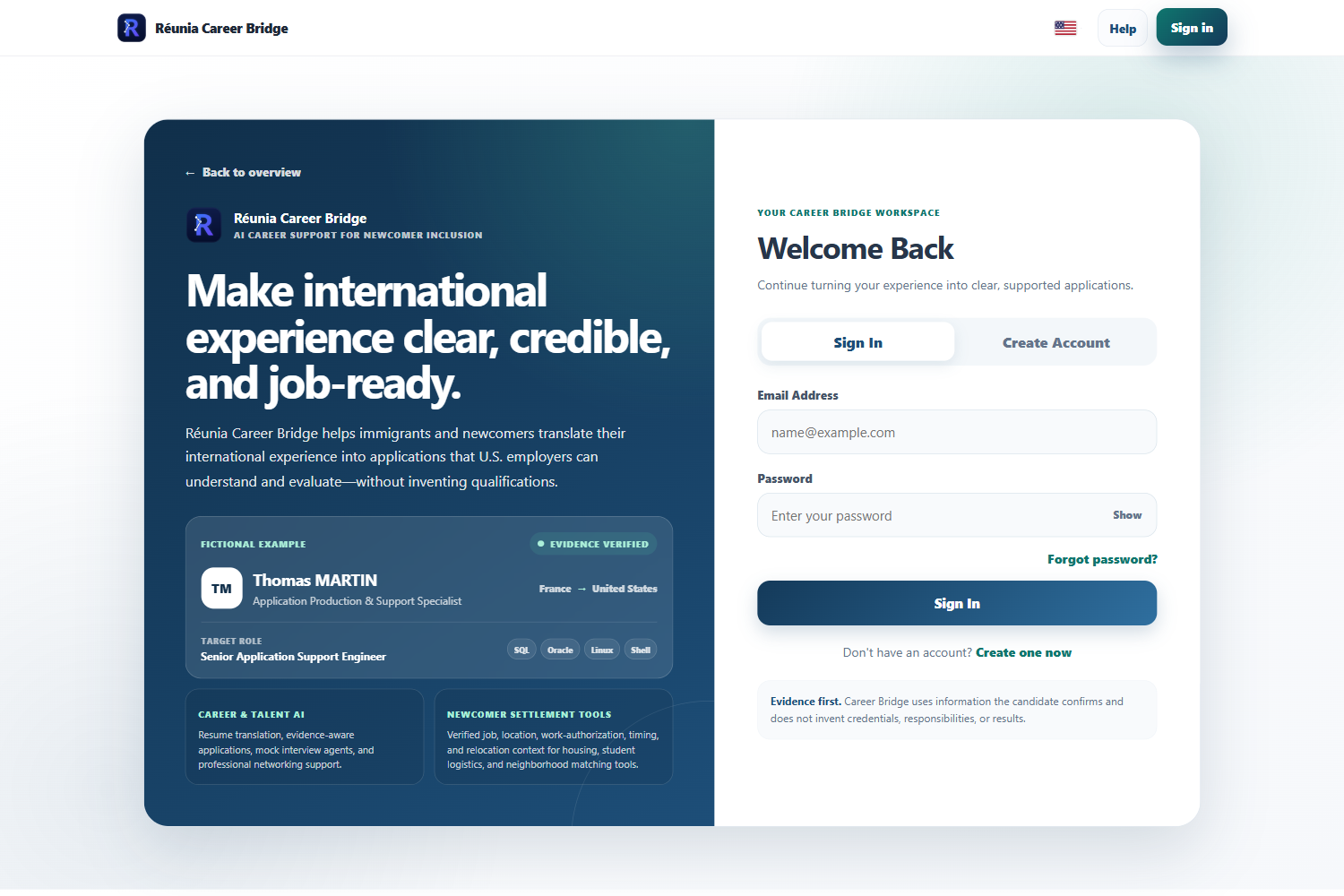
Login
-
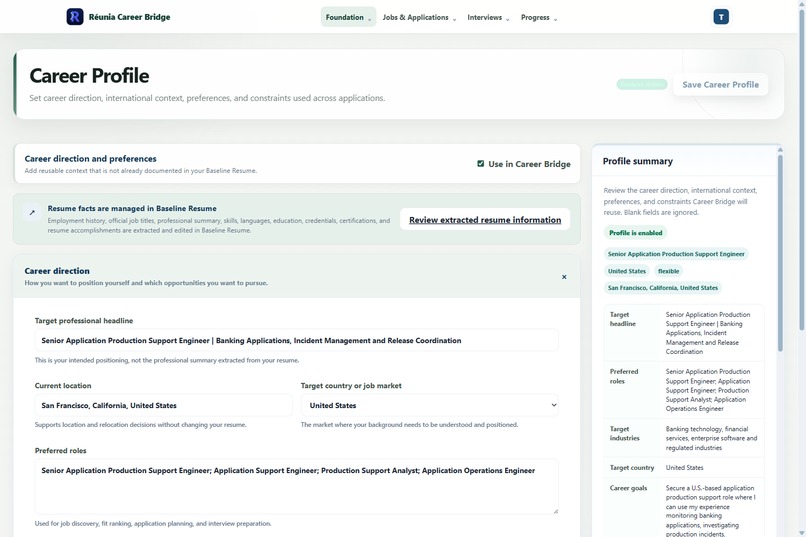
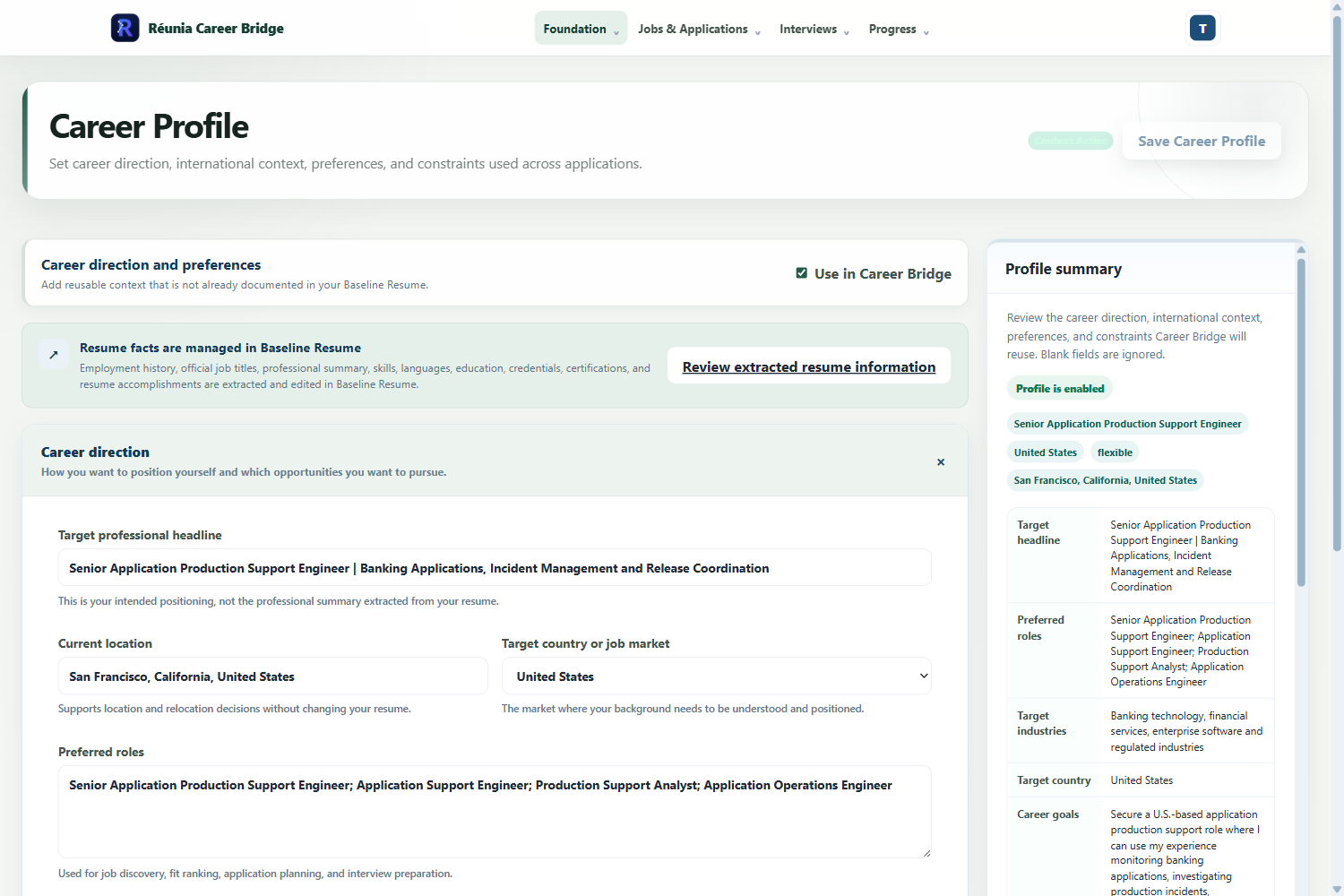
Career Profile
-
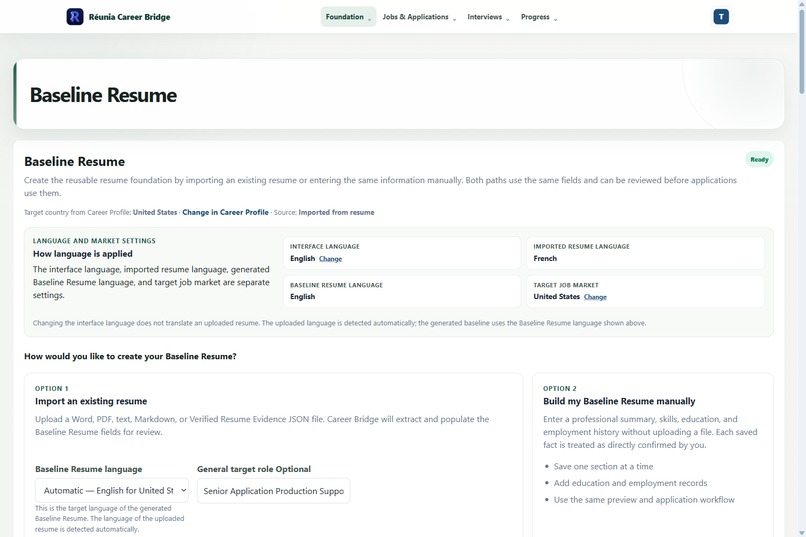
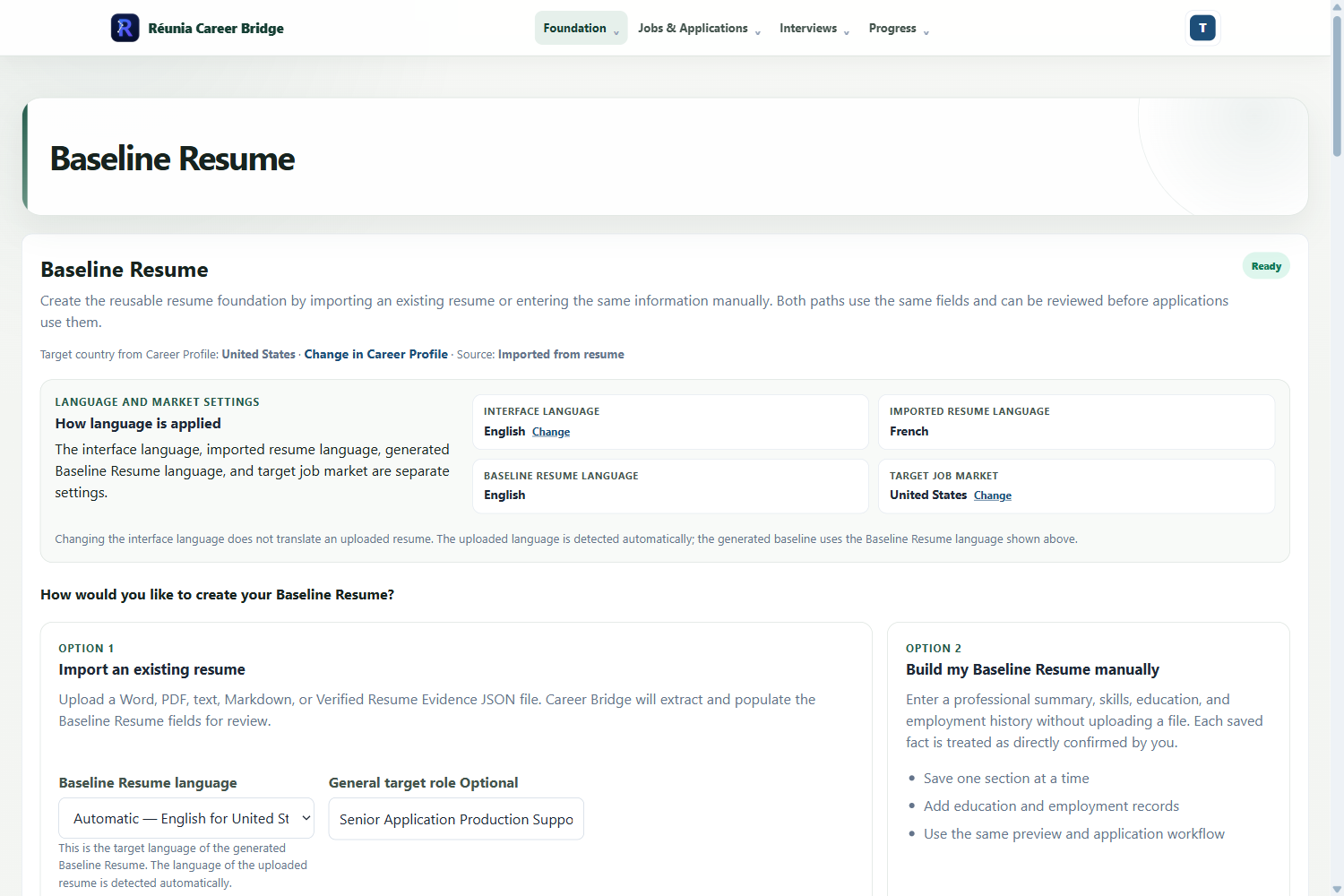
Career Translation
-
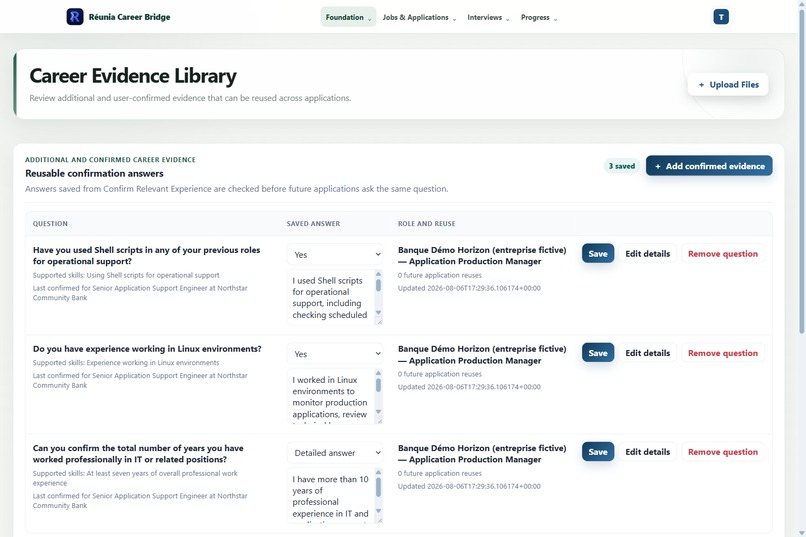
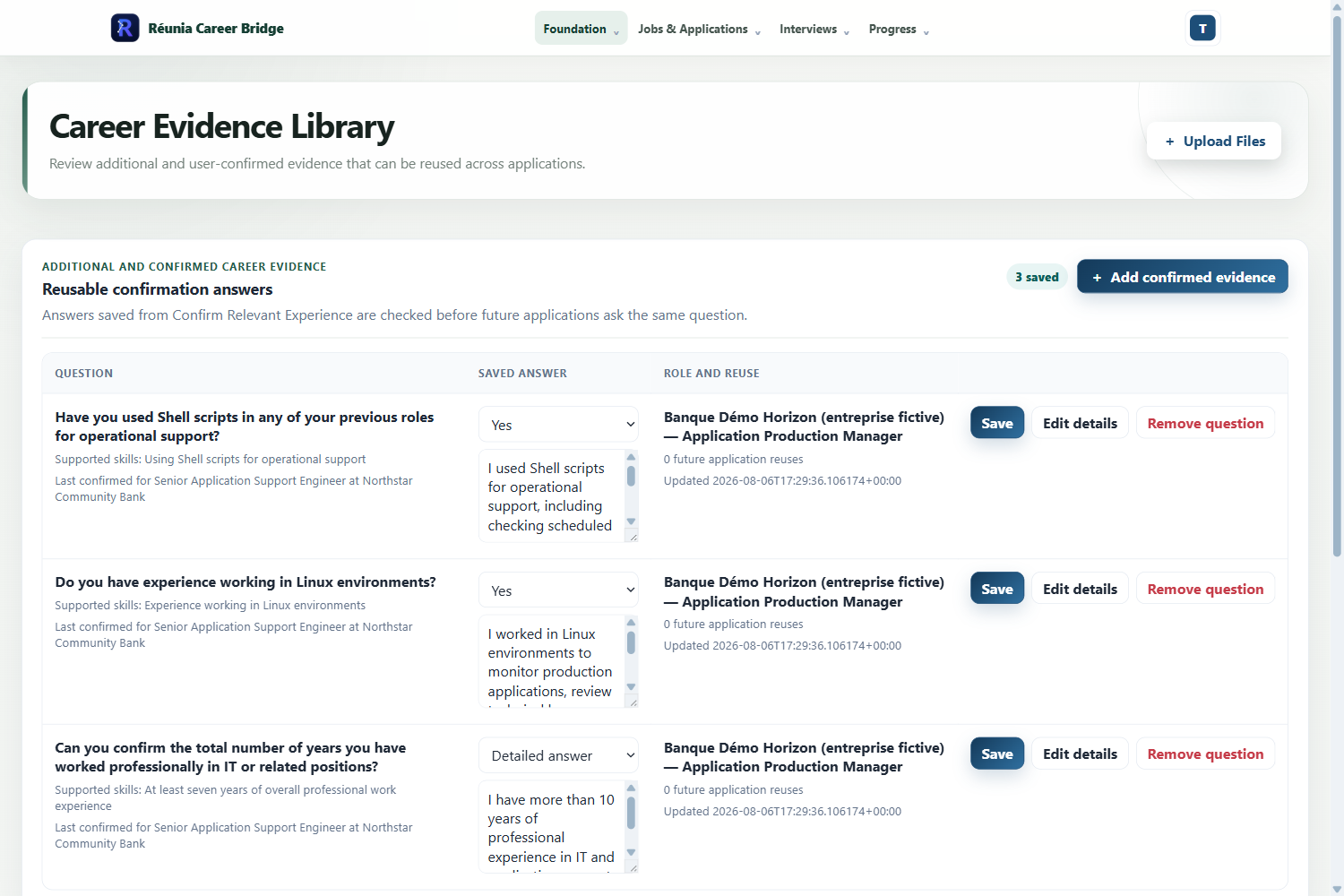
Evidence library
-
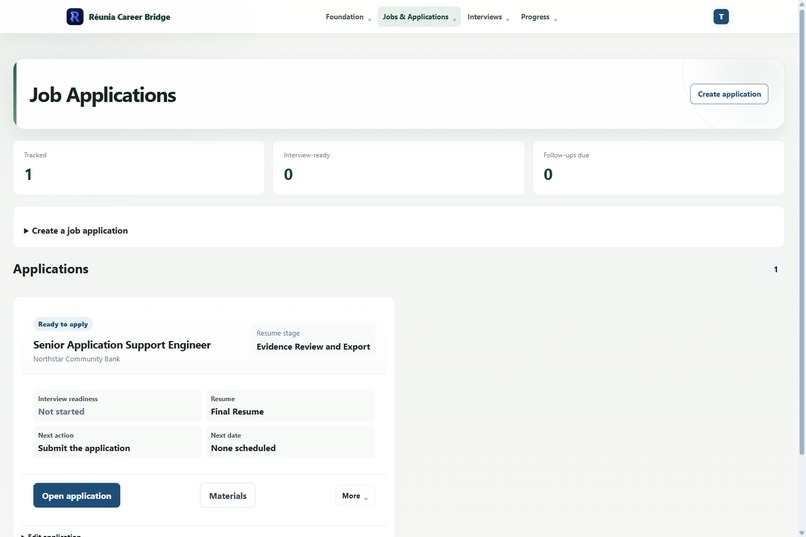
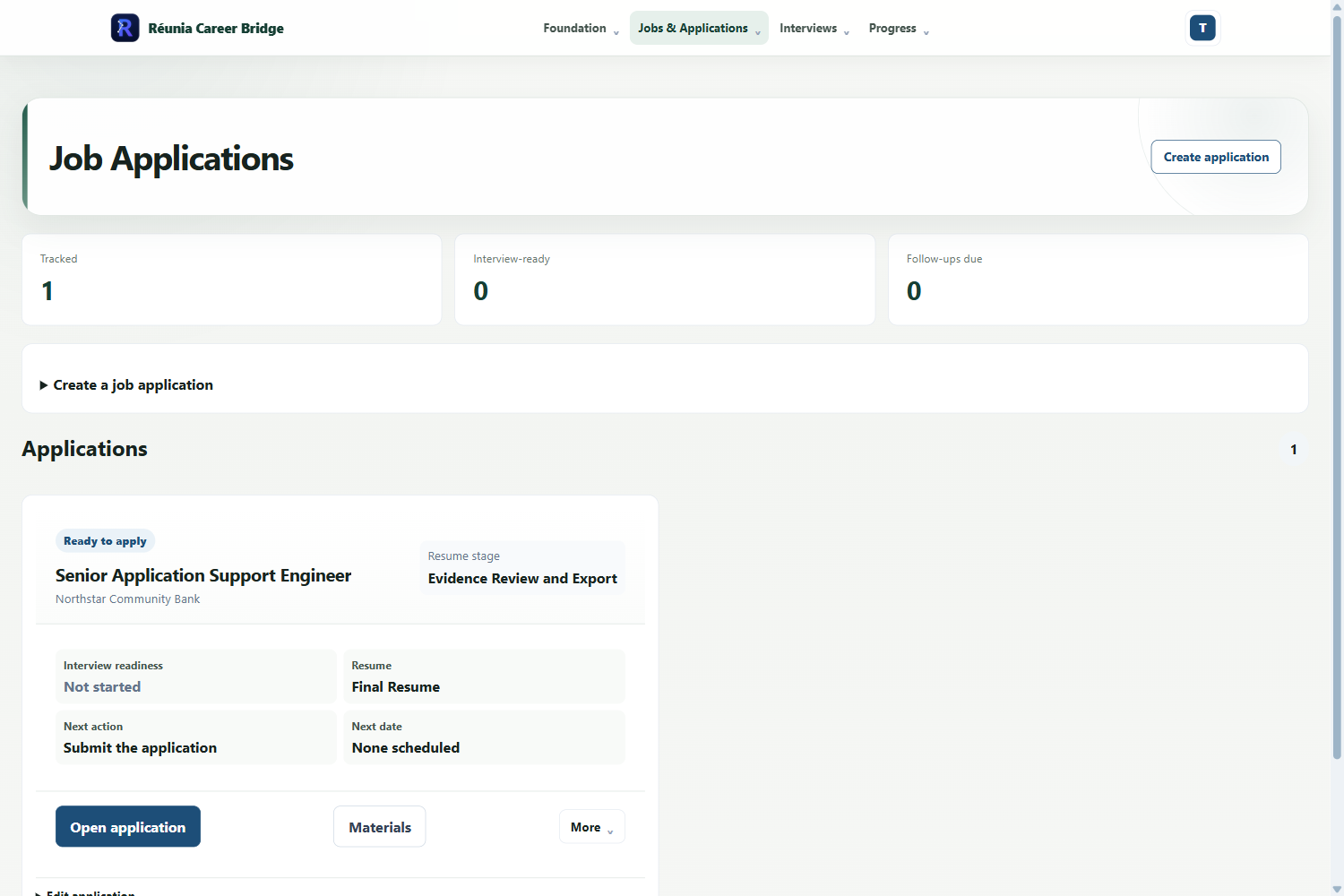
Job application
-
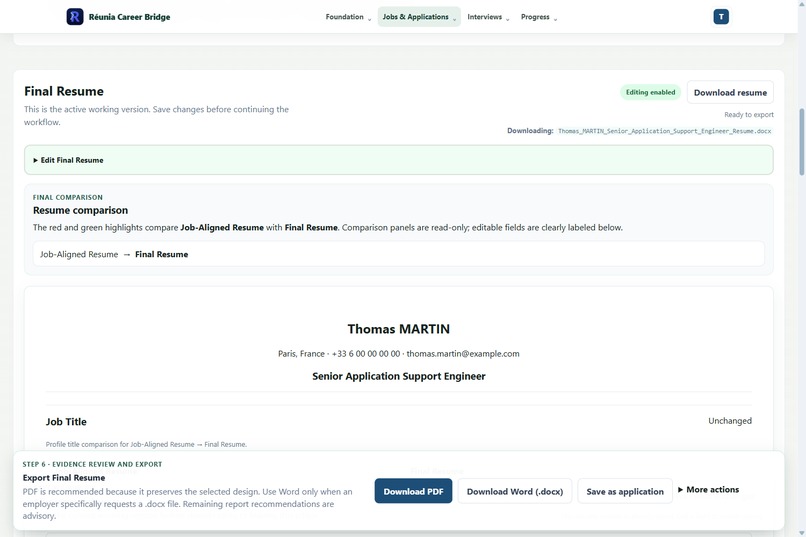
Resume workflow
-
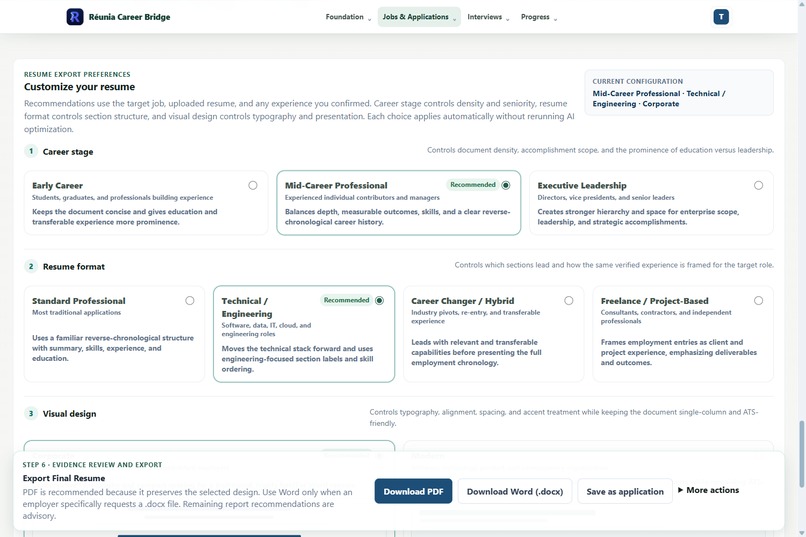
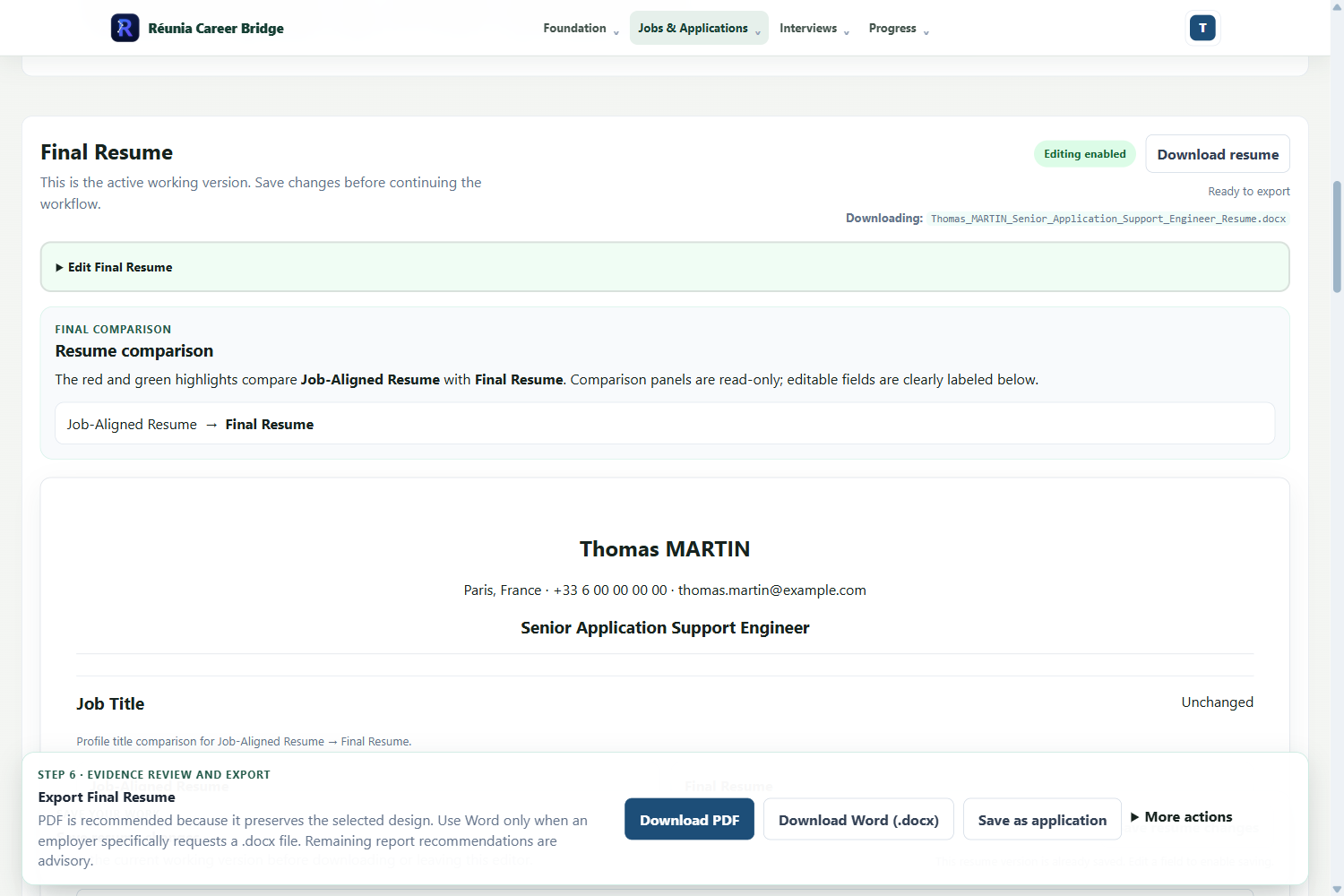
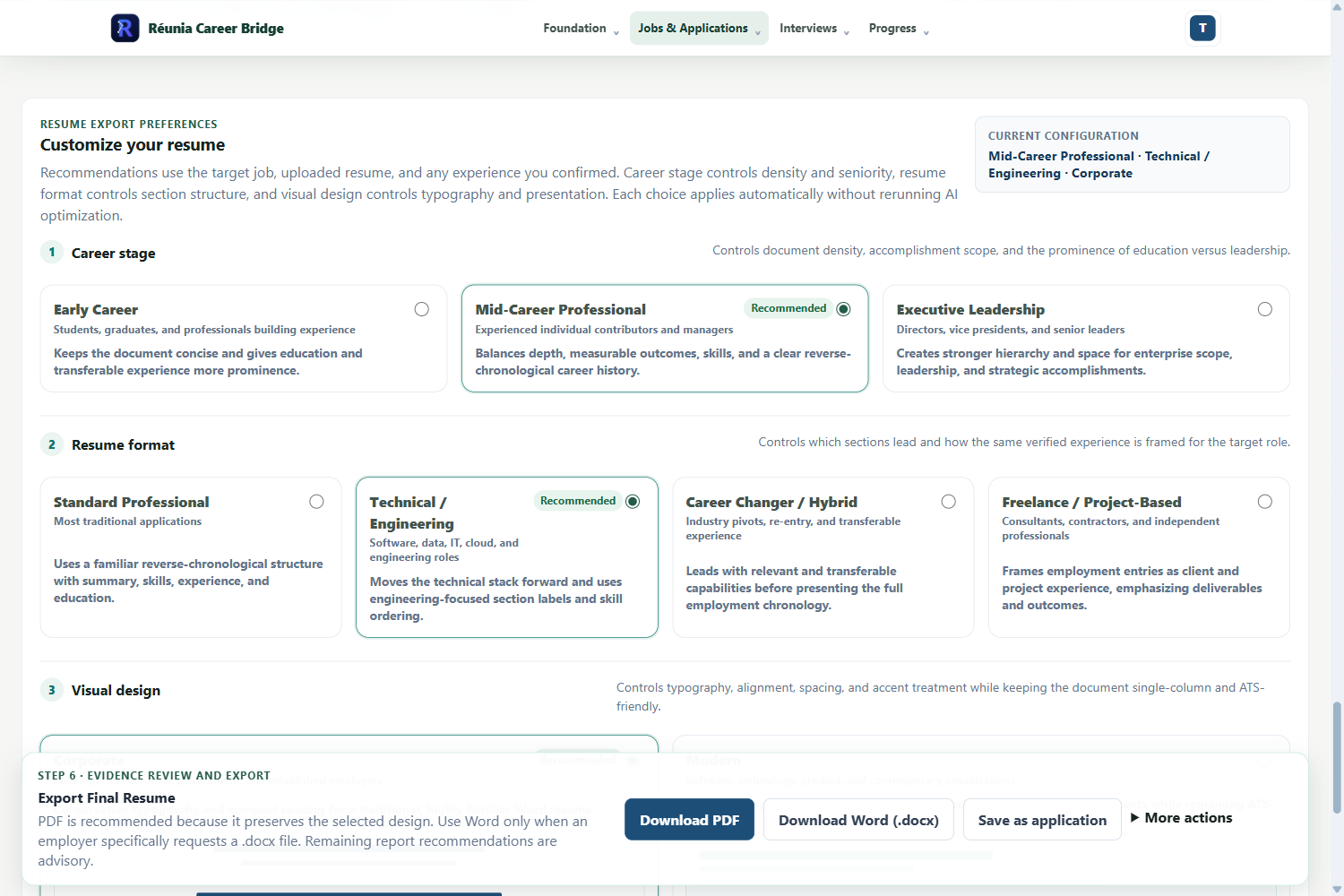
Resume export preferences
-
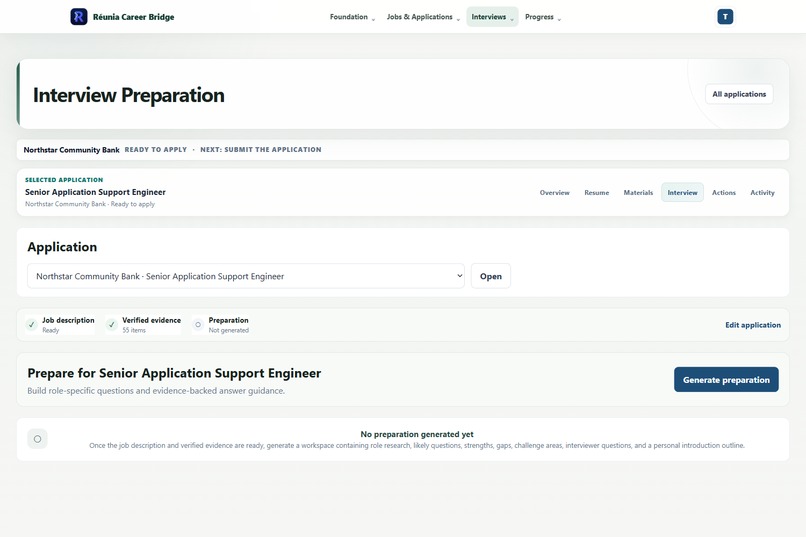
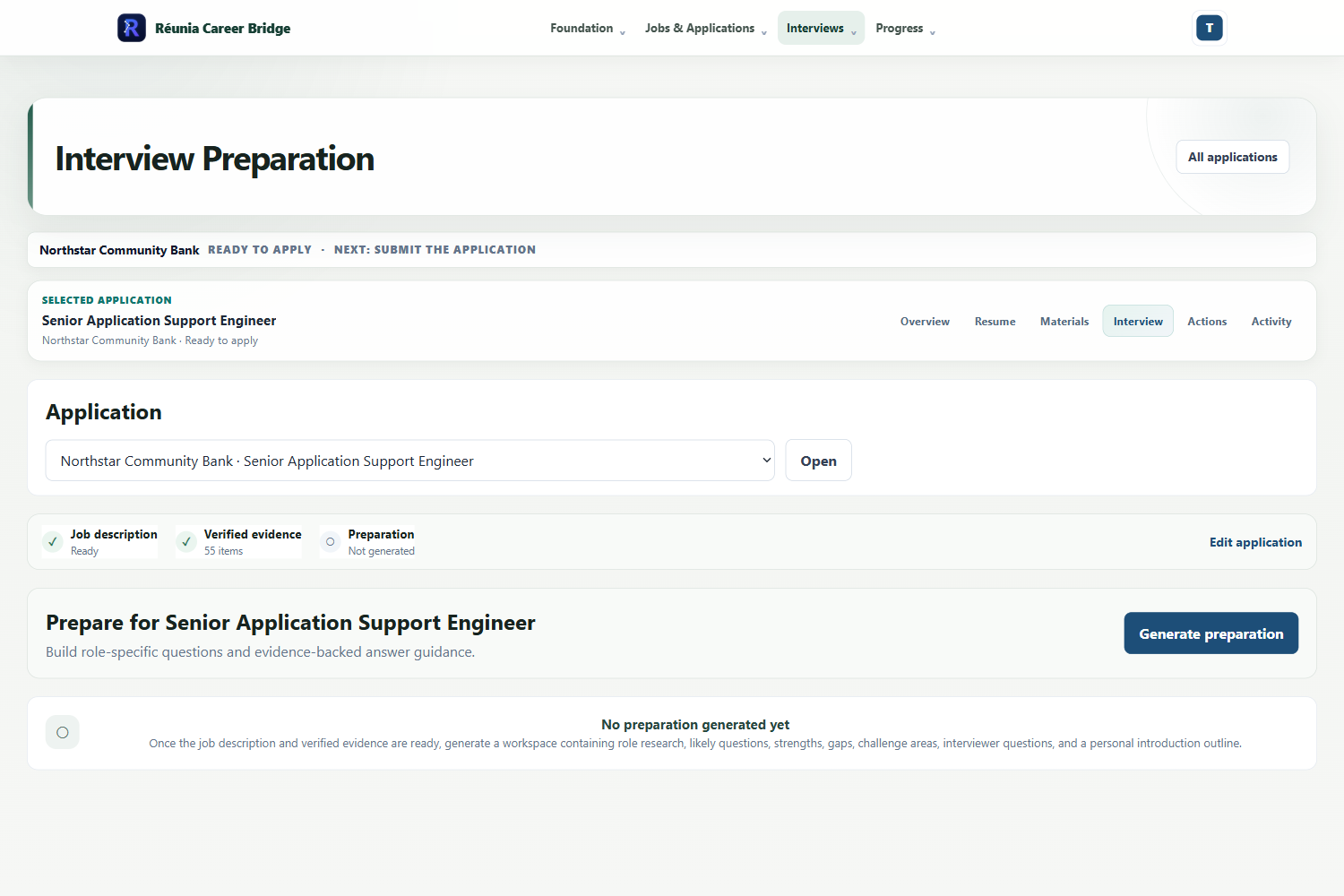
Interview preparation
-
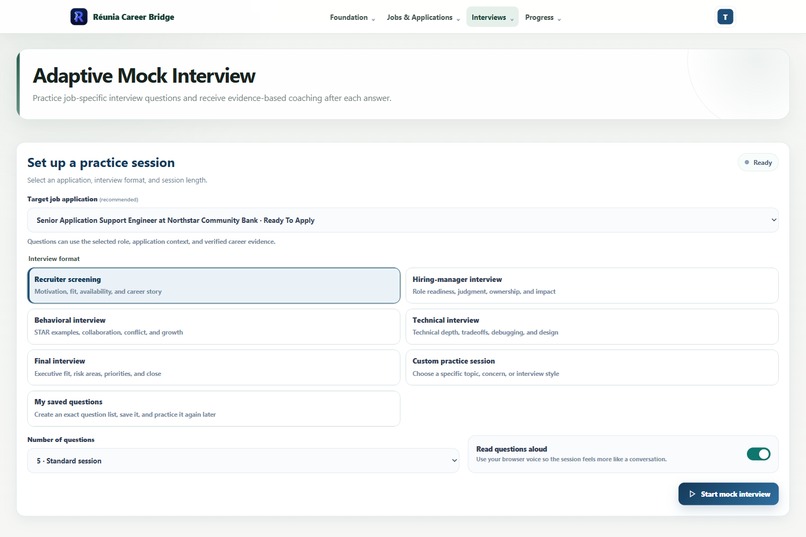
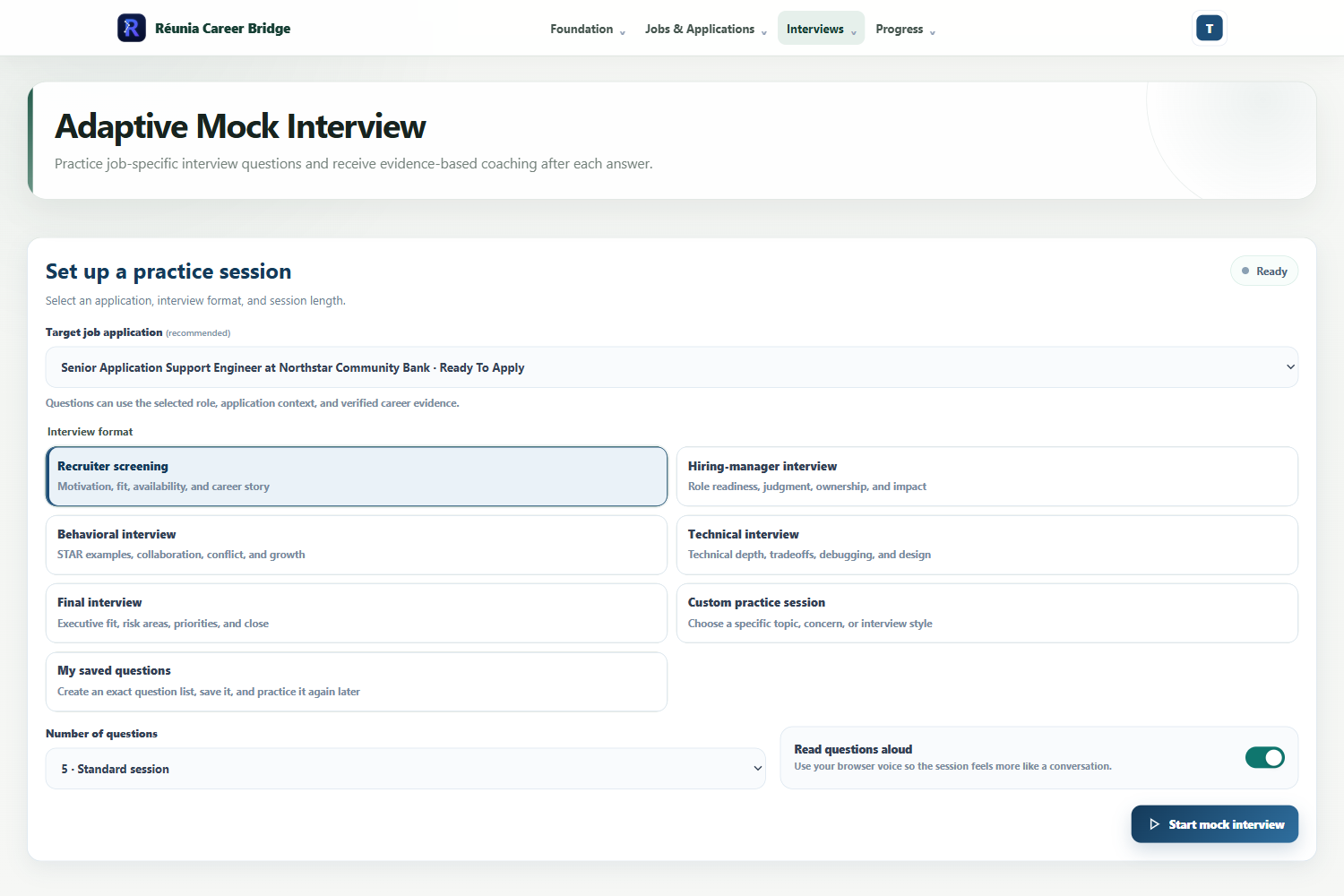
Mock interview
-
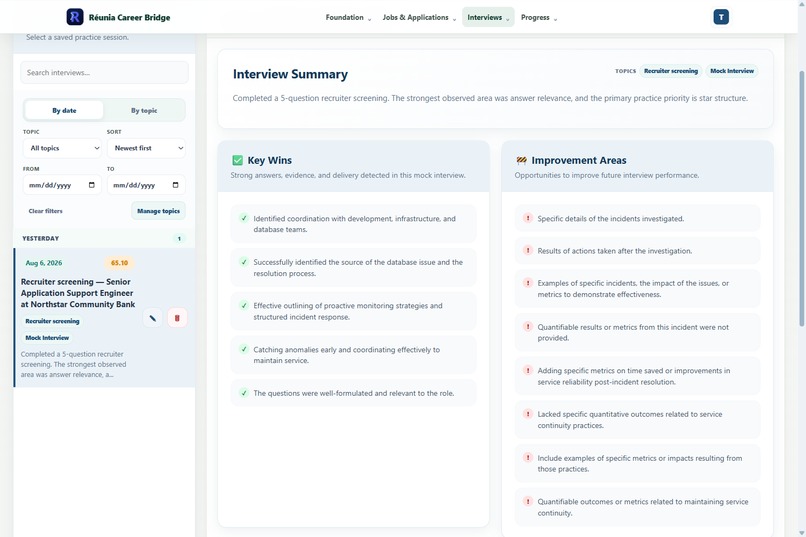
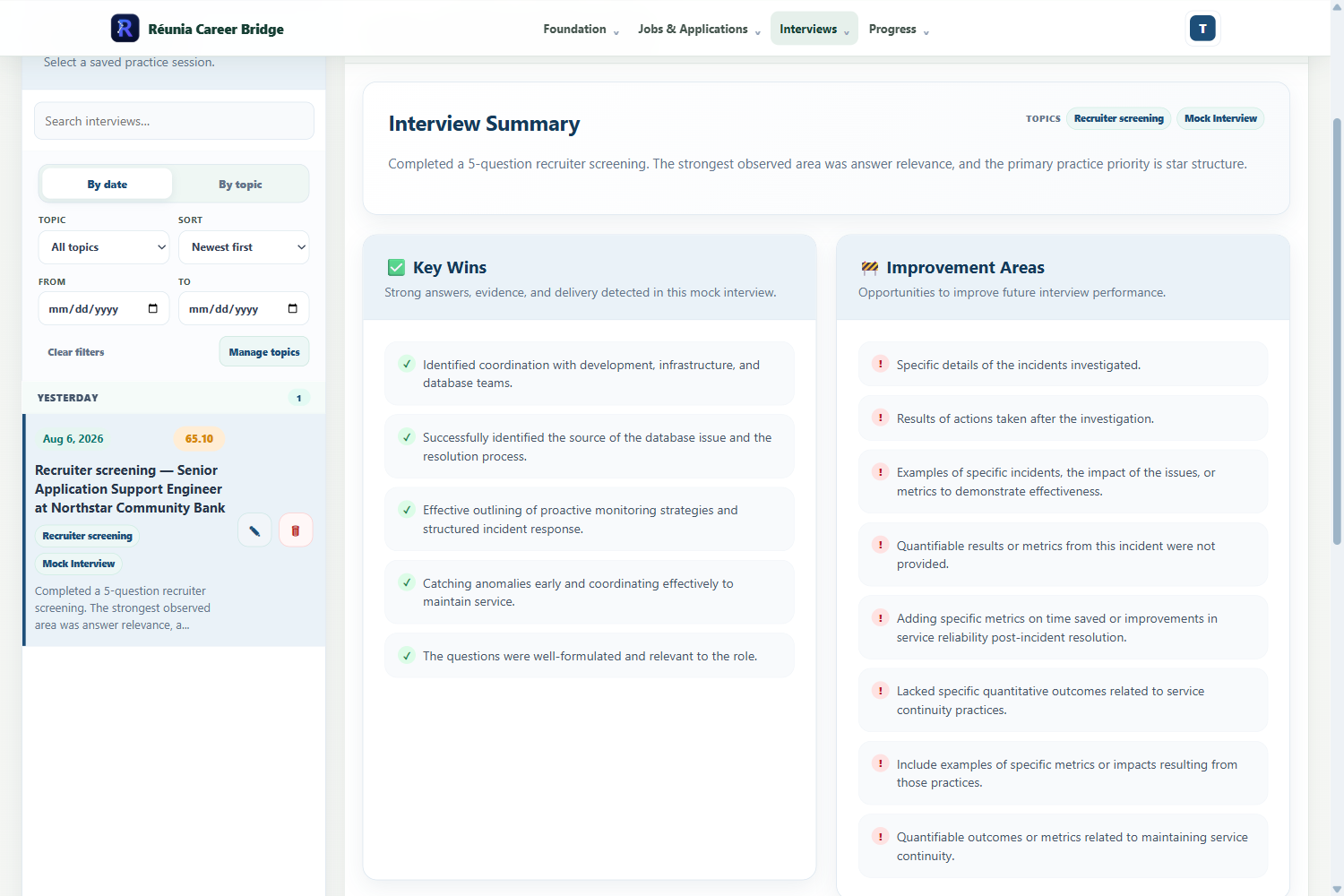
Interview review
-
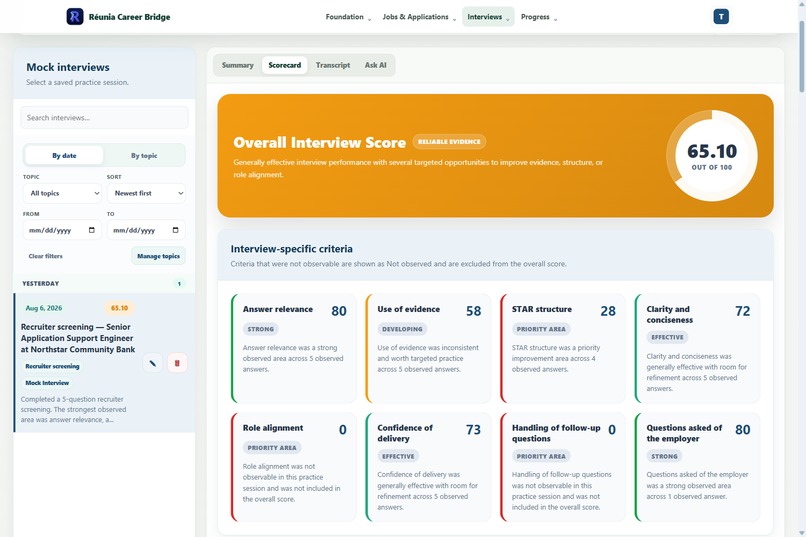
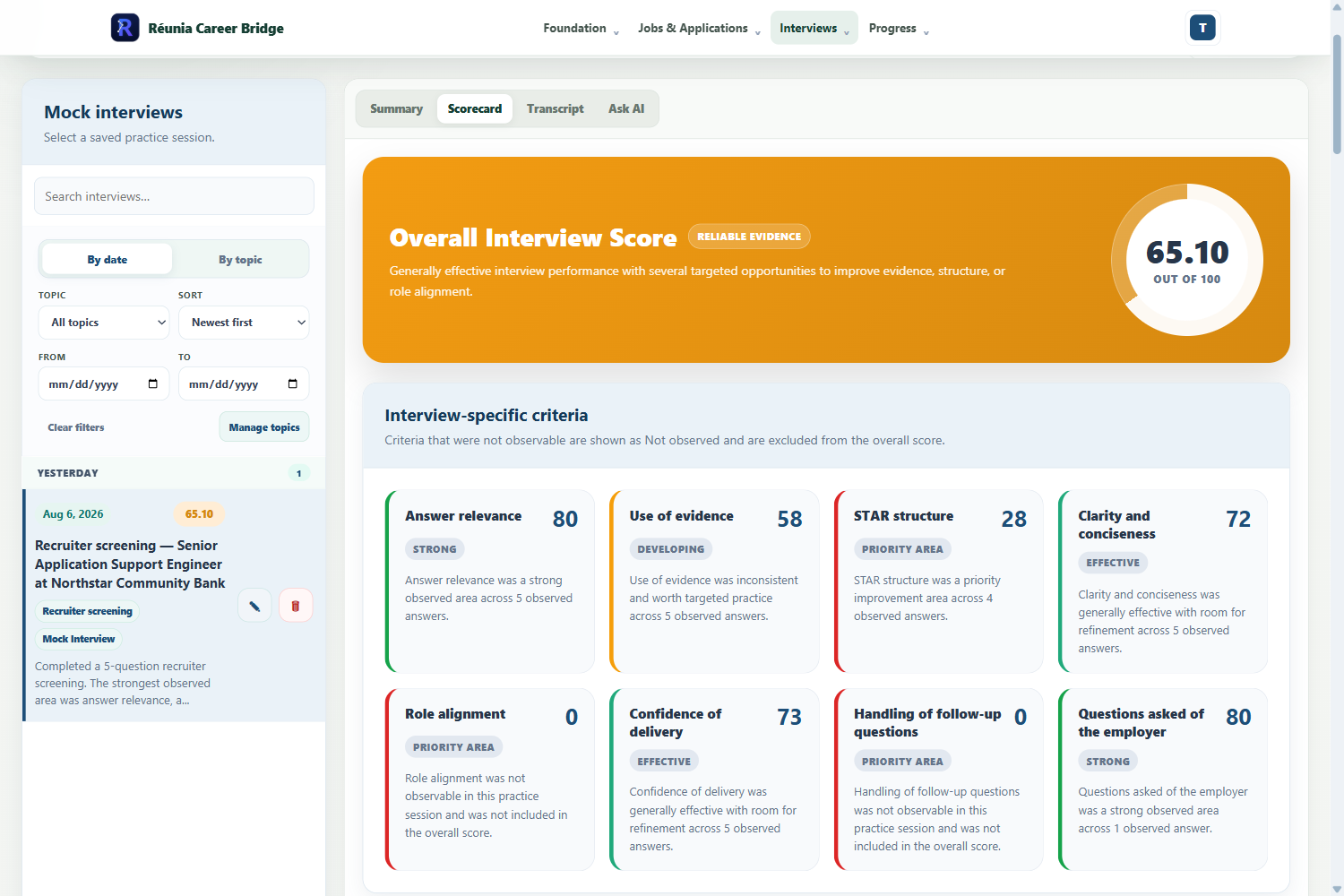
Interview review scorecard
-
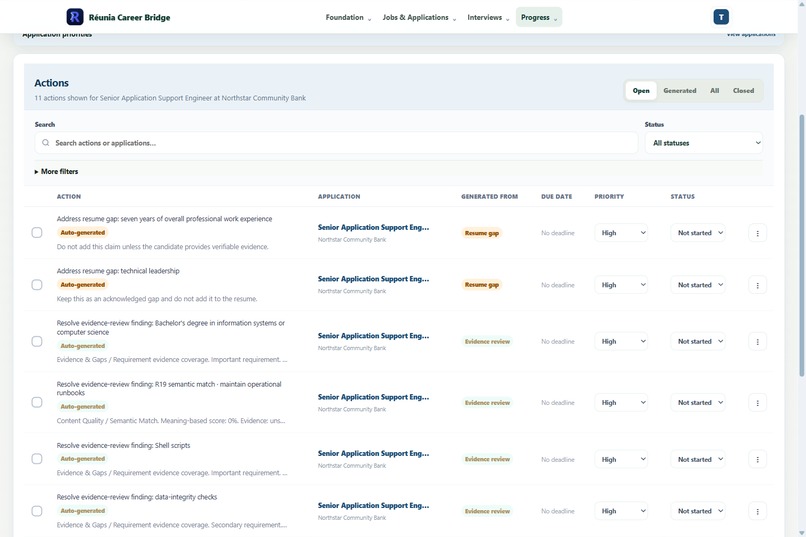
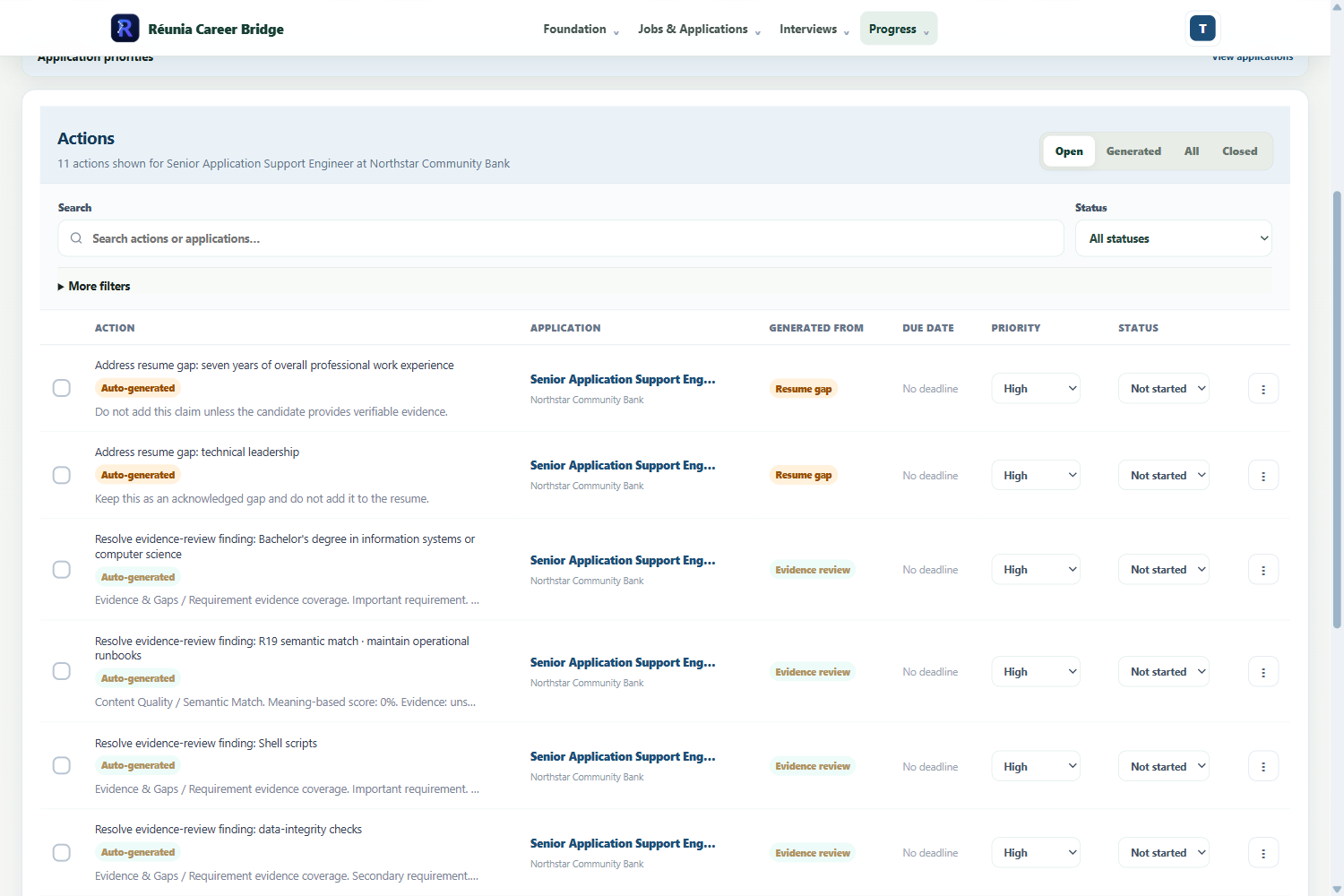
Action plan
-
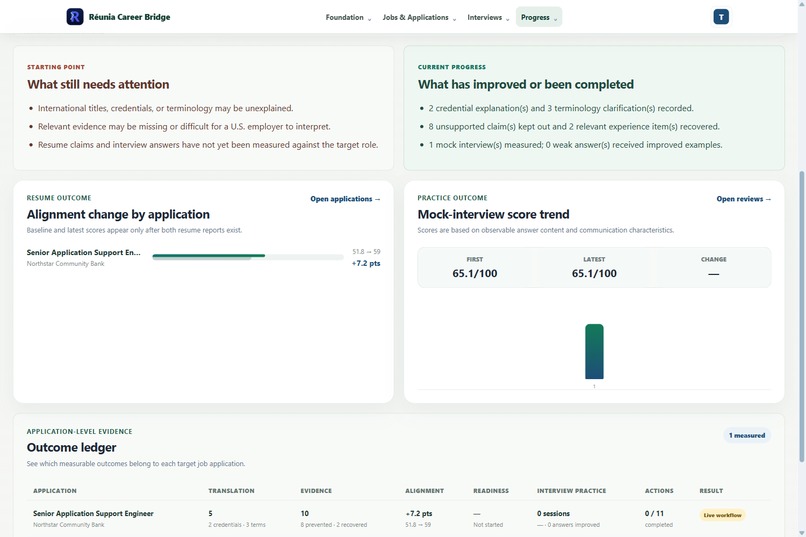
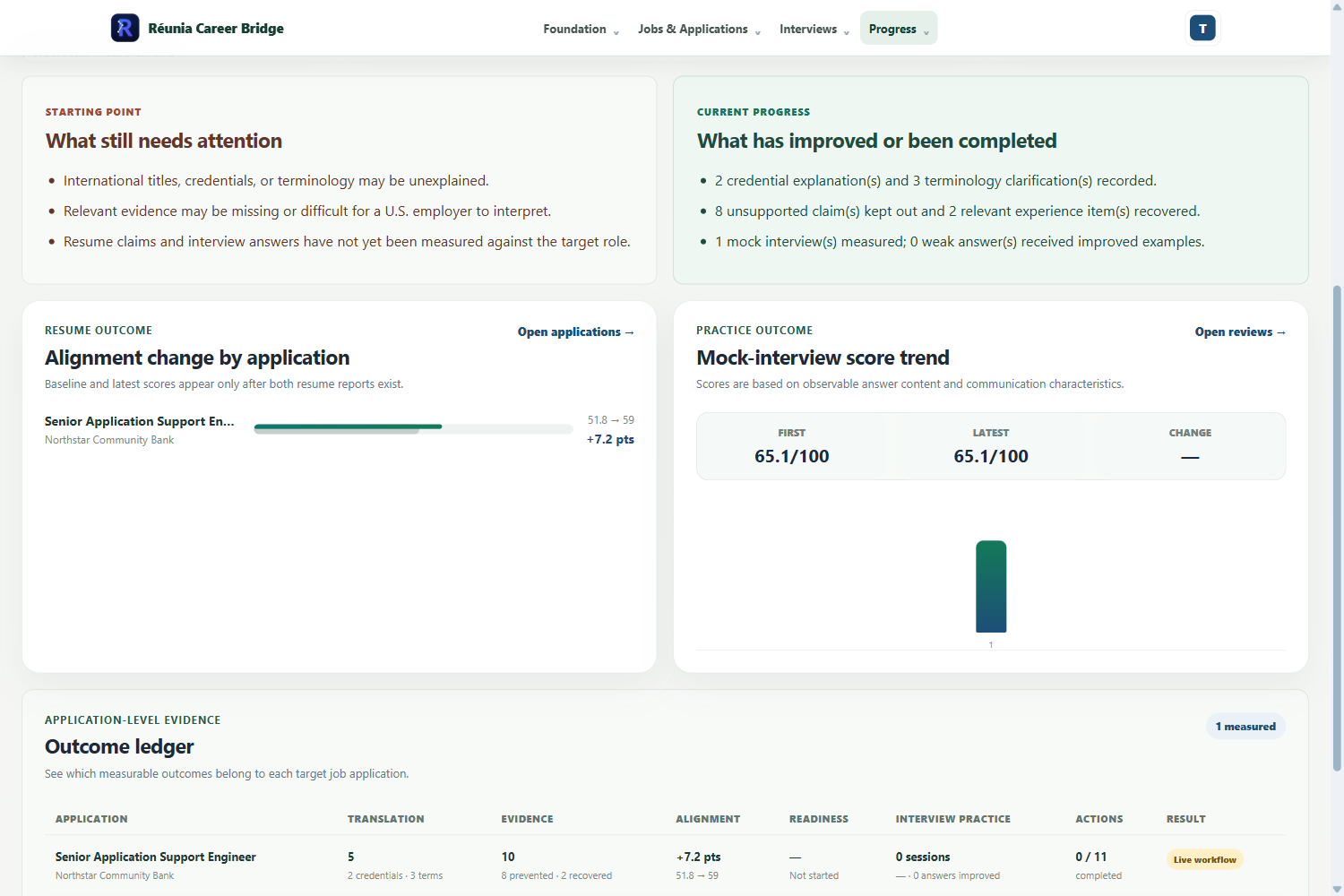
Progress
Inspiration
Réunia Career Bridge is closely connected to my own experience.
I am originally from France and moved to the United States about ten years ago. When I arrived, I already understood how to write a résumé, apply for jobs, and prepare for interviews in France, but I quickly discovered that doing the same thing in the U.S. was different.
It was not simply a matter of translating French words into English. Job titles did not always have a direct U.S. equivalent. Résumé conventions were different. Employers described skills and responsibilities differently, and I had to learn how to explain my previous experience in a way that U.S. recruiters and hiring managers could understand without changing what I had actually done.
I recently went through another job search in the U.S., which brought many of those challenges back into focus. While looking for jobs, tailoring résumés, preparing for interviews, and keeping track of applications, I started thinking about how AI could make this process easier.
I wanted to build a tool that could help me with my own job search, but more importantly, one that could help other immigrants and newcomers who find themselves in the same situation I experienced.
That became Réunia Career Bridge.
What it does
Réunia Career Bridge helps immigrants and newcomers translate their international experience into applications that U.S. employers can understand and evaluate, without inventing qualifications.
Instead of treating résumé translation, job applications, interview preparation, and career planning as separate AI tasks, Career Bridge creates a connected, evidence-grounded workflow that carries a candidate's verified experience through the entire process.
A candidate can import an international résumé and build a reusable career profile. Career Bridge identifies terminology, job titles, responsibilities, and qualifications that may not translate clearly into the target job market.
When something is ambiguous, the system does not automatically guess. It asks the candidate focused questions and stores their answers as candidate-confirmed evidence.
That evidence can then be reused across future applications and later AI-assisted stages of the career journey.
For a specific job, Career Bridge can:
- Compare the candidate's verified experience with the target role
- Identify important experience that still needs clarification
- Generate a tailored résumé grounded in confirmed facts
- Help prepare for likely interview questions
- Run personalized and adaptive mock interviews
- Review interview performance and provide a scorecard
- Turn gaps and feedback into a practical Career Action Plan
For example, a French title such as “Responsable de Production Applicative” could have several interpretations in the U.S. market. Rather than automatically deciding that it means application manager, software engineer, operations manager, or people manager, Career Bridge asks the candidate to clarify what they actually did.
The goal is not to make someone's background sound more impressive. The goal is to make their real experience understandable.
How we built it
Réunia Career Bridge is a web application built around an AI-assisted, evidence-grounded career workflow. Its architecture is designed around one core idea: AI can help candidates interpret and communicate their experience, but it should not invent qualifications or silently turn assumptions into facts.
Pre-existing work and Open Atlas development
Career Bridge brings together two earlier development foundations that were at very different stages when the Open Atlas submission period began.
Resume Tailor was a rudimentary résumé-tailoring prototype created before the Open Atlas submission window opened on June 20, 2026. It explored early concepts such as résumé import, job-description analysis, résumé tailoring and comparison, evidence review, résumé reports, and document export.
Réunia began separately as an AI meeting-assistant project during the Open Atlas submission period, with development underway by June 22, 2026. That work established useful foundations and patterns around the application shell, authentication, OpenAI integration, AWS storage, document handling, administration, and production operations.
The two codebases began being integrated on July 28, 2026. From that point, I substantially redesigned and expanded those foundations into Réunia Career Bridge: a unified career-inclusion platform focused on helping immigrants, newcomers, and internationally experienced candidates translate their professional experience for a new job market.
The Open Atlas development included the unified Career Bridge architecture and end-to-end career journey; Career Profile and Career Translation workflows; the reusable Career Evidence Library; Job Discovery and application workspaces; application-specific résumé workflows; Interview Preparation; Adaptive Mock Interview; Interview Review and scorecards; Career Action Plan; Progress & Outcomes; durable DynamoDB/S3 persistence; background processing for longer-running AI operations; and a simplified career-focused interface.
The published repository preserves this development history, while the README and submission documentation clearly distinguish the pre-existing Resume Tailor foundation, Réunia development during the Open Atlas period, and the later Career Bridge integration.
Evidence-grounded architecture
A central architectural decision was to separate three different kinds of information:
- Source information — résumé content, profile information, job descriptions, and other material supplied by the candidate.
- Candidate-confirmed evidence — facts the candidate has explicitly verified, clarified, or added.
- AI-generated interpretation and recommendations — translations, suggestions, analysis, résumé wording, interview coaching, and next actions generated from the available evidence.
This separation allows generated material to remain traceable to information the candidate actually provided or confirmed.
It is especially important when translating international experience. A job title, credential, responsibility, or organizational structure may not map directly into the terminology used in another labor market. Instead of silently guessing, Career Bridge can identify the ambiguity, explain why clarification is needed, and ask the candidate for additional evidence.
Connected career workflow
Career Bridge connects activities that are often handled by separate products:
Career Translation → Evidence Confirmation → Job Application → Tailored Résumé → Interview Preparation → Mock Interview → Interview Review → Career Action Plan
The goal is to preserve context throughout that journey. Evidence confirmed while clarifying a résumé, for example, can later support résumé tailoring, interview preparation, mock-interview questions, and application-specific recommendations.
This creates a multi-stage AI workflow rather than a collection of isolated AI generations. Analysis performed at one stage can affect what happens next: detected ambiguity can trigger clarification questions, candidate-confirmed answers become grounding evidence for résumé generation, that evidence informs interview preparation and mock-interview questions, and interview evaluation can feed application-specific actions.
OpenAI integration
AI is not used as a single generation step or a thin API layer in Career Bridge. OpenAI models perform different reasoning and generation tasks throughout a connected workflow, with structured context and verified evidence from earlier stages supporting later stages.
Career Bridge uses the OpenAI API with task-specific model configurations rather than relying on one general-purpose prompt for every feature.
OpenAI models are used to:
- analyze job descriptions and identify important requirements;
- compare those requirements with verified résumé and profile evidence;
- interpret international job titles, terminology, credentials, and responsibilities;
- identify ambiguous or unsupported claims that require candidate confirmation;
- generate targeted clarification questions;
- support evidence-grounded résumé tailoring;
- produce personalized interview preparation;
- generate and adapt mock-interview questions and follow-ups;
- evaluate interview responses and produce structured scorecards; and
- turn identified gaps into concrete, application-specific next actions.
Different model configurations are used depending on the task so the system can balance reasoning quality, latency, and cost rather than treating every AI operation the same way.
The result is not simply a UI around a single model response. AI participates at multiple points in the candidate journey, while candidate-confirmed evidence and application state provide continuity between those AI-assisted stages.
Reusable Career Evidence Library
Career Bridge also maintains a reusable Career Evidence Library.
When candidates confirm facts such as responsibilities, technologies used, leadership scope, achievements, or years of experience, those facts can be stored as reusable evidence.
Later applications can draw from that confirmed evidence instead of repeatedly asking candidates to establish the same facts from scratch. At the same time, application-specific claims still remain tied to the evidence that supports them.
Technical architecture
Python and Flask power the backend and application workflows.
Production application and workflow data use AWS services including DynamoDB and S3, with persistence designed around structured application state, reusable evidence, résumé artifacts, interview workflows, and other career data.
Longer-running AI operations are separated from normal interactive requests where appropriate so expensive analysis does not need to block the user-facing request lifecycle.
Career Bridge is deployed on AWS Lightsail as a working web application rather than only as a local prototype.
The result is an architecture designed not simply to generate career content, but to maintain continuity and evidence across the candidate's journey.
The principle that guided the system throughout development is:
AI can help explain evidence, transform evidence, and identify missing evidence — but it should not silently create evidence.
Challenges we ran into
One of the hardest problems was deciding when AI should make an interpretation and when it should ask the user.
International job titles are a good example. Translating a title literally can be misleading, but replacing it with the closest U.S. title can also accidentally introduce responsibilities the candidate never had.
Career Bridge therefore needed a way to distinguish between information supported by the résumé, information inferred by AI, and information explicitly confirmed by the candidate.
Another challenge was maintaining that evidence across a long workflow. A fact confirmed during career translation should still be available when generating a résumé or preparing an interview later. At the same time, outdated analysis should not silently continue to influence an application after the résumé or job description changes.
Building longer AI workflows also introduced technical challenges. Some operations involve several analysis stages and can take longer than a traditional web request. I worked on moving these operations into durable processing flows so users can leave a page and return without losing their progress.
There was also a significant UX challenge: the product contains sophisticated reasoning about evidence, ambiguity, résumé alignment, and interview readiness, but the user should not have to understand the underlying technical architecture. I repeatedly simplified terminology, screens, messages, and workflows so that the experience remained understandable to someone who simply wants help finding a job.
Accomplishments that we're proud of
I am especially proud that Career Bridge became more than a résumé-tailoring tool.
It now carries verified information across a much larger career journey.
A clarification provided while translating an international job title can later support a tailored résumé. The same evidence can help create interview questions. Interview performance can then generate specific next actions in the Career Action Plan.
I am also proud of the candidate-confirmed evidence model. Generative AI makes it very easy to produce polished professional language, but polished language is not useful if it introduces qualifications a candidate does not actually have.
Career Bridge tries to solve that problem by keeping the candidate in control of uncertain information.
Another accomplishment was turning the project into a functioning end-to-end web application with persistent user data, application workflows, résumé generation, interview preparation, mock interviews, interview review, and career planning instead of building a collection of disconnected AI demonstrations.
Most importantly, I built something that I would have wanted when I first moved from France to the United States.
What we learned
Building Career Bridge changed how I think about AI for career tools.
At first, résumé tailoring can look like a writing problem. In practice, the harder problem is evidence management.
The system needs to understand what a candidate has actually done, what can reasonably be inferred, what remains ambiguous, and what requires confirmation.
I also learned that international career translation is not the same as language translation.
A sentence can be perfectly translated into English and still be confusing to an American employer. Job titles, credentials, seniority, management expectations, technologies, and even résumé structure can carry different meanings between countries.
Another lesson was that continuity matters. Users should not have to repeatedly explain the same experience to separate AI tools for résumé writing, interviews, and career planning. Once information has been verified, AI should be able to responsibly reuse it throughout the candidate's journey.
Finally, building the project while going through a real job search helped me see the workflow from the user's perspective. Features that initially seemed separate—job discovery, résumé tailoring, interview practice, evidence tracking, and follow-up actions—are actually different stages of the same experience.
What's next for Réunia Career Bridge
My next priority is to deepen the core Career Bridge workflow while adding a small set of supporting features that make it easier to manage the full job-search process.
The product already helps candidates keep track of upcoming interviews, application follow-up dates, custom next steps, interview-preparation actions, and post-interview thank-you actions. For example, once an interview has passed, Career Bridge can shift the candidate away from outdated preparation tasks and toward appropriate follow-up actions.
There are several related capabilities in my product backlog that I would like to build next.
A logical sequence is:
- Application communication log — keep recruiter and employer interactions connected to the relevant application.
- Thank-you and follow-up message templates — help candidates act on the next steps already identified by Career Bridge.
- Recruiter-response drafting — use the application context and verified career evidence to help candidates prepare accurate responses.
- Optional calendar synchronization — connect interview and follow-up dates with the candidate's calendar.
- Cover-letter generation — create application-specific letters grounded in the same verified evidence used for résumé tailoring.
- AI-assisted networking — help candidates identify useful networking opportunities around a target role or company, understand why a connection may be relevant, prepare personalized outreach, and turn networking into concrete follow-up actions connected to their career goals and verified experience.
- Advanced application analytics — help candidates understand patterns across applications, interviews, outcomes, and next actions.
These are deliberately secondary to the product's core workflow: career translation, evidence confirmation, job-specific résumé tailoring, interview preparation and practice, and career action planning.
I also want to improve career translation across more countries, languages, industries, credentials, and professional cultures, and continue expanding the Career Evidence Library into a long-term verified career profile that becomes more useful with every application and interview.
Over time, I see Réunia Career Bridge becoming a broader career and newcomer platform: not just helping people produce better application materials, but helping them navigate an unfamiliar employment system with more context, continuity, and confidence.
The goal remains the same as when I started the project: make one of the hardest parts of moving to a new country easier, and help other newcomers avoid having to figure out the entire process on their own.
Built With
- ai
- amazon-web-services
- css
- dynamodb
- flask
- genai
- github
- gpt
- html
- javascript
- lightsail
- llm
- natural-language-processing
- openai
- playwright
- python
- rest
- s3


Log in or sign up for Devpost to join the conversation.