-
-
Returnrelay
Inspiration
What it does
How we built it
Inspiration
Product returns and warranty claims can be frustrating for customers. Finding the correct order, understanding eligibility policies, creating a support case, and tracking its status often involves several steps. I wanted to explore how conversational AI and agent-based workflows could make this experience simpler, faster, and more transparent.
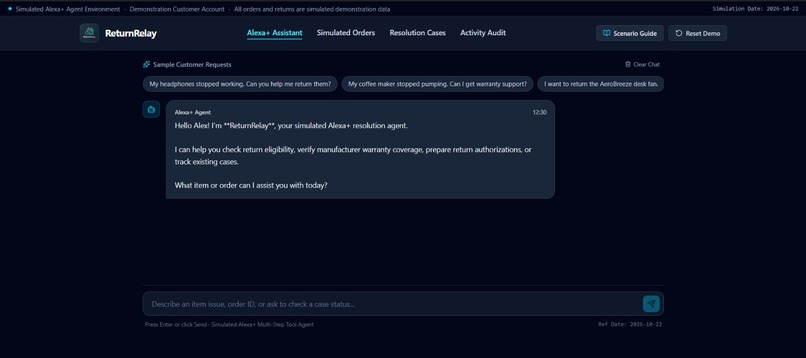
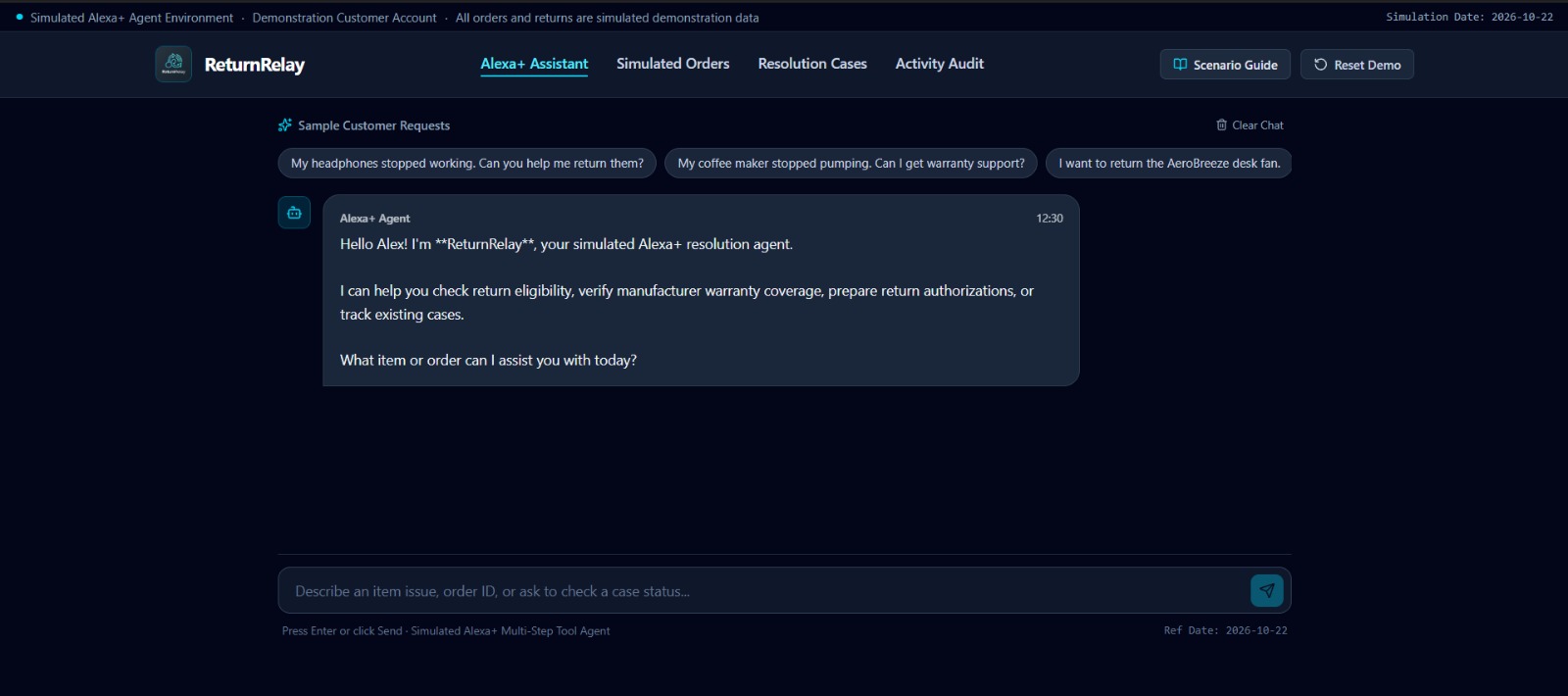
This inspired me to build ReturnRelay, an AI-powered conversational assistant that helps users navigate product returns and warranty resolution through a simple chat interface.
What it does
ReturnRelay allows users to describe their product issues in natural language. The system can find matching orders, check eligibility using predefined business rules, prepare resolution cases, and retrieve case status.
Key features include:
- Conversational order lookup: Find orders based on the user's request.
- Smart disambiguation: Ask follow-up questions when multiple orders match.
- Policy-based eligibility: Apply structured rules to return and warranty requests.
- Human-in-the-loop approval: Allow users to explicitly approve or reject proposed resolutions.
- Case tracking: Retrieve the status of previously created cases.
- Audit logging: Maintain a record of important actions for transparency.
- AI fallback: Use a local rule engine when the AI service is unavailable.
How I built it
I built the frontend using React, TypeScript, Vite, and Tailwind CSS. The backend uses Node.js, Express, and TypeScript to handle requests and execute the application's workflows. SQLite stores application data, while Zod validates incoming data.
For conversational intelligence, I integrated a large language model through the Groq API. I combined AI-powered intent understanding and tool-calling with deterministic backend rules, ensuring that important eligibility decisions are handled consistently. A local rule-engine fallback supports predefined workflows when the AI service is unavailable.
Challenges I faced
One of the main challenges was balancing flexible natural-language interaction with reliable business logic. AI can interpret user requests, but eligibility checks and consequential actions should not depend solely on generated responses.
I addressed this by separating conversational intelligence from deterministic policy checks and introducing explicit human approval before finalizing proposed resolutions. Handling ambiguous order matches, validating inputs, tracking case status, and maintaining an audit trail were also important parts of the implementation.
What I learned
Building ReturnRelay helped me understand how to connect an LLM to backend tools, design REST APIs, manage application data, validate requests, and combine AI reasoning with predictable application logic. I also learned the importance of fallback mechanisms, human oversight, and transparency when designing AI-powered systems.
What's next
ReturnRelay is a working prototype that demonstrates a potential customer-service workflow. Orders and transactions are simulated; the project does not connect to Amazon's actual systems or execute real refunds or shipping operations. Future improvements could include secure integrations with real commerce platforms, expanded warranty policies, and additional testing with real-world customer scenarios.
Built With
- ai-agents
- express.js
- groq
- html
- human-in-the-loop
- javascript
- llama-3.3-70b
- llm-tool-calling
- node.js
- react
- rest-api
- sqlite
- tailwind-css
- typescript
- vite
- vitest
- zod

Log in or sign up for Devpost to join the conversation.