-
-
ReturnReady 10
-
ReturnReady 9
-
ReturnReady 5
-
ReturnReady 3
-
ReturnReady 7
-
ReturnReady 8
-
ReturnReady 2
-
ReturnReady 4
-
ReturnReady 1
-
ReturnReady 6
-
ReturnReady returns flow and architecture
Inspiration
Online shopping makes buying effortless, but returning an item inside a busy household often fails for mundane reasons:
- Forgotten deadlines: A return window quietly closes while the parcel sits near the front door.
- Missing accessories: Someone packs the main item but leaves the charging cable, power adapter, or original receipt on a desk.
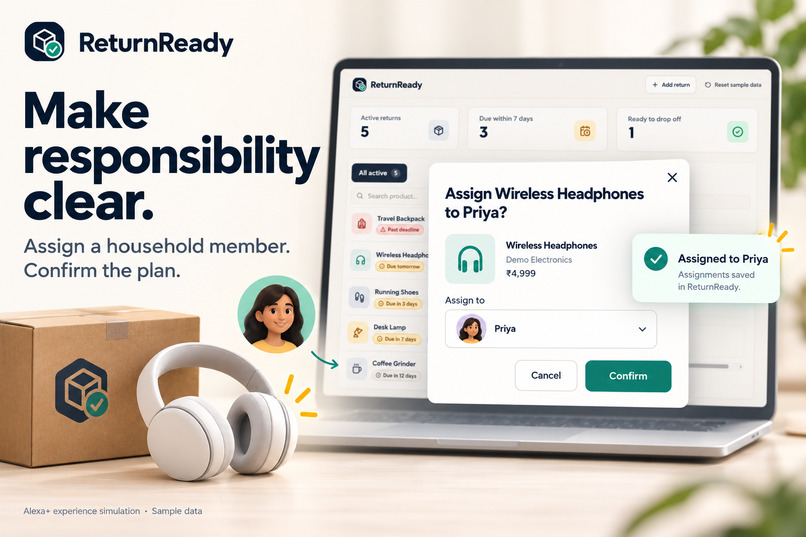
- Unclear responsibility: Two family members each assume the other person is handling the drop-off.
We wanted to explore a practical, grounded Alexa+ household assistant use case: turning an intention to return a purchase into a prepared, assigned task. Our core promise is simple:
Know what is due, prepare what is needed, and decide who will handle it.
What It Does
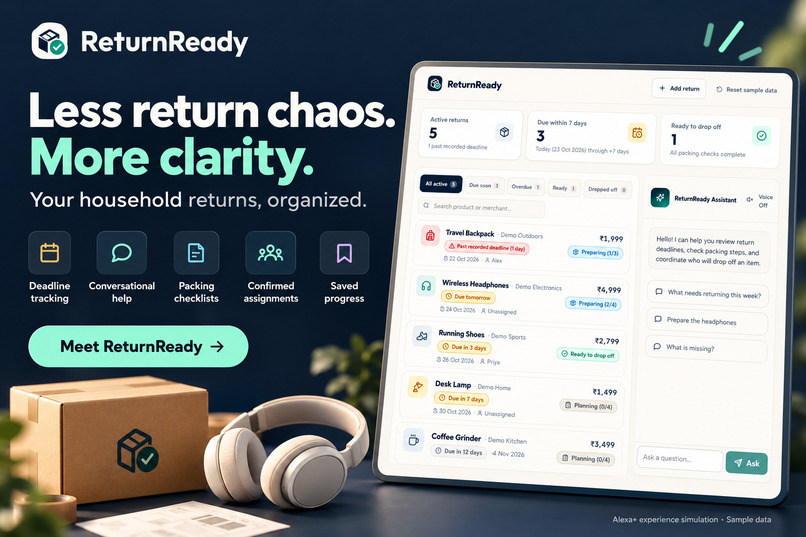
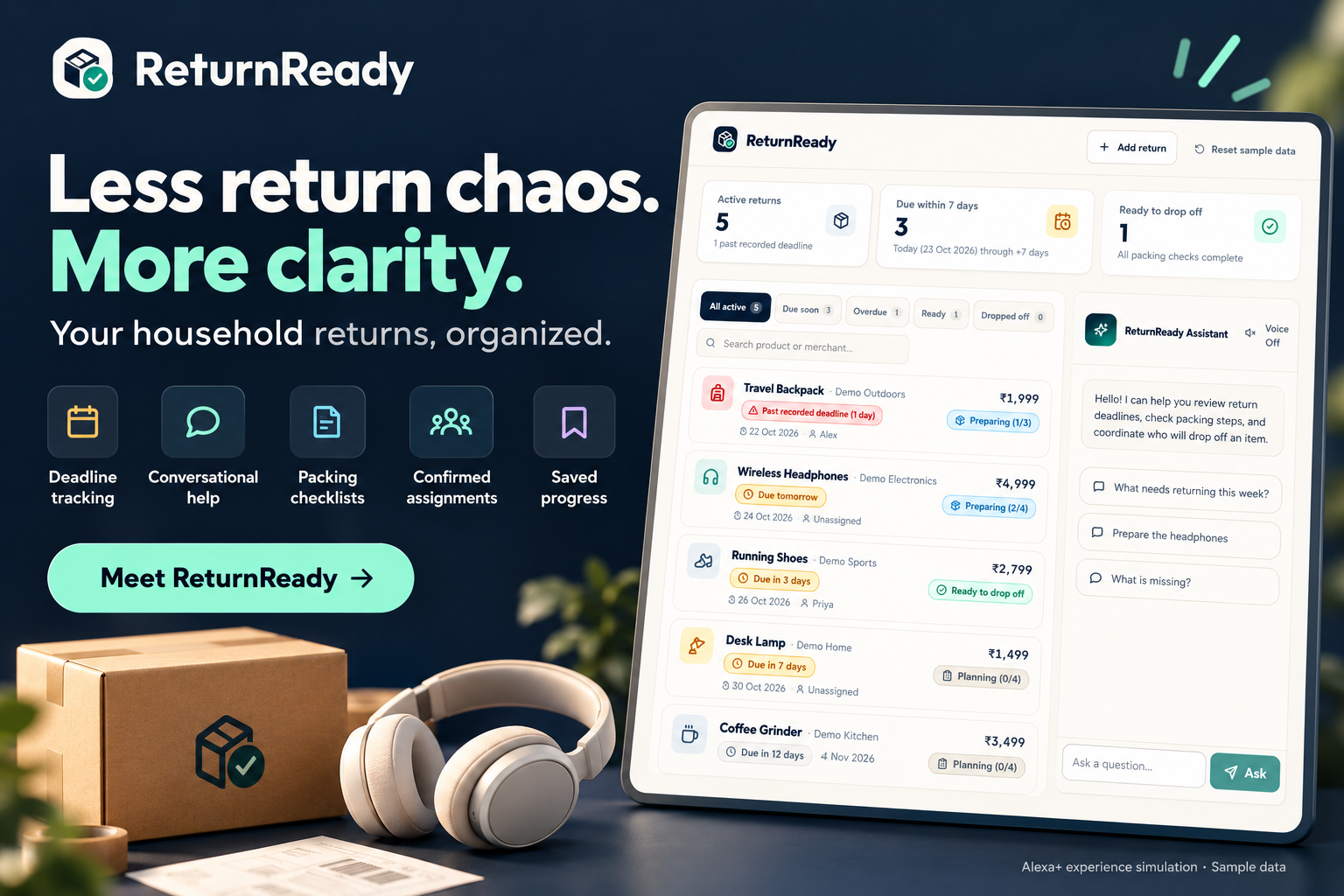
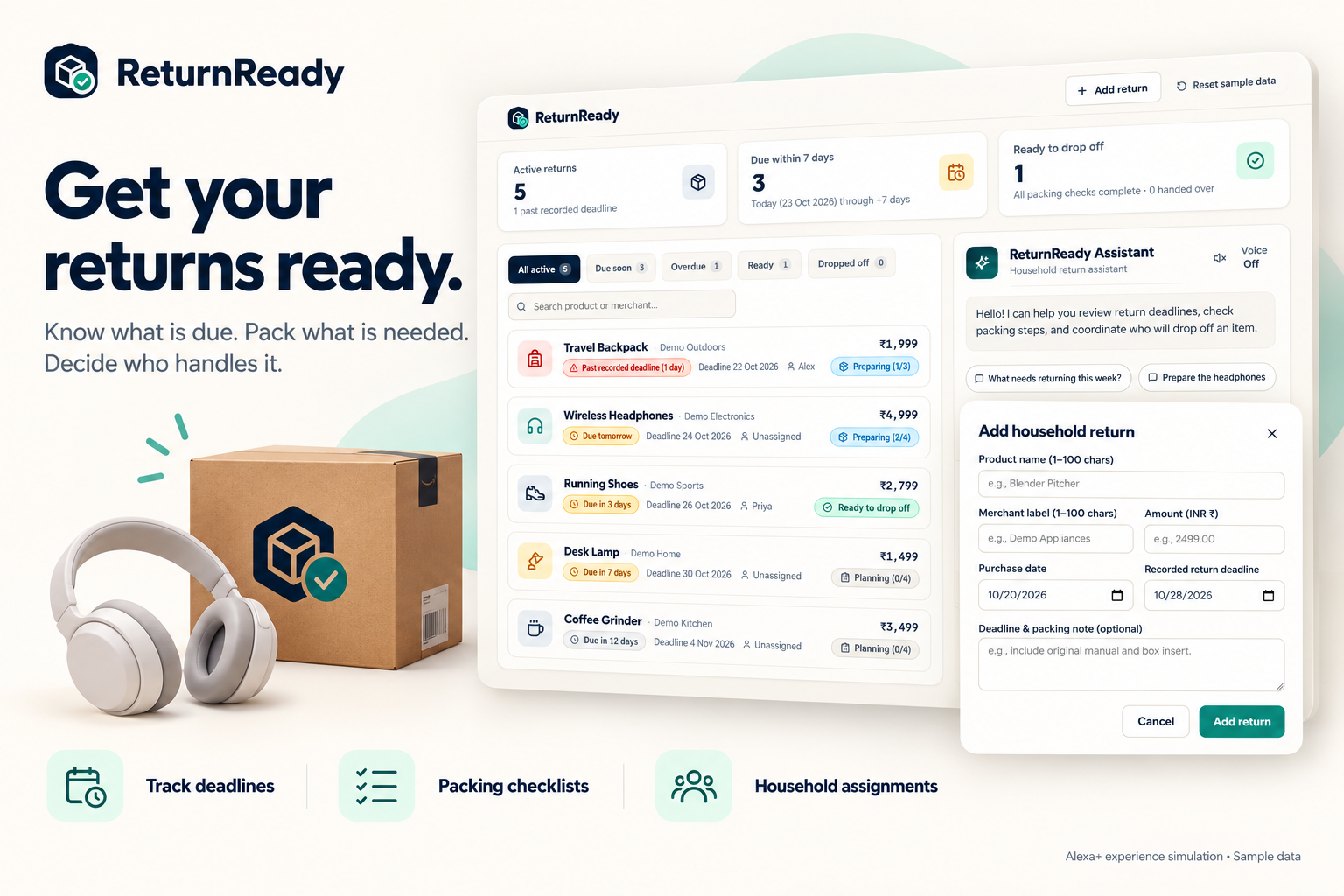
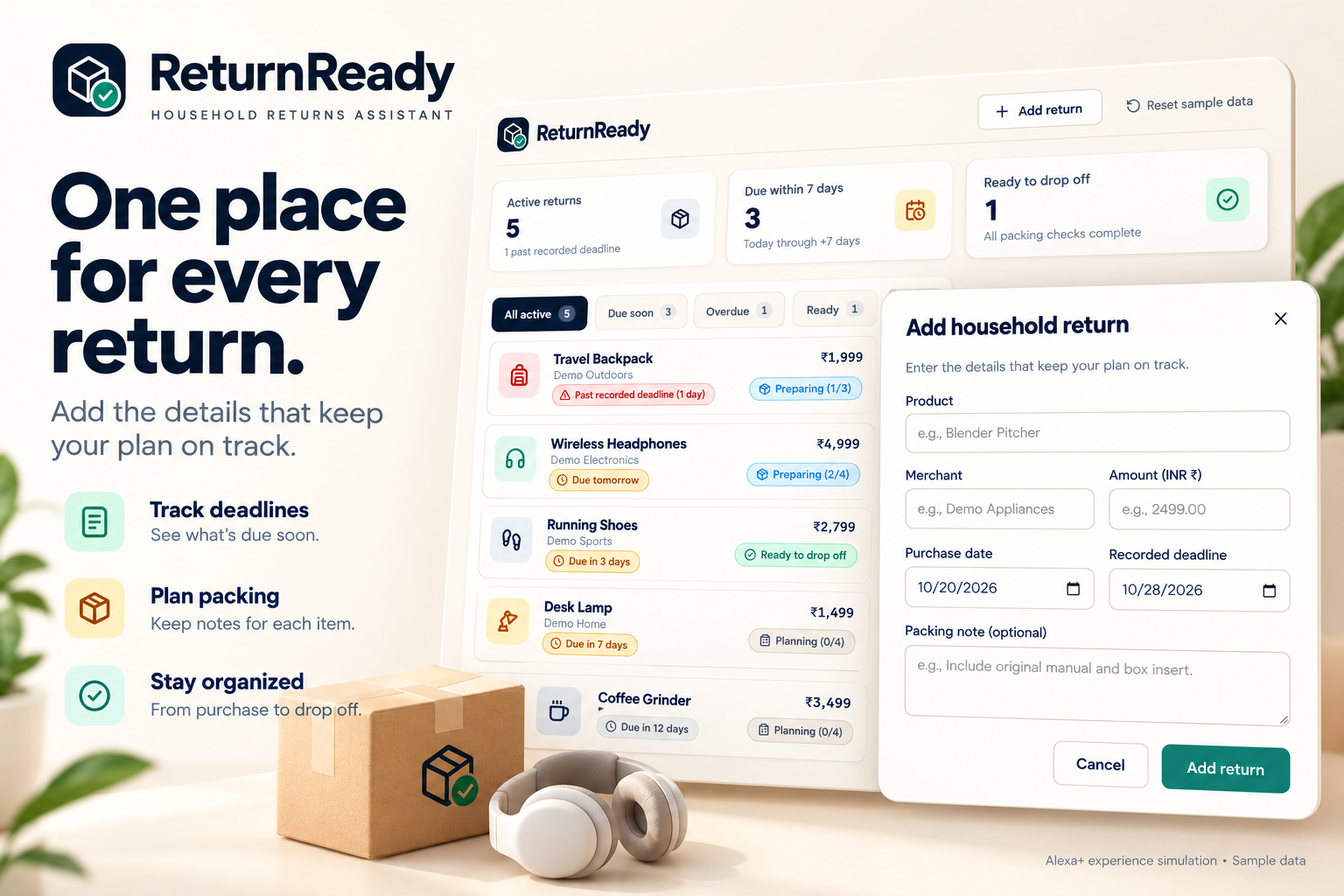
ReturnReady (https://returnready.ensure.in/) is a web-based Alexa+ experience simulation backed by a live Supabase PostgreSQL database:
- Zero-Friction Isolated Household Workspace:
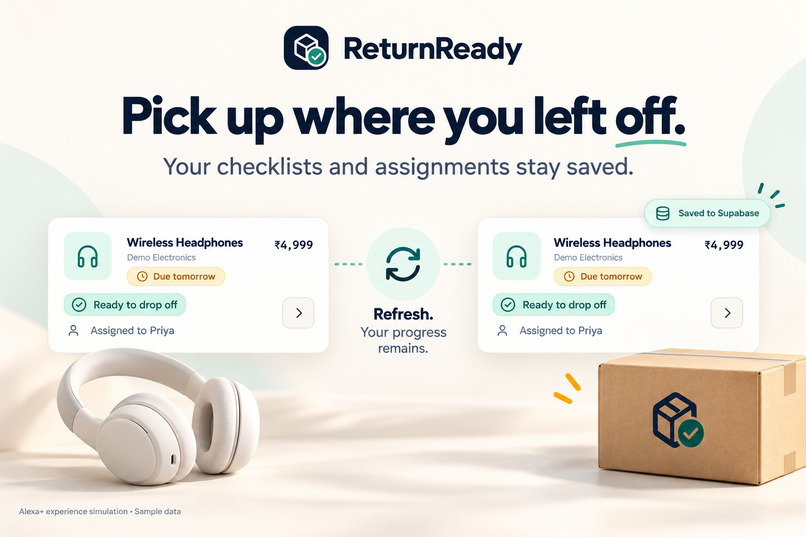
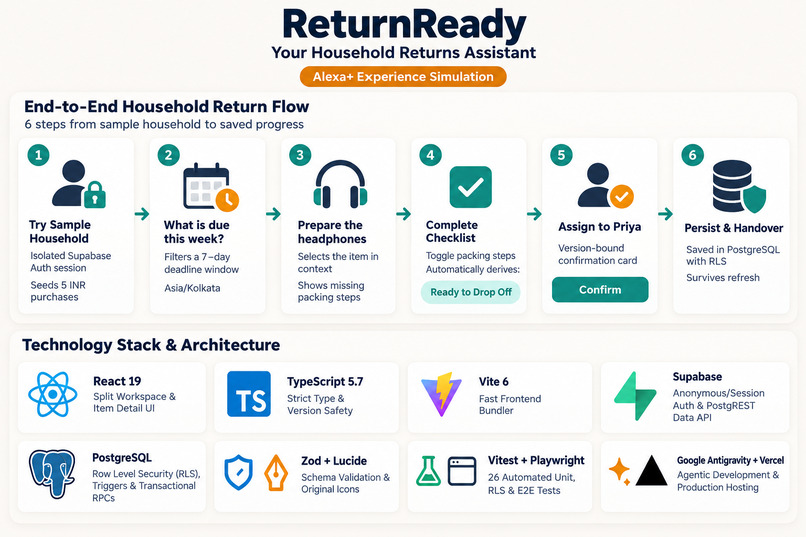
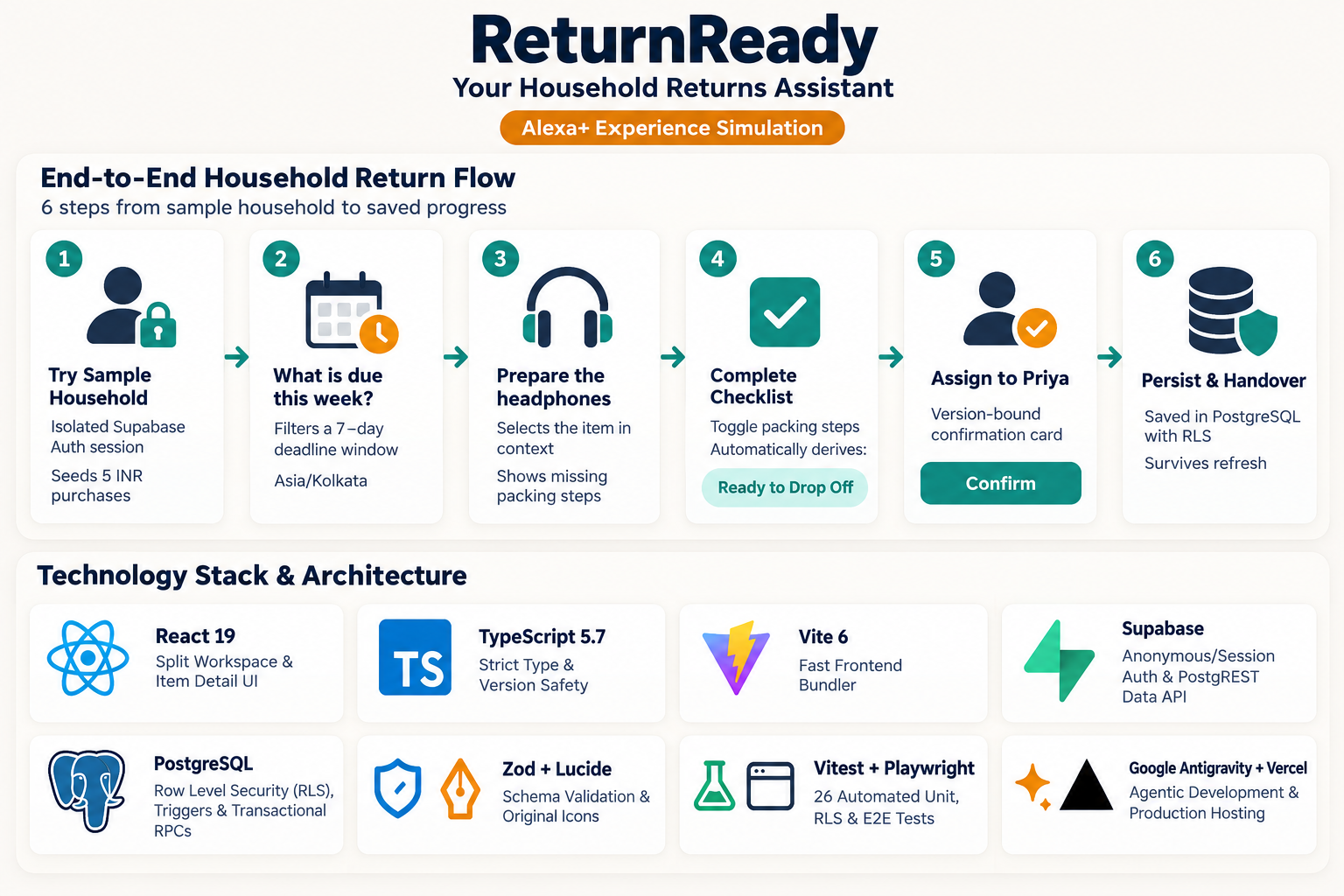
Clicking “Try sample household” establishes an isolated Supabase-authenticated browser session and runs a transactional bootstrap (
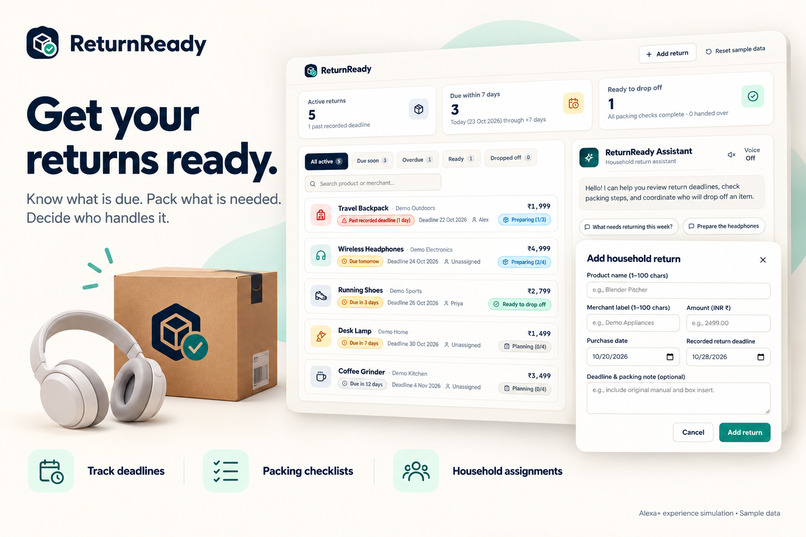
rr_bootstrap_demo) that seeds five sample purchases in INR (₹) and three assignable household member names (Me,Priya,Alex). - Timezone-Accurate Deadline Windows (
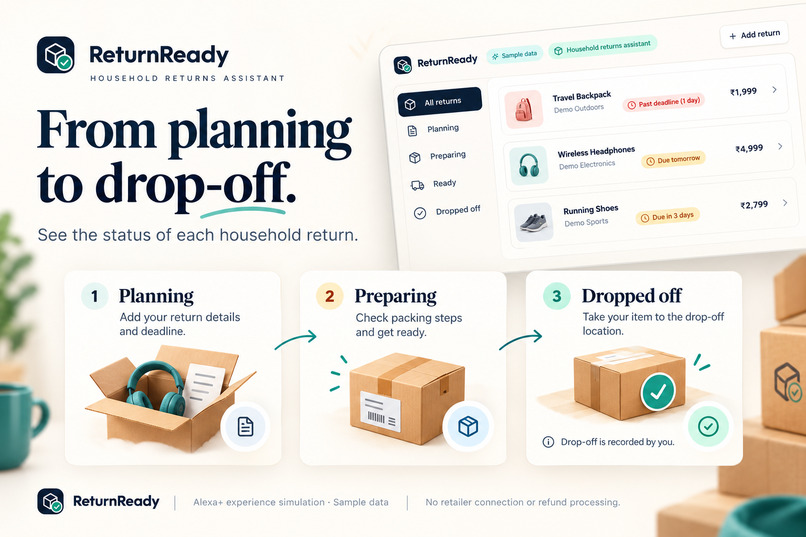
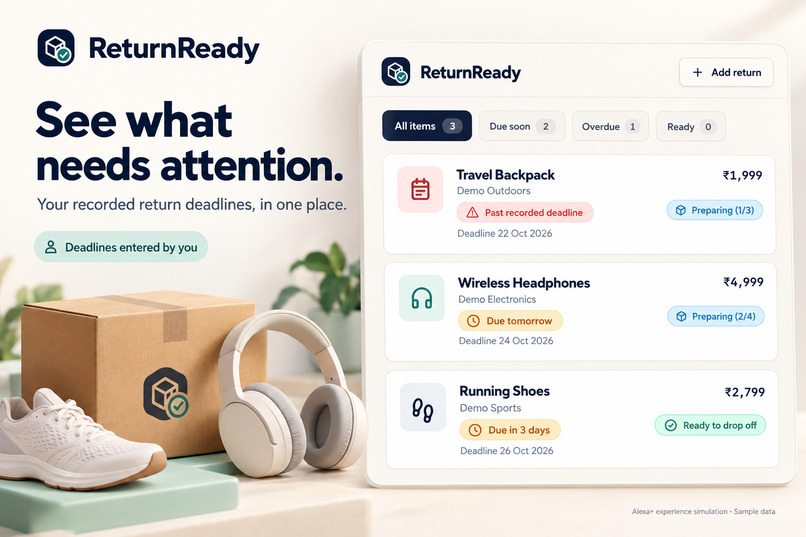
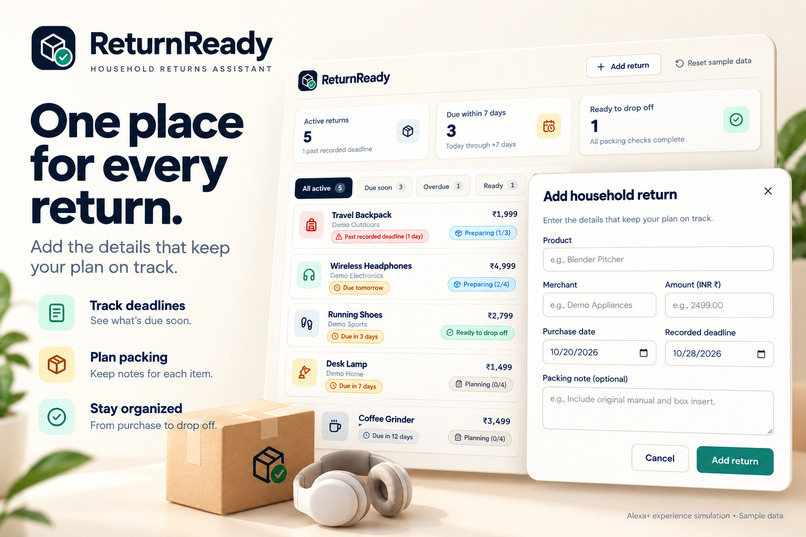
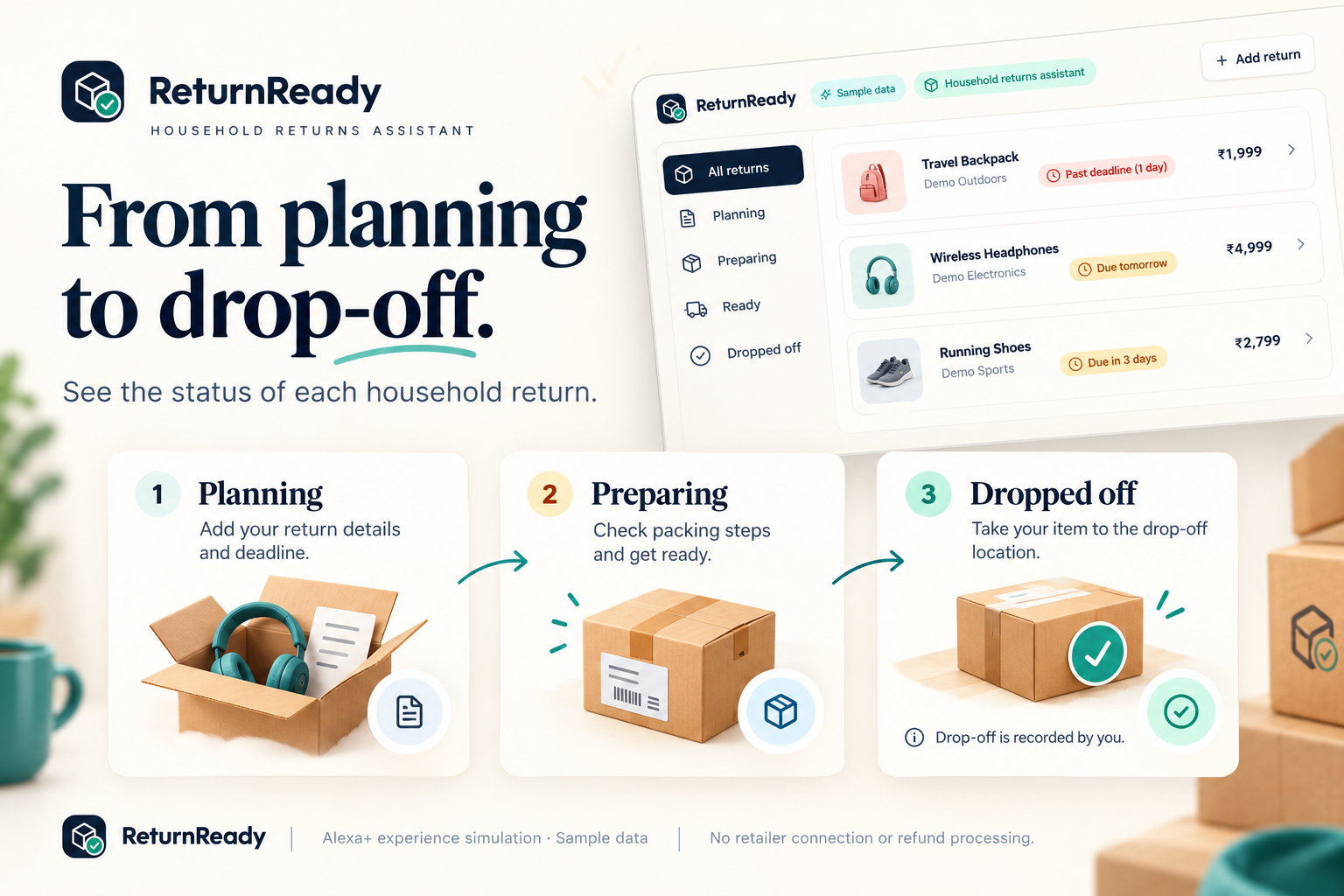
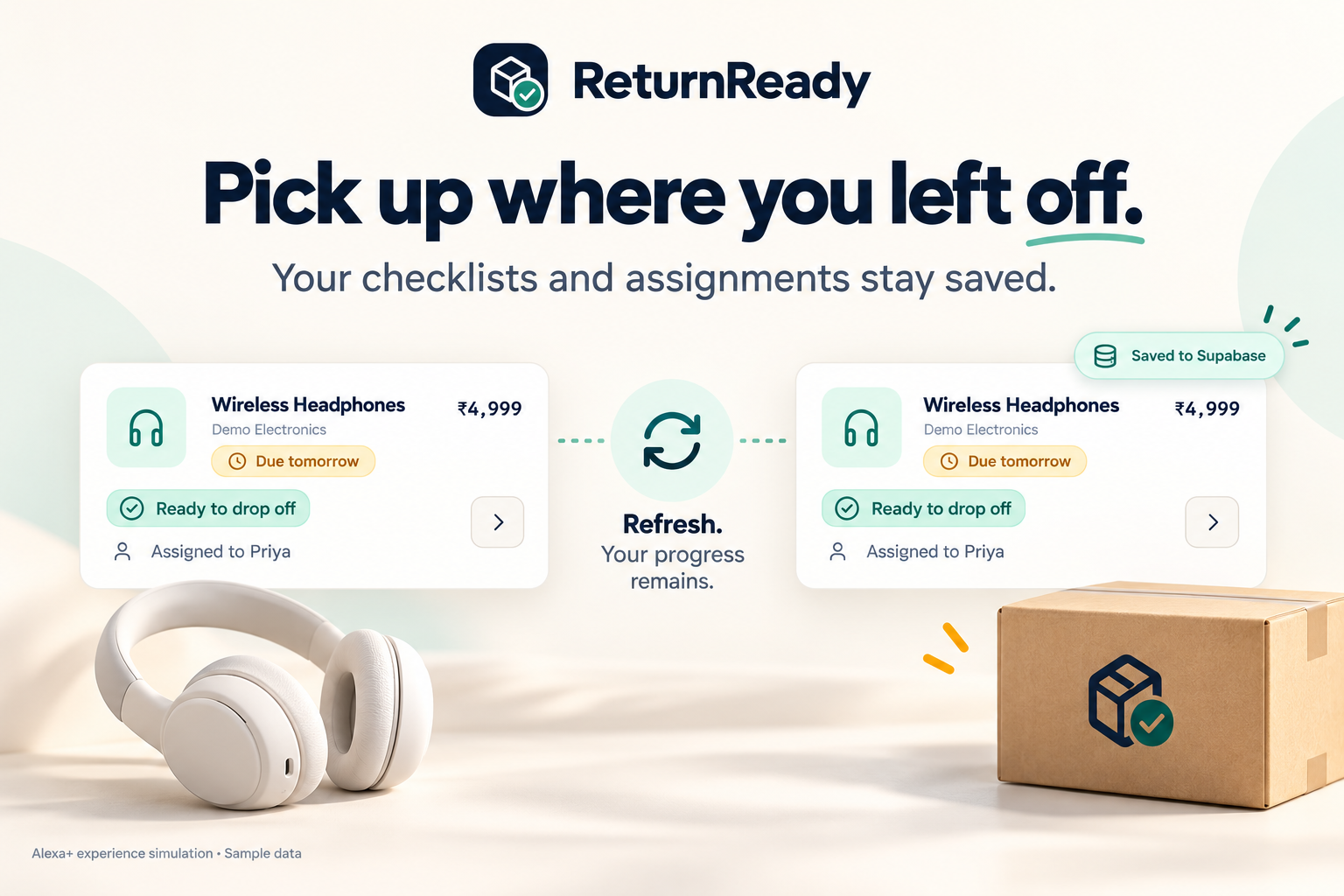
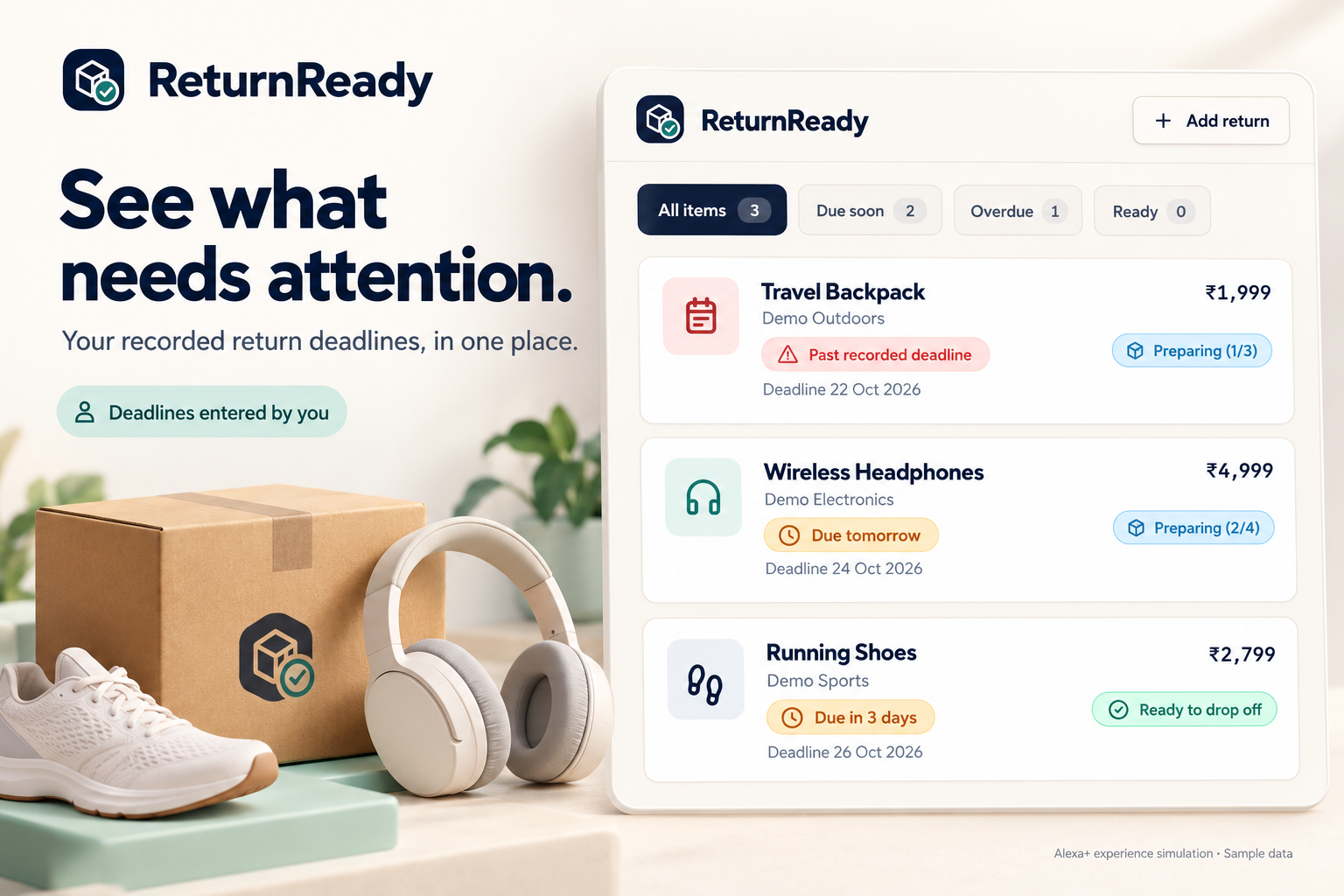
Asia/Kolkata): Displays active returns sorted by earliest user-recorded deadline, with filters for All active, Due soon (items due within the inclusive 7-day window), Overdue (past the recorded deadline), Ready, and Dropped off, plus case-insensitive product and merchant search. - Item-Specific Packing Checklists & Derived “Ready” Status:
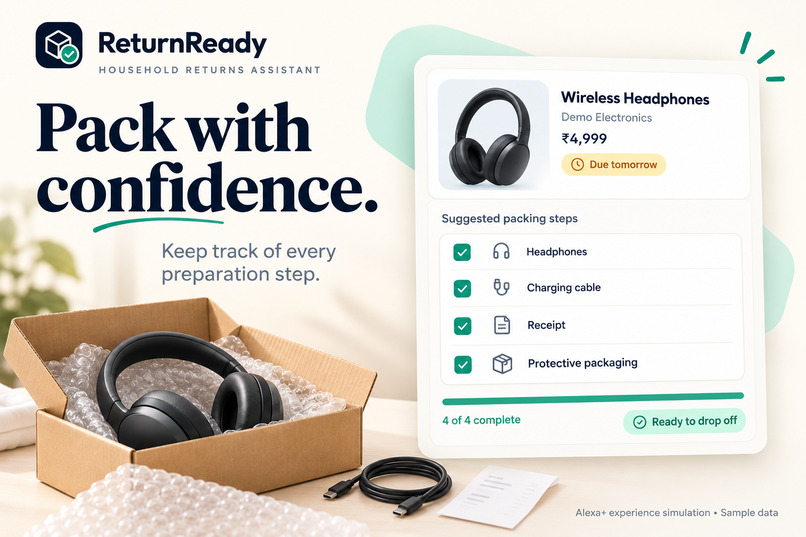
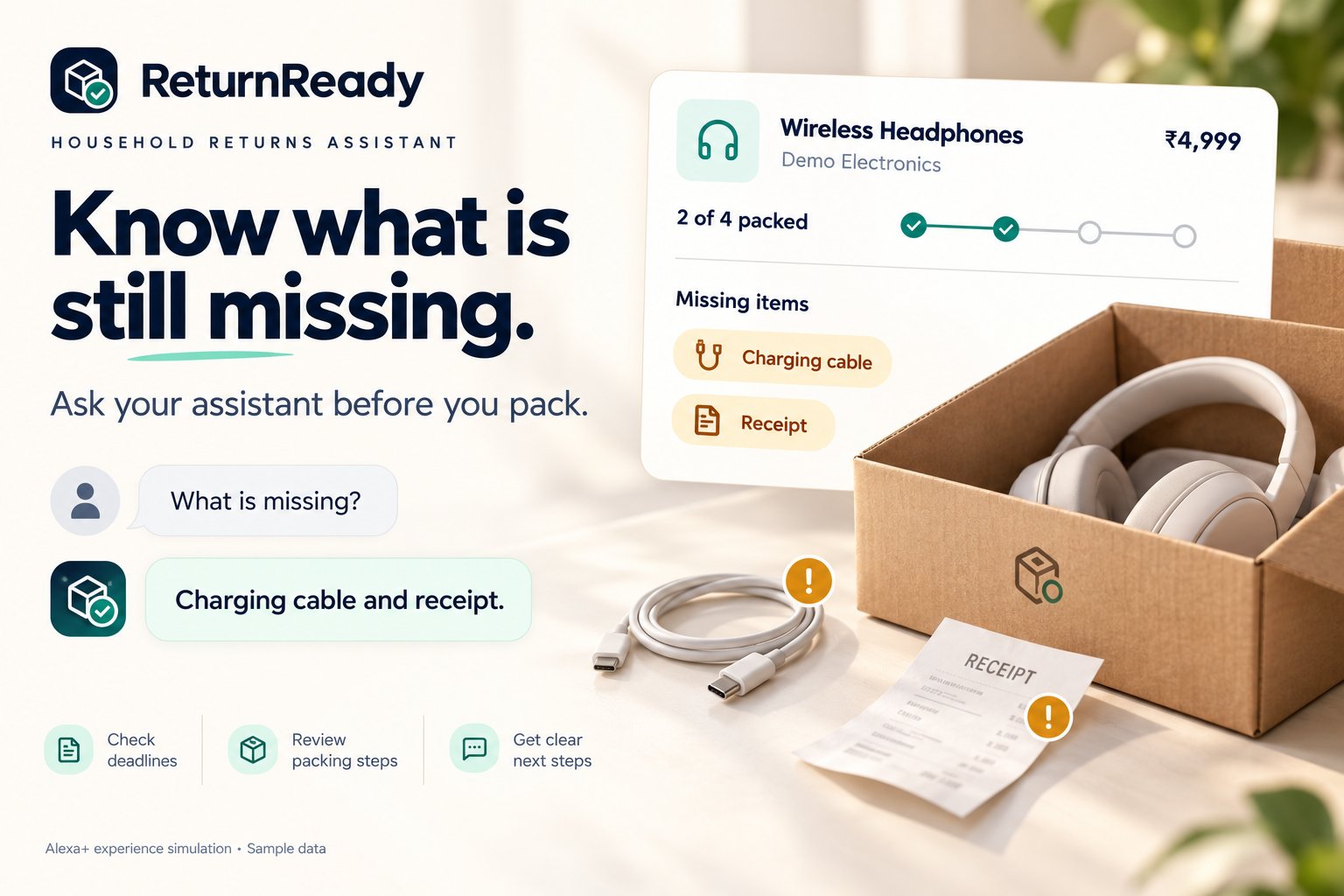
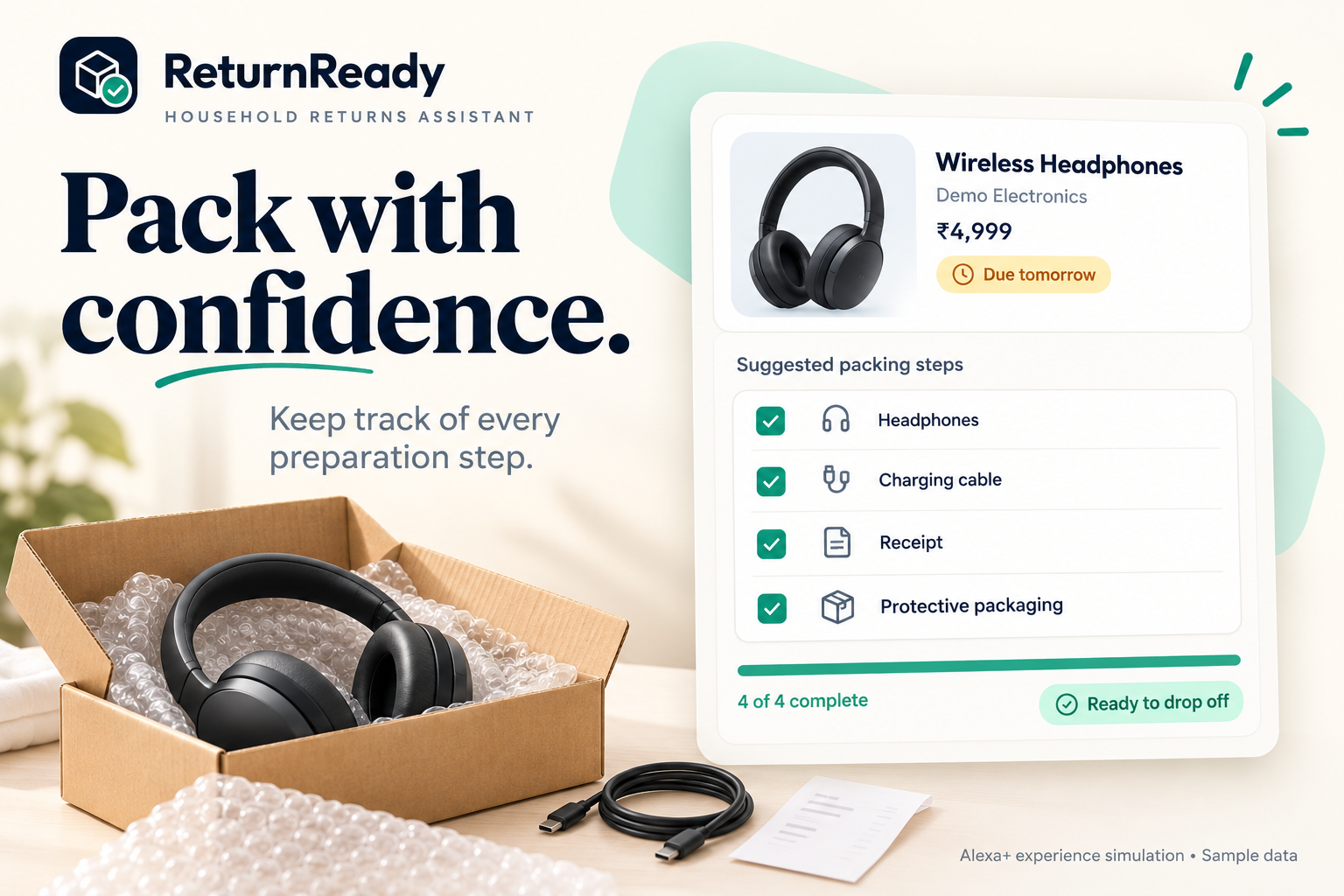
Each return includes a suggested packing checklist (for example: Headphones, Charging cable, Receipt, and Protective packaging). Checking or unchecking steps persists immediately to Supabase via
rr_set_checklist. When all checklist steps on an active item are checked, ReturnReady automatically derives the Ready to drop off state; unchecking any step removes Ready immediately. - Contextual Rule-Based Alexa+ Conversation:
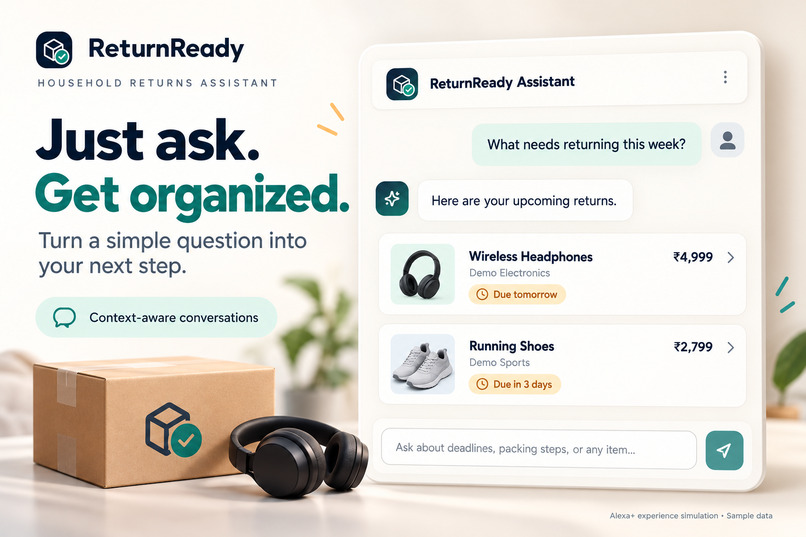
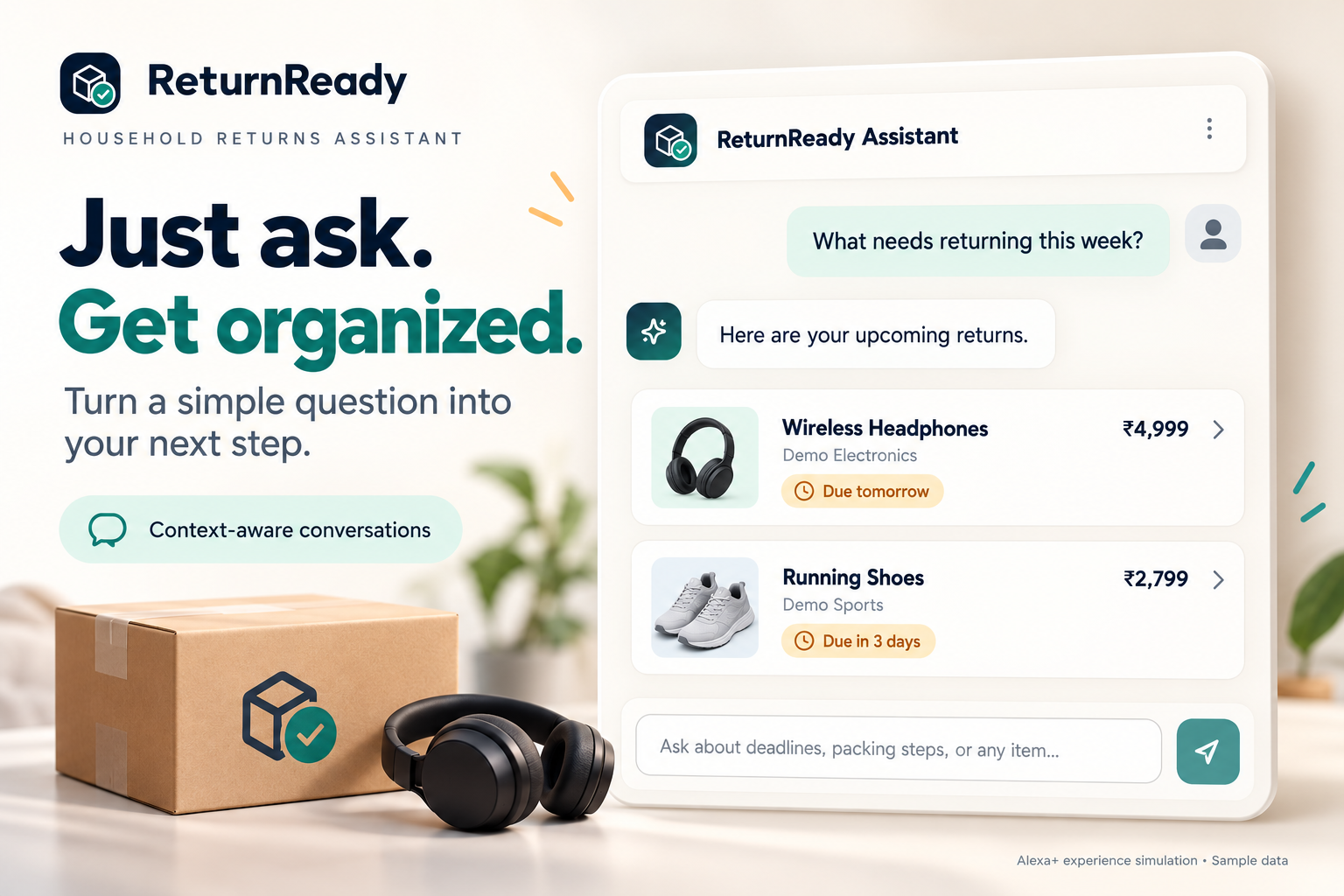
Visitors can interact through natural requests that share the exact same application service layer as the UI controls:
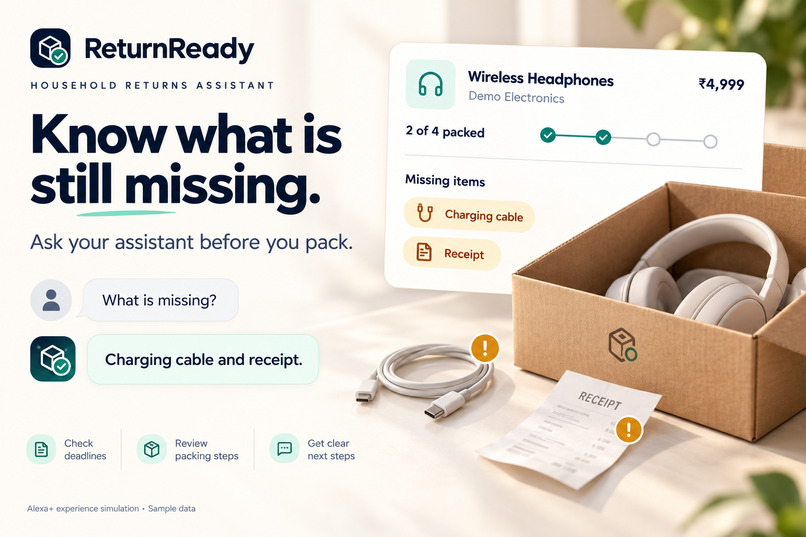
- "What needs returning this week?"
- "Show overdue items" / "Show all returns"
- "Prepare the headphones"
- "What is missing?"
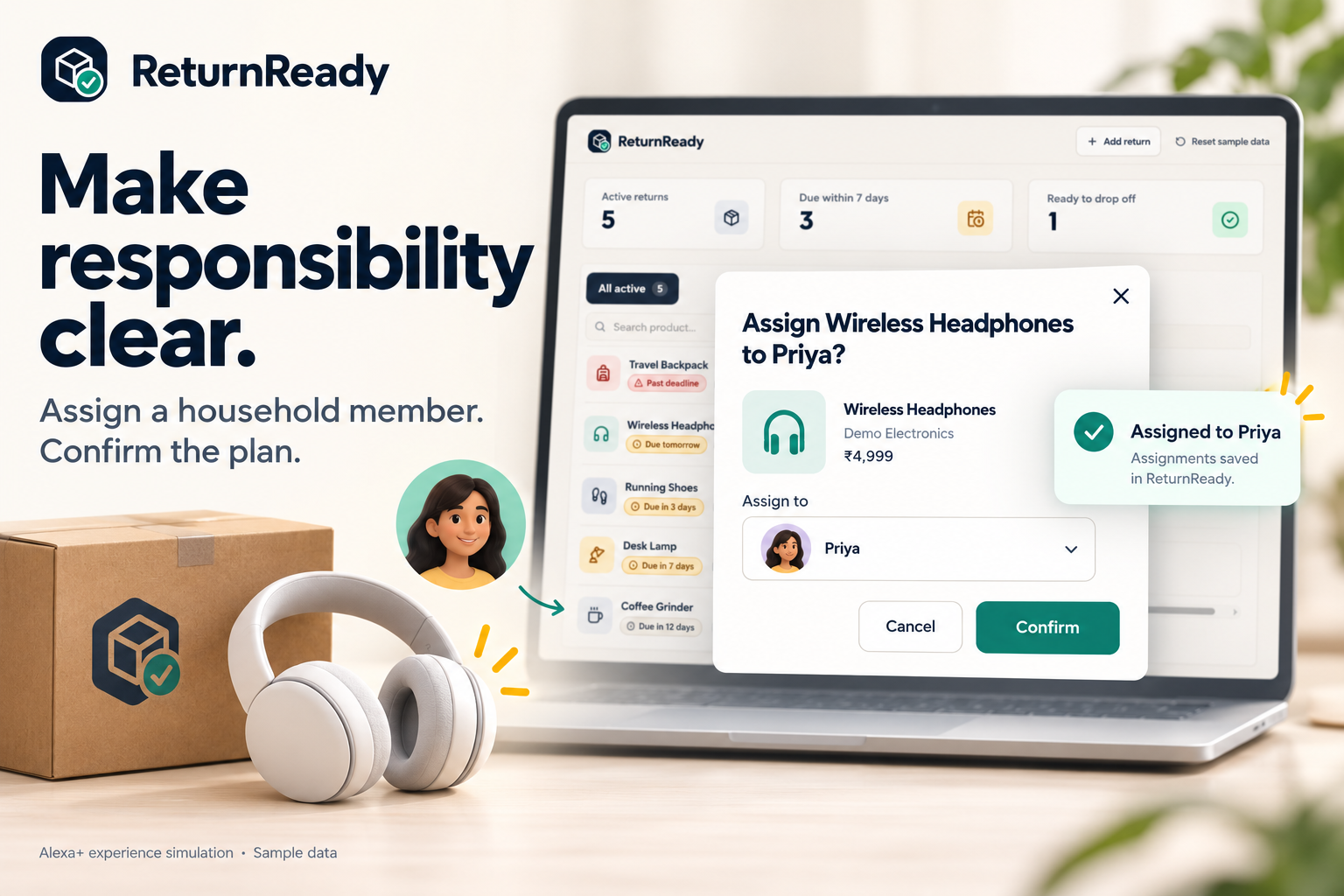
- "Assign this to Priya" → Confirm / Cancel
- "Mark the headphones dropped off" → Confirm / Cancel
- Version-Bound Confirmations:
Every mutation proposed in conversation or UI buttons creates a pending confirmation bound to the target
itemId,memberId, andexpectedVersion. Confirmations expire after 5 minutes, cancel automatically if an unrelated request is entered, and revalidate the database version before writing. - Honest Simulation Boundaries: ReturnReady clearly labels sample data and user-entered deadlines. It does not claim live Alexa hardware connectivity, retailer account imports, return-policy verification, courier booking, refund tracking, or external SMS/email notifications.
How We Built It
- Google Antigravity: Used as our agentic development environment to design the architecture, author the PostgreSQL schema and Row Level Security (RLS) policies, build the React + TypeScript frontend, diagnose live self-hosted Supabase endpoints, and run our automated test suites.
- Frontend (
React 19,TypeScript 5.7,Vite 6,Zod,Lucide React): Designed with a warm linen (#FAF8F5), deep navy (#0F1E36), and rich teal (#0D7A6F) editorial interface featuring accessible44pxminimum touch targets, status badges that pair distinct icons with text labels (never relying on color alone), keyboardEscapesupport, and focus restoration. - Backend & Security (
Supabase Auth,PostgreSQL,Row Level Security,PL/pgSQL RPCs):- Four scoped tables (
rr_workspaces,rr_members,rr_returns,rr_checklist_items) withENABLE ROW LEVEL SECURITYand policies restrictedTO authenticatedcheckingowner_user_id = (SELECT auth.uid()). - Composite foreign keys
(workspace_id, assignee_id)(ON DELETE RESTRICT) and(workspace_id, return_id)(ON DELETE CASCADE) enforcing strict tenant boundaries at the database layer. - Four transactional
SECURITY INVOKERRPCs:rr_bootstrap_demo(),rr_reset_demo(),rr_set_checklist(), andrr_confirm_action().
- Four scoped tables (
Formal Invariants Enforced
Calendar-Date Deadline Window (
Asia/Kolkata): Rather than dividing timestamps by $86{,}400{,}000\text{ ms}$ (which causes off-by-one errors across UTC and IST midnight boundaries), deadlines are stored as PostgreSQLDATEvalues. Given today's calendar date $t$ inAsia/Kolkataand a recorded deadline $d$ on an active return: $$\text{DueSoon}(d, t) \iff t \le d \le t + 7, \qquad \text{Overdue}(d, t) \iff d < t$$Derived “Ready” State: For a return with stored status $s \in {\text{planning}, \text{preparing}, \text{dropped_off}}$ and checklist steps $C = {c_1, \dots, c_n}$: $$\text{Ready}(s, C) \iff s \neq \text{dropped_off} \;\land\; |C| \ge 1 \;\land\; \forall c_i \in C,\; \text{checked}(c_i) = \text{true}$$
Optimistic Concurrency on Confirmed Actions: Every update on
rr_returnsorrr_checklist_itemsincrements the parent return version $v \leftarrow v + 1$. When confirming a pending action created at version $v_{\text{expected}}$,rr_confirm_actioncommits if and only if: $$v_{\text{db}} = v_{\text{expected}} \;\land\; (t_{\text{now}} - t_{\text{created}}) \le 300\text{ s}$$
Challenges We Ran Into
- Detecting Stale Confirmations After Checklist Edits:
If a user asked "Assign this to Priya" and then toggled a packing checklist step before clicking Confirm, the item's preparation state had changed while the confirmation was pending. We solved this with an
AFTER UPDATEPostgreSQL trigger onrr_checklist_itemsthat touches the parentrr_returnsrow and increments itsversion, causing stale confirmations to raise SQLSTATE40001(CONFLICT) and request a fresh confirmation. - Self-Hosted Supabase Kong & GoTrue Configuration:
When connecting to our dedicated self-hosted Supabase instance (
https://returnready-sb.propixer.in), we discovered that Kong's defaultrequest-terminationplugin blocked/mcpwith HTTP403, and GoTrue'sanonymous_userssetting defaulted tofalsewhilephone_autoconfirmwastrue. We applied our idempotent SQL migration directly in the Supabase Studio SQL Editor and builtensureDemoSession()to attemptsignInAnonymously()first with an automatic fallback to an isolated ephemeral authenticated session so every visitor receives a genuineauthenticatedJWT isolated byauth.uid(). - Preserving Prior UI State on Save Failures: To avoid false-positive checkmarks when offline, checklist toggles disable duplicate clicks while a write is in flight and only update to the new state (or display a success banner) after the PostgreSQL RPC returns the persisted record.
Accomplishments That We're Proud Of
- Unified Conversational & UI Service Layer: Conversational prompts and UI buttons call the exact same TypeScript service functions and PostgreSQL RPCs—there is no mocked chat state diverging from database state.
- Verified Two-Session RLS Isolation: Our automated test suite (
24/24unit and component tests +2/2live two-session Supabase integration tests) verifies that Session A cannot read, update, or assign members from Session B's workspace, and resetting Session A's demo leaves Session B untouched. - Fast Judge Onboarding: Any visitor opening
https://returnready.ensure.in/can explore a live, database-backed household workspace in under 5 seconds without an email signup wall.
What We Learned
- Designing conversational assistants around explicit, version-checked confirmation states makes voice and chat interfaces far more trustworthy for household coordination than open-ended text generation.
- Encoding domain invariants directly in PostgreSQL constraints and triggers (
dropped_off_at IS NOT NULLiffstatus = 'dropped_off', composite workspace foreign keys, and monotonic row versions) eliminates entire classes of frontend synchronization bugs.
What's Next for ReturnReady
- Optional LLM-assisted intent disambiguation layered ahead of the deterministic confirmation router.
- Multi-user household invitations with real-time Supabase channel sync.
- Calendar export (
.ics) for scheduled return drop-offs.
Built With
- css3
- github
- google-antigravity
- html5
- luc
- node.js
- playwright
- postgresql
- react
- supabase
- testing-library
- typescript
- vercel
- vite
- vitest
- zod

Log in or sign up for Devpost to join the conversation.