-
-
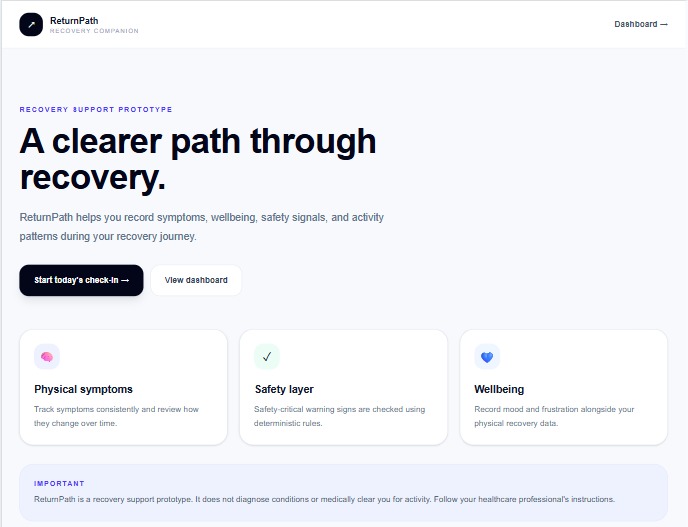
homepage
-
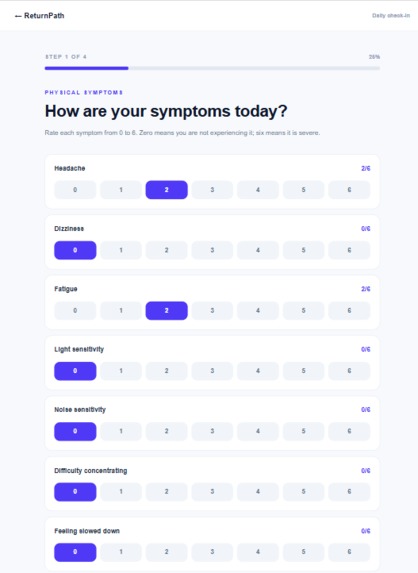
Daily Check-in
-
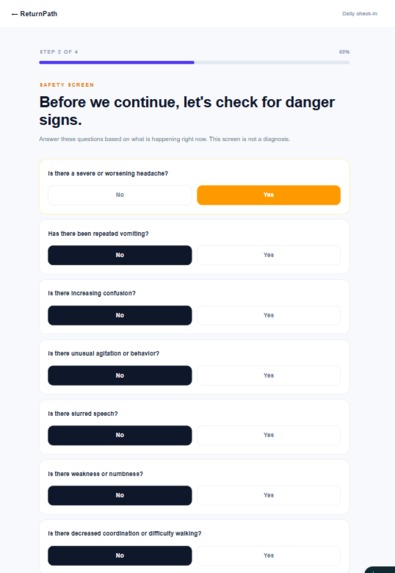
Safety Alert
-
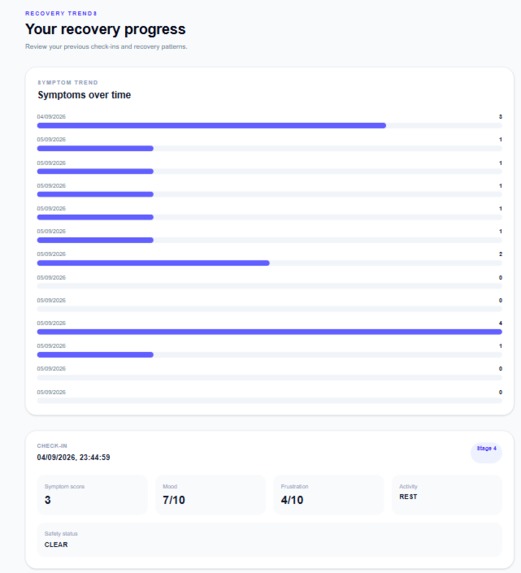
Trends
-
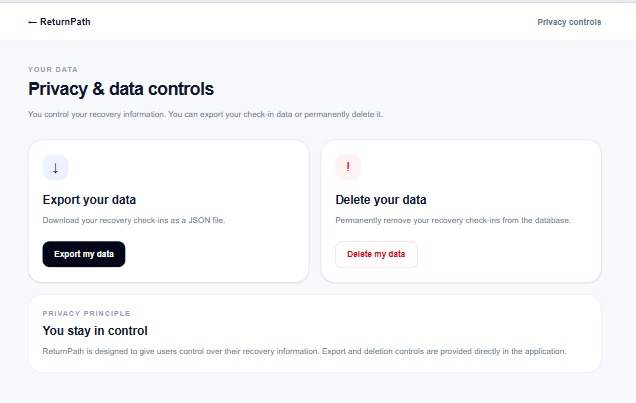
Settings
-
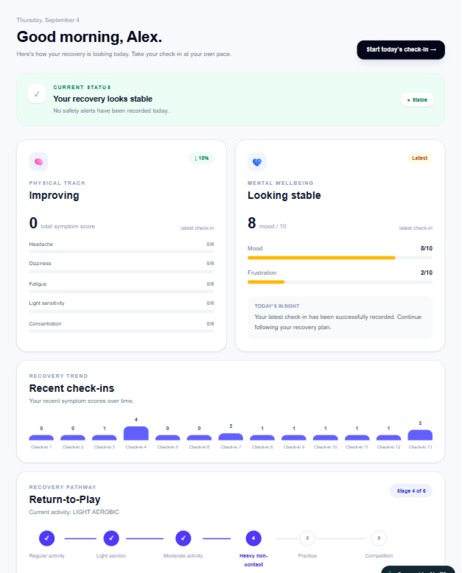
Dashboard
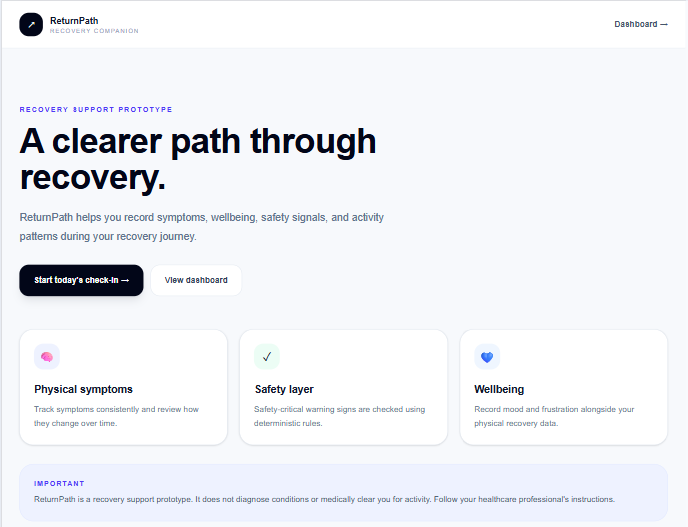
Inspiration
Recovery can be difficult to understand day by day. People may experience changing physical symptoms, mood, frustration, and activity levels, but it is often hard to recognize patterns over time.
We wanted to build a simple recovery companion that turns daily self-reported check-ins into something easier to understand. ReturnPath was inspired by the idea that recovery should be tracked as a journey rather than a single moment.
What it does
ReturnPath is a structured recovery tracking application that helps users:
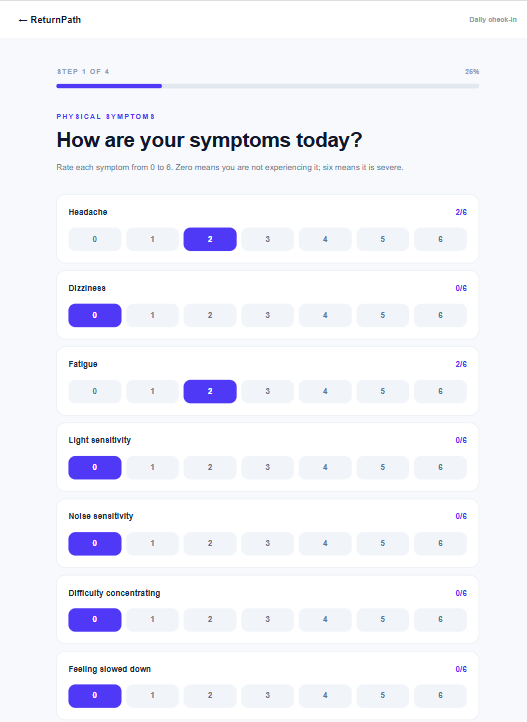
- Complete daily physical symptom check-ins.
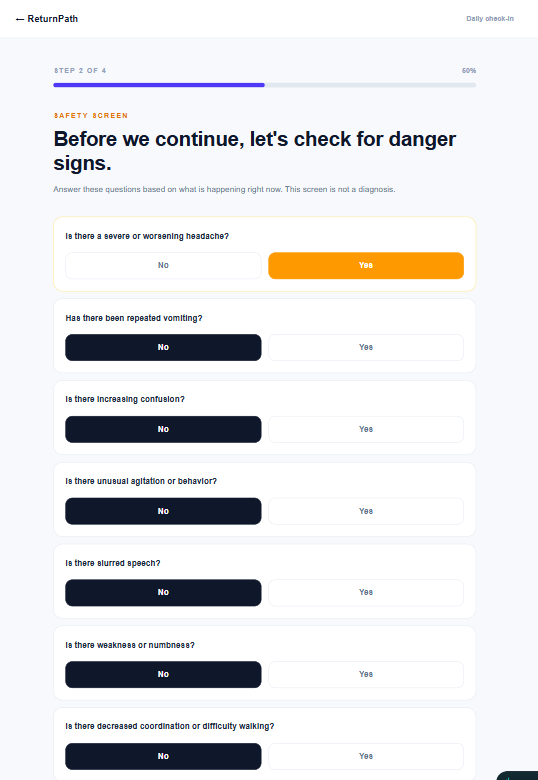
- Screen for predefined safety warning signs.
- Track mood and frustration.
- Record daily activity levels.
- Calculate a deterministic recovery stage based on check-in information.
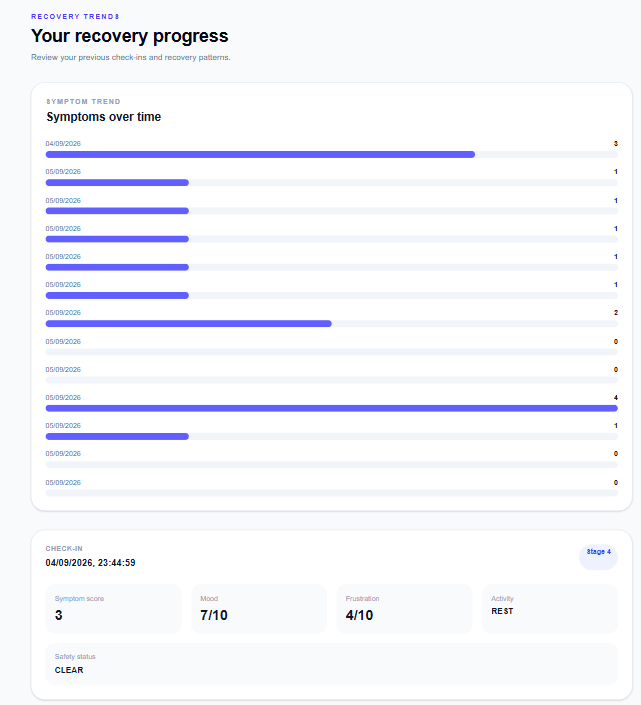
- View previous check-ins and recovery trends.
- Monitor symptom patterns over time.
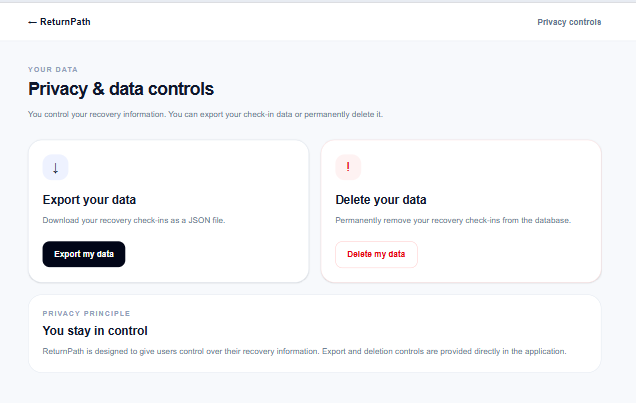
- Export their recovery data as JSON.
- Permanently delete their stored recovery data.
The safety screen uses predefined rules to identify concerning warning signs and clearly tells the user when urgent medical attention should be sought.
ReturnPath is a tracking and decision-support experience, not a medical diagnosis or medical clearance system.
How we built it
We built ReturnPath as a full-stack web application using:
- Next.js
- React
- TypeScript
- Tailwind CSS
- PostgreSQL
- Prisma/Prisma-compatible database tooling
- REST API routes
The application is divided into several main experiences:
- Check-in — collects physical symptoms, safety responses, wellbeing, and activity.
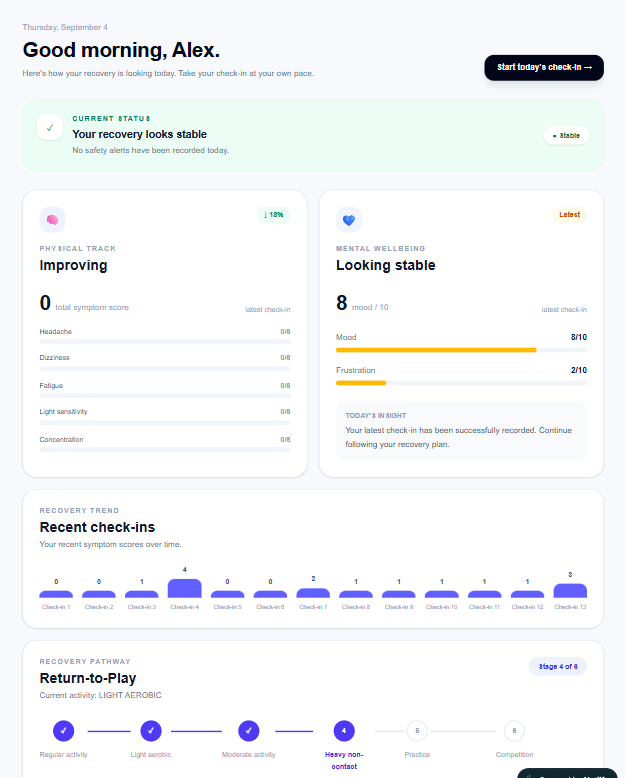
- Dashboard — presents the user's latest recovery information.
- Trends — displays historical check-ins and symptom patterns.
- Settings — provides data export and deletion controls.
The safety engine is deterministic. User responses are passed through predefined rules rather than allowing an AI system to override safety decisions.
Recovery stages are also calculated using explicit rules based on symptom severity, wellbeing, and safety status.
Challenges we ran into
One of the biggest challenges was designing the application so that safety-related decisions were predictable and transparent.
We wanted the system to clearly separate:
- user-reported information,
- safety screening,
- recovery-stage logic,
- and historical tracking.
Another challenge was connecting the frontend check-in flow to the PostgreSQL database while keeping the application simple enough for users to understand.
We also had to make sure that the dashboard and trends pages correctly reflected newly submitted check-ins.
Accomplishments that we're proud of
We are proud that ReturnPath became a complete working full-stack application rather than just a prototype interface.
Some highlights include:
- A four-step structured check-in flow.
- Deterministic safety screening with multiple predefined danger signs.
- Automated recovery-stage calculation.
- Persistent PostgreSQL data storage.
- Dashboard and historical trends.
- Data export functionality.
- Data deletion controls.
- A clean and accessible user interface.
- Clear messaging that prevents the application from presenting itself as a medical diagnosis tool.
What we learned
We learned that building a health-related application requires more than creating a good-looking interface.
Clear boundaries are important. Safety logic should be deterministic and explainable, while the application should clearly communicate what it can and cannot determine.
We also learned how frontend state, API routes, database models, and user-facing recovery logic need to work together as one system.
Most importantly, we learned that a useful recovery product should focus not only on collecting data, but also on making that information understandable over time.
What's next for ReturnPath
Our next goal is to make ReturnPath more personalized while keeping safety rules transparent and deterministic.
Future improvements could include:
- User authentication and individual profiles.
- More advanced trend visualizations.
- Better longitudinal recovery insights.
- Clinician-friendly reports.
- Notifications and reminders for check-ins.
- Improved accessibility.
- More configurable recovery protocols.
- Stronger privacy and security controls.
- Integration with wearable or activity data where appropriate.
Our vision is to evolve ReturnPath into a trusted recovery companion that helps people better understand their recovery journey while keeping medical decisions with qualified healthcare professionals.
Built With
- api
- application
- css
- health
- html
- javascript
- next.js
- postgresql
- prisma
- react
- rest
- tailwind
- typescript
- web

Log in or sign up for Devpost to join the conversation.