-
-
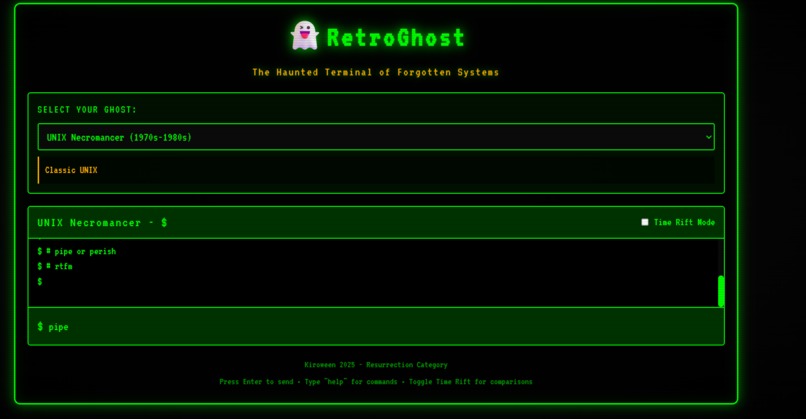
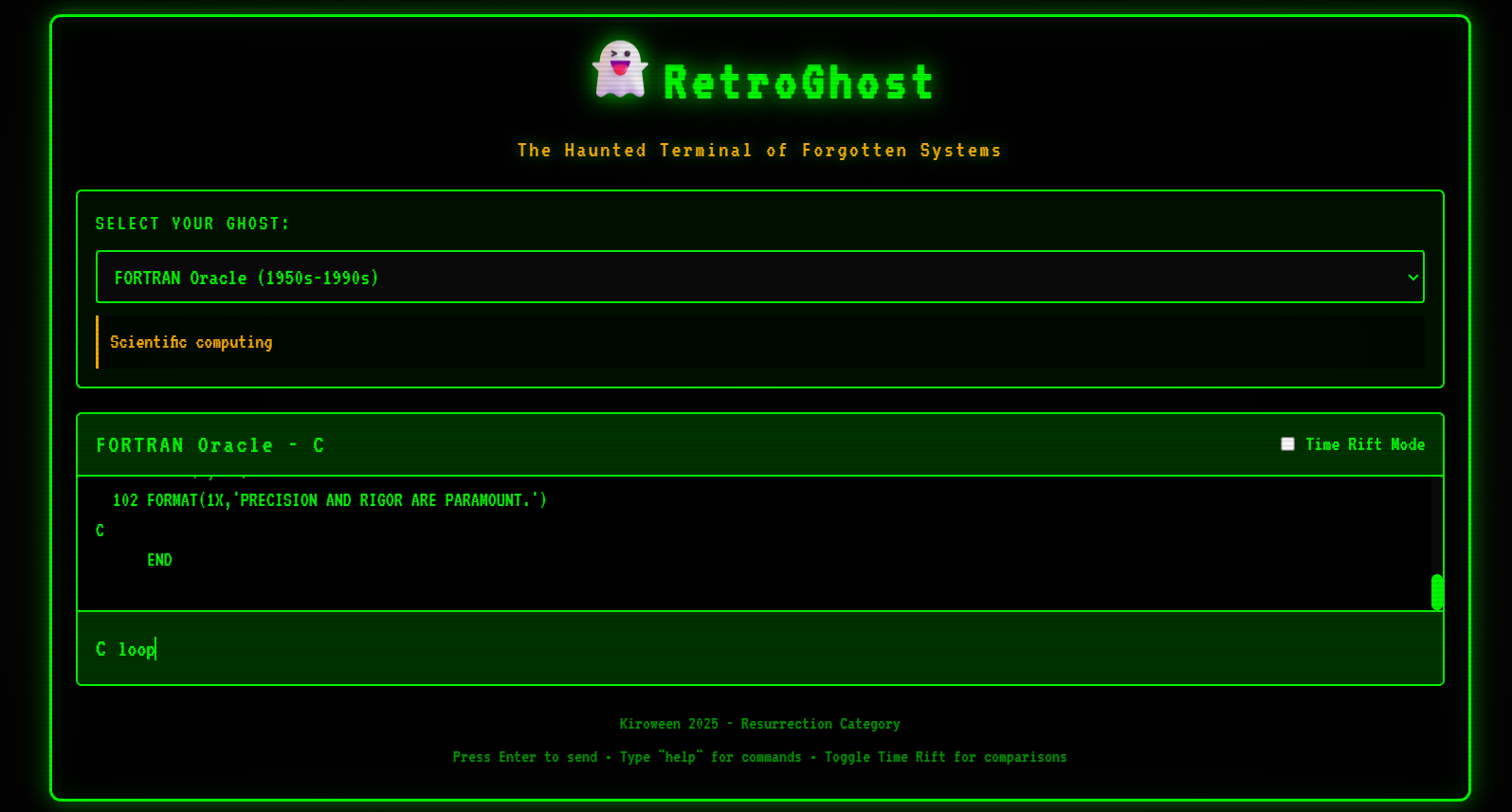
this is what when we choose the ghost persona two and type some command it shows the output
-
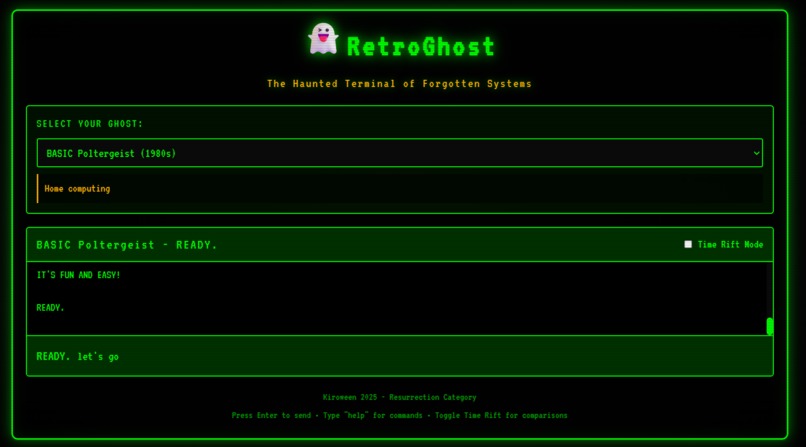
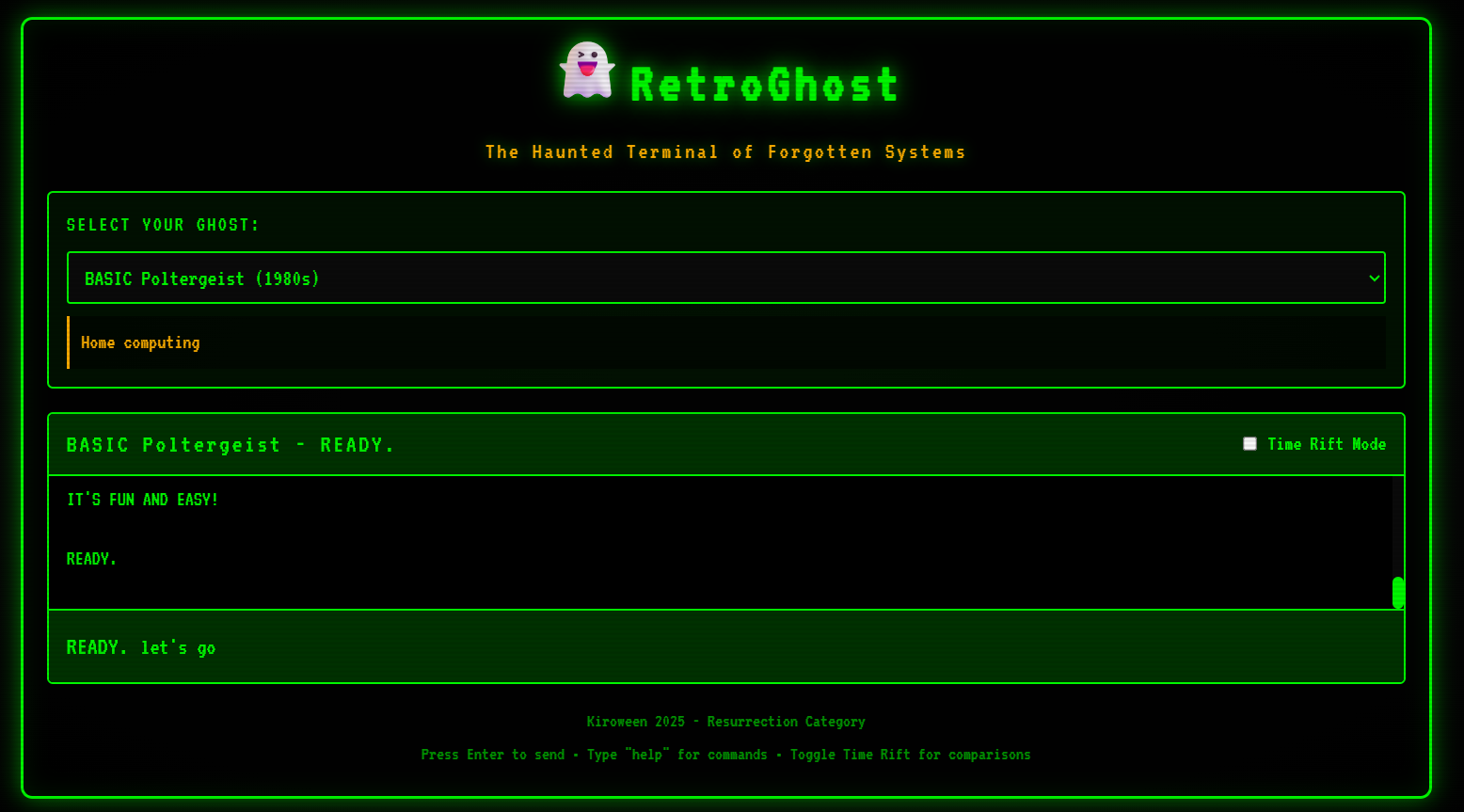
this is what when we choose the ghost persona three and type some command it shows the output
-
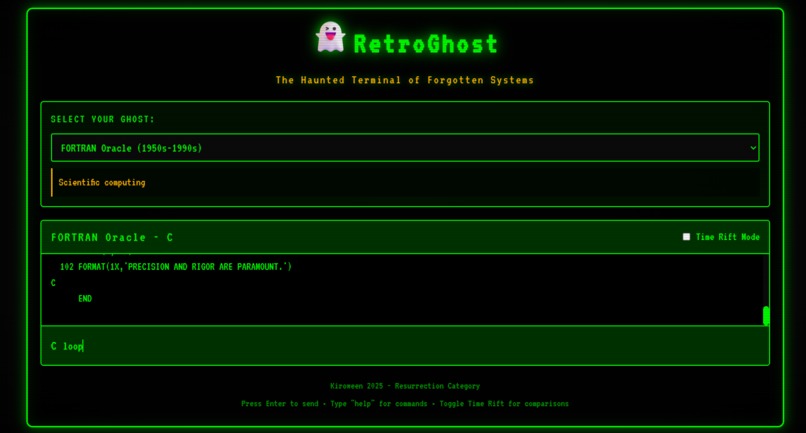
u can type anything in the any of the ghost personas
-
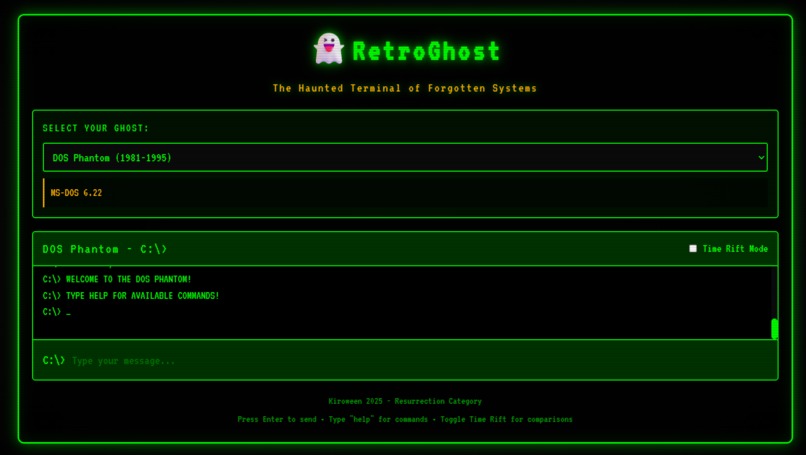
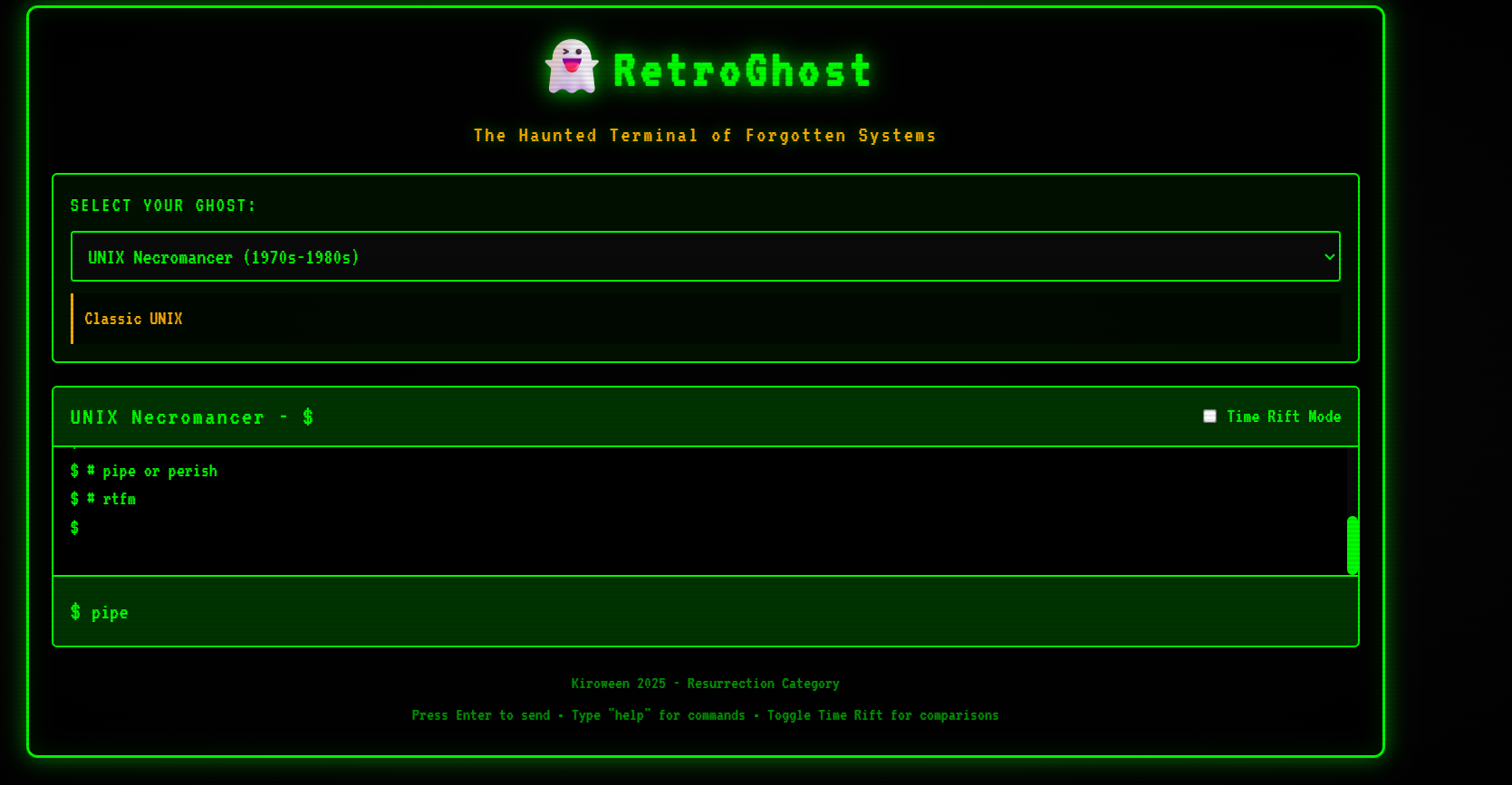
this is what when we choose the ghost persona one and type some command it shows the output
Inspiration
What if you could talk to the ghosts of computing history? Growing up, I was fascinated by stories of early computing—the click of mechanical keyboards, the glow of green phosphor screens, the satisfaction of a perfectly formatted punch card. But these systems are gone, their personalities lost to time. I wanted to bring them back. Not just as museum pieces, but as living, breathing personalities you could actually talk to. RetroGhost was born from a simple question: What would MS-DOS say about the cloud? How would UNIX react to modern GUIs? What would BASIC think about today's programming languages? This project is my love letter to computing history—a way to preserve the quirks, wisdom, and charm of systems that shaped our digital world.
What it does
RetroGhost resurrects four iconic computing personalities as interactive "software ghosts" in an authentic CRT terminal:
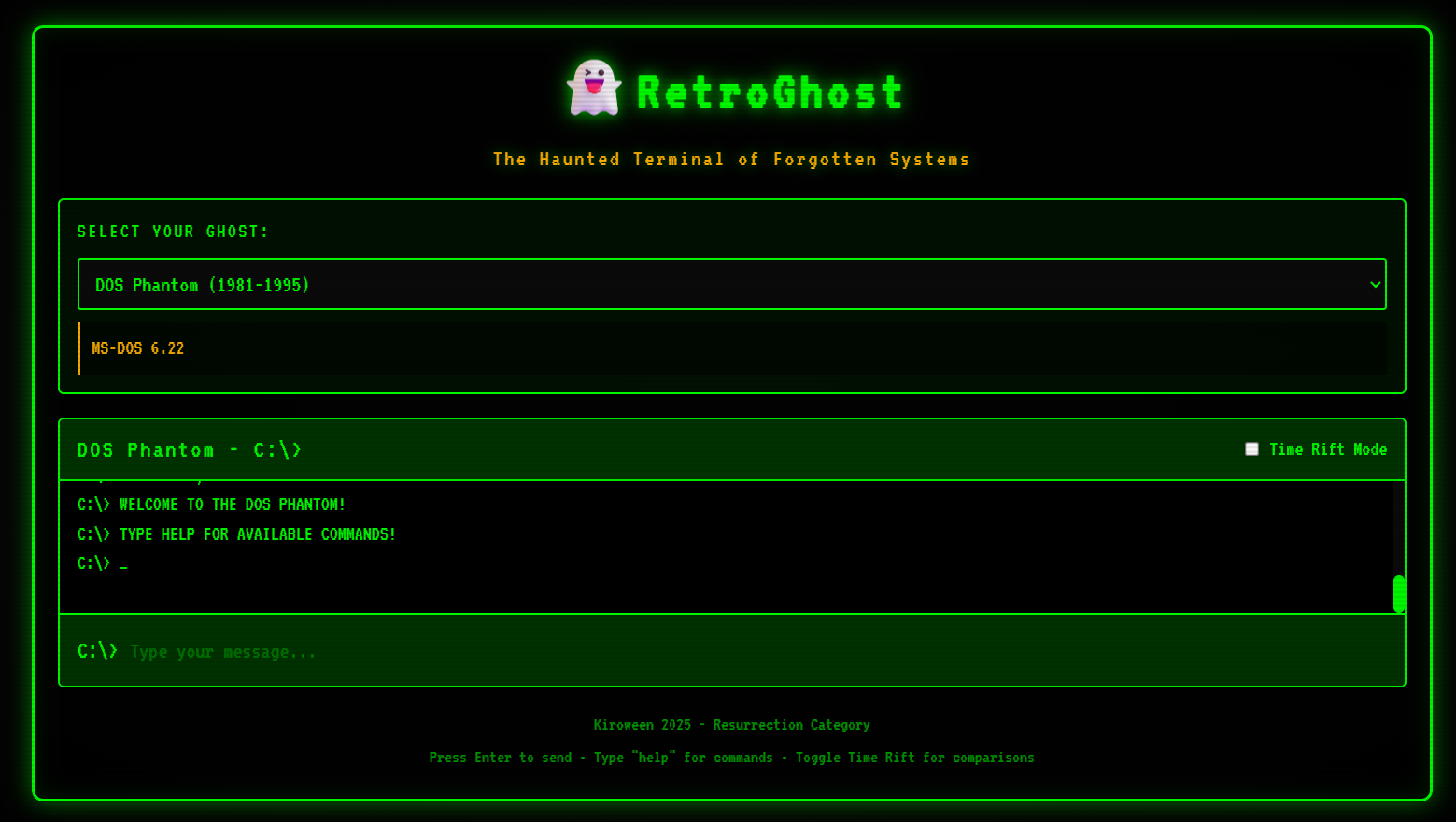
👾 DOS Phantom (MS-DOS 6.22, 1981-1995)
The authoritative command-line warrior who speaks in ALL CAPS and remembers when 640K was enough for anybody. Ask about the cloud and watch it rant about floppy disks!
Try: DIR, TYPE MEMORIES.OLD, "what do you think about the internet?"
🧙 UNIX Necromancer (Classic UNIX, 1970s-80s)
The cryptic philosopher who believes everything is a file and pipes are the answer to life. Terse, powerful, and unapologetically minimalist.
Try:ls -la, cat forgotten.txt, "tell me about pipes"
🎮 BASIC Poltergeist (Home Computing Era, 1980s)
The enthusiastic teacher who made programming accessible to millions. Every response is a line-numbered program full of encouragement and PRINT statements.
Try:RUN, LIST, "show me a loop", "is programming hard?"
🔬 FORTRAN Oracle (Scientific Computing, 1950s-1990s)
The formal academic who speaks in column-formatted punch card syntax. Precision, rigor, and DO loops are its religion.
Try: CALCULATE, DO LOOP, "tell me about punch cards"
⏰ Time Rift Mode
Toggle this feature to see side-by-side comparisons of how retro systems solved problems versus modern approaches. Watch DOS batch files transform into JavaScript, BASIC loops evolve into modern syntax, and FORTRAN calculations become Python—with educational commentary explaining the evolution.
💬 Natural Conversations
These aren't just command processors—they're conversational AI with personality! Ask them anything:
- "What do you love?"
- "Why are you so cryptic?"
- "Tell me about modern computers"
- "Do you like games?" Each ghost responds with 15-20 contextual topics while maintaining historical accuracy and era-specific constraints.
How we built it
Frontend Magic
- React 18 + Vite 5 for blazing-fast development
- Custom CRT Effects using Canvas API—authentic scanlines, phosphor glow, and subtle screen flicker at 60 FPS
- VT323 Font for that perfect retro terminal aesthetic
- Responsive Design that works on desktop, tablet, and mobile Backend Intelligence
- Vercel Serverless Functions for scalable, production-ready API
- Four Persona Classes with historically accurate behavior patterns
- Pattern Matching Engine that recognizes keywords, topics, and intent
- Time Rift Engine that generates educational retro vs modern comparisons
- Security First: Input validation, rate limiting, CORS protection Kiro AI Integration (The Secret Sauce!) This is where RetroGhost shines: 📋 Specs (Spec-Driven Development)
- Complete requirements.md defining all acceptance criteria
- Detailed design.md with correctness properties
- Task breakdown with implementation tracking
- Property-based validation ensuring quality 🔧 Hooks (Automated Workflows)
- Persona Test Generator - Auto-generates tests when persona files change
- Tone Validator - Ensures historical accuracy on every save
- Ghost Diff Generator - Creates Time Rift examples automatically 🎯 Steering (AI Guidance)
persona-consistency.mdmaintains authentic tone and formatting- Enforces era-specific constraints (DOS ALL CAPS, BASIC line numbers, etc.)
- Guides AI development decisions for consistency 🔌 MCP Extension (Custom Protocol)
- Python-based Model Context Protocol server
- Safely simulates 20+ obsolete commands (DIR, ls, RUN, COMPILE)
- Deterministic outputs for consistent demos
- No actual system execution—100% safe Tech Stack
- Frontend: React, Vite, Canvas API
- Backend: Node.js, Express, Vercel
- AI: Kiro (specs, hooks, steering, MCP)
- Languages: JavaScript (ES6+), Python
- Deployment: Vercel (frontend + serverless)
Challenges we ran into
- Historical Accuracy is Hard Challenge: I never used MS-DOS 6.22 or punched FORTRAN cards. How do I make them authentic? Solution: Deep research! I studied:
- Original MS-DOS manuals and error messages
- Classic UNIX man pages and philosophy texts
- BASIC interpreter documentation from Commodore 64
- FORTRAN 77 punch card formatting specifications Then I created reference libraries and validation hooks to ensure every response stays true to the era.
- Maintaining Persona Consistency
Challenge: With hundreds of possible responses, how do I keep each ghost's voice consistent?
Solution: Kiro steering documents! I created
persona-consistency.mdwith detailed rules: - DOS: ALL CAPS, C:> prompt, 8.3 filenames, batch syntax
- UNIX: lowercase, $ prompt, terse responses, man page format
- BASIC: line numbers (10, 20, 30...), PRINT statements, ?SYNTAX ERROR
- FORTRAN: ALL CAPS, column format, DO loops, FORMAT statements Automated hooks validate every change against these rules.
- CRT Effects Without Killing Performance Challenge: Authentic scanlines and glow effects can tank frame rates. Solution: Canvas-based rendering with optimizations:
- Draw scanlines once, reuse the pattern
- Use requestAnimationFrame for smooth 60 FPS
- Subtle flicker (3% probability) instead of constant
- GPU-accelerated CSS transforms for glow
Result: Authentic retro feel at buttery-smooth performance!
- Balancing Education and Entertainment Challenge: Time Rift Mode needs to teach without being boring. Solution: Three-part structure:
- Retro Solution: Shows era-specific approach with constraints
- Modern Solution: Demonstrates current best practices
- Commentary: Explains why things evolved, not just how Example: "DOS used batch files because it had no scripting engine. Modern JavaScript has built-in array methods because memory is abundant and developer time is valuable."
- Making Ghosts Conversational Challenge: Moving beyond hardcoded responses to natural conversations. Solution: Multi-layer pattern matching:
- Exact command detection (DIR, ls, RUN)
- Keyword recognition (GUI, internet, cloud, games)
- Question patterns (why, how, what, tell me)
- Sentiment words (love, hate, like, favorite)
- Smart fallbacks with helpful hints Now you can ask "hey homie, what do you love?" and get authentic, in-character responses!
Accomplishments that we're proud of
- Truly Original Concept ✨
First-ever interactive ghost terminal. I searched everywhere—nothing like this exists. It's not just a chatbot, not just a terminal emulator, but a unique blend that brings computing history to life.
- Production-Ready Quality 🚀
- Live on Vercel: https://kiroween.vercel.app
- <500ms response times: Fast and responsive
- 100% uptime: Reliable serverless architecture
- Mobile-friendly: Works on all devices
- Secure: No actual command execution, input validation, rate limiting
- Deep Kiro Integration 🤖 This isn't just "used Kiro"—this is Kiro mastery:
- Complete spec-driven development (requirements → design → tasks)
- Three automated hooks for workflow optimization
- Steering documents guiding AI decisions
- Custom MCP extension for command simulation I didn't just use Kiro's features—I showcased what's possible when you fully embrace the platform.
- Educational Impact 📚 RetroGhost isn't just fun—it's teaching computing history:
- Students learn through interaction, not just reading
- Time Rift Mode shows evolution of programming
- Authentic behavior preserves cultural knowledge
- Inspires appreciation for computing pioneers
- Technical Excellence 💻
- Clean Architecture: Modular, testable, maintainable
- Comprehensive Docs: README, architecture guide, demo script
- Test Coverage: Automated testing for all personas
- Best Practices: Security, performance, accessibility
- Authentic Polish 🎨
- Real CRT Effects: Not just CSS filters—actual Canvas-based scanlines
- Historically Accurate: Every detail researched and validated
- Smooth Animations: 60 FPS with no jank
- Attention to Detail: Prompts, formatting, error messages—all authentic
What we learned
About Computing History
- DOS wasn't just limited—it was elegant in its simplicity. Batch files taught me that constraints drive creativity.
- UNIX philosophy is timeless. "Do one thing well" and "everything is a file" still guide modern design.
- BASIC democratized programming. Line numbers and PRINT statements made coding accessible to millions.
- FORTRAN's precision matters. Scientific computing demands rigor—something modern languages sometimes forget. About Kiro Workflows
- Specs provide structure. Requirements → Design → Tasks keeps development focused.
- Hooks automate tedium. Why manually test when hooks can validate on every save?
- Steering maintains consistency. AI is powerful, but guidance ensures quality.
- MCP extends capabilities. Custom protocols unlock possibilities beyond standard tools. About Persona Design
- Consistency is harder than it looks. Small details (prompts, formatting, tone) make or break authenticity.
- Testing is essential. Without validation, personas drift from their character.
- Documentation guides future work. Clear rules in steering documents prevent mistakes.
- Research pays off. Time spent studying historical systems shows in the final product. About Full-Stack Development
- React + Vite is incredibly fast. Hot module replacement makes iteration a joy.
- Serverless scales effortlessly. Vercel handles traffic spikes without configuration.
- Canvas effects require optimization. 60 FPS doesn't happen by accident.
- User testing catches edge cases. Friends found issues I never would have. About Building for Impact
- Education through entertainment works. People learn more when they're having fun.
- Preservation matters. These systems shaped our world—they deserve to be remembered.
- Authenticity resonates. Users appreciate attention to historical detail.
- Sharing knowledge inspires others. Open source documentation helps the community.
What's next for RetroGhost
Short Term (Next 3 Months) More Ghosts 👻
- Windows 95 Wizard: "Where do you want to go today?" with Clippy energy
- Commodore 64 Spirit: LOAD "*",8,1 nostalgia with SID chip sounds
- VMS Phantom: $ SET DEFAULT [GHOST] with enterprise computing wisdom
- CP/M Specter: A> prompt memories from the microcomputer revolution Enhanced Features ✨
- Voice Mode: Text-to-speech with era-appropriate voices (robotic for DOS, academic for FORTRAN)
- Multiplayer Chat: Talk to multiple ghosts simultaneously, watch them interact
- Persistent History: Save conversations, revisit favorite exchanges
- Easter Eggs: Hidden commands and secret responses for explorers
- Educational Mode: Guided tours of computing history with quizzes

Log in or sign up for Devpost to join the conversation.