-
-
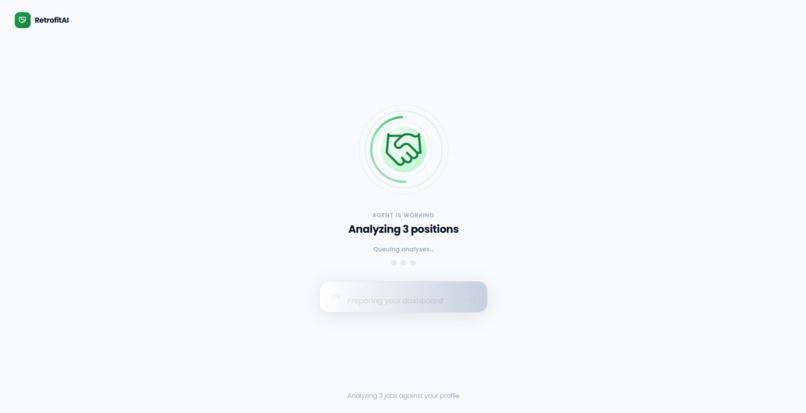
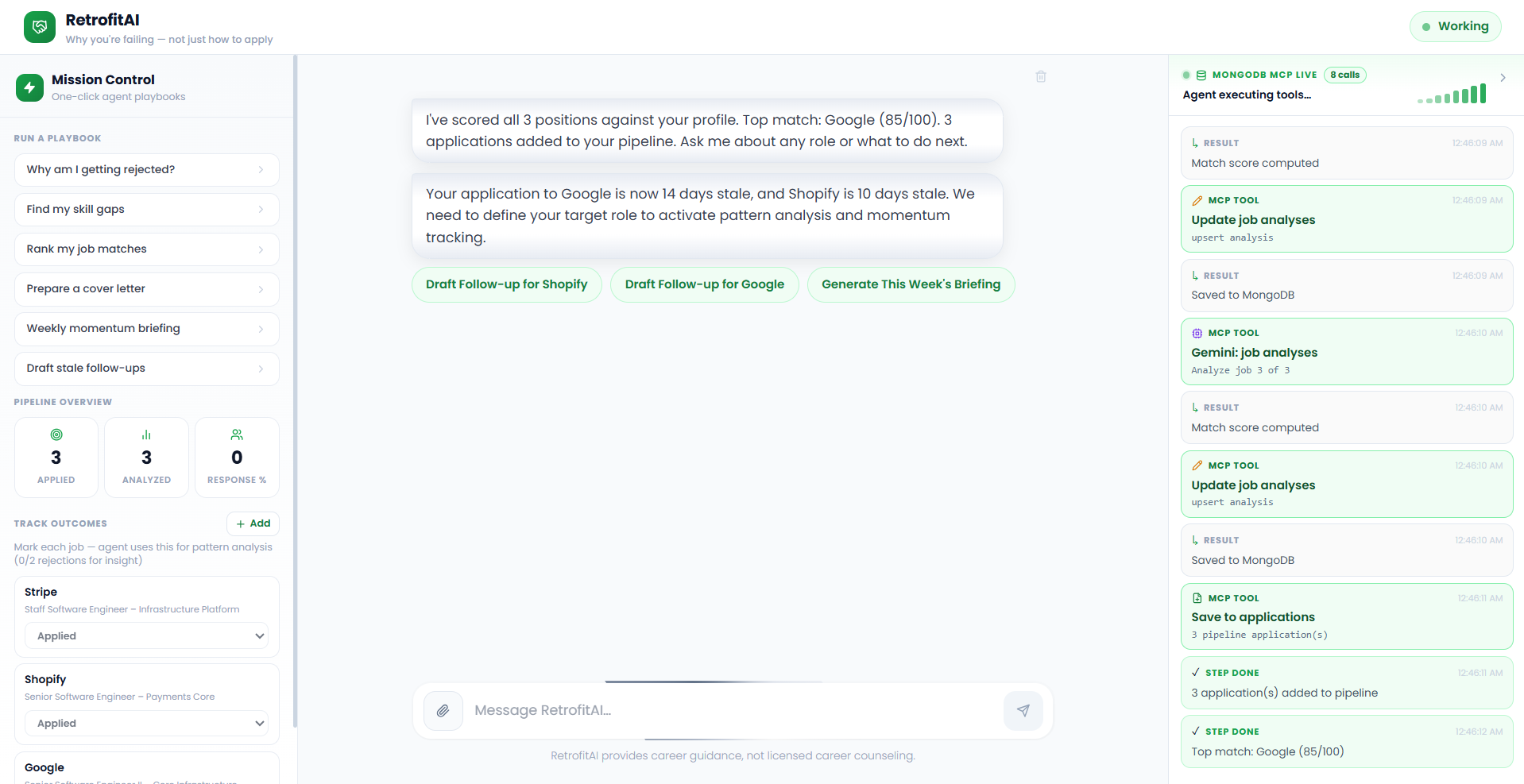
Onboarding agent scores 3 job descriptions against your profile in real time — visible in the MongoDB MCP panel.
-
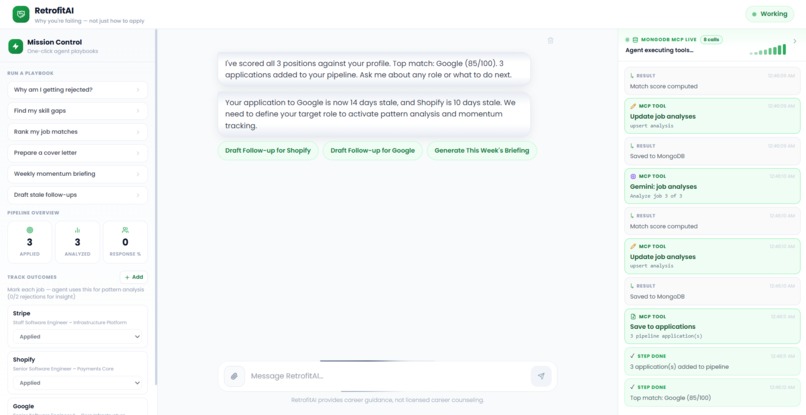
Return visit: agent leads with pipeline status, stale-app alerts, and quick actions — not a blank chat box.
-
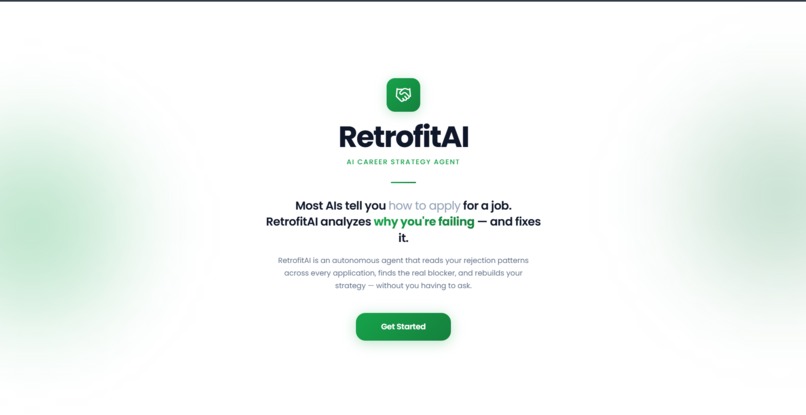
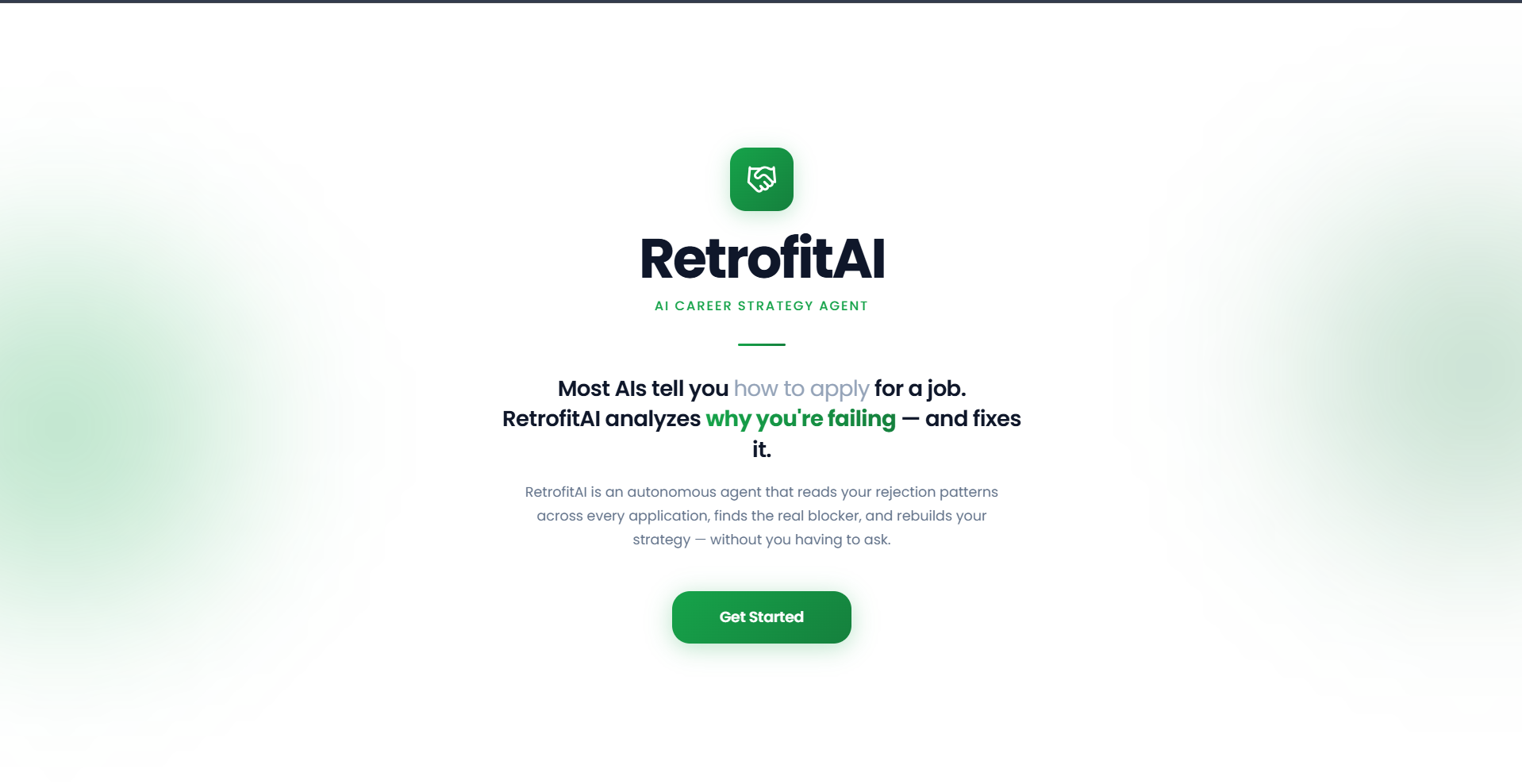
RetrofitAI: the AI career agent that diagnoses why your job search is failing — not just how to apply to more jobs.
-
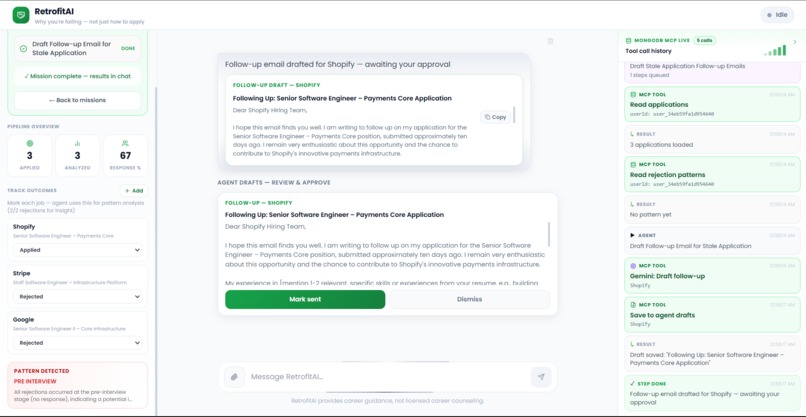
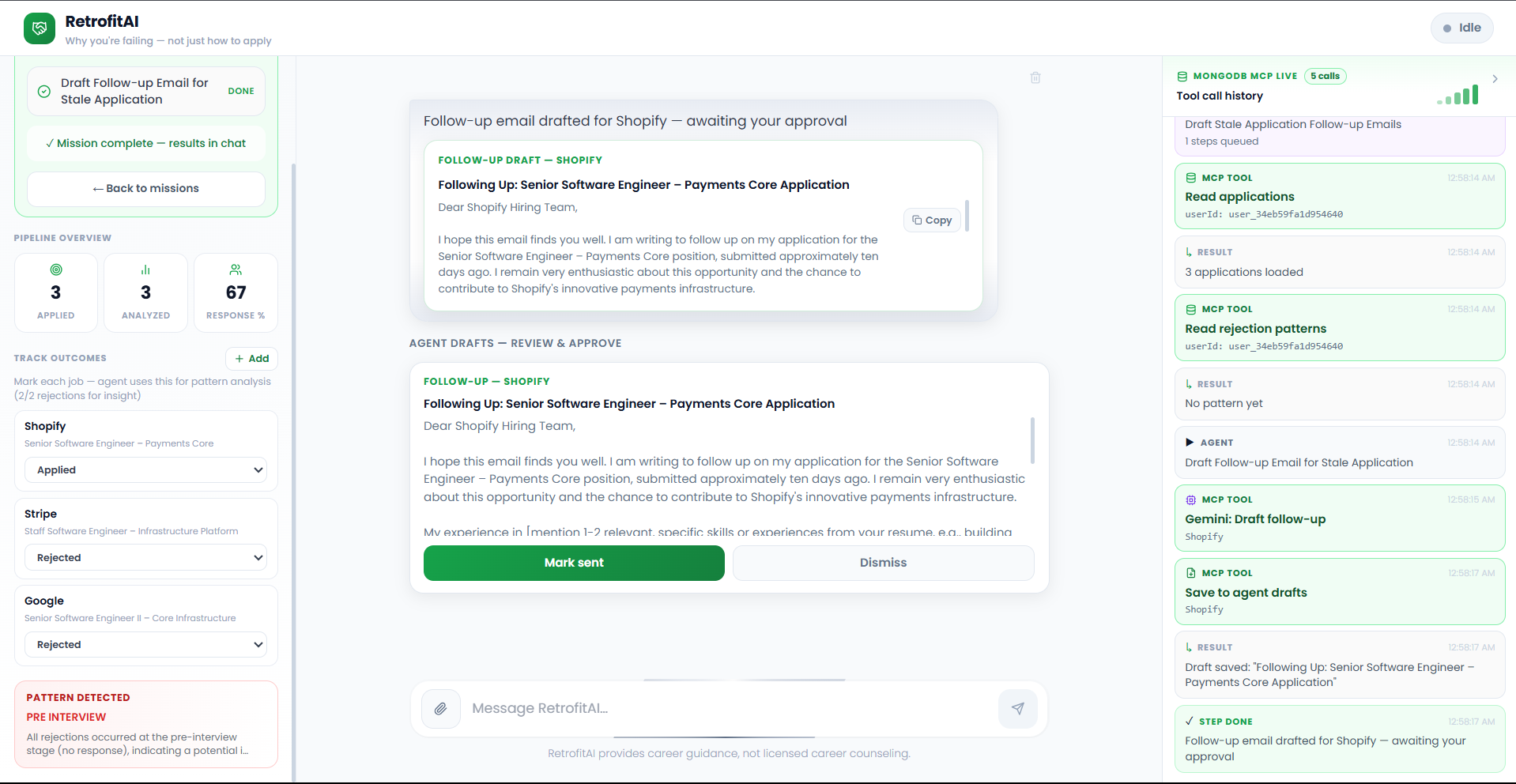
Autonomous pipeline drafts a Shopify follow-up; you approve or dismiss before anything is saved — human-in-the-loop by design.
-
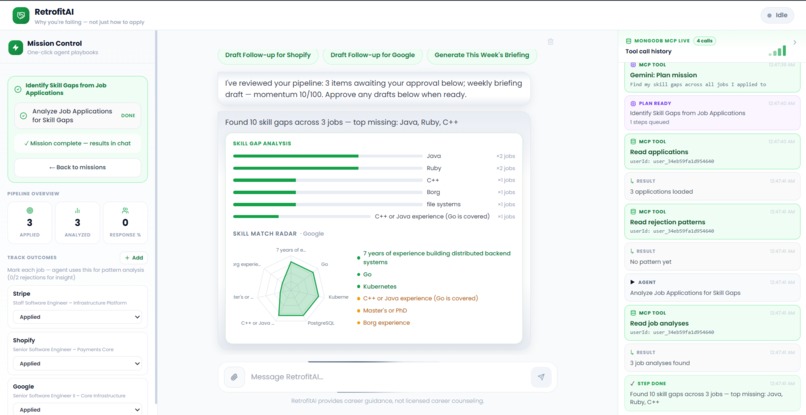
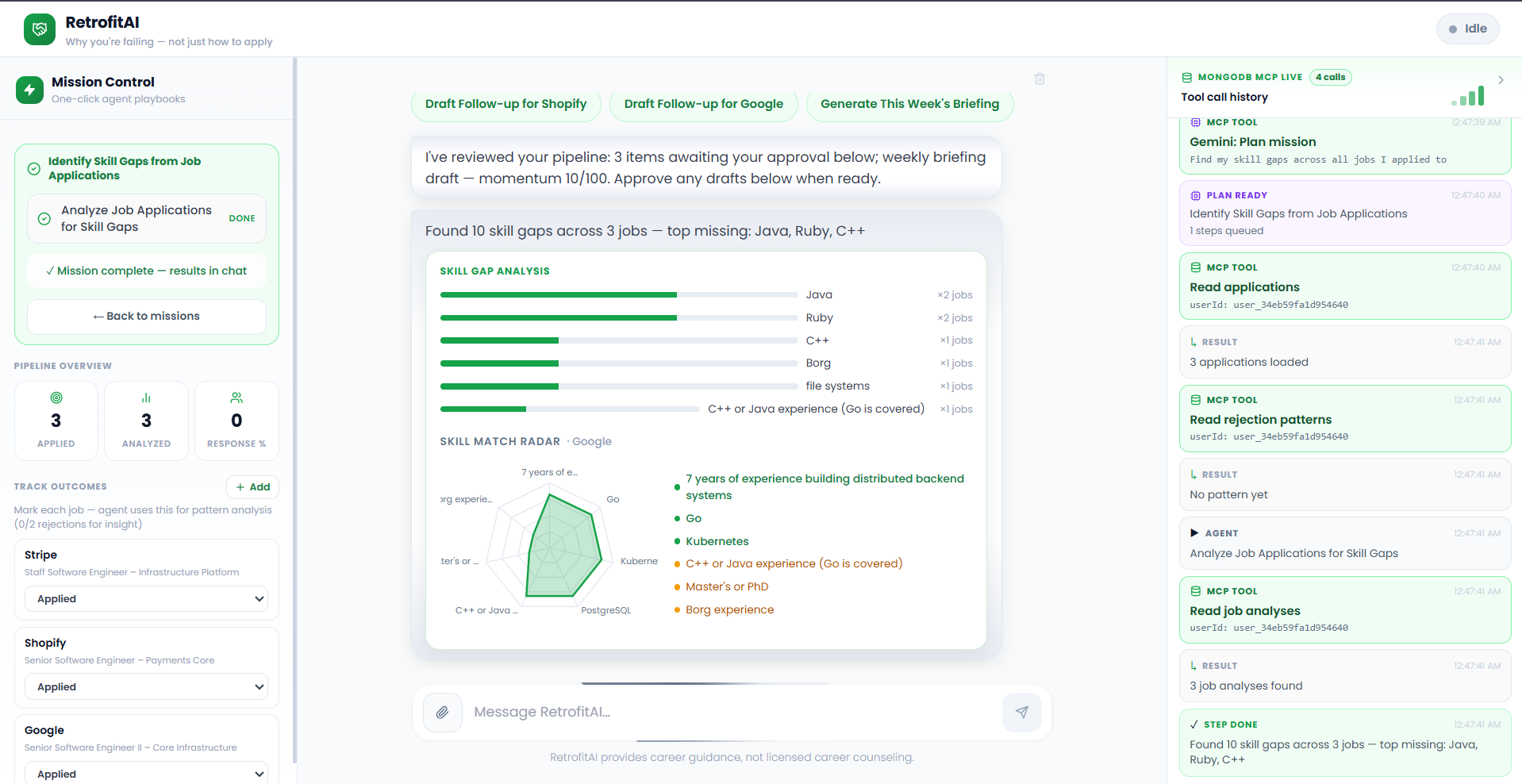
Skill gap mission across analyzed jobs — missing keywords and a radar chart vs. your profile, powered by Gemini + MongoDB.
-
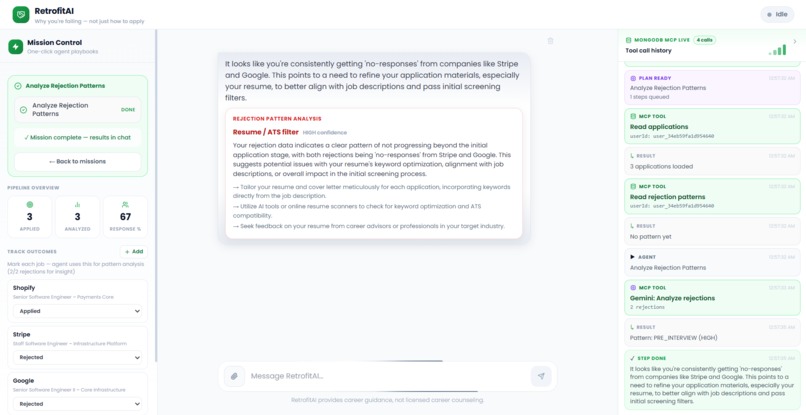
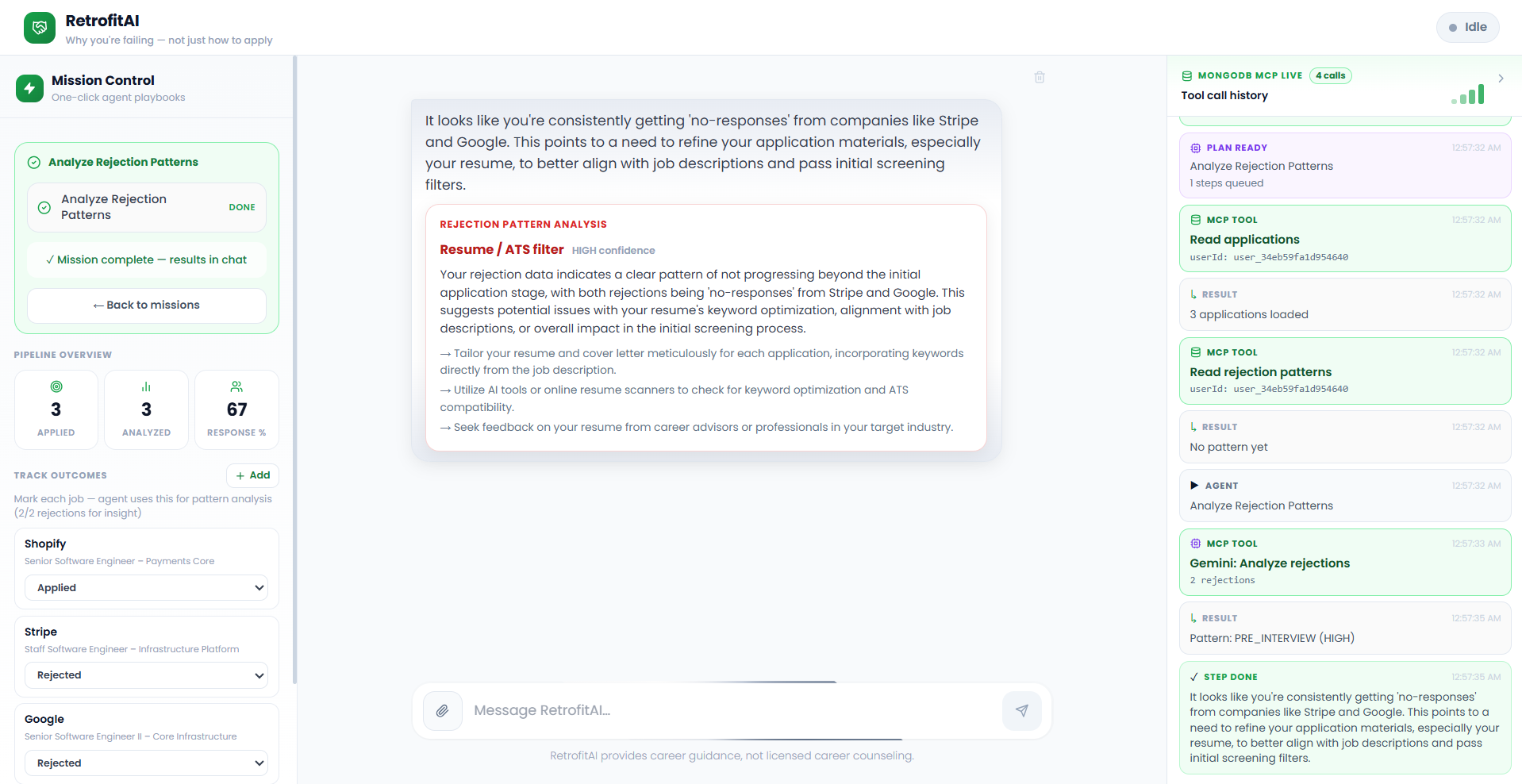
After 3 rejections, RetrofitAI detects a PRE_INTERVIEW pattern (resume/ATS) with high confidence — tied to your real data.
Inspiration
I kept seeing the same story in job search threads: people applying to hundreds of roles with AI tools, getting silence or rejections, and never knowing where they were failing. Resume? ATS keywords? Phone screen? Final round?
Every product I found optimized for volume — more applications, faster cover letters. None of them connected rejection history into a single diagnosis. I wanted an agent that reads your actual pipeline in a database, spots the pattern, and tells you what to fix next.
That became RetrofitAI: a career agent built around one idea — diagnose before you apply harder.
What it does
RetrofitAI is an AI career agent that detects why your job search is failing by analyzing patterns across your MongoDB data — then rebuilds your strategy in real time.
Six core flows:
- Intake interview — conversational onboarding; profile saved to
career_profiles - Job analyzer — paste a JD → match score, skill gaps, ATS keywords, verdict, cover letter →
job_analyses - Rejection intelligence — after 3+ rejections, classifies whether you're losing pre-interview, post-interview, or at the final round →
rejection_patterns - Proactive follow-up — on return visits, surfaces stale applications and drafts follow-up emails for approval
- Pipeline tracking — kanban-style application status with drag-and-drop
- Weekly briefing + PDF — momentum score, response rate vs. industry benchmark, priority actions
The agent doesn't just chat — it reads and writes your data through MongoDB MCP tools while Gemini reasons over live context. Users approve sensitive actions (follow-ups, pattern insights, briefings) before anything is committed.
Live demo: frontend-six-sigma-45.vercel.app
How we built it
Frontend: React 18 + TypeScript + Vite, Tailwind CSS, shadcn/ui, Recharts. Deployed on Vercel with /api/* proxied to Cloud Run.
Backend: Node.js + Express on Google Cloud Run. Anonymous sessions via express-session + connect-mongo.
AI: Gemini 2.5 Flash via Vertex AI (@google-cloud/vertexai). Each agent mode (NEW_USER → PROFILE_COMPLETE → ACTIVE_SEARCH → PATTERN_DETECTED) routes to a dedicated function in geminiService.js.
MongoDB: Atlas M0 cluster with five collections — career_profiles, job_analyses, applications, rejection_patterns, weekly_briefings — plus agent_drafts and agent_runs for the autonomous pipeline.
MCP integration: The official @mongodb-js/mongodb-mcp-server runs as a stdio child process. Gemini's tool-call loop invokes find, insert-one, update-one, and aggregate through MCP — visible live in the MongoDB MCP panel on the right side of the UI.
Agent Builder: Dialogflow CX detectIntent endpoint wired for Agent Builder compliance.
Architecture in one line:
Browser → Vercel → Cloud Run → Gemini (Vertex AI) ↔ MCP Server ↔ MongoDB Atlas
Autonomous pipeline: On onboarding complete (not every page refresh), the agent scans applications, drafts follow-ups for stale apps, queues pattern/briefing drafts for approval, and logs the run. Momentum scoring compares your response rate to a 15% industry baseline:
$$\text{momentumScore} = f\left(\frac{|\text{responded}|}{|\text{applications}|},\ \text{trend},\ \text{stale count}\right)$$
Challenges we ran into
1. MCP + Mongoose dual writes
Early on, some routes wrote via Mongoose while the agent loop wrote via MCP. Data could diverge between collections. I merged reads through mongoService.js helpers that prefer Mongoose but backfill from MCP, and mirrored critical writes both ways.
2. Duplicate follow-up drafts on every refresh
The autonomous pipeline ran on every sessionInit, recreating the same follow-up draft for stale applications each time the user landed on the main screen. Fix: load existing drafts on init only; run the pipeline once after onboarding; dedupe pending drafts by applicationId; add a 20-minute cooldown between pipeline runs.
3. Production-only UI bugs
The skill-gap radar chart rendered empty on Vercel but worked locally — ResponsiveContainer sizing in a flex layout. Fixed with explicit chart dimensions and fallback data from topKeywords / profile skills.
4. Session stability across deploys
connect-mongo session store failures could orphan userId references. Added auto userId assignment middleware and batchId fallbacks on job analysis routes.
5. Solo + deadline
Building six features, MCP wiring, Agent Builder integration, and two deploy targets in one hackathon window meant ruthless prioritization: backend correctness and agent behavior first, UI polish second.
Accomplishments that we're proud of
- Built a full agent lifecycle — not a chatbot wrapper — with mode-based behavior tied to real MongoDB state
- Wired MongoDB MCP so every agent read/write is auditable in a live panel (great for demos)
- Human-in-the-loop drafts — follow-ups, rejection patterns, and weekly briefings require explicit user approval before persistence
- Rejection pattern detection that classifies where in the funnel you're losing, not just that you lost
- Shipped a public, working deployment on Vercel + Cloud Run with a complete demo flow end-to-end
- Survived real production debugging (duplicate drafts, chart rendering, favicon caching) under deadline pressure
What we learned
- Agents need memory architecture, not just a prompt. Loading profile, applications, job analyses, patterns, and briefings into context — and giving Gemini tools to fetch more — made recommendations specific instead of generic.
- MCP is a judge-friendly integration story. Spawning the official MongoDB MCP server and logging
[MCP]operations made the database layer visible and verifiable. - Approval gates matter for trust. Career advice that auto-sends emails or overwrites patterns would feel reckless. Pending drafts + confirm/dismiss turned the agent into a collaborator.
- Deploy early, debug in prod. Vercel and Cloud Run surfaced issues (chart sizing, session cookies, API proxy) that localhost never showed.
- The best hackathon demos show one clear insight. "You're losing pre-interview — here are the missing keywords across your last 4 rejections" beats "here's a cover letter generator."
What's next for RetrofitAI
- LinkedIn / email integration — send approved follow-ups directly from the app
- Resume diff engine — auto-suggest resume edits when
missingKeywordsAcrossRejectionsupdates - Multi-user auth — move from anonymous sessions to proper accounts (Clerk or Auth0)
- Embeddings on job descriptions — semantic job matching and smarter ranking in MongoDB Atlas Vector Search
- Chrome extension — one-click JD capture from job boards into
job_analyses - Interview prep mode — when pattern is
POST_INTERVIEW, generate company-specific question banks from stored JDs
Built With
- axios
- dialogflow-cx
- docker
- express.js
- gemini
- google-cloud
- google-cloud-agent-builder
- google-cloud-run
- javascript
- model-context-protocol-(mcp)
- mongodb
- mongodb-atlas
- mongoose
- node.js
- pdfkit
- radix-ui
- react
- recharts
- rest-api
- shadcn/ui
- tailwind-css
- typescript
- vercel
- vertex-ai
- vite

Log in or sign up for Devpost to join the conversation.