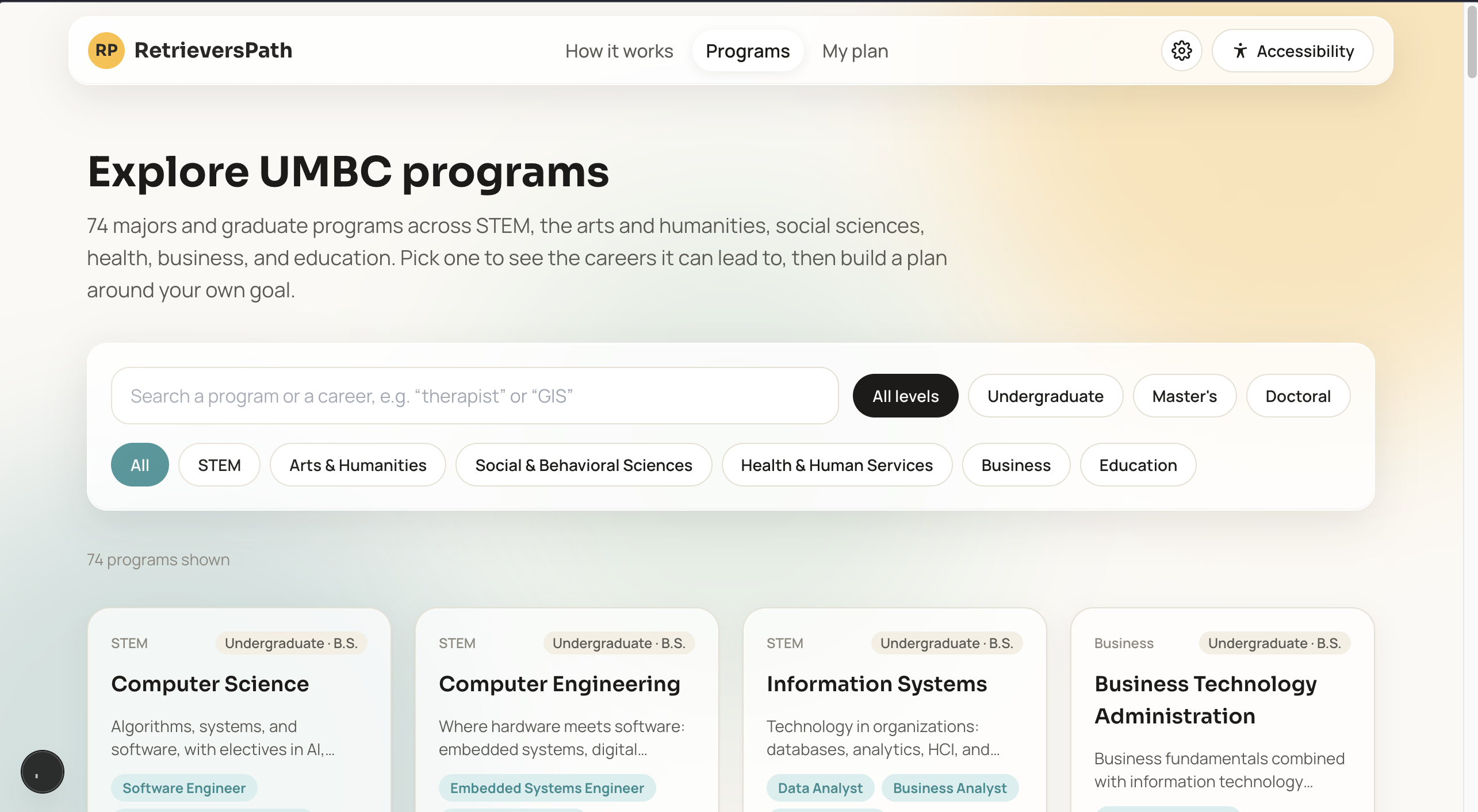
RetrieversPath
A career builder for college students, starting at UMBC. You tell it your major, what you're into, and the job you're aiming for. It gives you back the real numbers, the jobs, and an actual plan for getting there.
Inspiration
This started with a conversation none of us could answer. Someone asked, "What are you doing this semester to get the job you want?" and the three of us kind of looked at each other. We had majors. We had vague goals. We did not have steps.
Then we looked it up and it turns out we weren't alone. In a survey of 1,000 undergrads, 47% weren't confident they'd get a job after graduating, only 30% felt they had the tools to understand how their industry works, and just 24% had ever used their campus career center. Most people were asking family, or YouTube.
Handshake and LinkedIn are fine at showing you jobs. They're bad at showing you how to become someone who gets those jobs. That's what we wanted to build.
The other thing we cared about from the start: it had to work for everyone. One of us has ADHD and knows firsthand what a twenty-field form does to your brain, or what happens when a page is a wall of text with no way to hear it read aloud. So accessibility wasn't something we planned to add at the end. It was in the first sketch.
What it does
You sign in with your @umbc.edu email and answer three questions, one at a time: your major, your niche, and the career you're going for. That's it. No resume upload.
Then you get a dashboard. Median and 75th-percentile salary for that role. The percentage of alumni from your track who actually landed in that field. Top local employers. And a ranked list of career fields based on where people like you really ended up, not a guess.
Then the part we're proudest of: the roadmap. It looks at the courses you've already taken, compares them to the skills employers are asking for in that role, and shows you the gaps. For each gap, it tells you the UMBC course that covers it and an undergrad research lab on campus tied to that role. Every step has a "why this step" so it doesn't feel like homework for no reason.
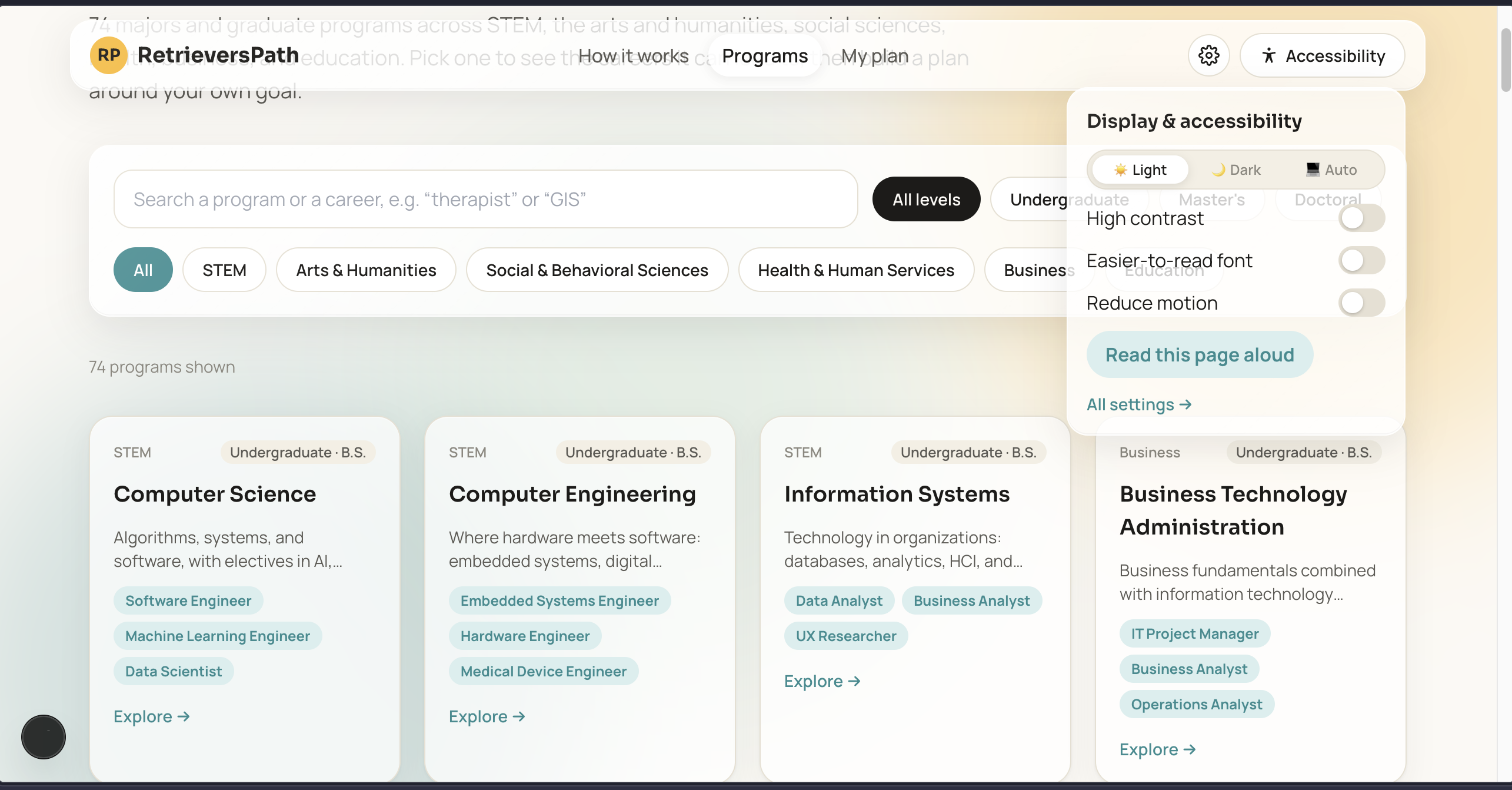
And on every page there's an accessibility button: read aloud, an easier-to-read font, high contrast, a focus mode that dims everything except the step you're on, reduced motion, and full keyboard control. Your settings save to your profile so they follow you.
How we built it
We split it three ways and built in parallel, which was both the smartest and the most stressful decision we made.
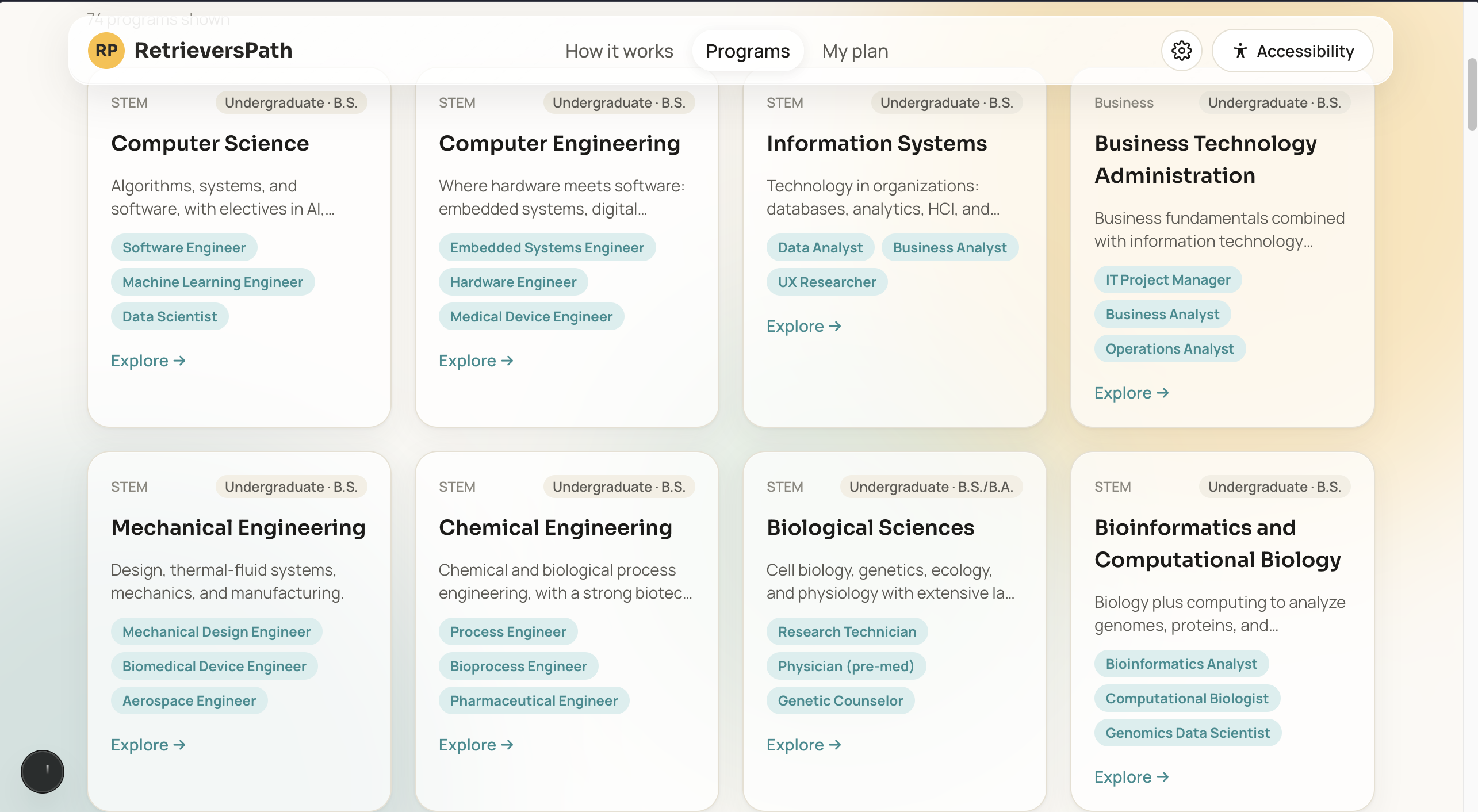
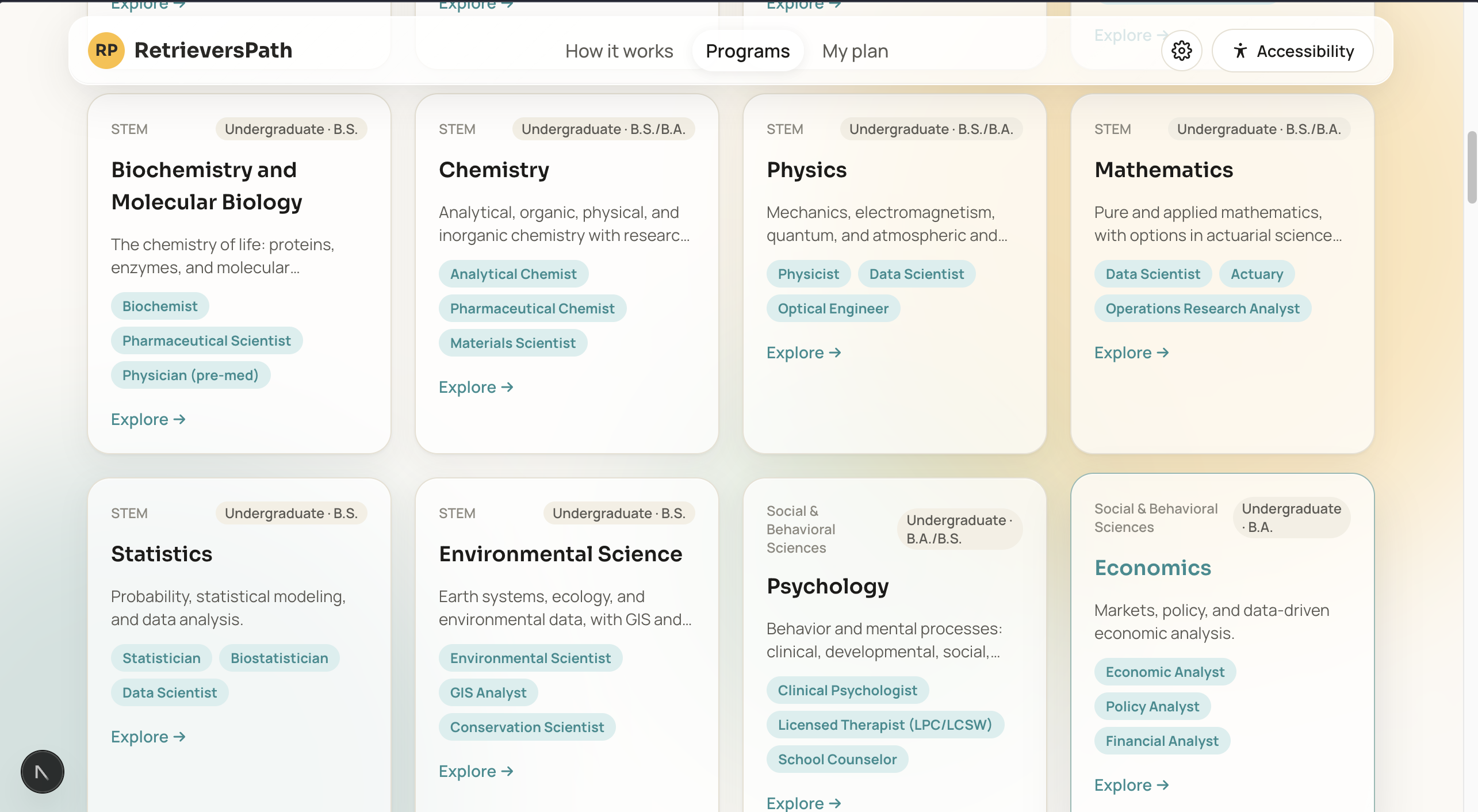
Anaiah did the frontend and design. Next.js, Tailwind, TypeScript. She started with UMBC's official black and gold and softened both so they'd work on a screen for hours: warm charcoal instead of pure black, warm off-white instead of white, gold saved for one action per page, and a calmer teal so gold didn't have to do everything. Every color is a token, so light, dark, and high-contrast modes are one switch instead of three separate designs. Sora for headings, Manrope for body. Accessibility gets linted at build time so mistakes show up as red underlines instead of complaints later.
Paul did the backend. FastAPI on a PostgreSQL database he seeded from the dataset we were given. Four endpoints:
POST /api/auth/loginchecks for@umbc.eduand pulls up the student by campus IDPOST /api/recommendationsranks career fields by real alumni placement percentages from the student's trackGET /api/careers/insightsreturns median and 75th-percentile salaries by seniority, top local employers, and hiring regionsPOST /api/roadmap/generatecompares completed courses to industry-demanded skills and returns what you have, what you're missing, the UMBC courses that fill the gaps, and the research labs tied to that role
Martin did security and systems. He set up Supabase Auth with email and password as the MVP. We talked about doing full university SSO and decided we couldn't finish it honestly in 24 hours, so he picked the approach that could grow into it without a rewrite. He wired the Supabase client, put every secret in .env.local, and double-checked that Git was ignoring it, so there are no keys sitting in our repo. He also mapped out what comes next: domain verification, SSO, Row Level Security so a student can only see their own data, and roles for advisors and admins.
Frontend on Vercel, API on Render, both deploying from GitHub.
Challenges we ran into
Gold on white is unreadable. UMBC's own brand guide warns about this and we found out anyway. Gold text on a light background fails contrast badly. We ended up with a rule: gold is a fill, never text, and when it has to be text it's a deeper gold. That one rule shaped the whole look.
Our "futuristic" designs kept being hard to read. Glass panels and glows look amazing in a mockup and awful behind a paragraph. We kept glass for floating things like the top bar, and added a fallback that turns it solid when your OS has "reduce transparency" on.
Getting three separate pieces to agree. The frontend, the API, and the auth were built by three people at the same time. Getting everyone to agree on what a "profile" or a "roadmap step" looks like took longer than writing any of the individual parts. We should have done that first.
This was our first hackathon. We were learning as we went. There were moments where we wanted to claim more than we'd built. We didn't, and we're glad.
What we learned
Accessibility is cheap at the start and expensive at the end. Tokens, landmarks, and labeled buttons cost almost nothing on day one.
Real data beats a made-up score. Telling a student "68% of alumni on your track went into this field" is worth more than a "91% match" number we invented.
A step nobody understands is a step nobody does. "Build a REST API" gets ignored. "Build a REST API because three of your top five employers require it, and CMSC 447 covers it" gets done.
Scope down and finish. Everything we shipped works. That felt better than a bigger thing that almost did.
What's next
- Live job feeds on top of our seeded dataset
- Row Level Security and student domain verification, then university SSO
- Talking to the UMBC Career Center and CSEE advisors about actually using this
- A second school. The login already checks by domain, so another university is another allowed domain.
Built with
nextjs react typescript tailwindcss fastapi python postgresql supabase vercel render
Survey figures: Forage Career Readiness Survey, 1,000 U.S. undergraduates, 2022.
Built With
- fastapi
- nextjs
- postgresql
- python
- react
- supabase
- tailwindcss
- typescript
- vercel

