-
-
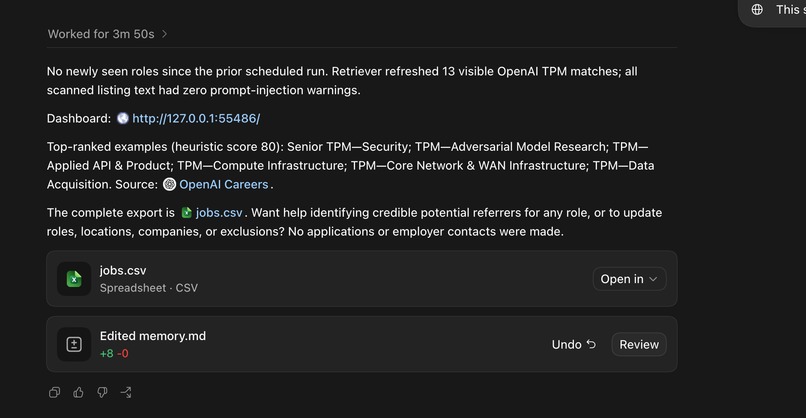
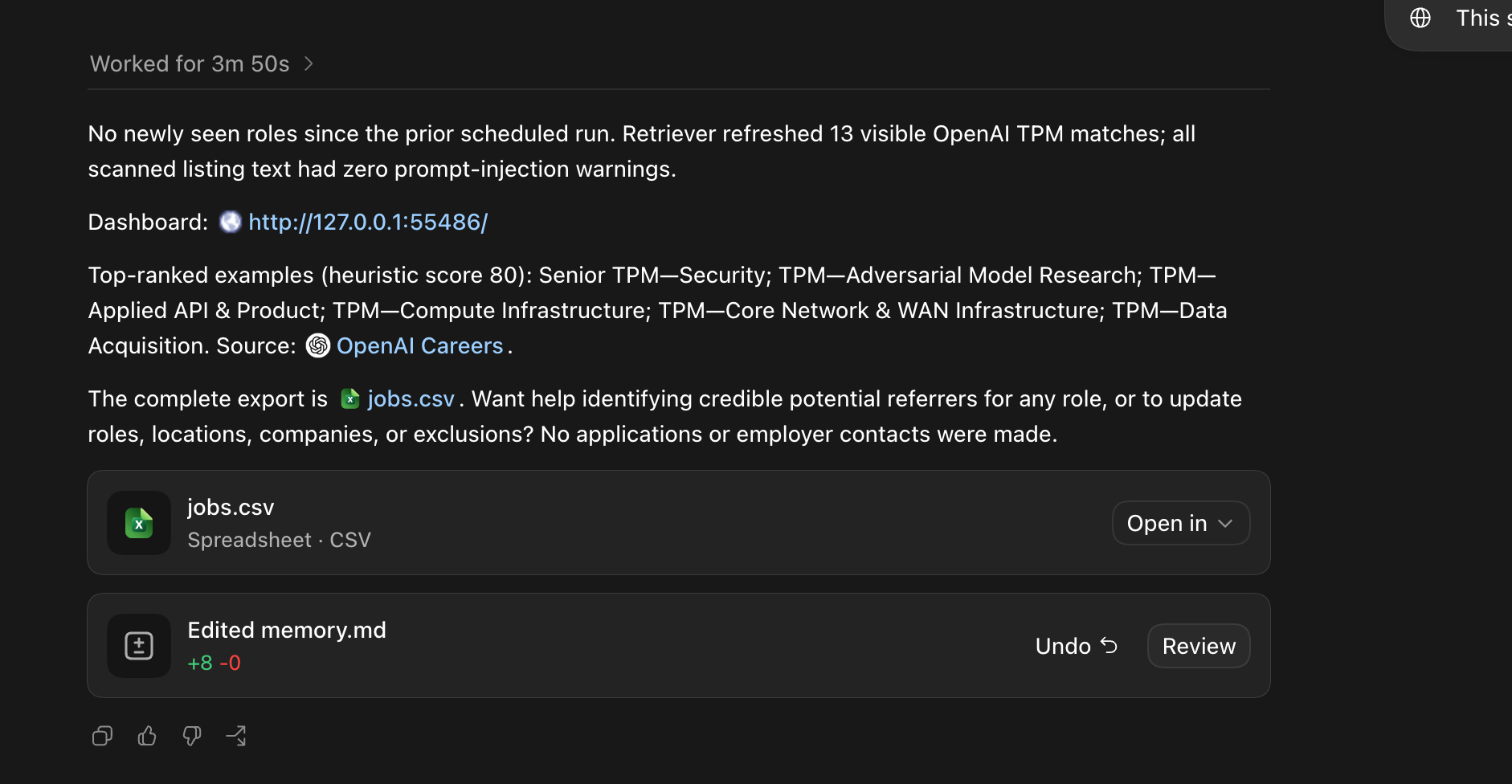
It will alert only on new roles, and let you know if there aren't any. With enough target companies you should have a steady stream of jobs
-
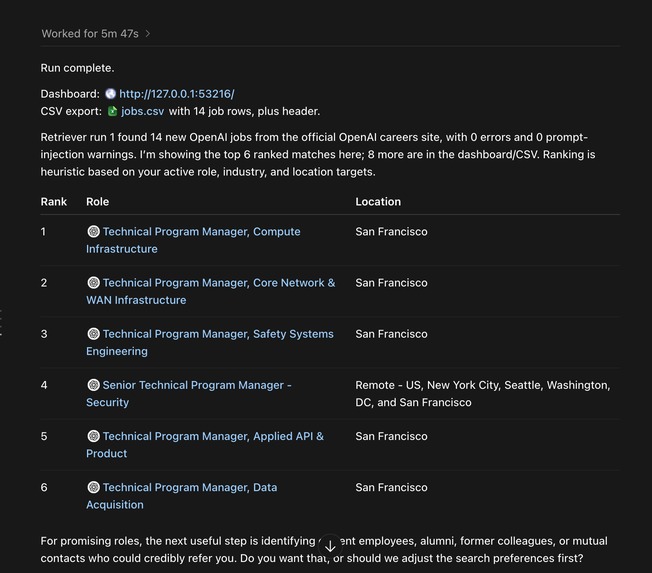
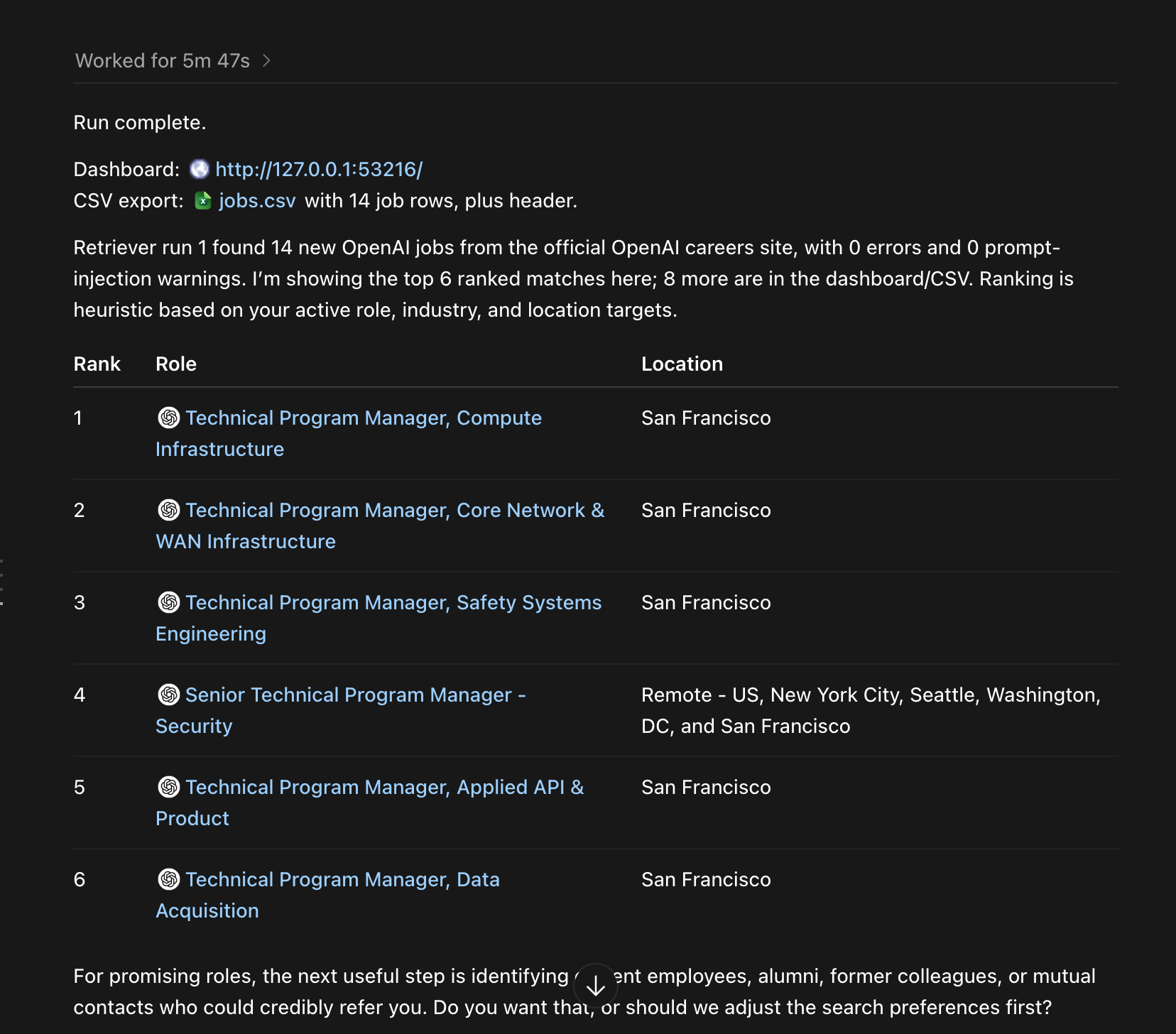
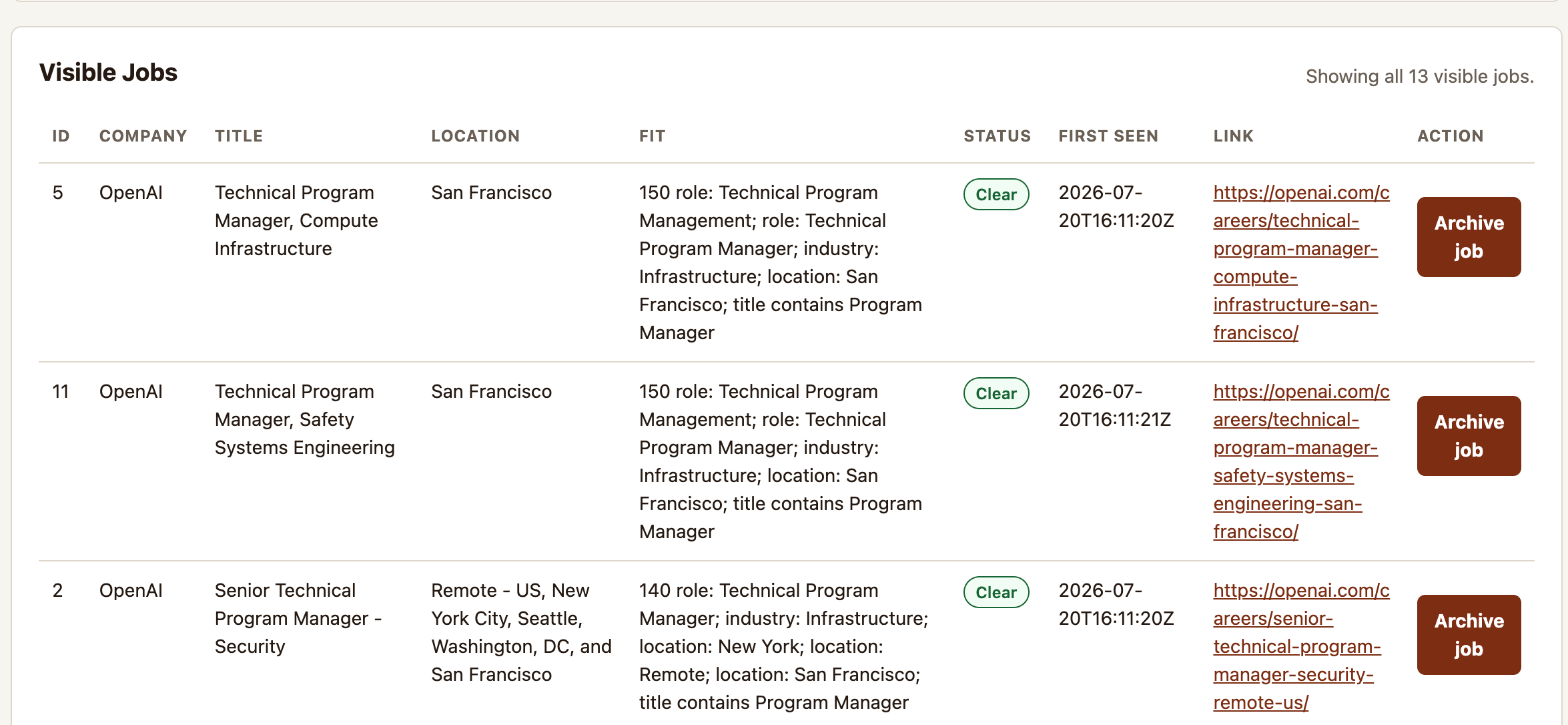
It finds jobs at companies you specify, and ranks them based on relevance based on YOUR resume
-
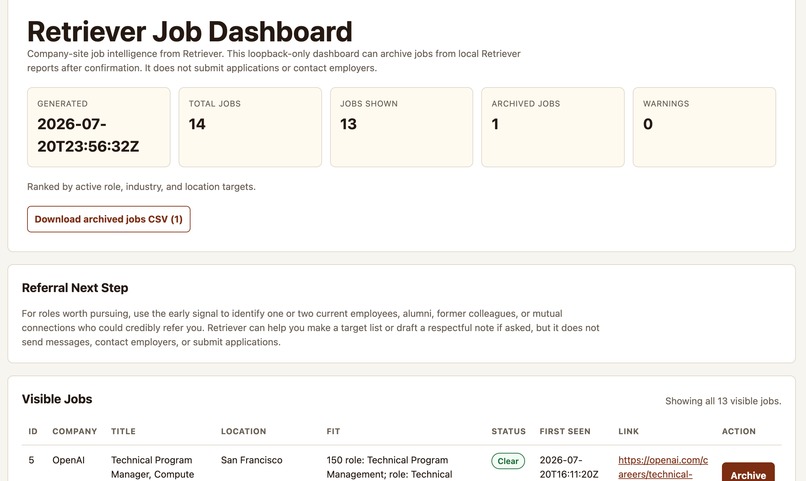
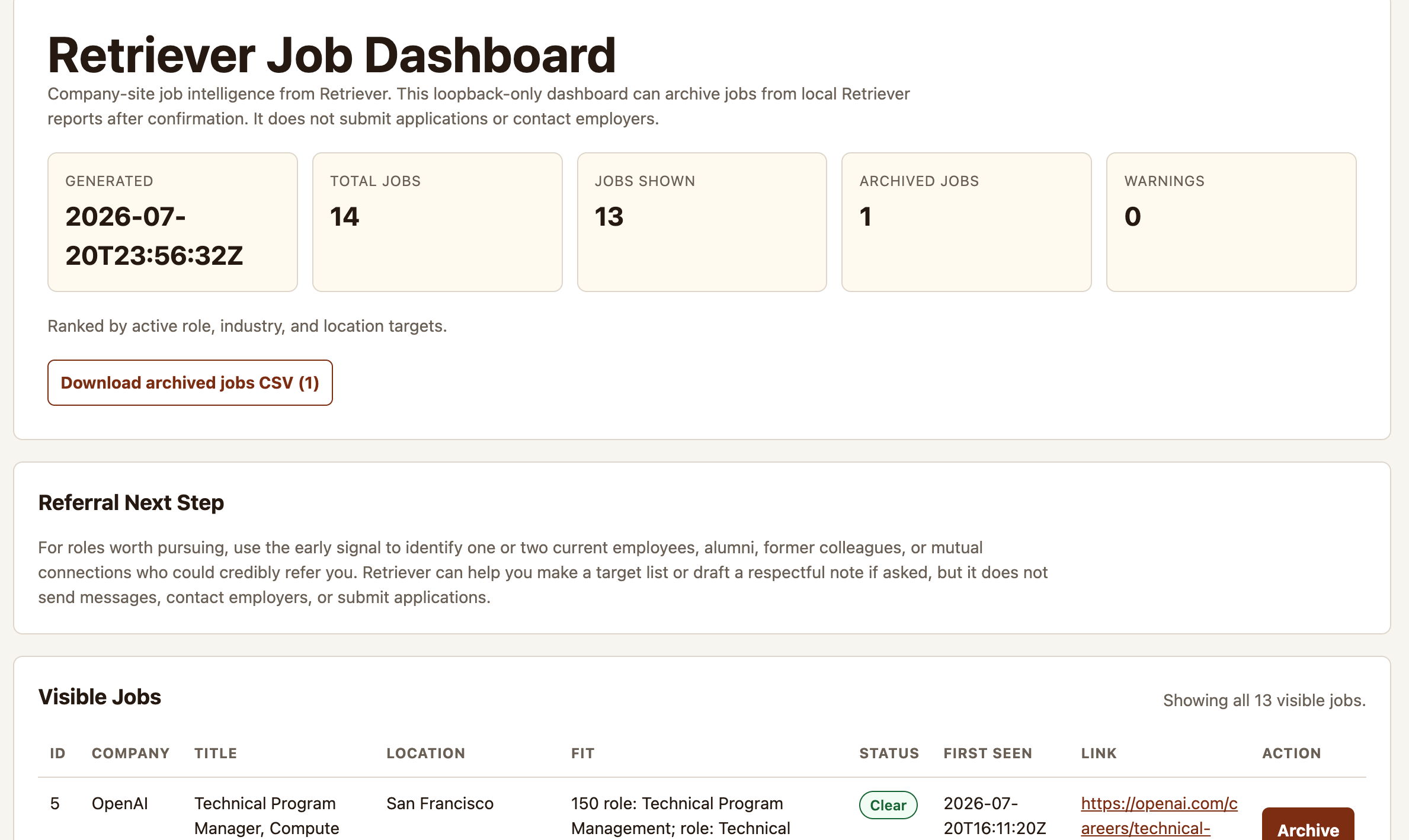
A loopback dashboard is included...
-
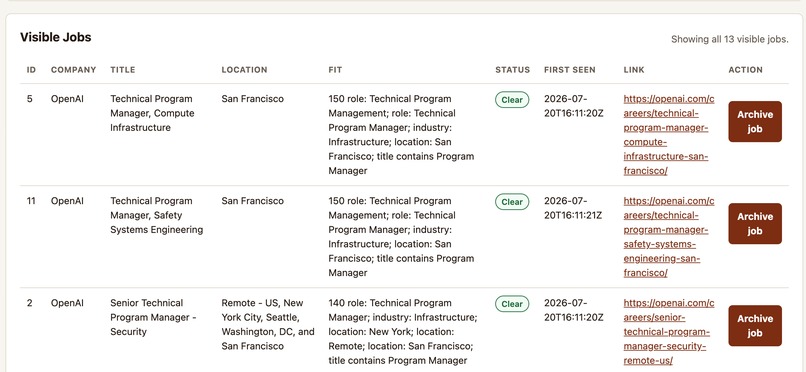
...that allows archiving jobs you don't want to see anymore.
-
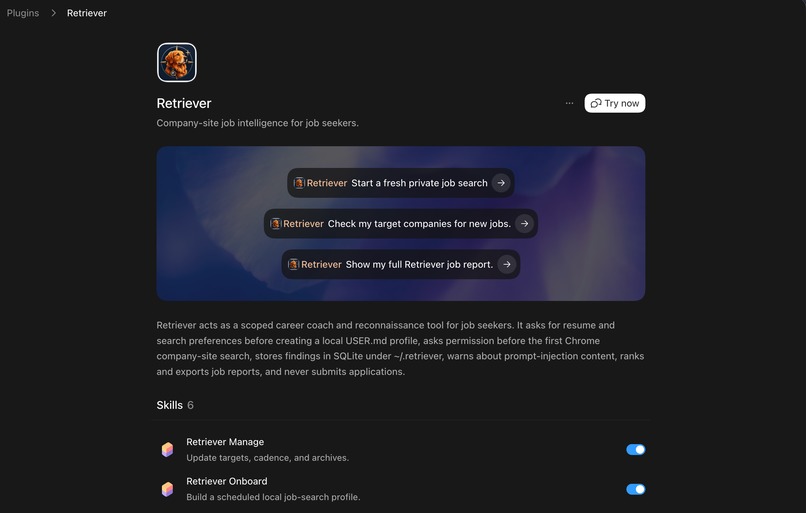
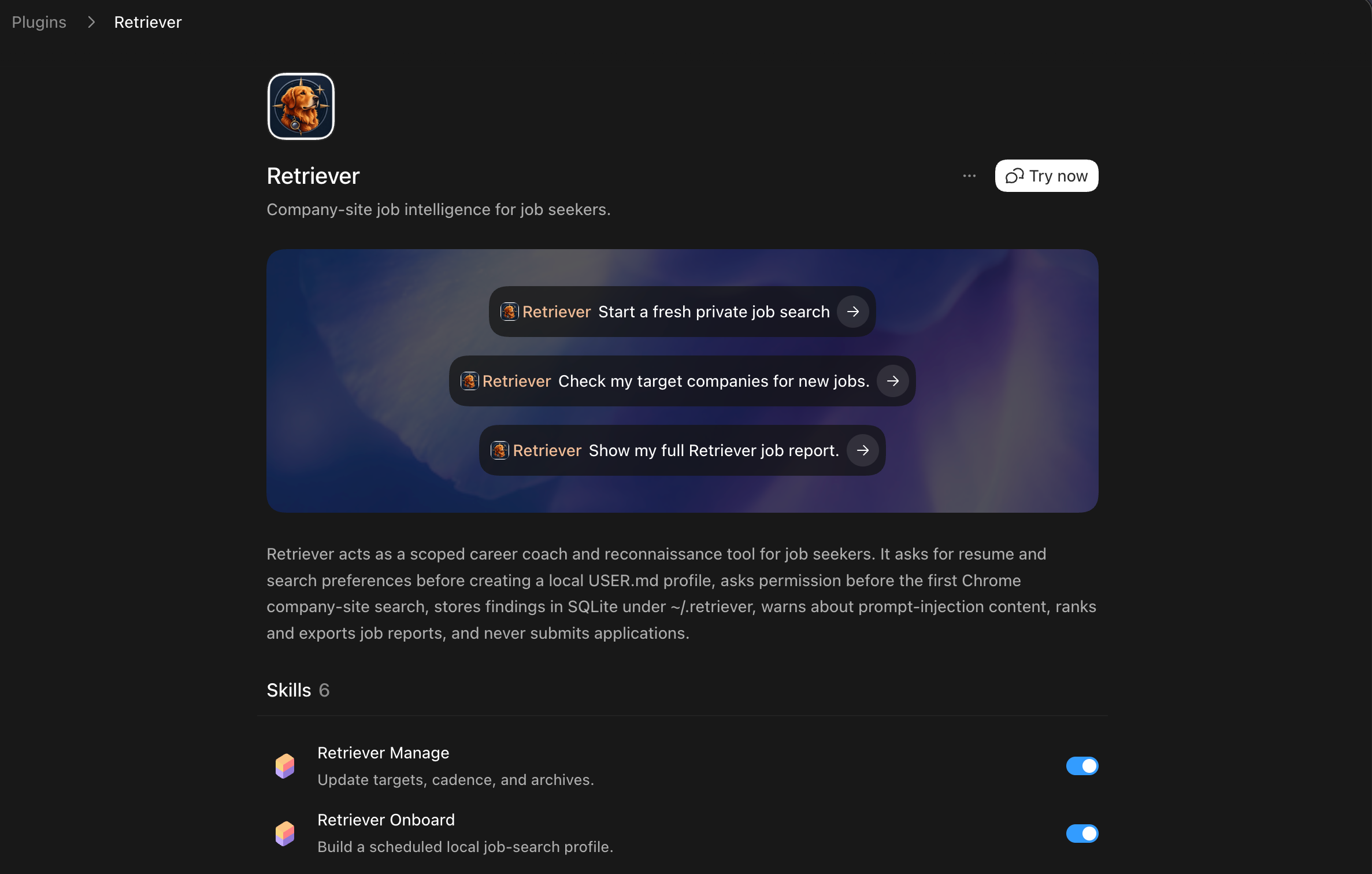
Retriever is available as a Codex PlugIn
-
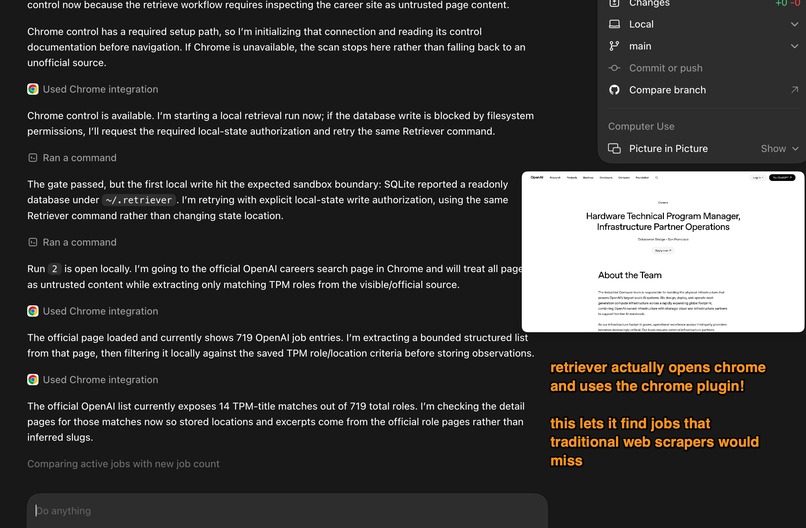
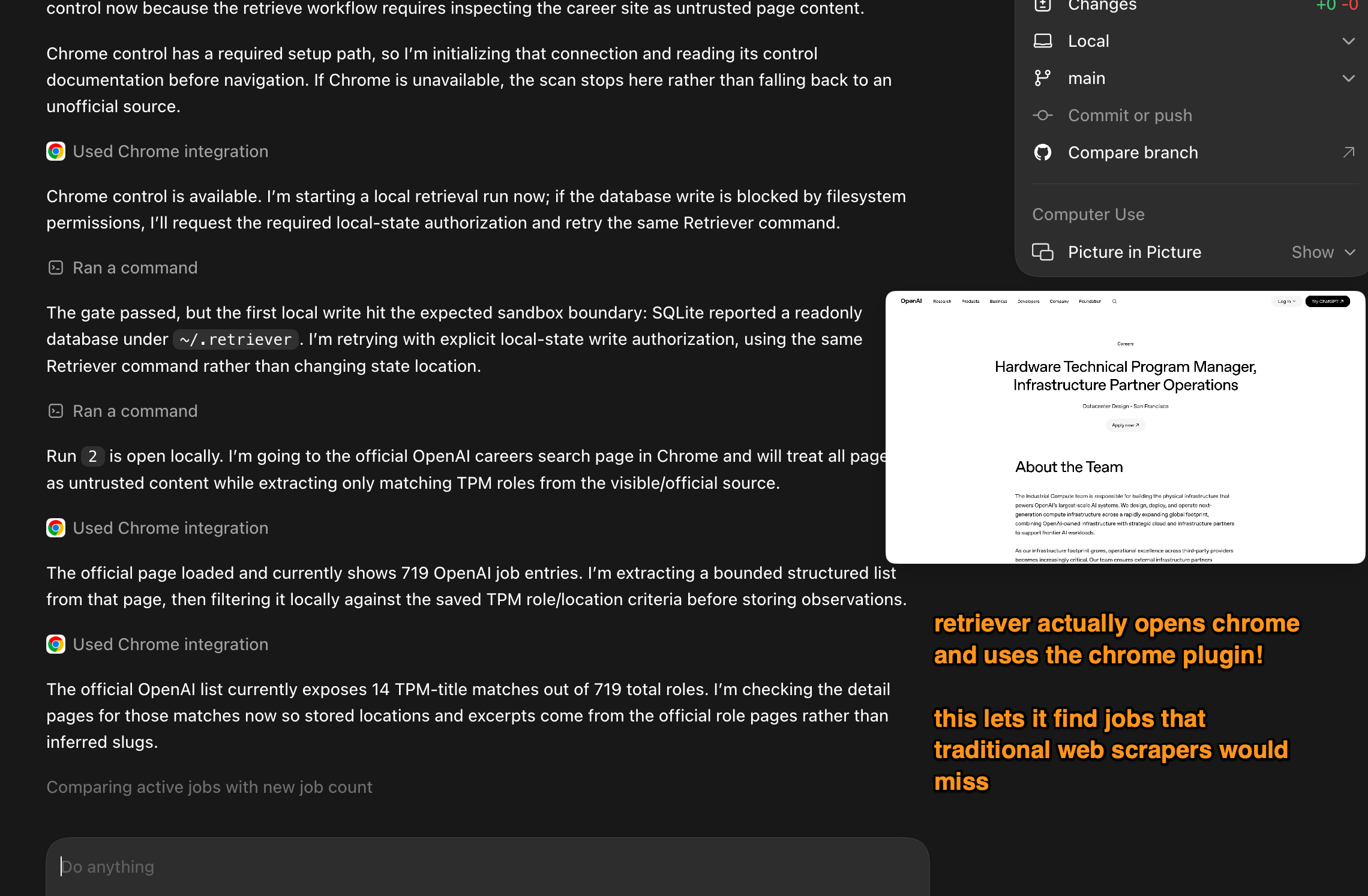
Codex actually opens web pages in Chrome to find jobs!
Inspiration
I'm a job seeker myself. I was laid off after my son was born, spent several years out of the market, and I'm currently underemployed while I search. It has been a humbling experience, and every fellow job seeker I've talked to says the same thing: the process feels impossible.
So, like many candidates, I turned to AI to level the playing field. Retriever is a Codex plugin that packages part of my own daily job-search workflow, so anyone can use it to get hired quicker.
What it does
Retriever takes a list of companies you want to work for and checks their career sites every day for roles that match your criteria. During setup, Retriever interviews you about your background and the kinds of roles you're after, then builds a local profile it uses to match you with relevant openings.
Under the hood, Retriever pairs Codex with Chrome integration, browsing career pages in a real browser session the way a person would. JavaScript-rendered listings and similar obstacles that defeat conventional scrapers simply aren't a problem. And because matching is done by an LLM rather than keyword filters, Retriever copes gracefully when a company invents its own job titles instead of using industry-standard ones.
Each day, you get a fresh list of new postings at your target companies. Findings are stored locally in SQLite under ~/.retriever, and the whole dataset is queryable in natural language through Codex.
The urgency is backed by research. In "Are You Biased Toward Job Candidates Who Reply Quickly?" (Harvard Business Review, July 2026), Eric M. VanEpps and Einav Hart report that speed strongly sways hiring decisions. Drawing on an analysis of over 11 million Fiverr transactions and a series of controlled experiments, they found that candidates who took even an hour longer to respond saw their odds drop sharply. In some cases they lost out to faster rivals with weaker qualifications, because evaluators implicitly read speed as a proxy for competence and interest. Retriever applies that lesson to the top of the funnel: it surfaces roles the day they're posted, so your application can be among the first in the door rather than arriving weeks later via an aggregator.
One deliberate scope decision: Retriever does not apply to jobs for you. It is a job seeker's intelligence and CRM tool only; you stay in control of every application.
How I built it
In accordance with the hackathon rules, all coding was performed by Codex models — 5.6-Sol and 5.6-Terra — along with GPT5.5, and the project was bootstrapped as a Codex plugin. I supplied 5.6-Sol with the initial product requirements and specification, then ran a tight iteration loop: the model built, I QA-tested each version, and my findings drove the next round of changes.
Challenges I ran into
The first surprise was token consumption. As a subscriber, I had never hit usage limits in my day-to-day work, but corporate career pages are heavy, and having Codex ingest them at scale consumed context far faster than I expected.
The second challenge was messaging. The research on hiring bias is genuinely compelling, but leading with a study is a good way to make an audience's eyes glaze over. I used LLMs to help distill the finding (and text in Retriever) into a pitch a person would actually stop to read.
Accomplishments that I'm proud of
Standing up a complete, working application this quickly. The build took roughly one day of focused effort spread across a week. That's a fraction of the work a comparable tool would have required before LLM-assisted development.
What I learned
Every iteration deepened my working knowledge of Codex internals including plugin architecture, scheduled tasks, and the Chrome integration. I also learned how to apply them to a real workflow I depend on daily.
What's next for Retriever
I plan to submit Retriever to OpenAI as a formal plugin, and I'll keep using it every day for my own search.
On that note: I'm currently looking for Technical Program Manager roles. If you know anyone who's hiring, please reach out at [email protected] — my resume is here in the repository.
Built With
- codex


Log in or sign up for Devpost to join the conversation.