Project name
Retrial
Tagline
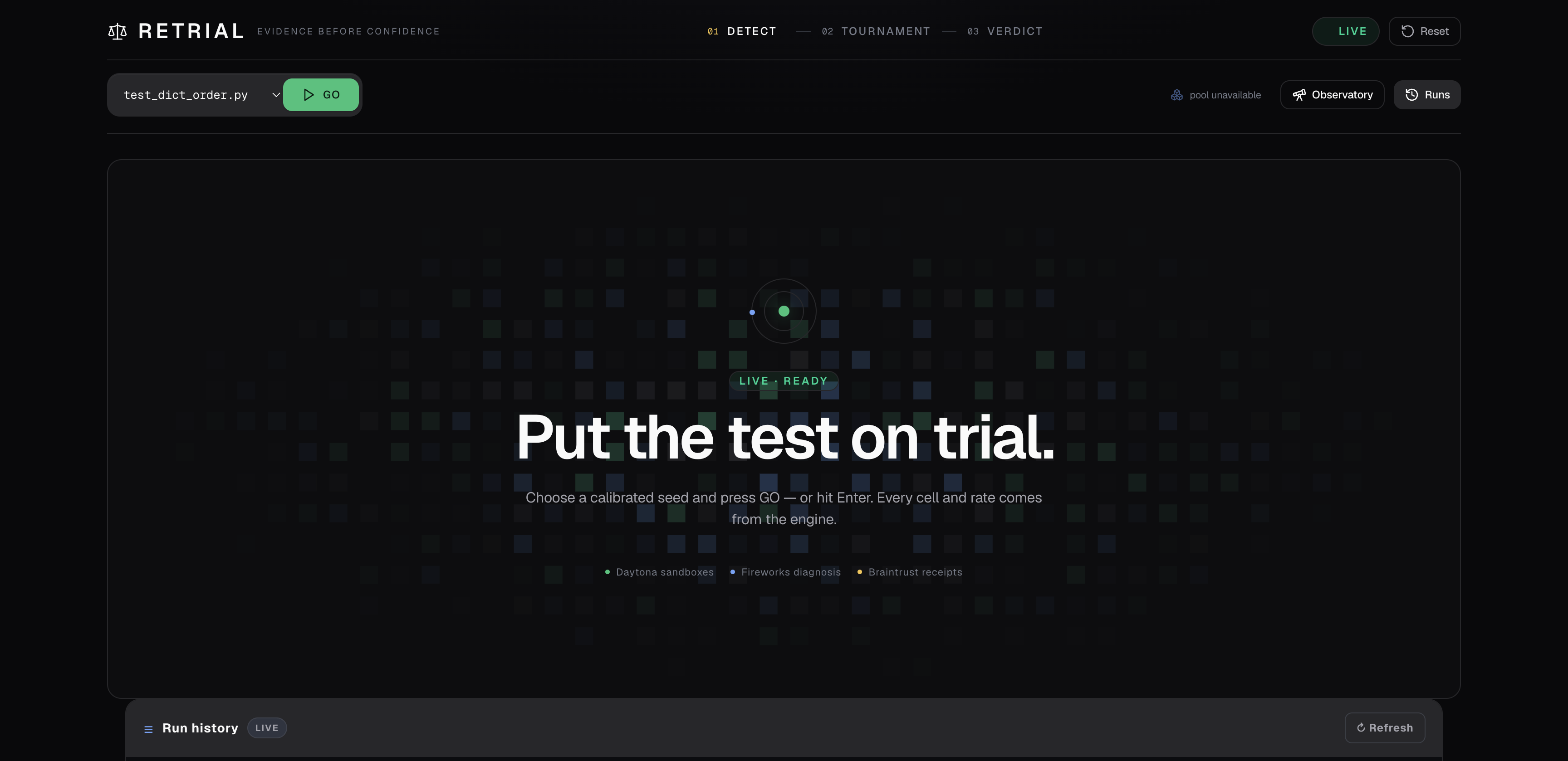
Your build isn't broken — it's lying. Retrial is the lie detector for flaky tests.
Elevator summary (2–3 sentences)
Flaky tests pass and fail on the same code, so a green run proves nothing and a red one gets ignored. Retrial reruns a suspect test across a swarm of disposable Daytona sandboxes to measure its empirical flake rate with a Wilson 95% confidence interval, then runs a hypothesis tournament — competing root-cause fixes from Fireworks models, each re-verified statistically across the swarm — and ships the survivor as an evidence-backed pull request with Braintrust permalinks as the audit receipt. It's the machine that doesn't just generate a fix; it proves the fix.
Built with
Daytona · Fireworks · Braintrust · ElevenLabs · CodeRabbit · GitHub · Python · FastAPI · React · Vite
Repo / media
- Public GitHub: https://github.com/nihalnihalani/retrial
- Demo GIF:
docs/assets/retrial-demo.gif - Verdict card:
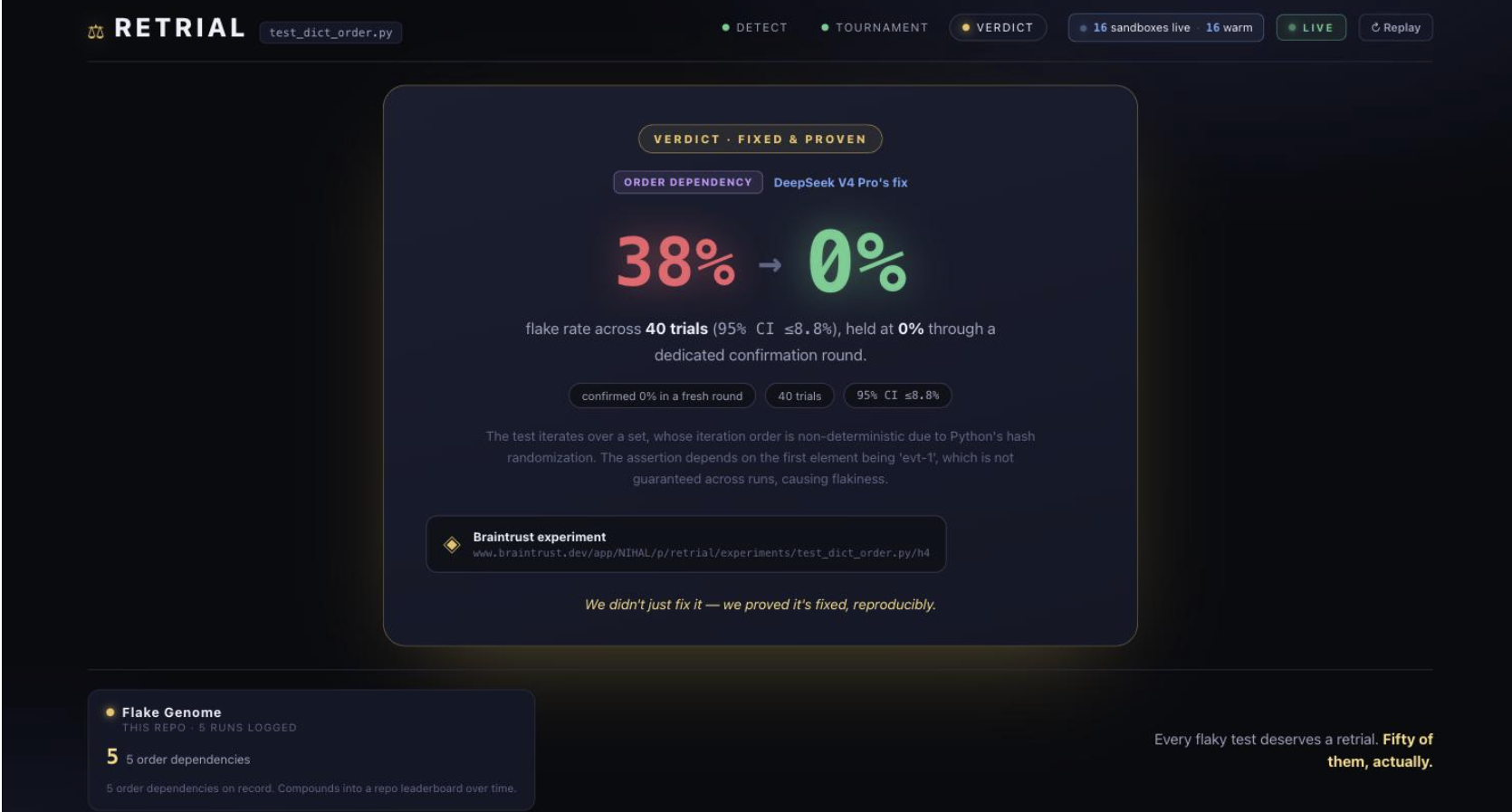
docs/assets/verdict-live.jpg - Event: Daytona HackSprint w/ Braintrust — SF, July 2026
Inspiration
Flaky tests are the number-one trust-killer in CI. A test that fails 40% of the time will pass three times in a row often enough that a human will merge — and will fail in production often enough that the team stops trusting the suite. In 2026 the whole industry noticed: Bitbucket, Datadog, and Kong all shipped flake-fixer agents. The pain is real, recurring, and budgeted.
Published research puts numbers on it (softly attributed): Google's work has put roughly 16% of tests somewhere on the flaky spectrum and reported about 3.7 engineering hours burned investigating a single flaky test, with roughly 1 in 7 suite runs hitting a flaky failure. Microsoft has reported that about 25% of CI test failures are flaky, at ~30 minutes of investigation each. Across the industry, teams burn an estimated 15–30% of CI time on reruns.
The deeper reason existing tools struggle is verification asymmetry. Flaky tests are the one bug class where verification, not generation, is the bottleneck. At a 40–50% flake rate, a single green run is statistically meaningless — which is exactly how every incumbent verifies a fix. Detection tools like Datadog and Bitbucket infer flakiness from weeks of accumulated CI history. We wanted something that works on demand, on any repo, in about a minute of sandboxes.
Everyone builds machines that generate fixes. We built the machine that proves them.
We named it Retrial — literally what it does: every rerun is a re-trial; the swarm is a court that establishes truth under evidence. (An earlier name, Polygraph, was already taken by an Nx shipping tool.) The pitch line writes itself: "Every flaky test deserves a retrial. Fifty of them, actually."
What it does
Point Retrial at a flaky test. It runs a measured pipeline —
detect → diagnose → tournament → confirm → promote → ship —
where every stage is empirical, not asserted. A live React tournament board subscribes to a typed event stream over WebSocket; the engine runs headless either way.
Act 1 — The lie detector (detect)
Retrial reruns the unmodified test across a swarm of disposable Daytona
sandboxes and measures its empirical flake rate with a Wilson 95%
confidence interval. Our locked demo seed (seeds/test_dict_order.py)
calibrated at 51% flake (95% CI 36–66%) over real Daytona trials — an
order/hash-dependency flake class, not a race. A recent live detect clocked
50% (95% CI 28–72%). The number is the lie made quantitative.
Incumbents need a month of CI history. We need sixty seconds.
Detect-gate (honesty): the tournament runs ONLY when detect verdict is
FLAKY. Otherwise the run terminates cleanly with no hypotheses and no PR:
| Detect verdict | Terminal | Meaning |
|---|---|---|
| ALWAYS_FAILING | REGRESSION | Fix the code, not the test |
| STABLE | ALREADY_STABLE | Nothing to fix |
| INCONCLUSIVE | INCONCLUSIVE_BASELINE | Can't prove flaky |
| ERROR | ERROR | No valid trials |
Act 2 — Differential diagnosis (diagnose)
Fireworks frontier models generate competing root-cause hypotheses — order dependency, shared state, timing, randomness — each with a concrete candidate patch. The unit of competition is the hypothesis, not the model; multiple models supply diversity of ideas. Live 4-model diagnosis takes roughly 23–29 seconds in parallel (bounded by the slowest model).
Act 3 — The tournament (verify)
Every hypothesis' patched copy is re-trialed across the swarm in parallel lanes. The board fills green/red live as trials land. Losers are eliminated as their confidence intervals stop beating the original rate. Sustained throughput measured at 6.1 trials/second in process isolation — about 200 trials in ~33 seconds.
Act 4 — Confirm (guard selection bias)
The winner isn't the one that looks right — it's the one that empirically survives. Retrial picks the lowest flake rate whose Wilson CI upper bound falls below the original's rate, then runs a fresh confirmation round on that winner alone. A winning fix confirmed at 0/40 is reported honestly as "≤8.8% at 95% confidence," never "0%." That recent live run went 50% → 0/40 (FIXED) with the full detect–diagnose–tournament–confirm arc in 42.7 seconds end to end — real Fireworks calls included.
Act 5 — Ship (human in the loop)
The winning fix waits at a promote gate (React modal + POST /promote). A
human approves; then PRSmith opens a real pull request via gh api with the
evidence dossier in the body — flake rate before/after, Wilson CIs, Braintrust
permalinks. If nothing fully stabilizes the test, Retrial instead opens a
quarantine PR carrying the same dossier. The run never dead-ends.
Extra capabilities that make it a product, not a demo script
- Rewind engine (Daytona experimental fork): opt-in fork-checkpoints for byte-identical trial starting state, plus time-travel bisection that freezes a suite at every test boundary and binary-searches to the test that poisons another.
- Sandbox Observatory: a live registry of every sandbox Retrial touches — role, lifecycle, fork lineage, exec history, destroy/reap controls, and an honest count-based spend estimate.
- Flake genome: every run records cause class and which model won —
compounding into a repo-specific leaderboard (
GET /genome). - ElevenLabs flake autopsy (opt-in): a spoken verdict narrated from the evidence dossier after the run finishes — numbers that cannot drift from the board.
- CodeRabbit (pre-run, disclosed): reviews the evidence-backed PR Retrial opens; latency is 1–5 minutes, so the demo review is pre-run and we say so.
Trap opening (how we make judges feel the problem)
Run the seeded test once live. Green → "Raise your hand if you'd merge." Red → rerun until green (the anti-pattern every engineer does) → "NOW would you merge?" Either branch reveals: it's ~51% broken. Your CI just lied to you, and you believed it. Then Retrial is the antidote.
Proven on a real bug: four plausible fixes, one survivor
We pointed Retrial at test_rearrange from
penman v1.2.1 — a real MIT-licensed
Python OSS project, catalogued in IDoFT (Illinois Dataset of Flaky Tests,
category NOD) and already fixed by the maintainer in
penman#102. Root cause:
model.random_order orders roles with Python's random module. We fed the
models a sanitized reproduction with every root-cause hint stripped, then
ran the full four-model tournament:
- Detect measured 100% flake (16/16, 95% CI 81–100%) on the sanitized repro.
- All four models correctly identified the randomness root cause from the failing test alone.
- Only one produced a fix that actually worked.
glm-5p2's patch — a valid alternative, not the maintainer's seed approach — drove the flake to 0/16, then survived a fresh confirmation round of 25 trials across 5 sandboxes (0 failures, 95% CI 0–13%). - The other three looked just as plausible and were rejected on measured
evidence:
glm-5p169% (11/16),kimi-k2p688% (14/16),deepseek-v4-pro94% (15/16). - Whole tournament: 85.5 seconds, 0 infra errors.
That's the thesis in one run: four fixes that all sounded right, one that held up under reruns. Naming the cause is cheap; proving the cure is the hard part.
Transparency: an earlier run of this experiment let the reproduction's comments name the root cause, and we initially over-claimed that models "rediscovered the maintainer's exact fix." A sanitized rerun did not support that. The numbers above are the corrected, hint-free run. Source:
seeds/real/penman_test_rearrange.md.
We reproduce and repair the honest class the substrate reaches — randomness and hash-ordering flakes. Thread/timing races do not flake on this Daytona container substrate (measured 0/120 across three variants) — we do not claim otherwise.
How we built it
Python engine (FastAPI + WebSocket) and a React/Vite tournament board, connected
by a typed event spine. The whole pipeline runs end-to-end headless before
any UI exists — the board is a subscriber, not the system. ui/src/types.ts is
the authoritative engine⇄UI contract; emitters live in engine/retrial/.
| Component | Role |
|---|---|
SandboxPool / ForkSandboxPool |
Warm, lease, recycle, destroy Daytona sandboxes; fork degrades stickily to snapshot |
TrialRunner |
One test execution in one leased sandbox; write+run collapsed into a single process.exec |
Verifier |
Wilson 95% CIs, adaptive early-stop, confirmation round, hermetic diagnosis |
DiagnosisEngine |
Fireworks multi-model structured {cause_class, explanation, patch} |
TournamentCoordinator |
DAG: detect → diagnose → verify-per-hypothesis → confirm → gate → ship |
EventBus |
Typed JSON events, ring buffer, fan-out to UI / logs |
EvidenceLedger |
Braintrust Experiments as the public scoreboard + permalink receipts |
PRSmith |
Winner ⇒ fix PR; no winner ⇒ quarantine PR — via gh api, behind promote gate |
SandboxRegistry |
Observatory feed: every sandbox, fork lineage, exec history, destroy controls |
Narrator |
ElevenLabs eleven_v3 dossier-templated autopsy (opt-in) |
| Flake genome | SQLite/JSON cause-class taxonomy + model win-rates per repo |
Daytona — the swarm (load-bearing)
This is the substrate. Retrial's entire premise — measure empirical flake rate — requires many isolated reruns, and disposable parallel sandboxes are the exactly-right tool. We use Daytona in two complementary modes.
1. Snapshot sandbox pool (default demo path)
engine/retrial/pool.py warms a pool of container sandboxes from a
pre-baked snapshot in region target="us". Verified on this account:
- Create → started ≈ 0.7s; 16 concurrent creates ≈ 2.0s
- Pre-warmed pool:
run_started→ first trial ≈ 0.60s (was 12.5s cold) - Every sandbox gets
auto_delete_interval(AUTO_DELETE_MIN, default 60) so a crashed run cannot leak credit forever - Infra errors never return a sandbox to the pool and are excluded from flake
math (
errorskey) — they never inflate the fail rate
Isolation level matched to flake class (the core design decision):
| Mode | Behavior | Measured throughput |
|---|---|---|
process (default) |
Reuse warm sandbox; fresh python3 per trial = fresh PYTHONHASHSEED + scheduling |
6.1 trials/s |
sandbox |
Fresh sandbox per trial; destroy dirty in background | 2.7 trials/s |
Process isolation is correct for order/scheduling flakes and is why a fully live 3-minute demo fits with margin. Sandbox isolation is reserved for state-polluting flakes (filesystem / port / env). Fresh-env-per-trial is a scientific requirement, not an implementation detail.
Throughput lever: we collapsed write+run into a single Daytona exec
round-trip (base64 seed → python3 /tmp/seed.py). That doubled throughput
(3.1 → 6.1 trials/s). The true unit cost is ~5s per 16-concurrent batch
of execs, not sandbox create time.
Hermetic mode (optional, default OFF): a second detect pass creates
sandboxes with network_block_all=True at create only (never mid-run —
that can kill the SDK control channel). CI overlap with the open-network
detect → env_independent (eliminates external_dep by infrastructure);
non-overlap → external_dep. Validated live: 56% vs 50%, env_independent.
2. Rewind engine — Daytona _experimental_fork (opt-in)
Ported from our Rewind execution-search project and selected with
RETRIAL_POOL_BACKEND=fork (default remains the safe snapshot pool).
Instead of creating N independent sandboxes (each with its own cold-start
history), ForkSandboxPool (engine/retrial/forkpool.py):
- Warms ONE root sandbox (repo + deps + hot caches) on the fork-capable
region (
us-east-1, Linux VM snapshot — containers inusare the critical-path demo substrate; VMs/fork are the scientific upgrade). - Freezes a checkpoint — a paused fork-child capturing full filesystem + RAM while the root keeps running.
- Calls Daytona's
_experimental_forkto spawn N byte-identical trial clones from that checkpoint.
Why this matters statistically: every trial clone starts from the same initial fs+RAM state, so trial-to-trial variance is purely the flake under test — not provisioning noise (different cache states, different first-exec timings). Tighter trial distribution → tighter Wilson CI for the same trial budget.
Honesty about the experimental surface:
- The fork/pause/start APIs are experimental. Forks are serialized (parallel
fork returns HTTP 409). Spend is guarded (
RETRIAL_MAX_FORKS, default 64). - The fork path is exercised against a mocked SDK in CI. Fork-primitive
timings we cite come from the Rewind spike (
docs/SPIKE-RESULTS.md) and are attributed as such — not re-claimed as re-measured in this repo. - Sticky degrade contract: on ANY fork-path failure (including a missing
_experimental_forkAttributeError), the pool permanently falls back to the proven snapshotSandboxPoolfor its lifetime and emitspool_degraded. The UI shows an honest "snapshot fallback" banner. We never silently pretend fork worked.
Time-travel flake bisection (engine/retrial/bisect.py, retrial bisect /
POST /bisect): for order-dependency flakes across a suite, run the suite
prefix in a live root while freezing a checkpoint at every test boundary, then
rerun ONLY the suspect from each checkpoint with the same Wilson-CI oracle,
binary-searching to the exact test that poisons it. Requires the fork backend
(the capability is the fork — no snapshot fallback). Assumes the flake rate
is a monotonic step function across checkpoints; noisy probes get a full-budget
confirmation pass; a contradicted confirmation reports inconclusive rather than
guessing.
3. Sandbox Observatory
A thread-safe SandboxRegistry tracks every sandbox Retrial ever touches —
pool sandboxes, fork roots/checkpoints/trial-clones, and bisect probes — with
role, lifecycle state, fork-lineage parent, the command running now, a bounded
ring of recent execs, and a Daytona preview link when one is exposed. Typed
events stream over /ws; GET /sandboxes returns the live grid + lineage tree
- exact live/total-ever/destroyed counts;
DELETE /sandboxes/{id}andPOST /sandboxes/destroy_allare real resilience controls (mid-run single delete is safe — infra errors are excluded from flake math). The Observatory panel in the UI is the backstage view of the swarm.
Daytona is not decorative. The product is Daytona's speed, parallelism, disposability — and, when opted in, its experimental fork checkpoints.
Fireworks — the differential-diagnosis engine
DiagnosisEngine (engine/retrial/diagnosis.py) calls Fireworks'
OpenAI-compatible API (https://api.fireworks.ai/inference/v1) across a panel
of models — glm-5p2, glm-5p1, kimi-k2p6, deepseek-v4-pro (read from
FIREWORKS_MODELS, never hardcoded; slugs use "p" not ".", verified live).
Each model produces structured {cause_class, explanation, patched_code}. Model
diversity is hypothesis diversity. Without a key the engine honestly degrades to
cached hypotheses or detect-only.
Braintrust — experiments as the scoreboard
EvidenceLedger (engine/retrial/ledger.py) models each hypothesis as a
Braintrust Experiment; each batch of reruns is an eval run whose scorer is
the empirical pass rate — a real, reproducible eval, not an LLM vibe-check. The
Braintrust dashboard literally is our tournament scoreboard, and the
permalinks are the governance receipt. A shipped PR
(retrial#1) carries multiple
Braintrust experiment permalinks documenting a measured fix across the swarm.
We didn't just fix it — we proved it's fixed, reproducibly, at a link you can
audit. Without a key, ledger calls are silent no-ops.
ElevenLabs — the flake autopsy (opt-in, OUTPUT only)
engine/retrial/narrator.py turns the final evidence dossier into a short
spoken autopsy after tournament_done — hesitant over eliminated hypotheses,
confident over the confirmed fix. Served at GET /narration/<run_id> and
offered as a play button under the verdict card (NarrationPlayer in the UI).
Three rules we built around:
- The script is derived, not generated. Narration text is templated deterministically from the result dict — no LLM sits between the dossier and the words. An LLM narrator could hallucinate a number that contradicts the board mid-pitch; a template cannot.
- The Wilson law applies to speech too. "0 of 50" is spoken as "at most 8.8 percent, at 95 percent confidence," never "zero percent."
- It can never cost a verdict. Synthesis runs off the run thread; every
failure degrades to "no audio."
NARRATEdefaults to 0 so the demo path is byte-identical unless opted in (~20s synth, ~50s of audio per verdict on this account). Model:eleven_v3(audio-tag support). Voice: Matilda (verified live). Retrial never takes voice input.
CodeRabbit — the PR gate (pre-run, disclosed)
CodeRabbit is not an in-engine API call. After PRSmith opens the fix (or quarantine) PR, CodeRabbit's GitHub App reviews that PR for quality and safety before merge — the natural last mile on an evidence-backed patch. Its review latency is 1–5 minutes, which does not fit inside a live 3-minute stage demo, so for the pitch we pre-run the review and disclose that unprompted. We never claim live CodeRabbit turnaround on stage. Depth over theatre.
GitHub / PRSmith — shipping
prsmith.py creates fix/quarantine PRs server-side via gh api (ref → blob →
PR), never touching the local working tree. Default path is behind the human
promote gate. Real output example:
retrial#1 — statistical
receipts + Braintrust permalinks in the body.
Statistics as a product feature
- Wilson 95% CI everywhere a rate is shown (UI, PR, spoken autopsy).
- Adaptive early-stop when a CI fully excludes the decision threshold — why the live demo fits 3 minutes.
- Confirmation round on the winner guards selection bias across candidates.
- Neutering guard disqualifies trivial-pass patches (
sys.exit(0),assert True, deleted assertions) so a stub in a bad-wifi fallback cannot ship as FIXED. - Never
rate or <default>—0.0is falsy in Python; a measured zero flake rate must use explicitis Nonechecks or the narrator invents nonsense. Fabricating a number is worse than showing none.
Challenges we ran into
1. Seeds must be calibrated on Daytona, not locally. Local flake rates are
meaningless — CPython version and CPU constraints differ. We built
scripts/calibrate_seeds.py (40+ trials, target 40–55% fail = IDEAL) and ran
~360 real Daytona trials across three rounds before locking
seeds/test_dict_order.py at 51%.
2. The flake class the substrate can actually reproduce. We assumed thread/timing races would be the natural demo. They measured 0/120 across three variants (including Barrier + split read-modify-write) — CPU-constrained container scheduling suppresses them. Claiming "we reproduce race conditions" would have been a lie. We pivoted to order/hash and randomness flakes, and we say so in the pitch.
3. Throughput vs scientific isolation. Full create+write+exec+delete was ~1.5–2 trials/s — too slow for a live tournament. Process-isolation reuse plus collapsing write+run into one exec round-trip got us to 6.1 trials/s without abandoning fresh-interpreter-per-trial for the flake classes we target.
4. Daytona's experimental fork is powerful and fragile. Parallel fork → 409;
sandbox.copy() is a Pydantic false-friend (not a fork); _experimental_fork
may be missing depending on target/snapshot. We built sticky degrade to the
snapshot pool with a visible pool_degraded banner rather than failing the demo
or lying about which backend served the trials.
5. Selection bias and dishonest "fixes." Racing four candidates and picking the luckiest green streak is bad science — hence the confirmation round. Trivial-pass patches look perfect under any trial budget — hence the neutering guard. Always-failing tests are not flakes — hence the detect-gate that refuses to tournament a REGRESSION.
6. Demo-config law (learned the hard way). Strict CI-upper rule: 0/40 →
upper 8.76% < 10% ✓ FIXED; 0/16 → upper ~19% ✗ INCONCLUSIVE → QUARANTINE
even for a perfect fix. Short trial budgets silently quarantine genuine fixes on
stage. MAX_TRIALS >= 40 is non-negotiable for any run that must reach FIXED.
7. Live diagnosis latency vs a 3-minute pitch. Four Fireworks models take
23–29s. Solution: hit GO at second zero of the pitch; the trap opening covers
the diagnosis window; the tournament starts live as the story arrives. Bad venue
wifi → certified cached hypotheses (scripts/fallback_hypotheses.json),
disclosed unprompted — never passed off as live generation.
8. Statistical honesty binds spoken output too. An early narrator used
rate or default; a measured 0.0 flake rate is falsy, so the autopsy announced
"flaked 100 percent" for a candidate the board showed at 0%. We fixed it with
explicit is None checks and made Wilson phrasing mandatory in speech.
Accomplishments that we're proud of
- Calibrated an IDEAL demo seed on the real substrate:
test_dict_order.pyat 51% flake (95% CI 36–66%) after ~360 Daytona trials — not a local guess. - Process isolation at 6.1 trials/s with a warm pool first-trial latency of 0.60s, making a fully live 3-minute demo real with margin.
- A fully-generated live run with no cached hypotheses: detect 44% (7/16) → 4 live Fireworks hypotheses → a wrong 'timing' guess stayed 56% flaky and was eliminated ("CI overlaps original flake rate") → winner confirmed 0/24 (CI ≤14%) → FIXED with a real Braintrust permalink. The differential-diagnosis story happened for real, autonomously.
- End-to-end arcs that fit the pitch: full tournament (detect + 2 hypotheses + confirm, 80 trials) in 17.3s; a recent full arc including live Fireworks in 42.7s (50% → 0/40 FIXED).
- Real OSS evidence: the penman IDoFT specimen — four models named randomness; only one fix survived confirmation; the other three (69/88/94%) were eliminated on evidence. We published our own overclaim correction when the sanitized rerun changed the story.
- A real evidence-backed PR with statistical receipts and Braintrust permalinks in the body — not a mocked ship step.
- The Rewind merge:
_experimental_forkpool + time-travel bisect + Sandbox Observatory, with sticky degrade honesty when the experimental path fails. - ElevenLabs autopsy that cannot lie to the room: dossier-templated script, Wilson spoken aloud, opt-in so it never burns demo time unless asked.
- A compounding flake genome already accumulating — live
GET /genomereturns real cause-class and model win-rate data. No single model dominates; the tournament beats picking a favorite.
What we learned
Verification asymmetry is the product. Flaky tests defeat single-pass verification by definition. Parallel disposable sandboxes aren't a sponsor checkbox here — they are the shape of the solution.
The substrate chooses which bugs you get to fix. Thread/timing races that flake on a laptop may be silent inside a CPU-constrained container. Calibrate on the swarm you ship on, or your demo is fiction.
Depth beats breadth on sponsor tools. Daytona + Fireworks + Braintrust are load-bearing. ElevenLabs and CodeRabbit are natural polish with honest limits (opt-in narration; pre-run review). Kitchen-sink integrations score worse than one substrate used flagship-deep — including Daytona's experimental fork, used for a real statistical reason (identical initial state), with a real degrade path when the experiment fails.
Statistical pedantry is a feature judges (and CTOs) feel. Wilson CIs, confirmation rounds, detect-gates, and neutering guards are not academic decoration — they are why a 0/16 "fix" doesn't ship and why a spoken autopsy cannot contradict the board.
Plan B is often the winning path. Concurrent snapshot container fan-out in
us is the measured, demo-safe critical path. Experimental VM fork in
us-east-1 is the upgrade for identical-state trials and time-travel bisect —
not a requirement to claim Daytona was used well.
Honesty compounds. Disclosing pre-computed pieces (cached hypotheses on bad wifi, pre-run CodeRabbit) unprompted builds more trust than claiming everything was live. Correcting our own penman overclaim in writing is part of the product story, not a footnote to hide.
What's next for Retrial
The compounding moat is the flake genome, and it's already accumulating — not a roadmap slide. Every run classifies the flake and records which model won on which cause class. Live data already shows no single model dominates, which is exactly why a tournament beats picking one favorite. That's the seed of a repo-specific flake leaderboard: a statistically-weighted model routing table that sharpens the more you run it.
From there:
- Detection → prediction → prevention. A CI gate that knows your suite's failure taxonomy before the flake ever reaches a human.
- Hermetic external-dep path in production workflows — network-blocked second passes that distinguish env-independent flakes from third-party dependency flakes by infrastructure, not vibes.
- Productionize fork/bisect time-travel for order-pollution suites: the Rewind engine already checkpoints at every test boundary; the next step is making that a default CI affordance wherever fork-capable VMs are available, with snapshot fan-out remaining the universal fallback.
- Richer Observatory governance — spend meters, lineage-aware reaping, and audit exports that sit next to Braintrust receipts in the PR body.
Detection today. Prediction and prevention next. Every flaky test deserves a retrial. Fifty of them, actually.
Built With
- braintrust
- copilotkit
- daytona
- elevenlabs
- fireworks
- githubcli

Log in or sign up for Devpost to join the conversation.