-
-
-
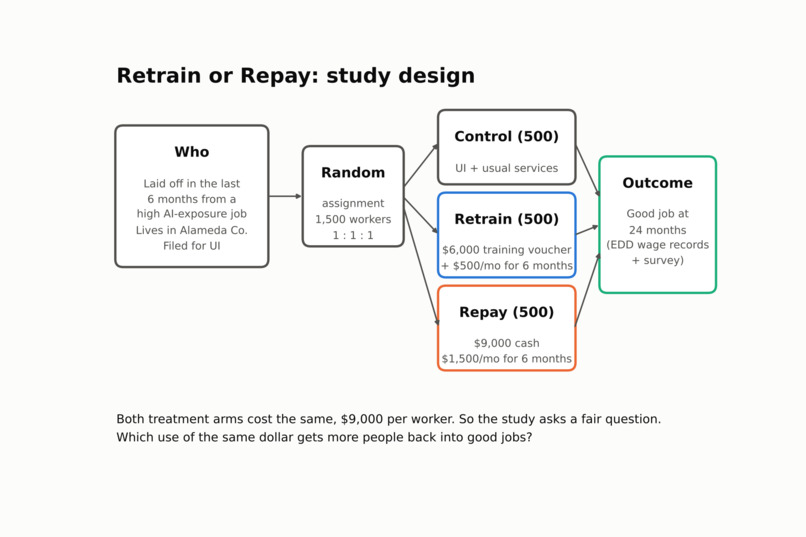
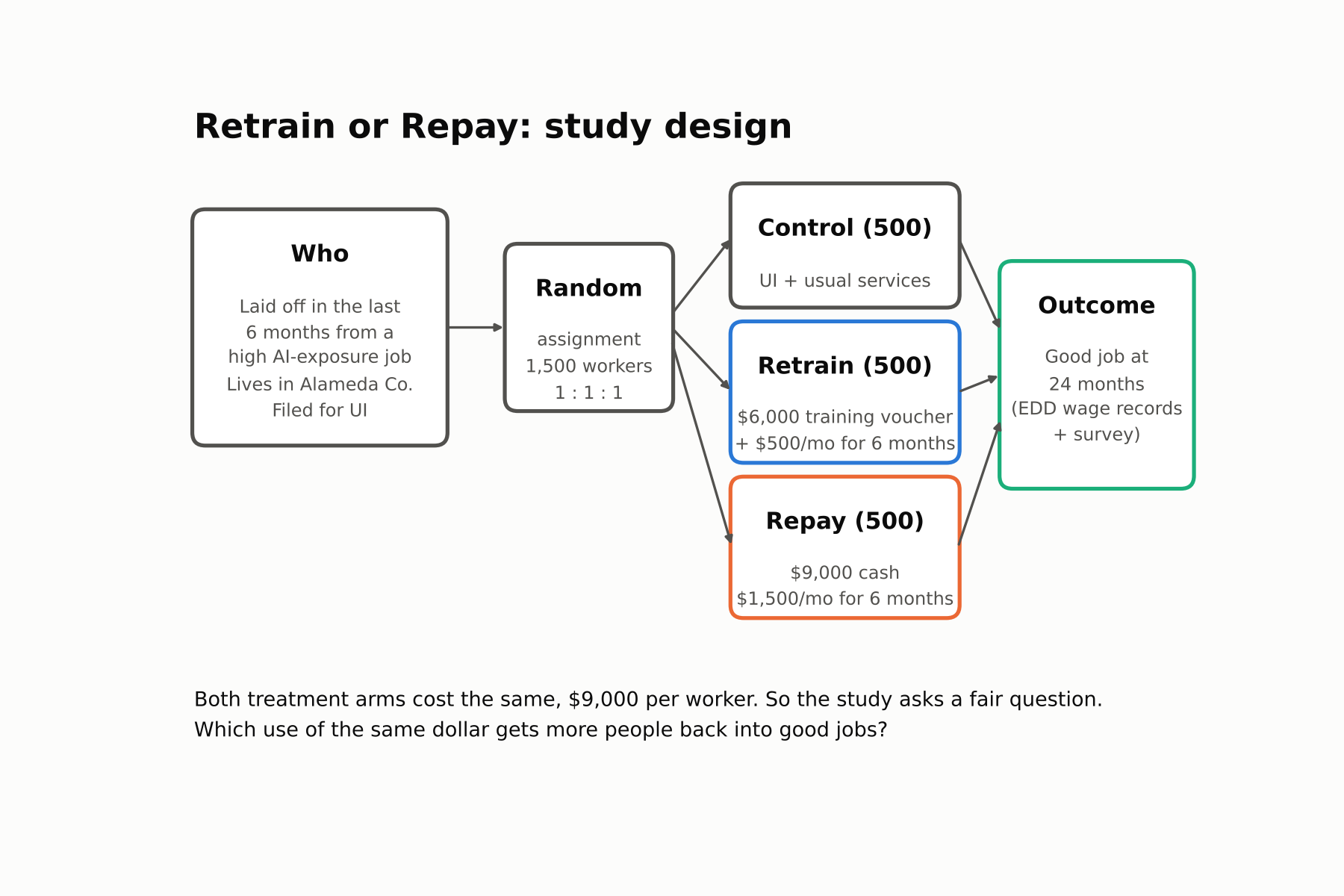
Study design: three groups, and both treatment groups cost $9,000 per worker
-
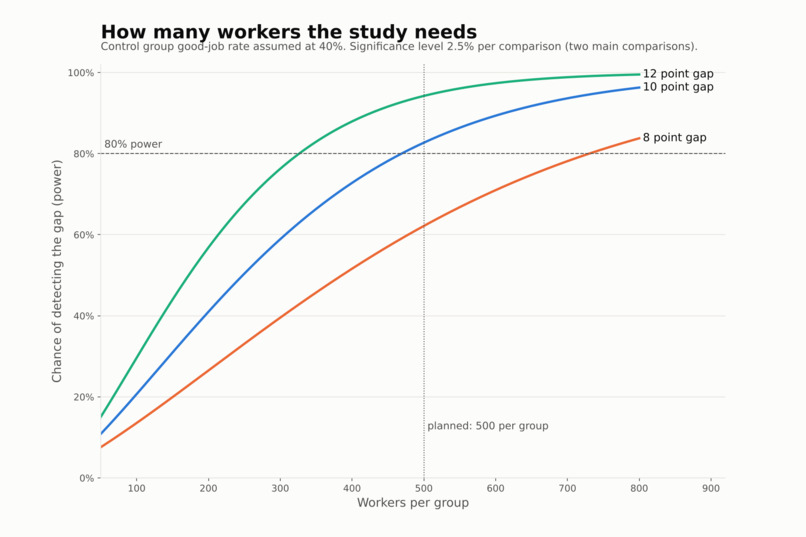
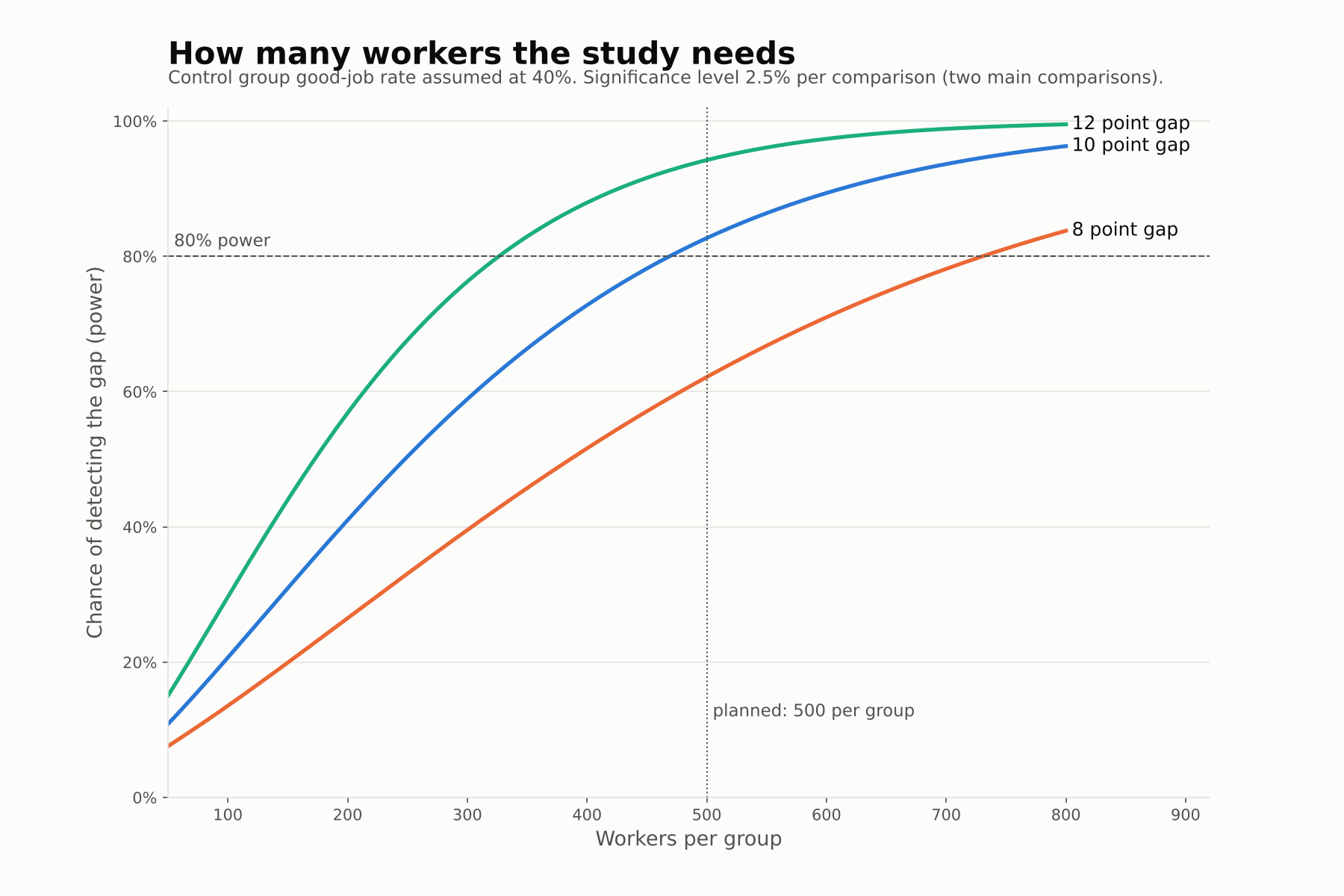
Power analysis: 500 workers per group gives an 83% chance of detecting a 10 point gap
Inspiration
While working on my research paper, "The Safety Net Was Not Built for This," I spent a long time matching AI exposure scores to wage data for 667 jobs. One result kept bugging me. Most jobs that are highly exposed to AI pay pretty well. Office and admin jobs don't. They're exposed and low paid, and most of the people doing them are women.
So I looked at what those workers actually get if they're laid off. In California it's unemployment, which tops out at $450 a week. The one federal program that paid people to retrain while helping with their bills, Trade Adjustment Assistance, started shutting down in 2022. That leaves a check that buys some time to look for the same kind of job that's going away.
That pushed me toward a more practical question. If my county had money set aside for these workers, should it pay for training or just give people cash? I went looking for a study that compared the two at the same cost and couldn't find one. So I designed one.
What it does
Retrain or Repay is a plan for a real experiment in Alameda County, where I live. 1,500 people laid off from high AI-exposure jobs would be randomly placed in one of three groups.
- Control. Regular unemployment and job center help.
- Retrain. A $6,000 training voucher plus $500 a month for six months, so people can afford to stay in class.
- Repay. $9,000 in cash with no strings attached.
Both options cost the same, and that's the whole point. If training cost more, you'd never know whether training worked or you just spent more money.
Success is measured in a plain way. Two years later, is the person earning at least 90% of what they made before the layoff? State wage records can answer that for almost everyone, so people don't quietly drop out of the results.
My guess is that cash looks better at first, since people in training aren't working yet, and training pulls ahead by year two. I'd still be glad to be proven wrong. Any clear answer tells a county where to put its next dollar.
How I built it
It started with a lot of reading. Card, Kluve and Weber's review of more than 200 programs showed that training usually looks weak for the first year and pays off later, which is why my study runs 24 months instead of 6. The sector training trials (Katz et al. 2022) and the Trade Adjustment Assistance results (Hyman 2022) convinced me training has a real shot. A large guaranteed income trial (Vivalt et al. 2024) made me take cash seriously too. People there worked a little less and didn't land better jobs, but they weren't laid-off workers, so it doesn't settle the question.
Next I used Python to figure out how big the study had to be. With 500 people per group, it has an 83% chance of catching a 10 point difference in good-job rates.
$$n = 2\left(\frac{z_{1-\alpha/2} + z_{1-\beta}}{h}\right)^2, \quad h = 2\arcsin\sqrt{p_1} - 2\arcsin\sqrt{p_2}$$
I made the charts in matplotlib and put the full design, literature review, risks, ethics and references in the attached PDF. The pitch video is narrated in my own voice.
Challenges I ran into
Keeping it fair was the hardest part. Training normally costs more than a check, so I had to split the Retrain budget between tuition and a living stipend to land at exactly $9,000. Without the stipend, people would drop out of class to pay rent and the test would be rigged against training.
Defining a "good job" was harder than I expected. Counting any job at all would call it a win when a former office manager ends up stocking shelves. I settled on 90% of prior pay because it's simple, it can be checked with real records, and it captures whether someone actually recovered.
The other challenge is cost. The full study would take about $9 million in payments, which is a lot to ask for. That's why I'm also pushing for a small first step.
Accomplishments that I'm proud of
My paper argued that the safety net doesn't fit what AI is doing to jobs. This project is my attempt at the next step, a way to actually find out what works instead of just saying the current system falls short.
What I learned
When you measure matters as much as what you measure. A study that stopped at six months would probably say cash wins and miss the real story.
I also learned that research design is full of value choices. Picking "90% of old pay" as success is a judgment call about what recovery means, and I had to be able to defend it.
What's next for Retrain or Repay
Through my school civics project, I'm pitching a $40,000 AI reskilling voucher pilot to a Dublin City Council member. A pilot that size can't prove anything about results, but it can answer the practical questions first. Can the city find eligible workers? Will they use the vouchers? Which local programs will take them? Those answers would make a full county study much easier to launch.

Log in or sign up for Devpost to join the conversation.