-
-
Logo of Retrace
-
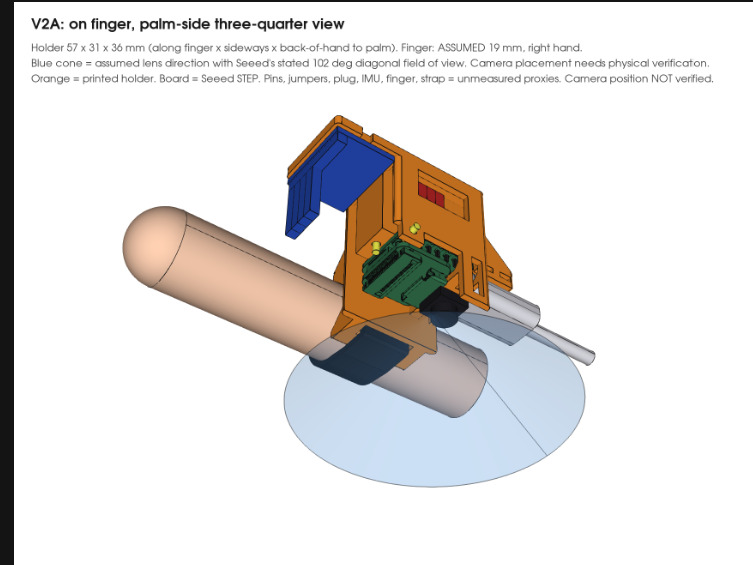
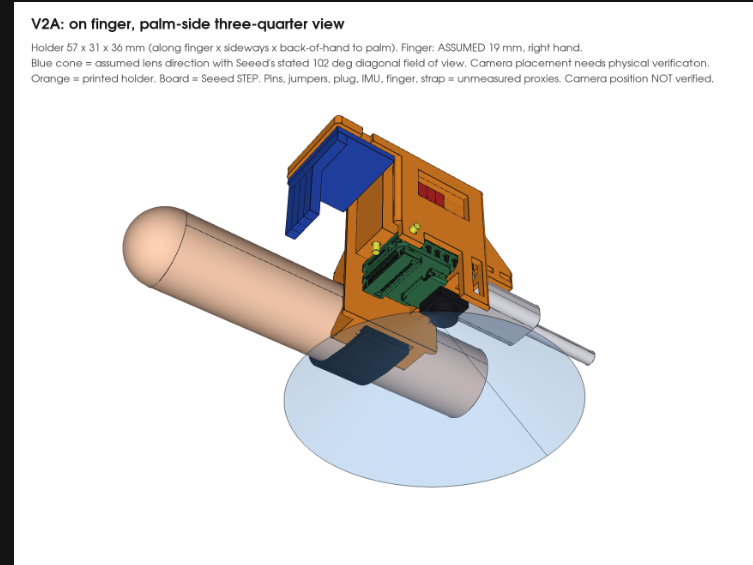
3d model of retrace ring
-
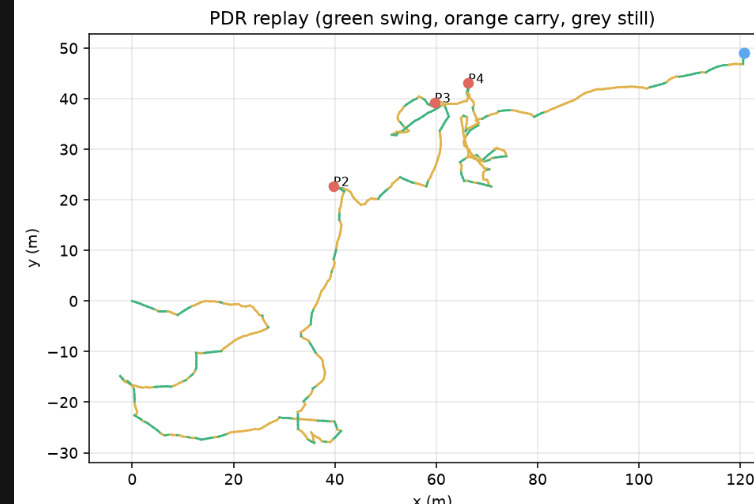
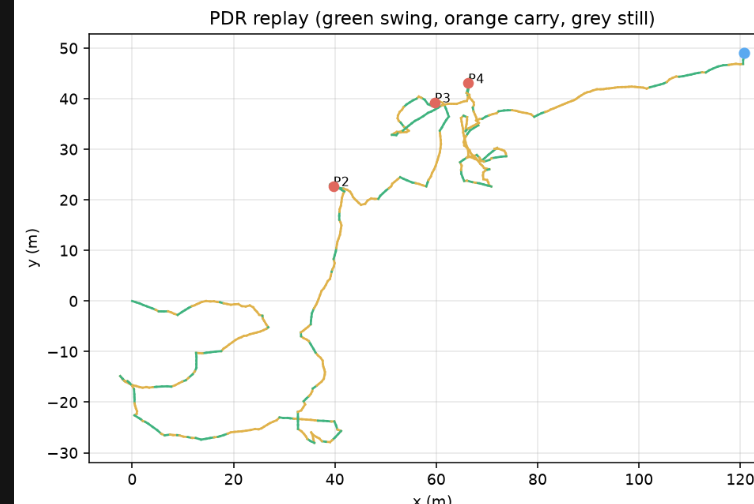
Pathing of retrace!
Inspiration
I lose things. Constantly. I'm always rushing out the door and then I'm standing in the hallway patting my pockets, because my keys or my wallet are somewhere in the apartment and I have no idea where. So I stay behind. I miss the bus, I'm late to the thing, and it's always over an object I was holding ten minutes ago.
The fix that exists is a tag. Tile, AirTag, whatever. But tags only work on things you remembered to tag, and buying one for everything I own isn't realistic — I can't afford to tag my life. The things I actually lose are the untagged ones.
So I started thinking about it backwards. I don't need the object to announce itself. I need a record of what my hands did. My hand is the thing that put the keys down. What if the hand remembered?
And the more I sat with it, the more I realized I'm the easy case. I'm annoyed and late. For someone with memory loss, or a brain injury, or ADHD, this happens many times a day, and it isn't an inconvenience — it's a thing that chips away at living on your own. Those are the people this should be for. I just happen to share a small version of their problem.
What it does
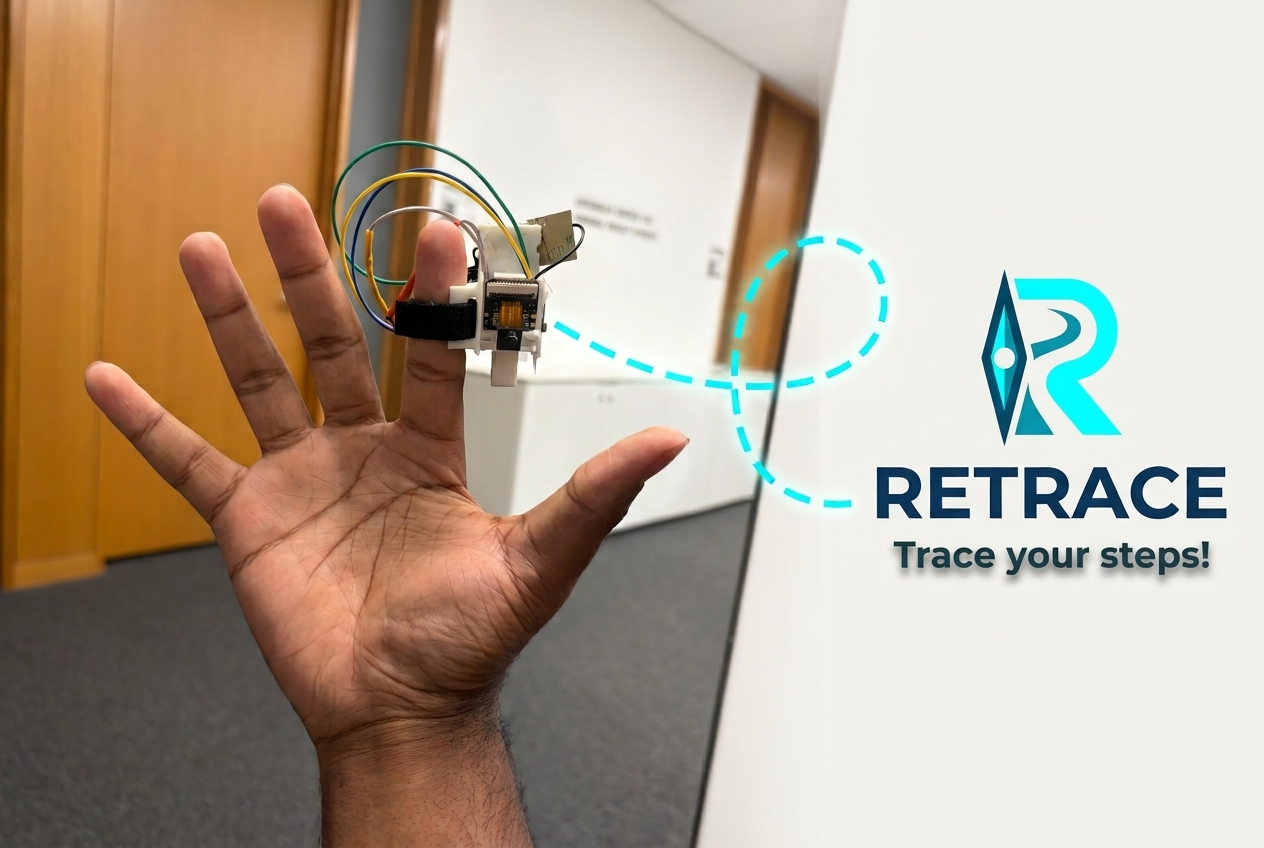
ReTrace is a camera ring you wear on your index finger, paired with a phone in your pocket.
- You set something down and save it with a tap.
- The ring photographs the spot and names what it saw: "keys, on the wooden desk, next to the laptop."
- Later you press Find. The ring vibrates — slowly when you're facing away, faster as you turn toward it and close the distance — while a live map on screen draws your path and pins where the object is.
No tags. No app to remember to open. Nothing attached to the object at all.
How we built it
The ring. A Seeed XIAO ESP32S3 Sense on a 3D-printed finger mount: a palm-facing camera, an MPU6050 motion sensor, and a vibration motor, streaming VGA frames at ~27 fps over USB.
The phone. An iPhone in your pocket, streaming orientation, gyro, compass and pedometer data at 100 Hz to the laptop. No camera — that was a hard requirement for us.
The laptop. A Python service that owns the ring's serial link, fuses the phone's heading and steps into a walked path, stores each saved item with its position and photo, names objects with a vision model, and decides how fast the ring should pulse.
The haptics. One motor, one pulse type. We encode distance as pulse rate rather than intensity, because a 22-person study on hand guidance found intensity-coded distance had no significant effect on performance and recommended rhythm instead.
Challenges we ran into
Almost everything we tried first didn't work. Instead of guessing why, we measured it, and the measurements are what built the final design.
The ring's camera is blocked most of the time. Over a 10-minute wear test, 5,878 analysed frames: 42% blocked by fingers, 29% fully covered, and only ~28% usable. A palm-facing camera on a swinging hand sees pants, floor, and blur.
Ring-only dead reckoning missed by ~4 meters. We walked 10 out-and-back loops of about 15 m each and tuned 2,187 parameter combinations against them. The best setting still landed a median 4.0 m from the start point, and only got there by breaking our own sit-still control test.
A finger-worn gyro read the turn-around correctly 4 times out of 10. Every loop had one 180° turn. The ring measured 175°, 169°, 162°, 136°, 131°, 128°, 110°, 107°, 77°, 30°. The wrist turns as much as the body does, and a sensor on your finger can't tell the difference.
What survived: walking time out matched walking time back, median ratio 1.00 across 10 walks. That single result is why tracking moved to the pocket and the ring kept the jobs a ring is actually good at — sensing the hand, seeing what it holds, and talking back through touch.
We also chased wireless streaming for hours before measuring that the camera link gave 0.1–3 fps in a crowded 2.4 GHz room while the motion data held 100 Hz. We cut it and ran the demo on USB.
Accomplishments that we're proud of
- A working passive memory loop: put something down, tap, walk away, get guided back by touch.
- We killed our own favorite ideas with data instead of defending them. Three separate approaches were measured, failed a pre-set bar, and got dropped the same day.
- Every number in this writeup came off our own hardware this weekend.
What we learned
Finger-worn relocalization is genuinely unsolved, and finding that out early changed what we built. Published visual place recognition drops to ~51% recall under heavy occlusion. The best training-free "where did I last see X" method reaches ~60% success and takes over a minute per query on a server GPU. Every SLAM system we evaluated needed a clean, calibrated, unobstructed camera — the exact opposite of a camera strapped to a moving finger.
The deeper lesson was about where to put a sensor. We kept trying to make the ring do everything because it was the cool part. The hand is the worst place on the body to measure walking and the best place to measure intent. Once we stopped fighting that, the system got simpler and started working.
What's next for ReTrace
- On-ring wireless, so the laptop comes out of the loop entirely.
- Automatic grip detection, so even the tap disappears and saving is fully passive.
- A world model from the ring's own camera — the thing that would let the ring do this alone, and the piece the field doesn't have yet.
- Testing with the people who need it, starting with occupational therapists who work with memory loss.


