Inspiration
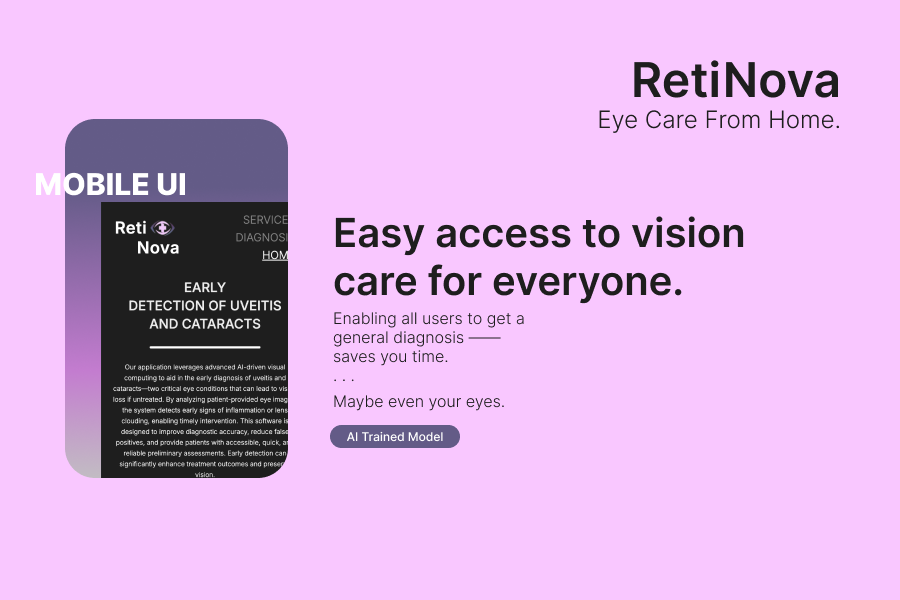
Eyes are one of the most important parts of your body. However, it is a body part that often goes neglected. This happens for many reasons including limited access to healthcare, misdiagnosis, or even just plain laziness. Eye healthcare is also a topic that holds close to us, as all of us have dealt with eye conditions or have had family members with eye problems. By creating RetiNova, we aim to let patients take control of their own eye health with AI-driven tools that simplify diagnosis and connect users to nearby healthcare providers.
What it does
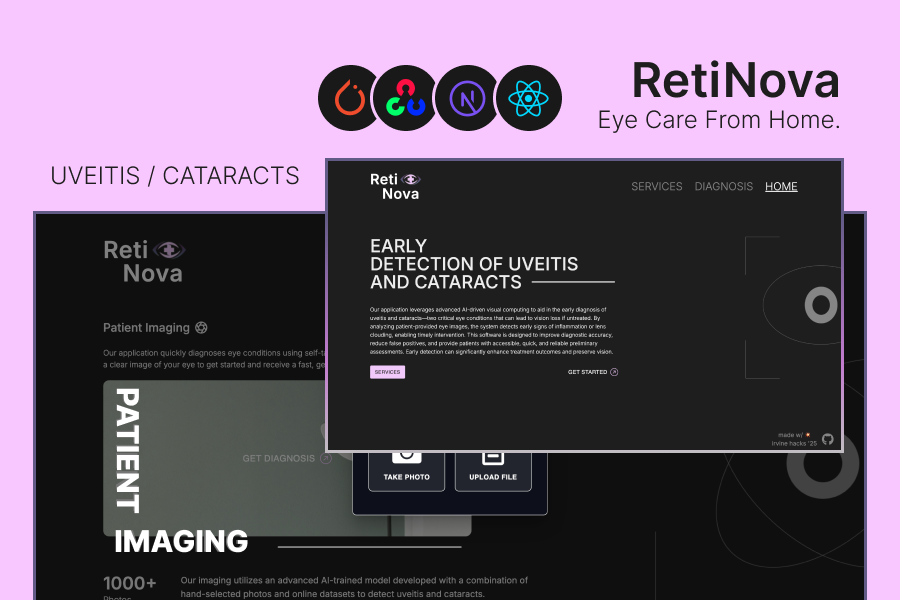
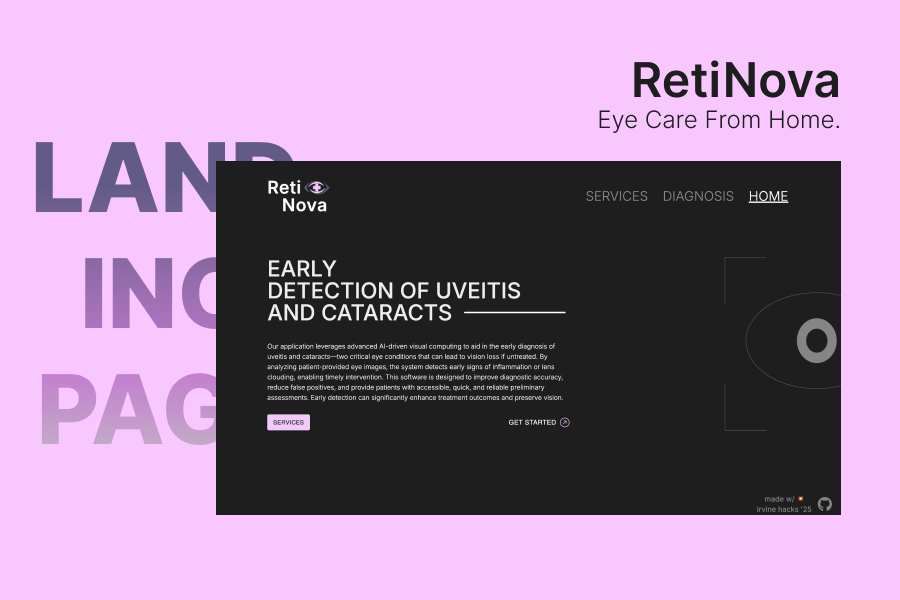
RetiNova is an AI-powered platform that allows users to upload or take a photo of their eyes to receive potential diagnoses for conditions such as uveitis and cataracts. The application also supplies users with the nearest healthcare providers based on geolocation.
How we built it
The platform uses computer vision models created using OpenCV and PyTorch to learn the differences between asymptomatic and symptomatic eyes after image grayscaling and sharpening. The front-end was built with React.js, Next.js, and Tailwind CSS, creating a sleek, user-friendly interface for patients to navigate. The backend was built with Express.js and the Nominatim/Overpass API for in-depth searching of nearby clinics and reverse searching addresses.

Challenges we ran into
For the challenges we ran into, our biggest was finding an adequate dataset to train our model. This took extensive searching and the use of multiple sources. Other challenges we ran into included containerizing the frontend, backend, and AI directories, as well as connecting the API endpoint from the prediction model to the frontend. This was a big learning curve for all of us and took hours of debugging and many energy drinks.
Accomplishments that we're proud of
We're proud that we were able to combine our skillsets to create a functional application that solves a real-world patient safety problem. Despite the time constraints, we were able to train and test an effective model and implement/design a polished interface successfully.
What we learned
For most of us, this was either our first or second hackathon, meaning we weren't too familiar with the environment we would be working in. We learned the importance of planning beforehand, delegating tasks, and how to operate on minimal sleep. This was also most of our first time working with AI, and although not all of us worked directly with the models, we all gained a deeper understanding of the process behind training and deploying AI models for real-time predictions.
What's next for RetiNova
In the future, we plan to extend RetiNova's diagnostic capabilities to detect more eye conditions. We aim to improve our AI model's accuracy by incorporating a larger and more diverse dataset. Additionally, we hope to implement insurance and demographic integration for more tailored clinic recommendations.
Built With
- docker
- express.js
- fast
- figma
- framer
- geocode
- material
- matplotlib
- next
- node.js
- nominatim
- numpy
- opencv
- postman
- python
- pytorch
- react
- render
- tailwind
- typescript


Log in or sign up for Devpost to join the conversation.