-
-
Logo
-
Homepage
-
-
-
RETINAREACH
A more careful way to think about retinal screening
Technology should not simply give an answer. It should help people understand when an answer can be trusted and what to do when it cannot.
1. Inspiration - The person behind the image
Imagine travelling to a health camp for an eye screening.
You may have taken time away from work, travelled a long distance, or waited in a queue because you are worried about your eyesight. You sit down in front of a camera. Someone takes an image of the back of your eye. That image is supposed to help identify early signs of diabetic retinopathy, a condition that can gradually damage vision and, if left undetected, lead to serious and potentially preventable sight loss.
But what happens if the image is blurred?
What if the lighting is poor? What if the camera is not positioned correctly? What if the person capturing the image is working with limited equipment, several patients waiting, and an unreliable internet connection?
The patient is still there. The need for screening has not disappeared. But the image may not be good enough to provide a reliable result.
That is where our thinking began.
We kept coming back to a simple question: What happens to a person when a healthcare system cannot make sense of the image that is supposed to help them?
A poor-quality image should not become a misleading result. And a rejection without an explanation should not leave a health worker wondering what went wrong or what to do next.
We wanted to build something that recognises the reality of healthcare outside perfectly controlled laboratories. Something that considers the person waiting for an answer, the frontline worker trying to help, and the specialist who may be responsible for reviewing dozens of cases.
RetinaReach grew from that idea.
Our goal is not to replace doctors, make medical decisions independently, or promise that technology can solve every problem. We want to make the screening process more thoughtful: identify when an image needs attention, explain why, guide the next step, and make sure uncertain cases are not quietly overlooked.
Because behind every retinal image is a person. And behind every screening result is a decision that deserves care.
2. What it does - Turning a retinal image into a clearer next step
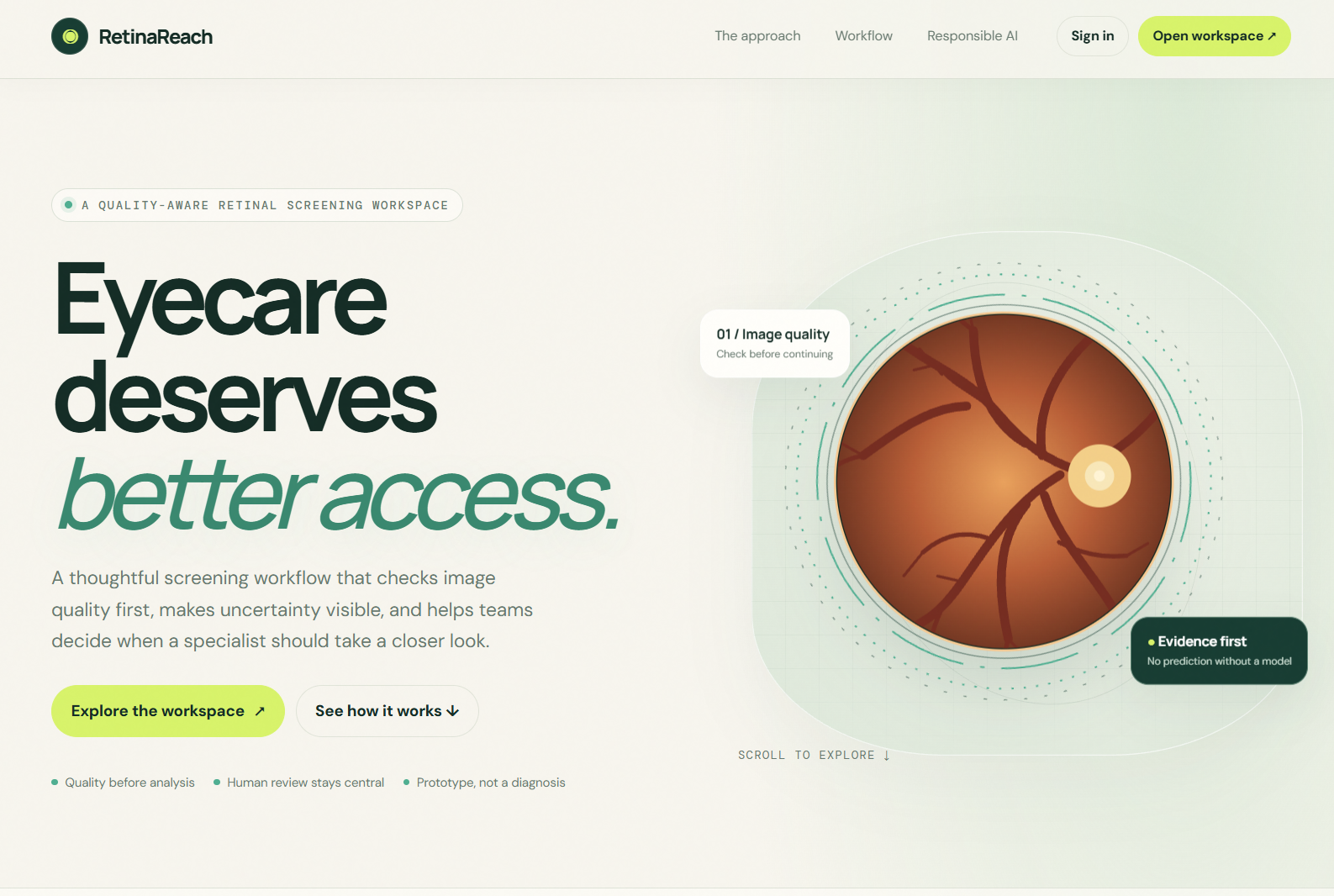
RetinaReach is a quality-aware retinal screening platform designed around one important principle: a screening result is only as useful as the image and process behind it.
The platform is being developed to support frontline health workers, screening teams and ophthalmologists by organising the journey from image capture to image review.
Instead of treating image upload as the end of the process, RetinaReach considers what should happen before, during and after an image is assessed.
The screening experience
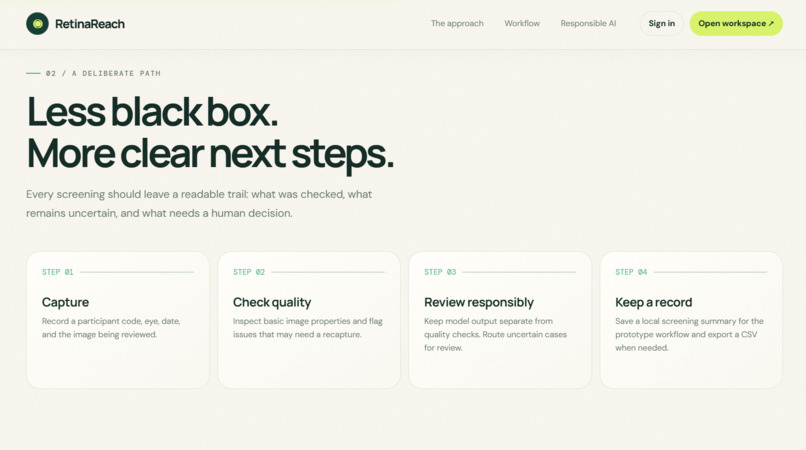
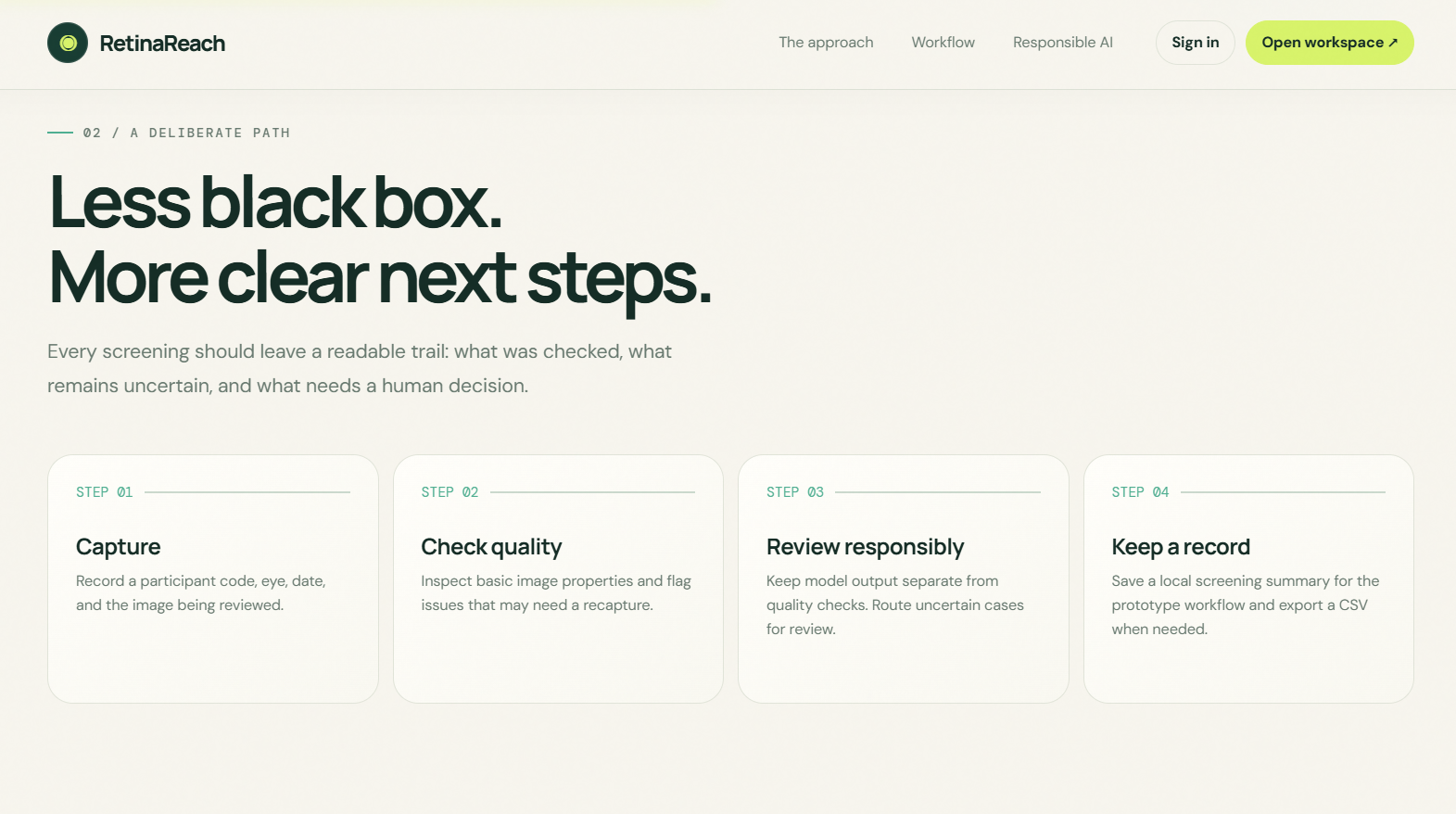
A typical screening journey is designed to work like this:
- Capture: A health worker uploads a retinal fundus image supplied through the screening process.
- Check: The platform examines basic image-quality characteristics.
- Understand: If the image appears unsuitable, the operator receives a reason to review or recapture it.
- Assess: If a separately configured and validated retinal model is connected, the image can proceed to that model for assessment.
- Review: Cases with poor image quality, uncertainty or incomplete results remain visible for human review.
- Record: Screening information can be organised so that the team can follow up on the case.
The idea is to make the next step clearer not to make the software the final medical authority.
The six main features
1. Retina Rescue - Helping users get a better image
A screening system cannot work responsibly if it ignores the quality of its input.
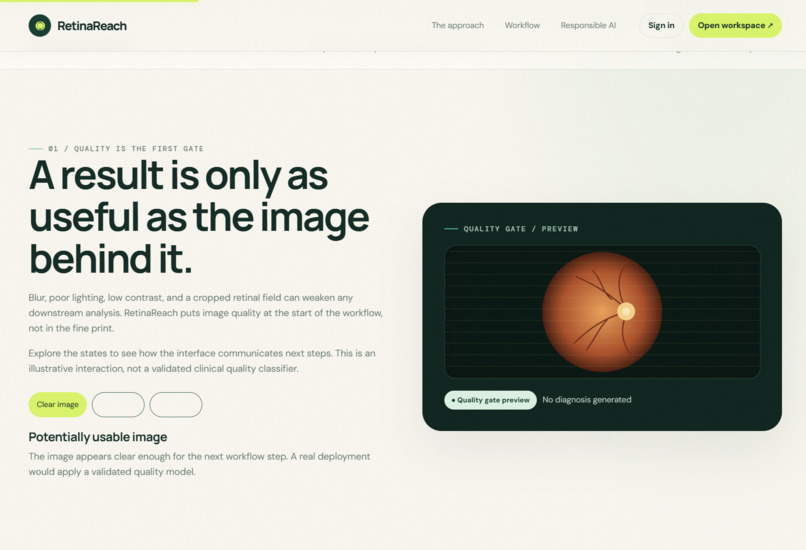
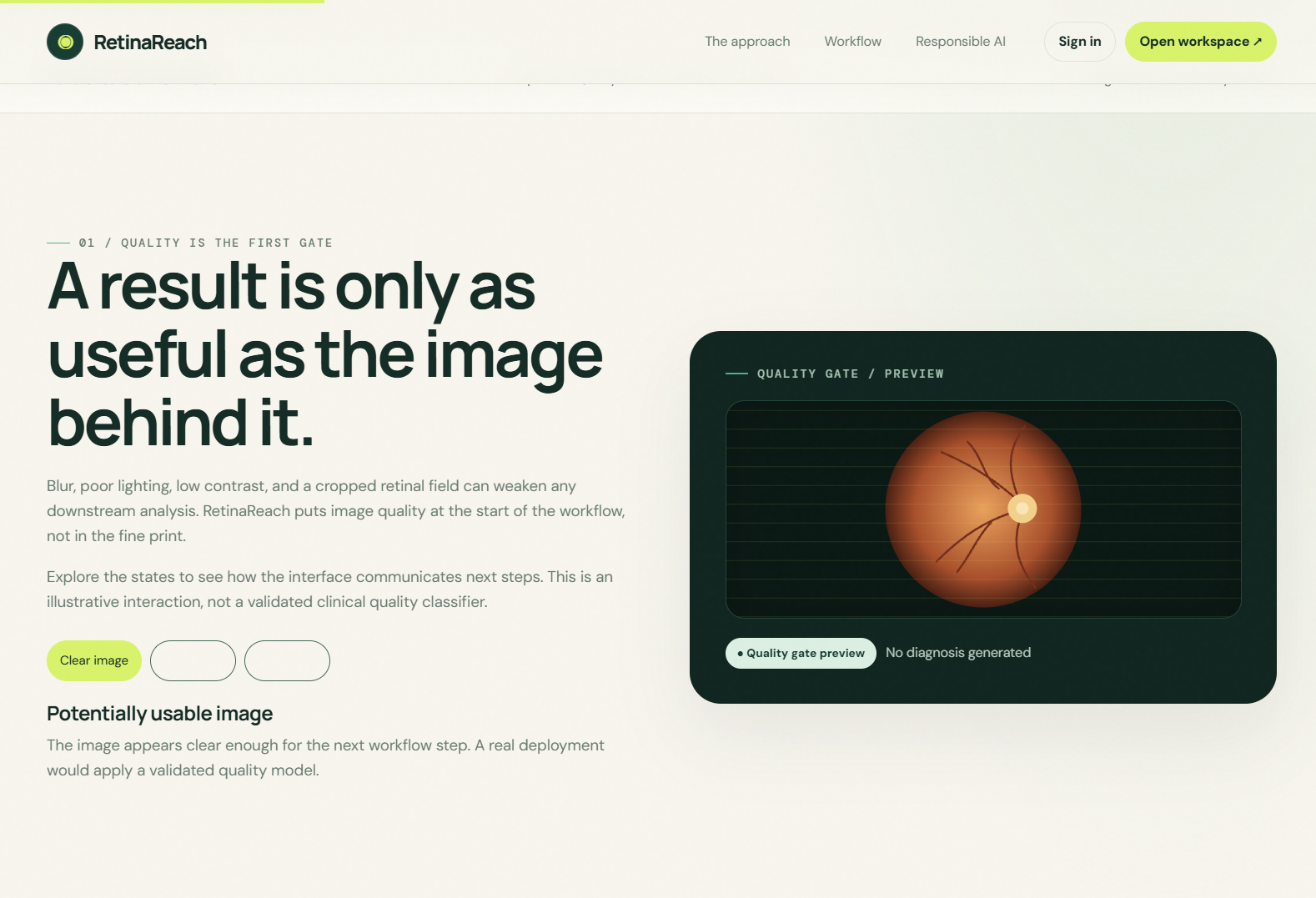
Retina Rescue is the image-quality checking module. It is designed to identify common issues that can affect retinal photographs, including:
- Motion blur and lack of sharpness.
- Poor brightness or uneven illumination.
- Low contrast.
- Images that may be too small or poorly framed.
- Potential problems with the visible retinal field.
The current prototype performs basic brightness, contrast and sharpness checks using image-processing heuristics. The broader proposal includes a more complete quality-assessment pipeline.
The purpose is practical: rather than simply telling a health worker that an image has failed, the system should explain what may be wrong and encourage an appropriate next step, such as improving focus, adjusting lighting or recapturing the image.
2. Confidence Contract - Making uncertainty visible
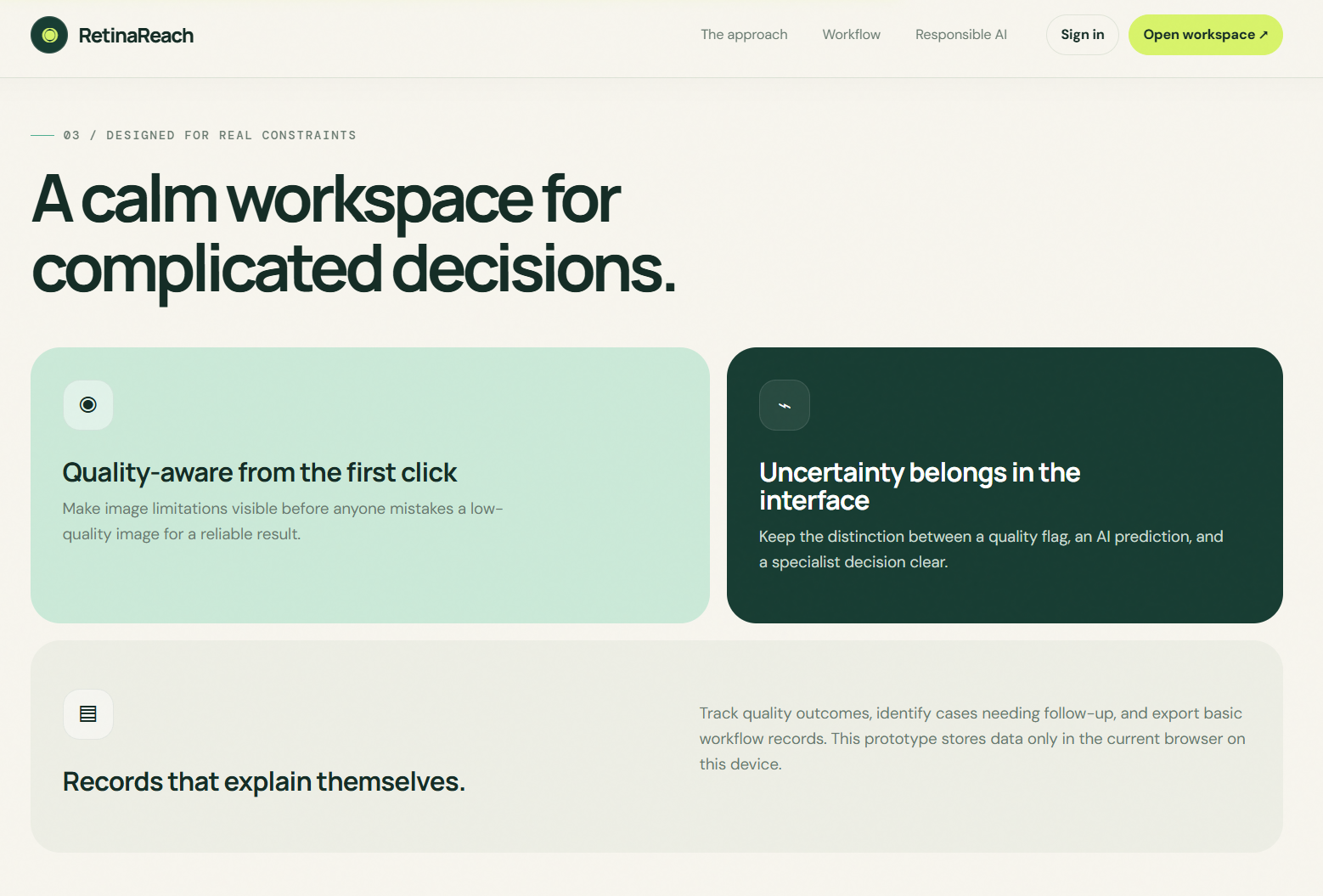
A number can look convincing even when the underlying result is uncertain.
Confidence Contract is a planned feature intended to evaluate how reliable a model's output may be. The proposed approach includes prediction entropy, model calibration and Monte Carlo dropout to examine uncertainty.
The proposed workflow would flag cases that fall below a defined confidence threshold—75% is the initial concept threshold and make them available for specialist review.
That threshold is not a clinically validated rule. It would need to be tested, calibrated and reviewed with clinical experts before being used in practice.
The principle is simple: when the system is unsure, it should not pretend otherwise.
3. Evidence Lens - Helping specialists understand a result
A screening output should not be an unexplained label.
Evidence Lens is a planned explainability feature that would use methods such as Grad-CAM to show which areas of an image influenced a model's output. The proposal also includes lesion-localisation support informed by retinal image annotations.
This could help a reviewing specialist inspect the image alongside the model's assessment and decide whether further investigation is appropriate.
An explanation overlay would be supporting information, not proof of disease and not a substitute for clinical interpretation.
4. Blind-Spot Lab - Testing what happens when conditions are imperfect
Real-world images are not always clean.
Blind-Spot Lab is designed as a testing environment for examining how image quality changes affect model performance. It would test conditions such as:
- Blur.
- Reduced contrast.
- Changes in colour and illumination.
- Other image disturbances that may occur during capture.
The objective is to understand where a model's performance begins to deteriorate, rather than reporting only its performance on ideal images.
This matters because a system that works on carefully selected images may behave differently in a busy screening environment.
5. Referral Optimizer - Helping teams prioritise review
In a screening programme, not every case can necessarily be reviewed at the same moment.
Referral Optimizer is a proposed workflow to help organise cases for human review. Its planned prioritisation factors include the available screening grade, uncertainty, age and relevant systemic risk information.
The intended outcome is a more organised review queue, helping specialists identify cases that may need attention sooner.
It is designed to support clinical judgement not independently decide who receives treatment or who can safely be ignored.
6. Offline Passport - Designed for places with unreliable connectivity
Access to a stable internet connection should not determine whether a health worker can organise a screening session.
Offline Passport is the longer-term plan for supporting low-connectivity environments. The proposed direction includes local model execution through ONNX, protected local storage, synchronisation and recovery mechanisms, and the ability to generate screening reports as PDFs.
A page that opens without Wi-Fi is not automatically a fully offline healthcare application. Local inference, data protection, synchronisation and recovery all need to be implemented and tested.
Our aim is to make RetinaReach practical for settings where connectivity cannot always be assumed.
Data: Keeping the demonstration grounded in real images
RetinaReach is intended to work with real retinal fundus images supplied by the screening user or operator. We are not presenting artificially generated retinal images as real patient cases, and the demonstration should not imply that synthetic images represent actual clinical evidence.
For the current demonstration, images are supplied by the user. They are used to exercise the upload and image-quality workflow.
The original proposal identifies APTOS 2019 and IDRiD as potential datasets for future development and evaluation. These are proposed research resources; they should not be described as datasets already used to train a completed RetinaReach diagnostic model.
Any future use of real patient images must follow appropriate consent, privacy, access-control and research requirements. Identifiable patient information should not be included in a public demonstration.
3. How we built it - From an idea to a working foundation
We approached RetinaReach by first asking what a useful screening workflow would actually need.
It would be easy to begin with a disease prediction model and build an interface around it. But that would leave a major question unanswered: what if the image supplied to that model is not reliable in the first place?
So we approached the project from the workflow backwards.
We considered the person capturing the image, the quality of the image, the need for a clear result, the possibility of uncertainty, and the specialist who may eventually review the case.
That thinking shaped the architecture and the order in which the system is being developed.
The current technical foundation
The current backend starter uses:
- Python: The main backend programming language.
- FastAPI: The framework used to expose application endpoints.
- SQLAlchemy: Database interaction and record management.
- SQLite: The default local database for accounts and screening records.
- Pillow and NumPy: Basic image processing and image-quality checks.
- PBKDF2 password hashing: To avoid storing account passwords as plain text.
- Bearer-token authentication: To protect routes that require a signed-in user.
- An optional inference adapter: A connection point for a separately hosted retinal-image model.
The working foundation includes account registration and login, protected routes, image upload, screening-record storage, record listing, a review queue and deletion of records and associated images.
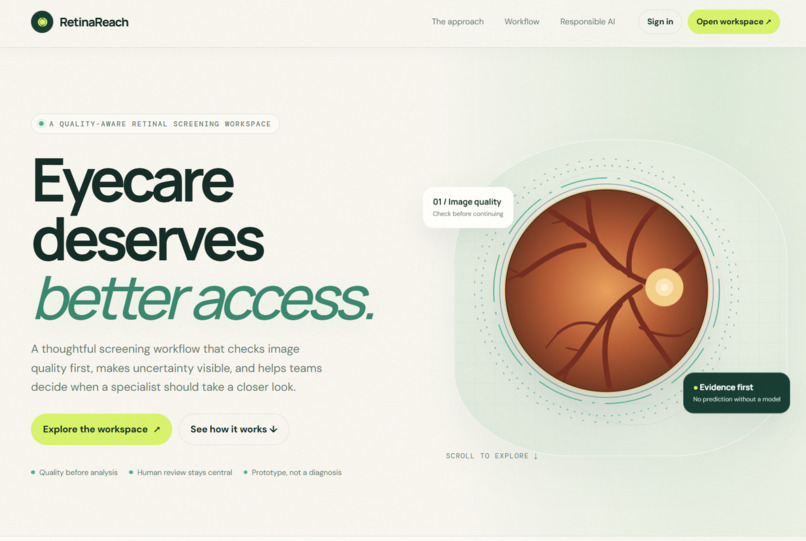
The interface concept is designed around a clear screening journey, with areas for the overview, new screening, records and review.
APIs, configuration and security
The current backend exposes routes for the following operations:
| API route | Purpose |
|---|---|
GET /api/health |
Check whether the backend is running |
POST /api/auth/register |
Create an account |
POST /api/auth/login |
Sign in |
GET /api/me |
Retrieve the signed-in user's information |
POST /api/screenings |
Upload an image and create a screening record |
GET /api/screenings |
List the user's screening records |
GET /api/review-queue |
Retrieve records requiring review |
DELETE /api/screenings/{id} |
Delete a record and its image |
Protected endpoints use bearer-token authentication.
The backend setup uses an environment variable called RETINAREACH_JWT_SECRET to configure the token-signing secret. This is a private configuration value and should be generated locally, kept out of source control and never published in a project submission.
The current project documentation does not establish that an external API key is required or that a third-party clinical inference API is already connected. The optional inference adapter is a connection point, not evidence of a deployed diagnostic service.
For that reason, we should not publish secret values or claim integrations that have not been configured and tested.
The proposed next-stage technology
The original technical plan includes:
- PyTorch and EfficientNet-B0 for a retinal diagnostic model.
- OpenCV for more comprehensive image-quality checks.
- Entropy and Monte Carlo dropout for uncertainty assessment.
- Grad-CAM and lesion localisation for visual explanations.
- React, Tailwind CSS and Recharts for the proposed frontend.
- ONNX for a future local-inference workflow.
These are planned components until they are integrated, tested and evaluated. Keeping this distinction clear helps everyone understand exactly what the present prototype can do and what the next development phase must deliver.
4. Challenges we ran into
Building a healthcare screening tool comes with a different kind of responsibility. It is not enough to make an application look complete. The system has to be designed around the consequences of getting something wrong.
Working with inconsistent image quality
Retinal images can vary significantly depending on the camera, lighting, focus, positioning and person capturing the image.
An image that looks acceptable on a computer screen may still lack the detail required for a reliable assessment.
This makes quality checking difficult. A simple brightness or sharpness measurement cannot fully establish whether an image is clinically suitable.
We therefore had to think beyond accepting or rejecting uploads. The longer-term challenge is to create meaningful quality checks that can explain their limitations and guide the operator towards a better capture.
Making accuracy meaningful
A high accuracy score alone does not tell the whole story.
A screening system must also be examined for false negatives, false positives, performance across different image conditions, calibration and the consequences of uncertain predictions.
We have not yet established clinical accuracy for RetinaReach because the trained diagnostic model and its clinical evaluation are not complete.
Our next challenge is to obtain appropriately governed evaluation data, define clinically meaningful measures and work with qualified reviewers to understand how the system performs.
Collecting and handling real-world data
Real retinal photographs are not interchangeable with ordinary demonstration images. They may contain sensitive patient information and require careful handling.
Data collection also raises practical questions: Are the images properly labelled? Are the labels reviewed by qualified professionals? Are there enough examples of different disease grades and image-quality conditions? Do the images represent the people and environments in which the application is expected to operate?
We have to address these questions before claiming that a model is reliable.
Balancing simplicity and responsibility
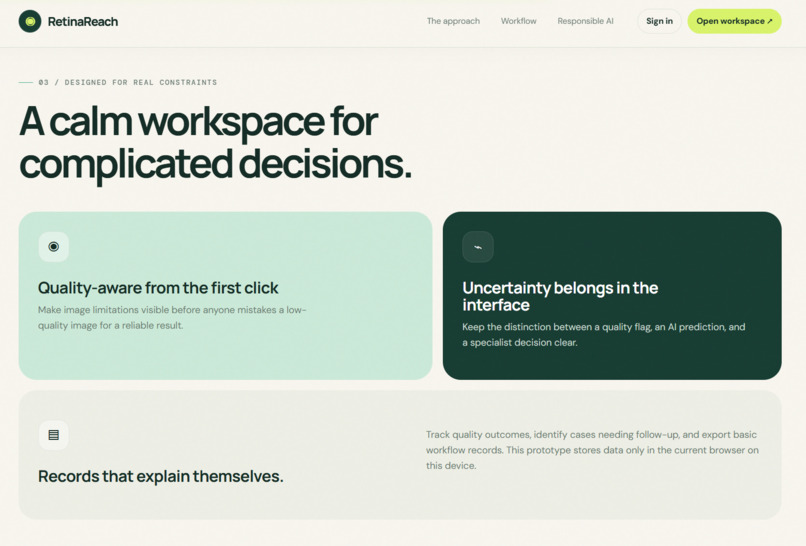
Frontline workers need a clear interface, not a complicated technical dashboard.
At the same time, the application must not hide important warnings or make an uncertain output look definitive.
Finding the right balance between a simple user experience and meaningful information has been an important design consideration.
Building the complete system in stages
The concept contains several connected modules, each with its own technical and evaluation requirements.
We have had to separate what can be demonstrated now from what needs more research, development and clinical collaboration. That has helped us avoid presenting a visual feature as a working medical capability.
5. Accomplishments that we're proud of
One of our biggest accomplishments is turning a broad healthcare problem into a structured application concept with a working technical foundation.
We are proud that RetinaReach is not simply built around producing a prediction. It begins with the conditions under which that prediction would be made.
So far, we have established:
- A clear screening workflow from image upload to review.
- A working backend foundation using FastAPI.
- Account registration, login and protected routes.
- Screening image upload and record management.
- Basic brightness, contrast and sharpness checks.
- A review-queue foundation for cases requiring attention.
- An optional connection point for a separately hosted inference service.
- A structured six-module product direction.
- A user interface concept focused on clarity and a calmer screening experience.
- A development roadmap that separates the current prototype from future clinical capabilities.
We are especially proud of the principle behind the project: we would rather make uncertainty visible than present an answer that has not earned trust.
That is the standard we want the future version of RetinaReach to meet.
6. What we learned
This project has taught us that healthcare technology is not only about building something that works. It is about understanding who will depend on it, what could go wrong, and what happens after the software produces an output.
We learned that:
A good result begins with a good input. Before asking what a model predicts, we need to understand whether the image is suitable for assessment.
Accuracy is not the same as trust. A system needs to communicate uncertainty and be evaluated in the conditions where it will actually be used.
The user experience can affect the quality of the workflow. Clear instructions and understandable feedback matter, especially when the person using the application is not a specialist.
Healthcare needs human judgement. A software tool can organise information and support screening, but clinical decisions belong with qualified professionals.
Privacy is part of the product, not an afterthought. Real patient information needs appropriate consent, security, retention and access policies.
Most importantly, we learned to be honest about the difference between an idea, a prototype and a clinically validated product. That distinction is essential when building anything intended to support healthcare.
7. What's next for RETINAREACH
The next stage is about moving from a useful prototype towards a system that can be properly evaluated.
Stage 1 - Complete the screening experience
We want to strengthen the current application by improving the upload workflow, image-quality feedback, screening records, review queue and user experience.
We will also test the complete frontend and backend together, improve error handling and verify that access controls work as intended.
Stage 2 - Develop and evaluate the retinal model
The next major research step is to develop a retinal diagnostic model using appropriately sourced and labelled retinal images.
The proposed direction includes EfficientNet-B0 and the potential use of APTOS 2019 and IDRiD for development and evaluation.
We will need to examine data quality, label reliability, class imbalance, performance across different groups and the model's behaviour on images that differ from its training data.
No model should be presented as clinically reliable until it has been independently and appropriately evaluated.
Stage 3 - Introduce uncertainty and explainability
Once a real model is available, we want to develop the Confidence Contract and Evidence Lens.
This means testing calibration, defining appropriate review thresholds, evaluating uncertainty methods and examining whether visual explanations are useful and understandable to clinicians.
Stage 4 - Work with healthcare professionals
We want to collaborate with ophthalmologists, optometrists, retinal specialists, screening staff and public-health organisations.
Their feedback will be essential in deciding whether the workflow is useful, whether the warnings are understandable and whether the review process fits existing clinical practice.
Stage 5 - Pilot testing and clinical studies
Before considering clinical deployment, RetinaReach would need a carefully designed pilot under appropriate institutional oversight.
The process would include a research protocol, ethics committee approval where required, informed consent, data governance, defined inclusion criteria, clinical reference labels and clear safety procedures.
A pilot could assess usability, image recapture rates, workflow time, review-queue usefulness and agreement with qualified clinical assessment.
If the results support further development, the project could progress to larger prospective clinical studies and, where appropriate, formal clinical trials and regulatory review.
We do not consider a clinical trial a marketing milestone. It is a necessary evidence-building step before making claims about clinical benefit.
Stage 6 - Build for low-connectivity environments
We want to explore local inference, encrypted local storage, secure synchronisation and reliable report generation.
The goal is to make the platform useful in screening settings where internet access may be inconsistent, without compromising patient privacy or the reliability of the workflow.
8. Architectural design - Why we chose this pipeline
The architecture of RetinaReach came from one central decision: do not send every image directly to a diagnostic model without first considering whether the image is suitable.
We designed the pipeline around the sequence of decisions a real screening team would need to make.
First: receive and protect the image
The process begins when an authorised user uploads a retinal fundus image. The application records the screening information and applies its access controls.
This creates an organised starting point for the screening workflow.
Second: examine image quality
Before a diagnostic model is considered, the image goes through a quality-assessment stage.
This stage is intended to identify issues such as blur, poor lighting, low contrast and weak retinal framing.
The current implementation performs basic brightness, contrast and sharpness checks. The proposed architecture expands these checks into a more complete image-quality gate.
Third: decide what should happen next
If the image is unsuitable, the workflow should guide the operator towards review or recapture.
If the image passes the quality checks, it can proceed to the next stage when a properly configured model is available.
This separation is important. It prevents an image-quality problem from being mistaken for a medical finding.
Fourth: assess the result responsibly
The future diagnostic engine is planned around a retinal-image model. Its output would then be assessed for uncertainty rather than being treated as automatically trustworthy.
If the result is uncertain, incomplete or outside the system's validated operating conditions, the case should remain visible for human review.
Fifth: provide useful context to the reviewer
The proposed Evidence Lens would help display relevant image regions and model explanations. The review workflow would keep the original image, available assessment information and reasons for escalation together.
Sixth: preserve a clear record
Screening records and review outcomes should be organised so that the team can understand what happened, what action was taken and what needs follow-up.
The longer-term offline design would extend this process to local execution and secure synchronisation.
We chose this pipeline because it reflects the real order of responsibility: first understand the image, then consider an assessment, then make uncertainty visible, and finally leave clinical judgement with a qualified person.
9. Market opportunities - Where RetinaReach could make a difference
RetinaReach addresses a practical challenge in eye-care screening: the need to organise image capture, quality assessment and follow-up in settings where specialist access and connectivity may be limited.
The opportunity is not simply to sell another diagnostic application. It is to support the people and organisations that already carry out screening and need a clearer process for handling images and review.
Potential areas of use
Community and rural screening programmes
Health camps and community screening initiatives may benefit from clearer image-quality feedback and a more organised process for cases that need another image or specialist attention.
Hospitals and eye-care clinics
Clinics could explore whether a structured upload, record and review workflow fits their existing screening operations.
Diabetes-care centres
Diabetes programmes that include retinal screening may find value in a workflow that helps organise screening records and follow-up.
Non-governmental organisations and public-health programmes
Organisations running outreach programmes could explore RetinaReach as a way to support frontline teams and improve consistency across screening sessions.
Teleophthalmology networks
Remote specialist-review networks could explore whether a quality-aware workflow helps ensure that images sent for review are usable and accompanied by relevant context.
These are potential customer and partnership segments, not confirmed customers or signed partnerships.
Why the opportunity exists
The problem is connected to several practical needs:
- More organised screening workflows.
- Better visibility into image-quality problems.
- Reduced avoidable recaptures through clearer guidance.
- More structured specialist-review processes.
- Support for screening in low-connectivity environments.
- Better documentation of what happened during a screening session.
RetinaReach's strongest potential position is as a workflow-support platform that can work alongside existing healthcare processes, rather than asking institutions to replace their entire screening infrastructure.
10. Feasibility and viability - Can we build it, and can it be sustained?
Technical feasibility
The current prototype demonstrates that the basic application foundation is achievable. User accounts, authentication, image uploads, screening records, basic image checks and review-queue functionality have a defined implementation path.
The more advanced components are technically plausible, but each requires additional development and testing.
The diagnostic model requires suitable data and rigorous evaluation. Uncertainty assessment requires a working model and calibration. Explainability requires testing with clinical reviewers. Offline operation requires local inference, protected storage and reliable synchronisation.
The project is therefore feasible as a staged development programme. It should not yet be described as a complete clinical screening solution.
Operational feasibility
The intended workflow is designed to fit the needs of frontline screening staff and reviewing clinicians.
For adoption, the interface must be easy to learn, image feedback must be understandable, and the review process must fit the way each organisation works.
Training, support, camera compatibility and clear operating procedures will also matter.
Financial and commercial viability
A sustainable version of RetinaReach could explore several models:
- Institutional licensing: Annual or subscription-based access for clinics, hospitals and screening organisations.
- Programme partnerships: Agreements with NGOs, public-health initiatives and community screening programmes.
- Per-site deployment: Pricing based on the number of screening locations or authorised users.
- Enterprise integration: Custom deployment and integration services for larger healthcare organisations.
- Research partnerships: Collaborative projects with academic institutions and clinical research groups.
The most appropriate model would depend on deployment costs, infrastructure needs, clinical evidence, support requirements and the ability of target organisations to pay.
We would also want to explore partnerships and grant-supported deployments so that affordability does not become a barrier in the very communities the project aims to serve.
11. Impact and benefits - What success should look like
For us, success is not simply the number of images processed or the number of predictions generated.
It is whether the workflow becomes more useful and responsible for the people involved.
For patients
- A clearer screening journey.
- Fewer confusing or unexplained image rejections.
- Better organisation of cases that need follow-up.
- A process designed to reduce the risk of misleading outputs from unsuitable images.
For frontline health workers
- Clearer feedback about image quality.
- More actionable guidance when a scan needs to be repeated.
- A more organised way to manage screening records.
- Less dependence on interpreting technical outputs.
For ophthalmologists and specialists
- A structured review queue.
- Access to the original image and available supporting information.
- Greater visibility into uncertain or incomplete cases.
- A workflow that supports, rather than replaces, professional judgement.
For healthcare organisations
- More consistent screening documentation.
- A possible way to organise outreach and review workflows.
- Better visibility into image-quality issues.
- A foundation for future offline and low-connectivity deployment.
These are intended benefits. They must be measured in real-world studies before being presented as demonstrated clinical outcomes.
12. Who are we building RetinaReach for?
We see four primary groups.
The frontline health worker
The person capturing the image and interacting with the application. They need clear instructions, a simple workflow and useful feedback—not complicated technical language.
The reviewing ophthalmologist
The professional responsible for interpreting the available evidence and making clinical decisions. They need access to the image, relevant context and a clear indication of why a case has been flagged.
The healthcare organisation
The hospital, clinic, NGO or screening programme responsible for coordinating screening activity, maintaining records and arranging follow-up.
The patient
The person whose eye health is at the centre of the entire process. Even if they never directly interact with the application, the workflow should be designed around their safety, dignity, privacy and access to appropriate care.
13. How we would take RetinaReach to the market
We would not begin by making large claims about diagnosis or promising that the platform can prevent blindness. Healthcare adoption depends on trust, evidence and relationships.
Our approach would be to introduce RetinaReach through the people who understand the screening problem first.
Step 1 - Start with clinical conversations
We would approach ophthalmologists, optometrists, eye hospitals and community screening teams to understand their existing workflows.
We would ask where image capture fails, how poor-quality images are handled, what information specialists need and what makes a screening tool genuinely useful.
Step 2- Demonstrate the workflow
We would create demonstrations using appropriately consented or otherwise authorised real retinal images.
The demonstration would focus on image upload, quality feedback, records and the review workflow. We would clearly distinguish these working features from planned diagnostic capabilities.
Step 3 - Build partnerships
Potential partners could include:
- Eye hospitals and ophthalmology departments.
- Medical colleges and research institutions.
- NGOs running community health programmes.
- Diabetes-care centres.
- Public-health and telemedicine initiatives.
These relationships could help us validate the workflow, obtain appropriate expert feedback and identify suitable pilot settings.
Step 4 - Run controlled pilots
With the required approvals and safeguards, we would test the application in a limited setting.
We would measure practical outcomes such as usability, time taken to complete a screening workflow, image recapture rates, review-queue usefulness and user satisfaction.
Step 5 - Communicate with evidence
Our communication would focus on what the platform actually does and what has been evaluated.
We would use demonstrations, clinical feedback, research collaborations and transparent product documentation rather than exaggerated claims.
Campaign message
“A clearer next step for every retinal image.”
Supporting message:
RetinaReach helps screening teams pay attention to image quality, organise cases for review and keep people at the centre of the screening process.
The campaign would speak to health workers, clinicians, healthcare institutions and community organisations. Its tone would be reassuring, practical and evidence-led.
14. Our larger vision
We imagine a future in which a health worker in a small community does not have to wonder why a retinal image was rejected. A future in which an uncertain result is not quietly presented as a confident one. A future in which specialists receive more organised information and patients are not lost between screening and follow-up.
RetinaReach is still growing. There is important technical, clinical and operational work ahead. We know that building a healthcare product requires more than a promising idea or a functioning prototype. It requires evidence, collaboration, careful testing and accountability.
But we believe the problem is worth working on.
Because the person behind the image deserves more than an unexplained error message. They deserve a screening process that takes their health seriously.
RETINAREACH - Better image quality. Clearer decisions. People always at the centre.
Built With
- api
- authentication
- fastapi
- healthcare
- html
- image
- jwt
- numpy
- pillow
- processing
- python
- rest
- retinal
- screening
- sqlalchemy
- sqlite
- technology

