-
-

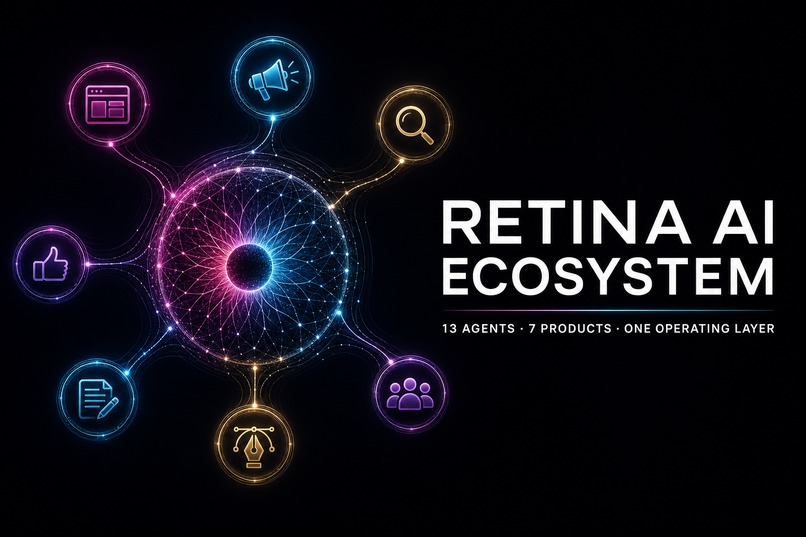
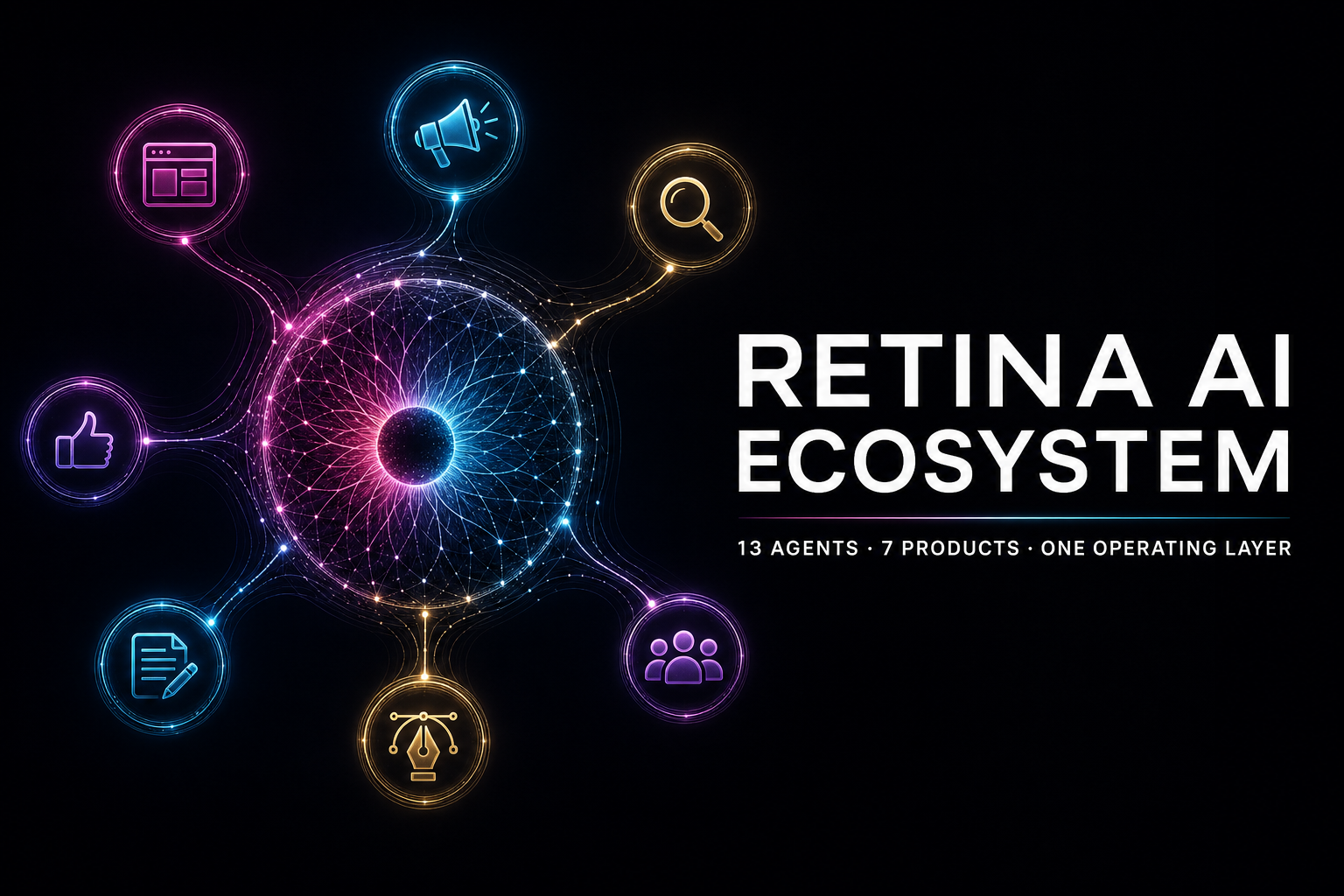
Retina AI Ecosystem identity and operating-layer map
-
Seven product journeys connected through one approval-first workflow
-
Interactive navigator routing business goals to specialists and products

Inspiration
Small businesses are surrounded by specialized tools but still struggle to turn a business objective into a coordinated sequence of work. A website builder does not know when the brand is ready. An ads platform does not know whether tracking, landing pages or content should come first. Social, SEO and identity tools often create more dashboards instead of a clearer next action.
Retina already had working products for websites, ads, SEO/GEO, social operations, content, visual identity and specialist consulting. The opportunity was not to pretend these products were new. It was to connect them into one understandable operating layer.
What it does
Retina AI Ecosystem turns a business goal into a coordinated, approval-first operating sequence.
The Build Week demo lets a user choose:
- a primary goal: launch, grow, automate, strengthen infrastructure or build a responsible Web3 initiative;
- the current maturity of the business;
- the preferred delivery pace.
It then produces:
- the recommended lead specialist;
- an ordered sequence of Retina products;
- a context-aware starting rule;
- a delivery cadence;
- direct paths to the live ecosystem.
The operating model connects seven focused product surfaces: Sites with AI, Ads AI Manager, SEO + GEO, Social Operations, Content Studio, Visual Identity and Specialist Agents. It maps two complete specialist networks while keeping evidence precise: the 65-scenario homologation applies only to 13 Retina primary specialists, not every profile in both catalogs. It also maps five established foundations, tools or ventures: Retina Comunicação, RetinaCoin, Consultoria Blockchain, the Codex-built Token Generator and the independent AstroConsulta vertical.
The broader live Retina portfolio has also expanded with Retina Apresenta, an AI presentation product with editable PowerPoint and PDF exports, and IAEquipePro, an independent free platform with 100 AI specialists. These projects are presented as additional ecosystem evidence, not as extra Build Week functionality. IAEquipePro is not included in the 65-scenario validation claim.
How we built it
We used GPT-5.6 in Codex as the primary agentic development environment.
Codex helped us audit the existing multi-product ecosystem, recover the most reliable facts from live and local evidence, distinguish confirmed functionality from roadmap ideas, and identify the strongest Work & Productivity framing.
During the Build Week submission period, we created the connective layer:
- A unified catalog across the Retina products.
- A central setup and intake architecture.
- A shared operating state model: briefing → access → configuration → approval → documented delivery.
- Specialist and product-routing logic.
- A responsive, runnable Ecosystem Navigator.
- A judge-safe repository without production credentials or customer data.
- Original visual identity, documentation and submission materials.
GPT-5.6 in Codex supported product architecture, implementation, responsive design, copy, compliance review, build troubleshooting, QA and the preparation of the evidence package. The founder made the core product decisions and approved the final positioning, scope and risk boundaries.
What is new versus pre-existing
The individual Retina products existed before July 13, 2026. They are supporting evidence and are not claimed as new hackathon work.
The submission asks judges to evaluate only the meaningful Build Week extension: the shared orchestration model, unified intake and delivery states, cross-product routing, interactive navigator, consolidated documentation and original presentation layer.
This distinction is documented in the repository README and supported by the primary Codex session.
Challenges we ran into
Separating a real ecosystem from a feature list. The project spans several production systems. We had to find the smallest coherent experience that demonstrates the value of the whole without hiding complexity.
Proving new work on top of existing products. The official rules evaluate pre-existing projects only on the extension built during the submission period. We designed a clean new layer and documented the boundary explicitly.
Keeping agentic work accountable. The system must not publish campaigns, posts or production changes automatically. We retained human approval gates and a documented next action.
Communicating Web3 responsibly. RetinaCoin is part of the long-term utility and payments roadmap, but staking, rewards, NFT memberships and governance are not presented as completed Build Week functionality. The submission makes no investment or return claims.
Eligibility transparency. The Devpost form accepts Brazil, while the Official Rules list Brazilian residents as ineligible. We kept the real country in the form and are requesting written clarification rather than trying to bypass the rule.
Accomplishments that we are proud of
- One clear operating model for seven previously separate AI-product journeys, two specialist networks and five established foundations, tools or ventures mapped transparently as supporting context.
- A direct route from blockchain specialist discovery to the pre-existing Codex-built token generator.
- A working navigator that produces a different route from real user inputs.
- Thirteen specialist roles with a previously completed 65-scenario QA matrix.
- A safe public demo with no credentials, customer data or speculative token promises.
- A submission that clearly distinguishes historical work from the new Build Week contribution.
What we learned
The most useful agentic system is not the one that produces the most output. It is the one that understands context, chooses one concrete next step and knows when human approval is required.
We also learned that Codex is especially valuable when the work spans product strategy, legacy systems, production evidence, code, design, compliance and communication. GPT-5.6 helped us preserve that context while still producing a focused implementation.
What's next for Retina AI Ecosystem
- Turn the navigator plan into a structured business briefing.
- Connect real progress states across the product surfaces.
- Add evidence-based recommendations from campaign and site performance.
- Expand judge-safe sandboxes for each specialist workflow.
- Continue the RetinaCoin and Retina Pay work as a utility/payment roadmap, subject to technical, merchant and compliance validation.
Our long-term goal is simple: give a small business one reliable operating layer that can coordinate its entire digital presence while keeping ownership and approval with the human team.
If the project becomes eligible for any form of funding or support, the resources will be fully reinvested in turning the current operating layer into a scalable production system: strengthening security and privacy, connecting the product surfaces, expanding specialist workflows, supporting pilot businesses and preparing multilingual documentation.
Founder
William Noronha is the founder and product builder coordinating the Retina portfolio and its approval-first operating model.
- LinkedIn: https://www.linkedin.com/in/williamnoronha/
- Instagram: https://www.instagram.com/williamnoronha/
Built With
- ai-agents
- business-operations
- cloudflare-workers
- codex
- css
- gpt-5.6
- marketing-automation
- next.js
- openai
- react
- responsive-design
- typescript
- vinext
- workflow-automation

Log in or sign up for Devpost to join the conversation.