

🧠 Synaptic Nexus: Rethinking How the Brain Codes Emotion and Memory
Where emotion meets logic, the mind weaves memories through the rhythm of sleep.
🌟 Inspiration
Humans spend a third of their lives asleep, yet how memories—especially emotional ones—are formed remains largely unknown.
We asked:
- How does the brain tag emotional vs analytical memories?
- How do REM and NREM sleep phases contribute to memory consolidation?
- Can neurotransmitter pathways be leveraged to enhance memory safely?
🧩 What It Does
Synaptic Nexus integrates neuroscience, sleep science, and computational modeling:
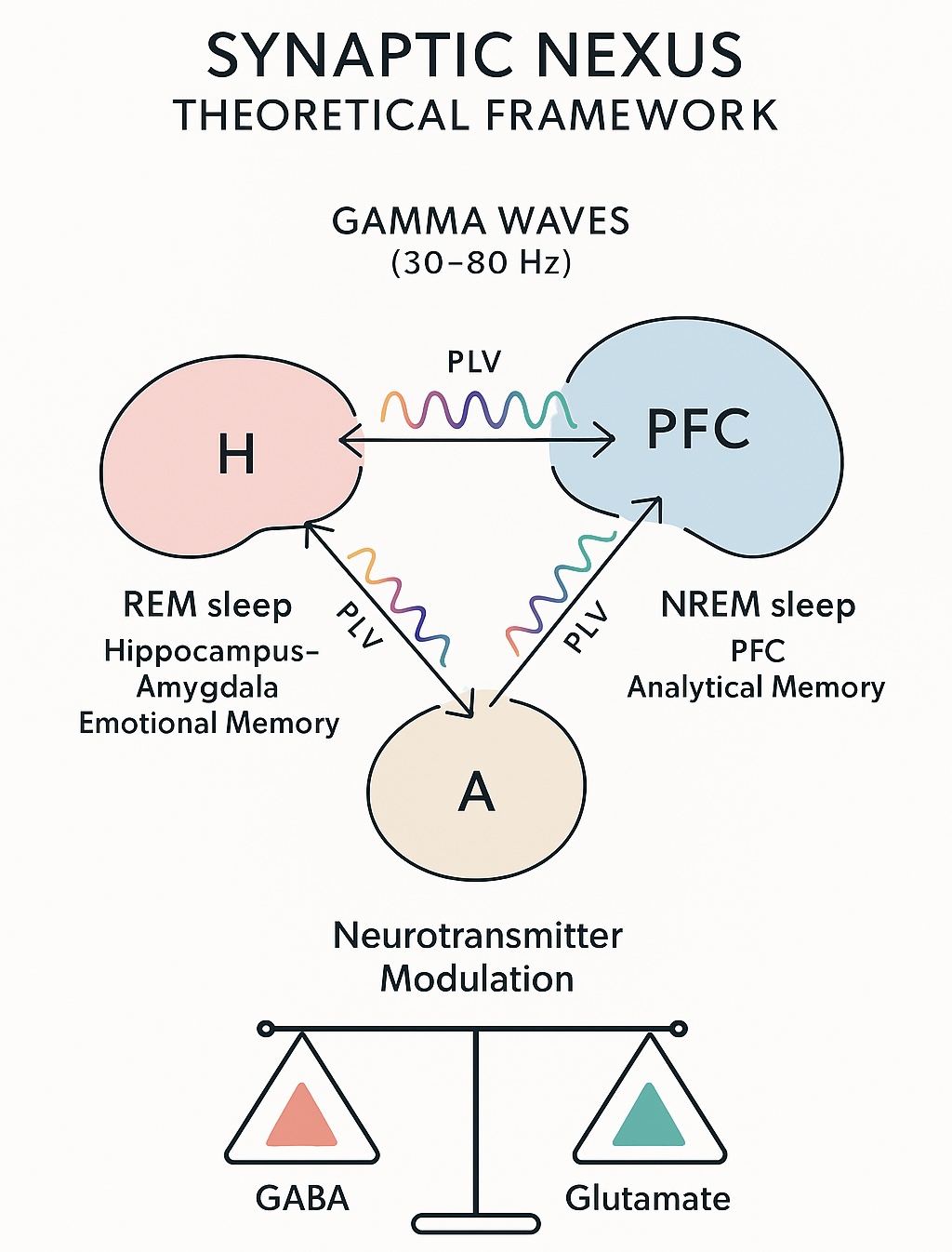
- 🧠 Emotional tagging: Tracks amygdala–hippocampus interactions.
- 🌙 Sleep-phase consolidation: Differentiates REM vs NREM memory roles.
- ⚡ Neurochemical modulation: Explores dopamine, serotonin, GABA, and glutamate effects.
- 📊 Gamma wave measurement: Conceptual link to memory efficiency and cognitive ability.
🛠 Step-by-Step Framework
1. 📚 Literature Integration
- Synthesized 30+ neuroscience and cognitive research studies.
- Focused on hippocampus-PFC-amygdala circuits, neurotransmitters, and sleep cycles.
2. 📈 Conceptual Framework Design
- Multi-layered diagrams mapping emotional memory pathways.
- Differentiated REM vs NREM sleep effects.
- Created hypotheses for neurotransmitter interventions.
3. 🤖 Computational Modeling (Conceptual)
- Proposed AI–EEG correlation system to predict memory strength via gamma waves.
- Logic to distinguish emotional vs analytical memory retrieval.
4. 🎨 Visualization
- Flow diagrams of neurotransmitter interactions.
- Conceptual EEG-to-memory maps.
5. 🧪 Hypothesis Testing Plan
- Plan for EEG dataset simulations.
- Proposed neurotransmitter precursor interventions.
- Methods for measuring emotional memory tagging and recall efficiency.
⚡ Key Hypotheses
- H1 (Sleep-phase memory)
Emotional memories consolidate primarily during REM sleep; analytical memories consolidate during NREM sleep.
$$ M_{\text{emotional}} \propto f(\text{REM}), \quad M_{\text{analytical}} \propto f(\text{NREM}) $$
- H2 (Gamma wave synchronization)
Gamma wave synchronization across hippocampus (H), PFC (P), and amygdala (A) correlates with memory efficiency:
$$ \text{Memory Efficiency} \sim \gamma_H \cdot \gamma_P \cdot \gamma_A $$
- H3 (Neurotransmitter modulation)
Modulating GABA and glutamate via precursors may enhance memory without disrupting brain balance:
$$ \text{GABA}^* , \;\text{Glutamate}^* \;\rightarrow\; \text{Improved Memory}, \quad \text{without } \Delta \text{Homeostasis} $$
- H4 (Emotional tagging)
Emotional tagging during high-stress or high-arousal states enhances long-term memory encoding:
$$ M_{\text{long-term}} \propto \text{Arousal Level} \times \text{Amygdala Activation} $$
🧠 Challenges We Faced
- Translating complex neuroscience concepts into a model understandable for both judges and STEM peers.
- Balancing scientific depth with narrative clarity.
- Finding reliable multi-neurotransmitter data sources.
- Conceptualizing AI–EEG models without lab datasets.
Each challenge strengthened the clarity and originality of the framework.
🚀 Future Steps
EEG Simulation
Use open datasets to test gamma wave–memory hypotheses.Neurotransmitter Intervention Studies
Collaborate with labs to test precursor compound effects.Interactive Student Projects
Create gamified EEG analysis tools for high school students.Dissemination
Publish in youth neuroscience journals.
Present at STEM fairs and hackathons.
Aim: Build a framework for understanding human consciousness — one neuron, one emotion, one dream at a time.
🔗 References
- PubMed
- Nature Neuroscience
- Selected neuroscience and cognitive research journals.
✨ Author
Senushi Dinara
Independent Researcher | Cognitive Neuroscience Enthusiast

Log in or sign up for Devpost to join the conversation.