-
-
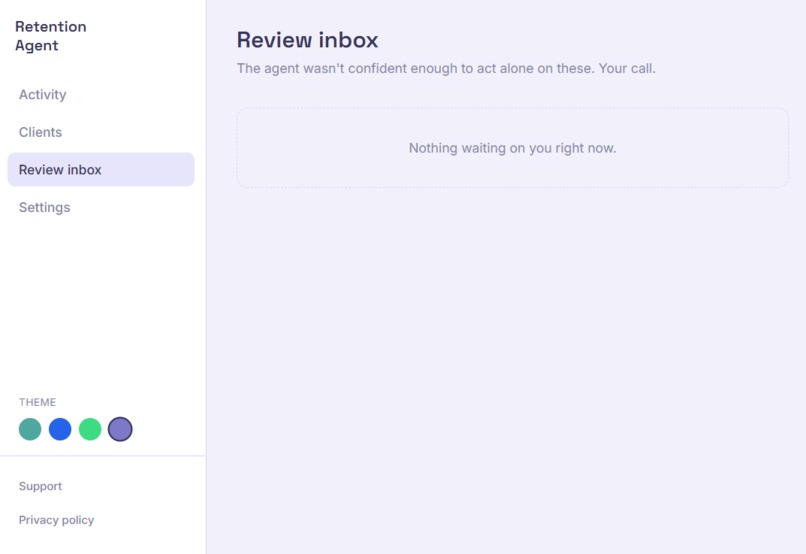
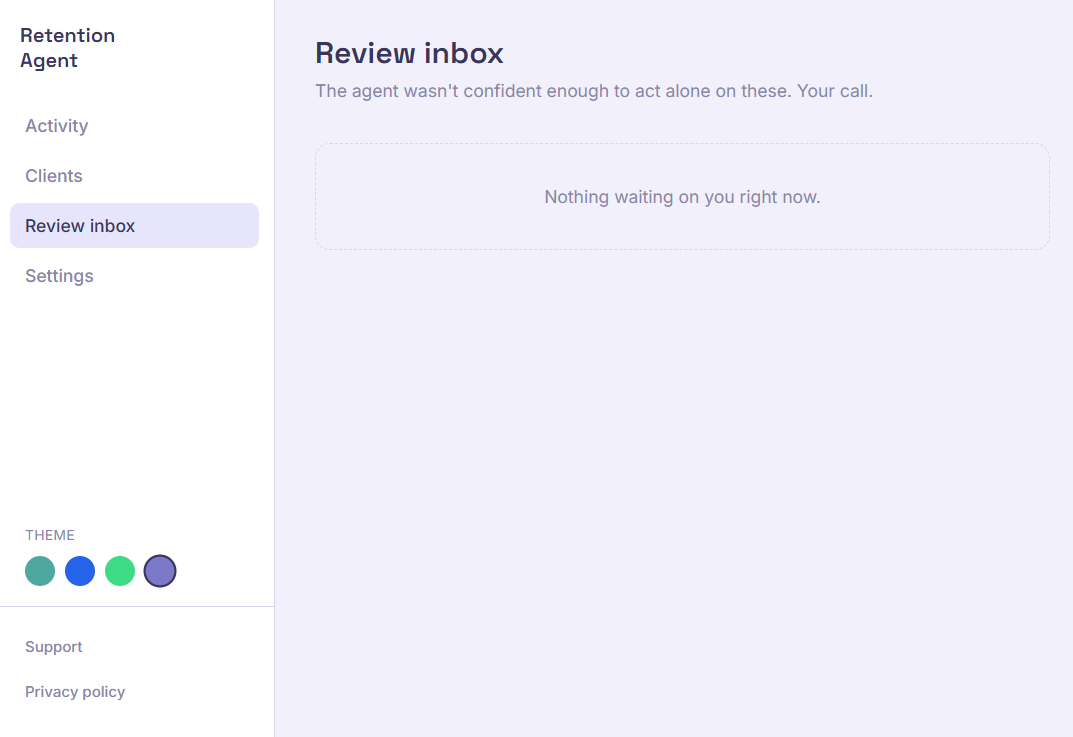
Decisions below the confidence threshold wait here for human approval.
-
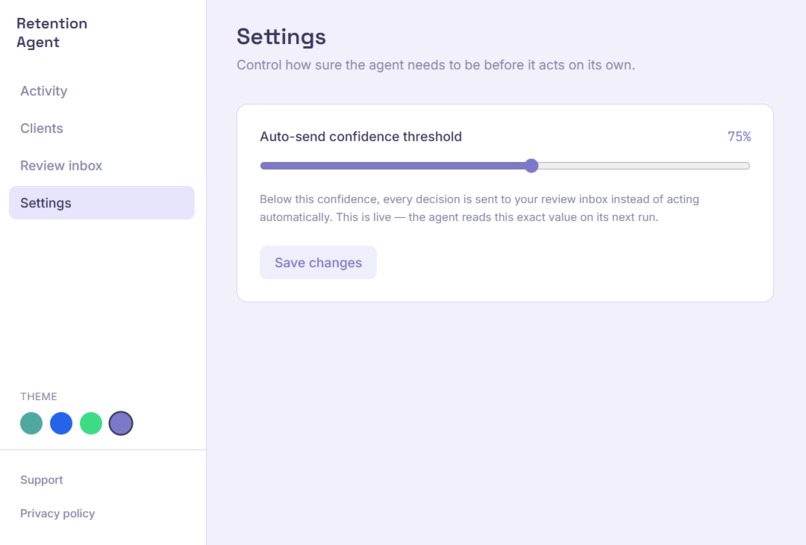
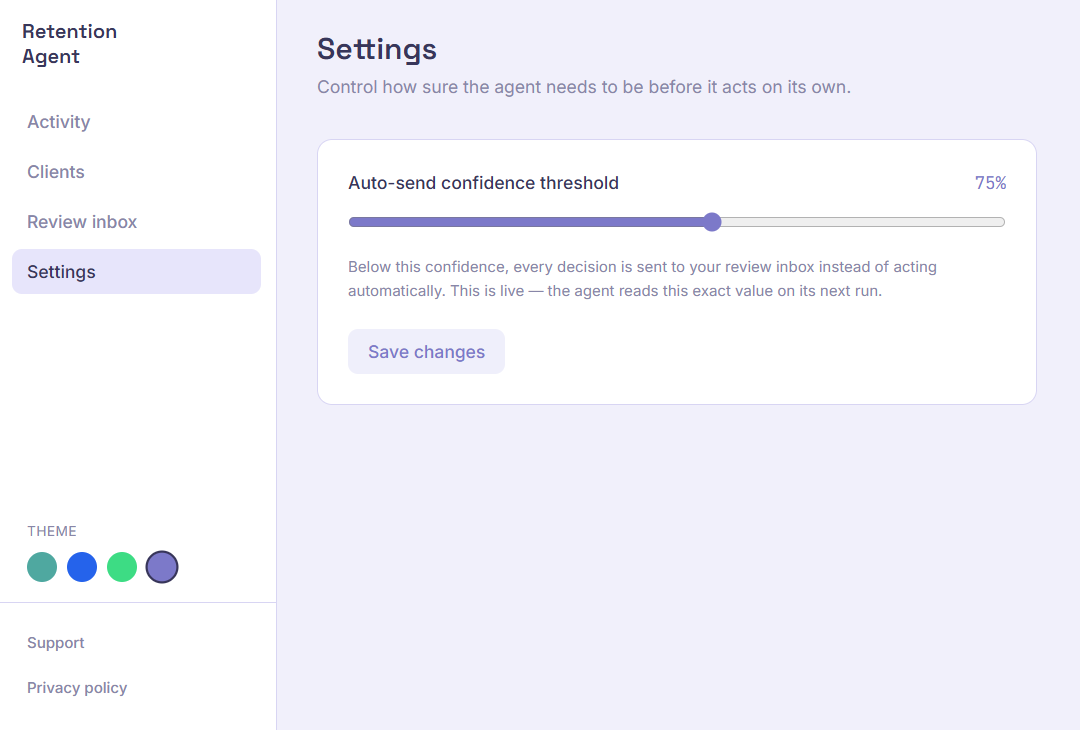
Confidence threshold is live, the agent reads this exact value.
-
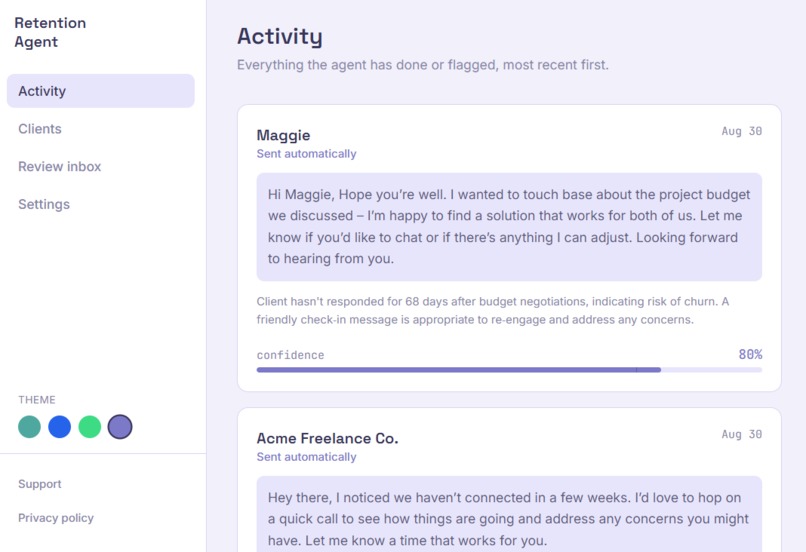
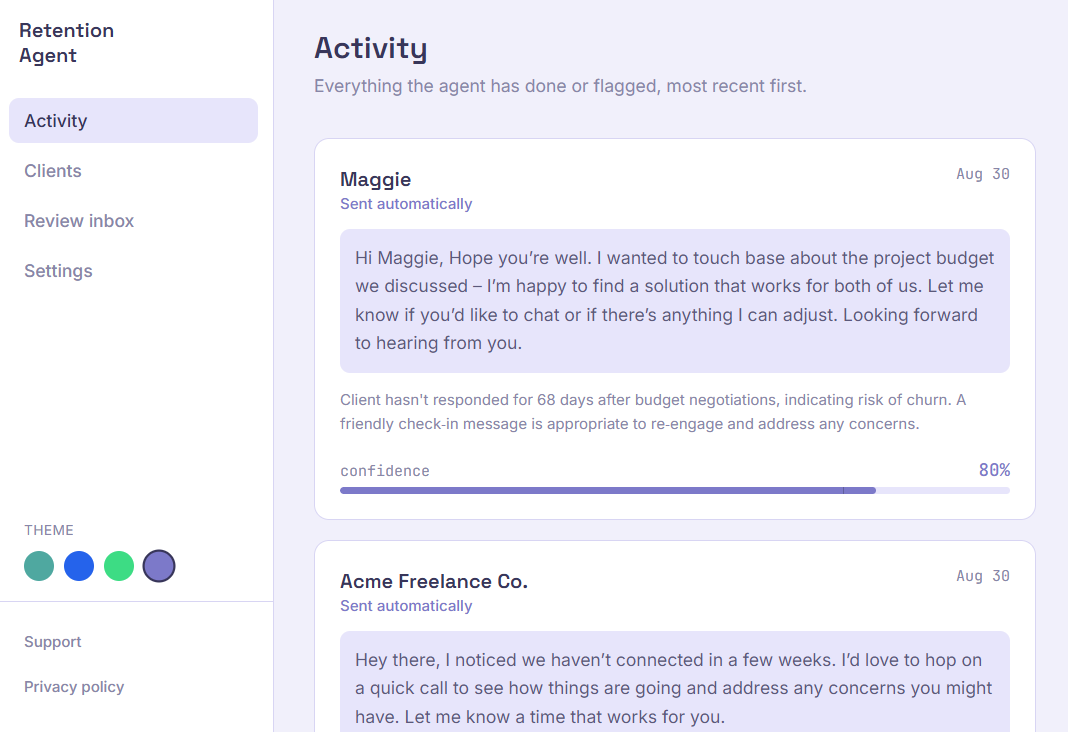
Activity feed; every decision the agent has made, with confidence and reasoning shown.
-
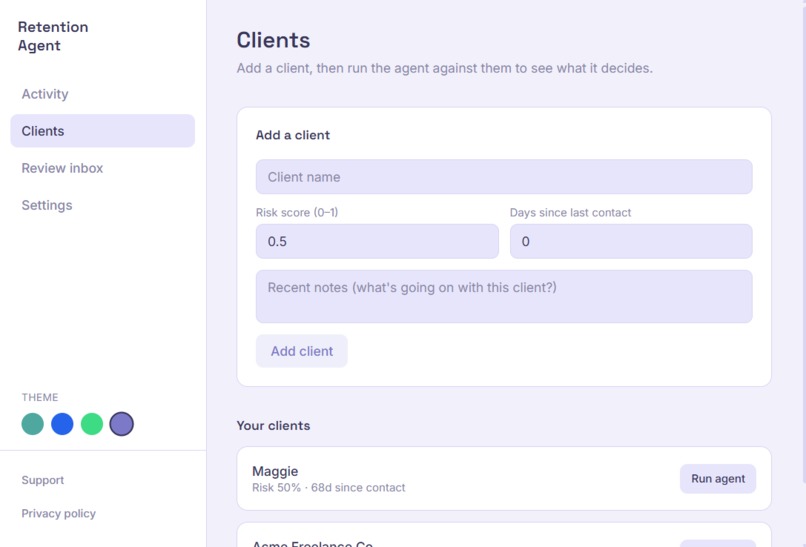
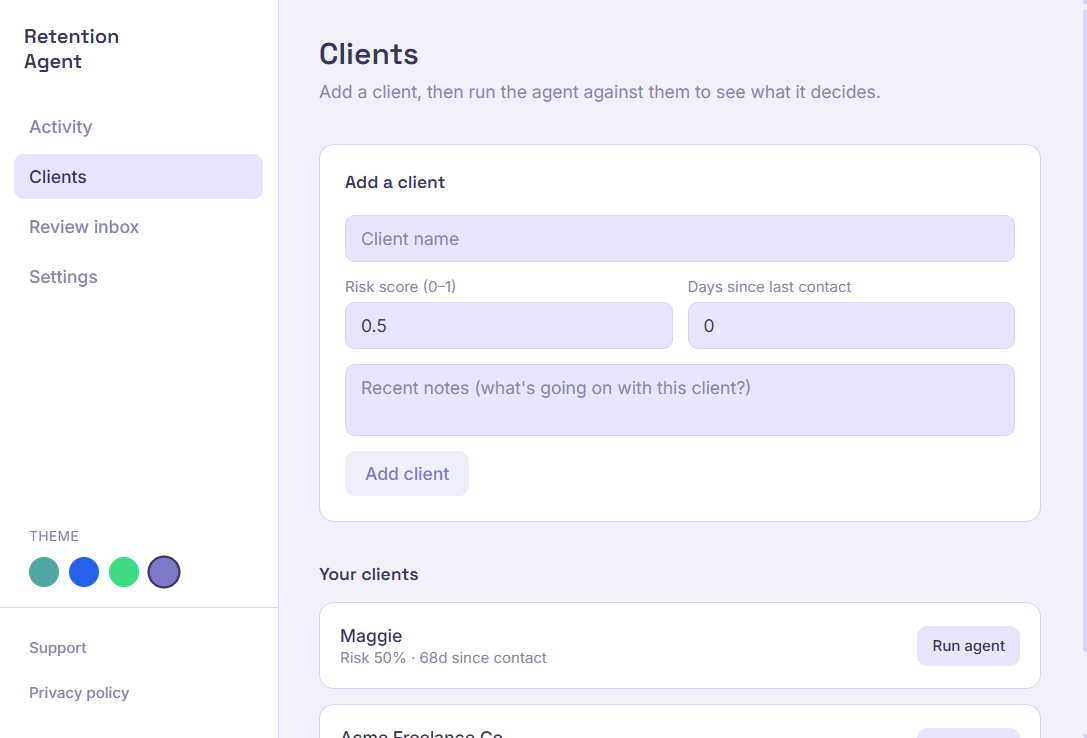
Adding a client and triggering the agent with one click.
Inspiration
Freelance consultants lose clients quietly all the time — not because they don't care, but because follow-up is easy to let slip when you're running the business solo. By the time you notice a client's gone quiet, the moment to meaningfully re-engage them has often already passed.
When this hackathon asked for an agent that actually does the work instead of just talking about it, that gap felt like the natural place to start.
What it does
It looks at a client's situation — risk score, how long since you last talked, any notes you've left — and figures out if something needs to happen. If it does, it decides what: a check-in message, a call, or nothing at all. It drafts the message itself, in your voice.
Then it makes one more call: is it sure enough to just send this, or should you look at it first? Above a confidence threshold you set, it sends. Below it, it lands in your review inbox instead. That split isn't up to the model, on purpose — the code enforces it, so a human's always in the loop for anything genuinely unclear.
The dashboard lets you add clients, run the agent, see what it's done, review flagged decisions, tweak the threshold, plus a support form and privacy page so it doesn't feel like a half-finished demo.
How I built it
Python and the Strands Agents SDK for the agent itself — two tools (pull client context, record the decision) and a system prompt that tells it to stay cautious on anything touching a complaint or a payment dispute.
I didn't lock it to one model provider. It runs on Anthropic or Groq with basically a one-line swap, and the same code path is written to support AWS Bedrock too. That flexibility wasn't originally the plan — more on that below.
Supabase for data, with row-level security turned on for every table. The dashboard's key can only do what it's supposed to; the agent writes through a separate, more privileged key that never touches a browser.
The dashboard's React, Vite, and Tailwind. There's a small Flask API sitting between the dashboard and the agent — and that's not a throwaway piece, it's literally the same function an AWS Lambda would call once this is deployed.
It also has a daily call cap, so it can't rack up cost if something goes wrong, and it won't review the same client twice within 12 hours for no reason.
Challenges I ran into
Honestly? My AWS account still hasn't cleared phone verification. I've got a support case open and I've tried more or less everything. Rather than let that stall the whole project, I built the model layer to be swappable from the start — so when Bedrock wasn't reachable, switching to Groq's free tier took minutes, not a rewrite.
Outside of that, it was a lot of small, very normal dev friction — a PowerShell permissions issue, a wrong Supabase URL causing CORS errors, a model ID that got deprecated by the provider mid-build. None of it was hard exactly, just the usual tax of actually shipping something instead of just planning it.
Accomplishments that I'm proud of
The agent's decisions are real, not scripted. It's chosen to escalate to a phone call instead of just sending another message when the situation actually called for that — which is a genuinely useful, non-obvious call for it to make on its own.
I also didn't leave security for later. Row-level security and separating the two keys happened before the product was "done," not patched in afterward because a checklist told me to.
What I learned
The hard part of building an agent isn't the model call — it's deciding what the model gets to decide, versus what stays in plain code you can actually audit. The confidence threshold is the clearest example of that: let the model reason and draft, but never let it be the one deciding it's safe to act alone.
What's next
Deploy to Lambda (or AgentCore) once my AWS account actually works. Wire up real message sending — right now it logs what it would send, on purpose, since I didn't want to risk emailing a real person while still debugging.

Log in or sign up for Devpost to join the conversation.