Inspiration
You meet someone, have a great conversation, and walk away remembering their face—but forgetting the project they were excited about or the detail you wanted to follow up on.
At a hackathon, that happens constantly. Names, ideas, introductions, and conversations compete for your attention.
As a team of three, we wanted to explore a simple question: could technology help us remember a conversation while keeping our attention on the person?
The Even G2’s Quiet Tech philosophy gave us a direction: small, useful reminders in your line of sight, delivered when they matter.
What Rete does
Rete brings live captions and conversation memory to Even G2 glasses.
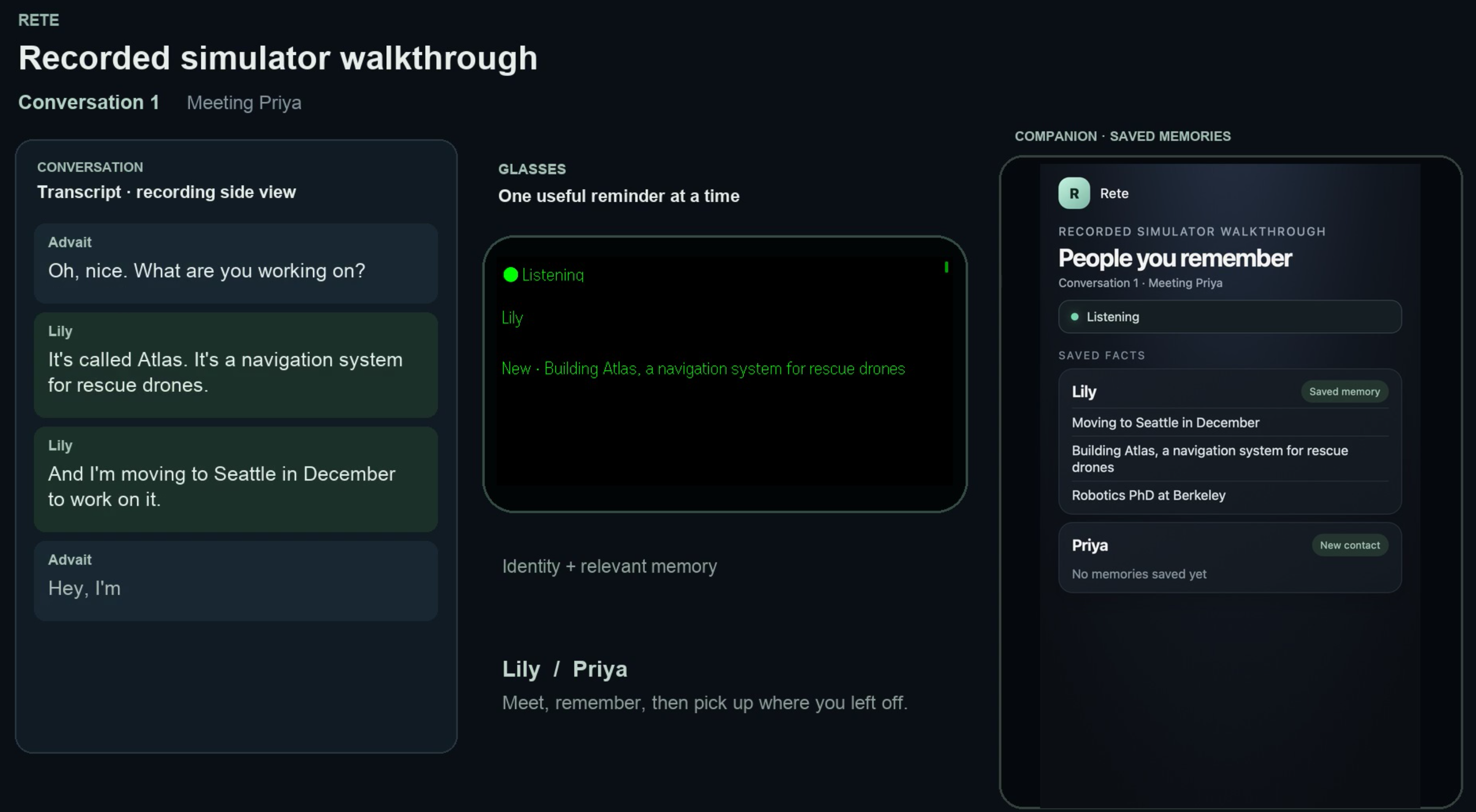
During a conversation, the wearer can follow live captions while Rete captures useful details about the person they are meeting. Spoken introductions and greetings help connect the conversation to a contact. Uncertain identities remain available for review in the companion interface.
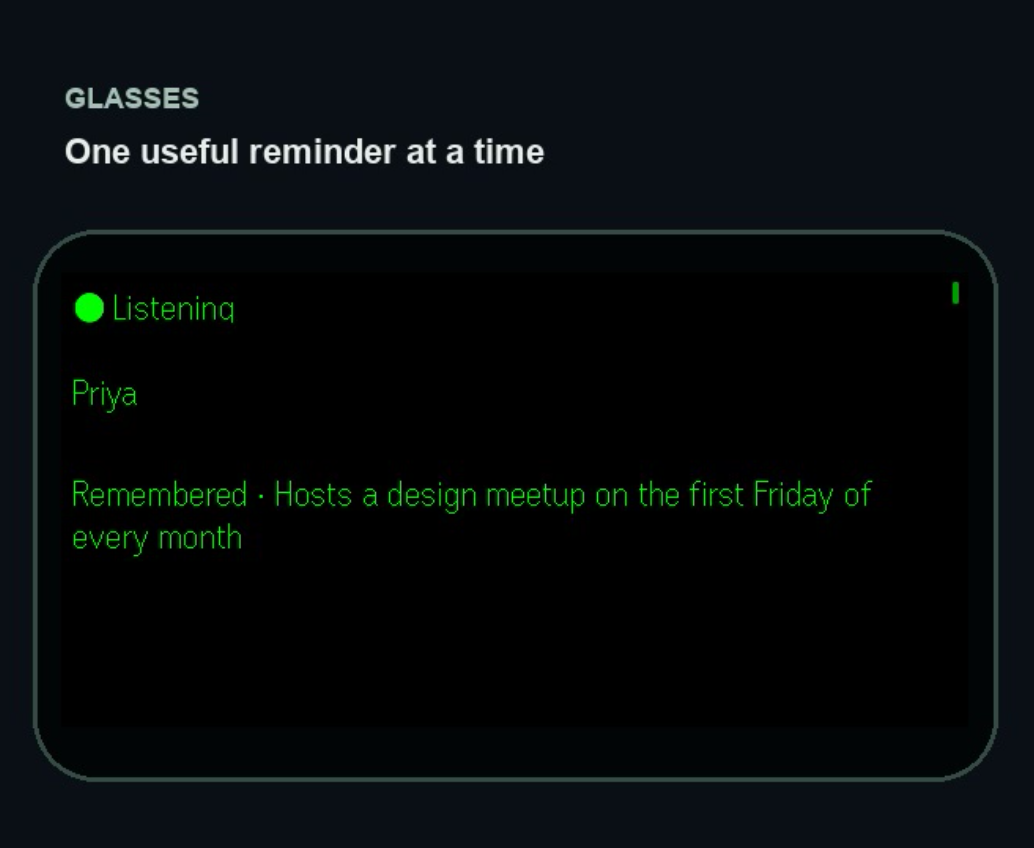
When a topic comes up again, Rete can surface a relevant saved detail. The wearer can also ask a question such as, “What did Lily say about her project?” and receive an answer grounded in saved memories.
Imagine meeting Lily and learning that she studies robotics, is building a project called Atlas, and plans to move to Seattle. When you reconnect, those details become context you can use to continue the conversation.
A companion memory vault lets the wearer review people, correct identities, inspect dated facts, and delete memories.
How we built it
We built Rete with TypeScript, Vite, and the Even Hub SDK.
Audio from the glasses streams to OpenAI for live transcription. Partial and final transcript updates feed both the glasses display and the companion interface. The glasses use separate areas for status, each speaker’s captions, a compact person card, and relevant context.
Our backend saves finalized transcript segments before running background fact extraction. Extracted facts retain references to their source conversation, allowing recall answers to use stored evidence.
Local storage holds profiles, people, conversations, and processing jobs. We integrated Mem0 as an optional semantic search index, with local search available as a fallback.
The OpenAI API key stays on the server; the client receives a short-lived transcription token.
Challenges we faced
Keeping the display quiet. Captions, identity, and memories all compete for limited space. We prioritized readable captions, compact person cards, and temporary context that disappears after it is useful.
Attaching information to the right person. Introductions can be ambiguous, names can overlap, and speaker-role signals can be uncertain. We separated provisional information from confirmed contacts and added identity correction.
Coordinating live speech with background memory. Words can appear before transcription is final, and saved text can exist before facts have finished processing. We had to handle those stages separately without duplicating turns or presenting unfinished information as confirmed memory.
Preserving work through interruptions. Pausing, exiting, network failures, and delayed transcription required careful save sequencing and recovery handling.
What we learned
We learned that useful wearable intelligence depends heavily on timing and restraint. A relevant sentence can help someone continue a conversation; too much information can pull their attention away.
We also learned that transcription, speaker attribution, identity, and memory are separate problems. Each needs its own handling of uncertainty.
What’s next
We want to refine physical-device reliability, noisy-room performance, identity handling, and the timing of reminders.
Beyond networking, we see opportunities in learning, field-team handoffs, and humanitarian coordination—settings where people need to carry important context through busy, demanding days.
Rete helps you remember what someone told you, so you can stay present for what they say next.
Built With
- css
- even-hub-sdk
- even-realities-g2
- html
- mem0
- node.js
- openai
- typescript
- vite
- websockets

Log in or sign up for Devpost to join the conversation.