Inspiration
As college students applying for internships and entry-level roles, we kept hitting the same frustrating wall: sending out dozens of applications and getting silence, with zero clarity on why. Most existing "resume checkers" either spit out an arbitrary black-box "ATS score" without explaining how it was calculated, or use generative AI to rewrite bullet points with inflated metrics and buzzwords that candidates cannot actually defend in an interview.
We built ResumeIQ to replace guesswork and fabricated AI fluff with transparent, evidence-backed career readiness—helping students see exactly how their resume stacks up against a target job description, what skills give them the highest return on effort to learn next, and how to prepare for real interviews using only their genuine experience.
What it does
ResumeIQ is an end-to-end Resume Intelligence & Career Readiness Platform designed specifically for students and freshers:
- Resume Parsing & Hygiene Check: Extracts text, sections, links, projects, and skills from PDFs, DOCX files, or raw text, and runs structural hygiene checks (contact/GitHub link presence, bullet density, action-verb strength, and date consistency) without inventing fake ATS scores.
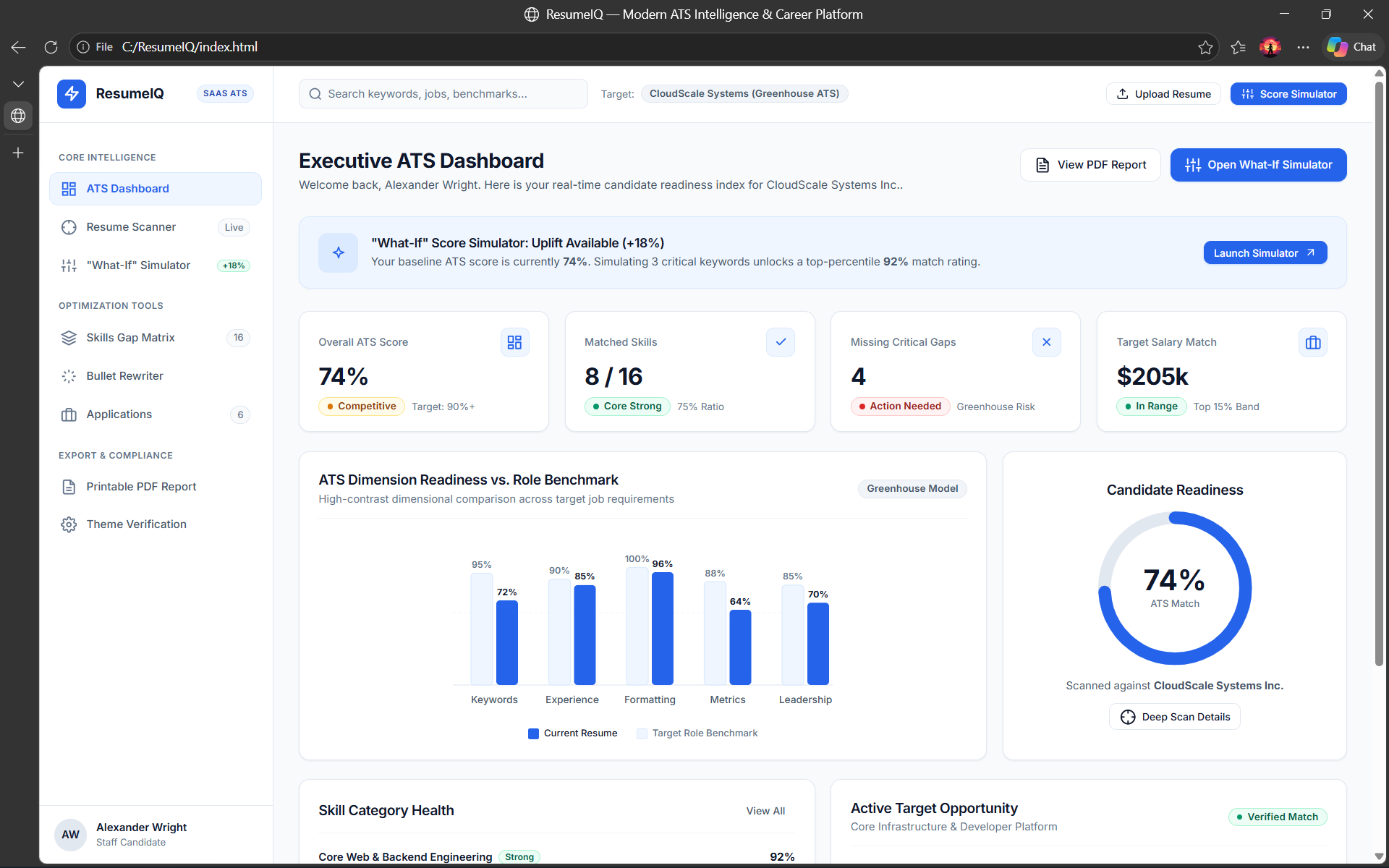
- Explainable Resume–JD Matching: Breaks down job descriptions into required vs. preferred skills, maps matches using exact keywords, synonyms (e.g.,
JS↔JavaScript,Postgres↔PostgreSQL), and semantic similarity, and highlights the exact evidence snippets from the resume. - "What-If" Skill & Score Simulator: Lets students toggle missing skills as "Simulated Learned" to preview real-time score improvements and rank missing skills by highest point impact (
+pts). - Multi-JD Side-by-Side Comparison: Evaluates one resume against multiple internship descriptions simultaneously to identify the strongest immediate fit and high-leverage skills shared across roles.
- Grounded Project Bullet Improver & Version Snapshots: Rewrites weak project bullets side by side without ever inventing fake numbers, generates tailored resume summaries and recruiter outreach notes, and saves version snapshots (
v1 Basevs.v2 Tailored) exportable to DOCX. - Skill Gap Roadmap & Mini Project Blueprints: Orders missing skills by impact and generates scoped weekend project blueprints pairing the student's existing tech stack with the target skill.
- Targeted Interview Prep & PDF Reports: Generates categorized interview questions (Project Deep-Dives, Skill Verification, and Skill-Gap Bridges) grounded in the user's real projects, complete with practice notes and a downloadable light-themed PDF report.
How we built it
We structured ResumeIQ as a clean, modular monolith with a strict light-mode SaaS interface (#F8FAFC canvas, #FFFFFF cards, #2563EB primary blue):
- Frontend: Built with React, Vite, Tailwind CSS, React Router, Axios, Lucide Icons, and Recharts for clear, responsive score breakdowns and side-by-side comparison views.
- Backend & Database: Built with FastAPI, Pydantic, SQLAlchemy, and JWT authentication, backed by PostgreSQL (with automatic SQLite fallback for instant local setup).
- NLP & Document Pipeline: Combined PyMuPDF and python-docx for multi-format extraction, spaCy and regex section-heading detection for structured parsing, a configurable JSON skill/synonym taxonomy, and ReportLab for generating formatted PDF career reports.
- Hybrid AI + Deterministic Architecture: Integrated the Gemini API for structured bullet rewriting, mini project blueprints, and interview prep generation, paired with deterministic rule-based local fallbacks so every feature works reliably even offline or without an API key.
Challenges we ran into
- Preventing AI Hallucinations in Resume Rewrites: Early prompts tended to invent fake percentages (e.g., "improved latency by 40%") when rephrasing student projects. We solved this by enforcing strict prompt constraints, adding a deterministic local fallback engine, and using explicit
[X%]verification placeholders whenever measurable metrics are absent. - Avoiding False-Positive Skill Matches: Pure semantic similarity occasionally matched unrelated terms (such as matching general "Java" concepts to "JavaScript"). We engineered a tiered matching pipeline that prioritizes exact taxonomy matches and curated synonyms first, using semantic similarity only as a secondary signal for partial matches backed by resume evidence snippets.
- Inconsistent Student Resume Layouts: Multi-column PDFs and creative headings caused raw text extractors to scramble project descriptions. Combining PyMuPDF block extraction with flexible regex section-header detection and an interactive review screen allowed users to verify and adjust parsed sections cleanly.
Accomplishments that we're proud of
- 100% Explainable Scoring & Simulation: Every point in our compatibility score (
50%required skills,20%keyword coverage,20%project relevance,10%resume completeness) is traceable to real extracted evidence—and powers a live "What-If" simulator that helps students prioritize what to learn next. - Zero-Dependency Demo Mode: Judges and users can test the entire platform—parsing, hygiene checks, scoring, simulation, bullet improvements, and interview prep—immediately without needing external API keys.
- Cohesive End-to-End Workflow: Taking a student from raw resume upload to tailored DOCX export, mini project ideas, interview talking points, and a downloadable PDF report inside one unified, distraction-free light interface.
What we learned
- Explainability builds trust faster than magic numbers: Students and mentors respond far better to seeing why a resume scored 68%—and which two skills will push it to 82%—than to an opaque score.
- Graceful fallbacks make AI apps resilient: Designing deterministic NLP and template engines alongside LLM calls forced us to structure our schemas cleanly and guaranteed reliable performance during live demos.
- Ethical guardrails are a product feature: Explicitly preventing fabricated metrics and avoiding exaggerated "hiring guarantee" claims made the tool genuinely useful for real internship preparation.
What's next for ResumeIQ
- GitHub Repository Analyzer: Directly inspect a student's public GitHub repositories and READMEs to auto-extract verified tech stacks and suggest stronger resume bullets from actual commits.
- Campus Placement & Mentor Portal: Allow college career cells and faculty mentors to review student readiness trends, share curated internship JDs, and track cohort skill gaps.
- Browser Extension for One-Click JD Capture: Capture job descriptions directly from LinkedIn, Internshala, or company career pages into ResumeIQ's Multi-JD Comparison matrix with a single click.
Built With
- fastapi
- gemini-api
- javascript
- jwt
- lucide-react
- natural-language-processing
- postgresql
- pydantic
- pymupdf
- python
- python-docx
- react
- react-router
- recharts
- reportlab
- sentence-transformers
- spacy
- sqlalchemy
- sqlite
- tailwindcss
- vite
