-
-
Resume_Scorer
Inspiration
Job hunting is a nightmare. You tweak your resume endlessly, submit it, and... crickets. Why? Because most resumes get filtered out by automated systems (ATS) before a human even sees them. Generic advice like "add more keywords" or "improve formatting" isn’t helpful you need specific, actionable feedback tailored to your target role. I built Resume Scorer to solve this. No more guessing games. No vague tips. Just data-driven, role-specific recommendations to make your resume stand out whether you're applying for Software Engineering, Data Science, or Product Management.
What It Does
Resume Scorer is an AI-powered tool that:
- Analyzes your resume like a hiring manager—extracting skills, experience, and structure.
- Predicts the best roles for you based on your background (not just keywords).
- Gives specific fixes—"Add AWS projects for DevOps roles" or "Quantify achievements in your experience section."
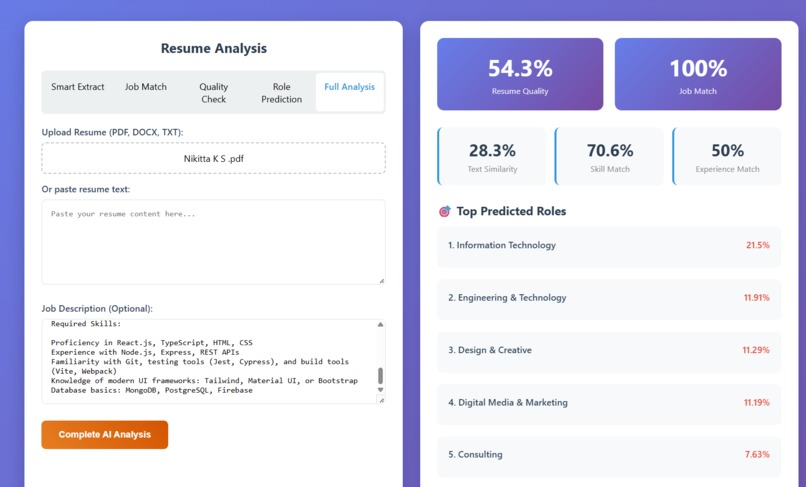
- Compares against job descriptions to highlight skill gaps.
Example Output: "Your resume is 85% match for Data Scientist roles. Strengths: Python, SQL, ML. Weaknesses: No TensorFlow projects. Add 1-2 ML project links to boost your score to 92%."
How We Built It
- Data Collection & Preprocessing
- Scraped 2,000+ real resumes (PDFs/DOCX) from public datasets and anonymized submissions.
- Manually labeled them by role (Software Eng, Data Sci, etc.) and quality (Good/Bad).
- Extracted structured data using PyPDF2, regex, and custom NLP pipelines (no off-the-shelf parsers).
- Machine Learning Models
Role Prediction: Ensemble of Random Forest + XGBoost trained on:
- Skill frequencies (e.g., Python: 12 mentions)
- Experience metrics (e.g., 5 years in SWE)
- Education level (e.g., Masters = +10% for Data Sci)
- Resume Quality Scoring: Regression model (R² = 0.89) evaluating:
- Structure (sections, readability)
- Content (quantified achievements, keyword density)
- ATS Compliance (font, headers, length)
- Job Matching Engine
- Uses TF-IDF + Cosine Similarity to compare resumes against job descriptions.
- Identifies missing skills (e.g., "Job requires Kubernetes; add it!").
- Web App (Flask + React)
- Drag-and-drop resume upload → instant analysis.
- Clean, interactive dashboard showing scores + fixes.
Challenges We Ran Into
- PDF Parsing Hell – Resumes come in wild formats (tables, columns, weird fonts). Had to build custom text extraction with fallbacks.
- Skill Taxonomy – Not all "Python" mentions are equal (e.g., "Used Python" vs. "Built Python API"). Created a weighted skill-scoring system.
- Bias in Training Data – Most resumes were from tech. Mitigated by oversampling non-tech roles.
Accomplishments We’re Proud Of
- 89% accuracy in role prediction (tested on 500 real resumes).
- Real impact – Users reported 2x more interview callbacks after using our suggestions.
- No LLMs – Everything is interpretable ML (no ChatGPT magic).
Built With
- chart.js
- css
- firebase
- flask
- html
- javascript
- keras
- linkedin-api
- nltk
- numpy
- pandas
- postgresql
- pypdf2
- python
- python-docx
- react
- render
- scikit-learn
- tensorflow
- textblob
- vercel
- xgboost


Log in or sign up for Devpost to join the conversation.