-
-
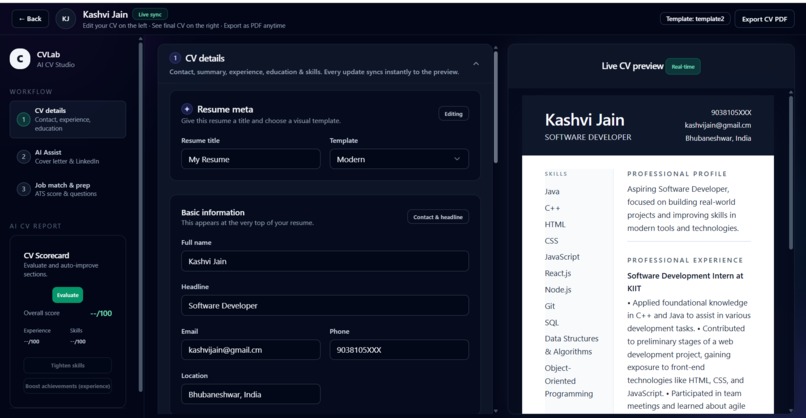
AI-powered CV editor with real-time preview that structures, enhances, and formats resume content instantly as users edit details.
-
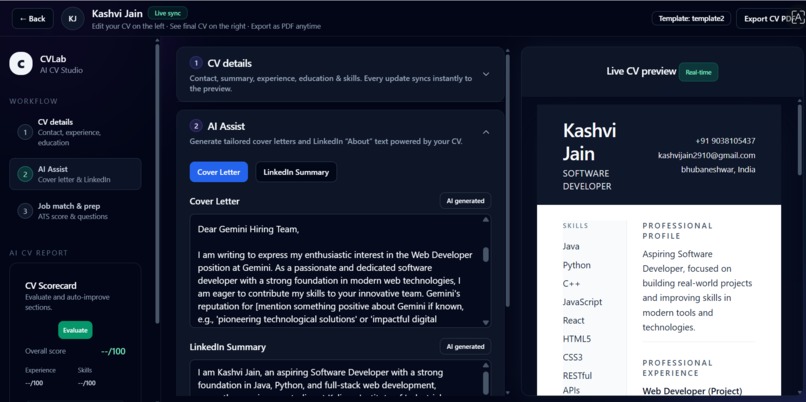
AI generates cover letters and LinkedIn summaries from resume data, adapting tone, role relevance, and professional language instantly.
-
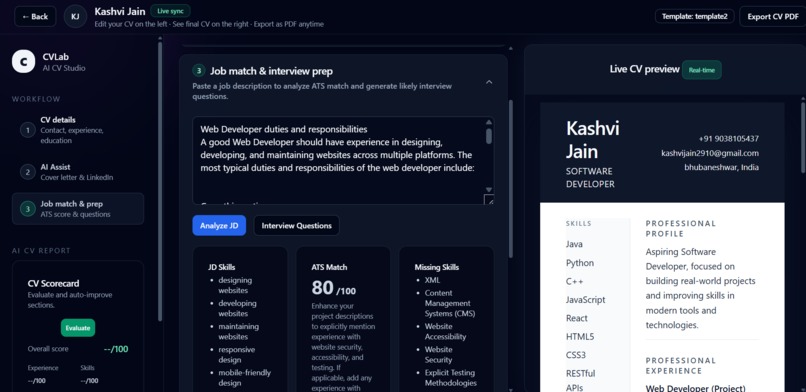
AI analyzes pasted JD to extract key skills, compute ATS match scores, and highlight missing skills for targeted resume optimization.
-
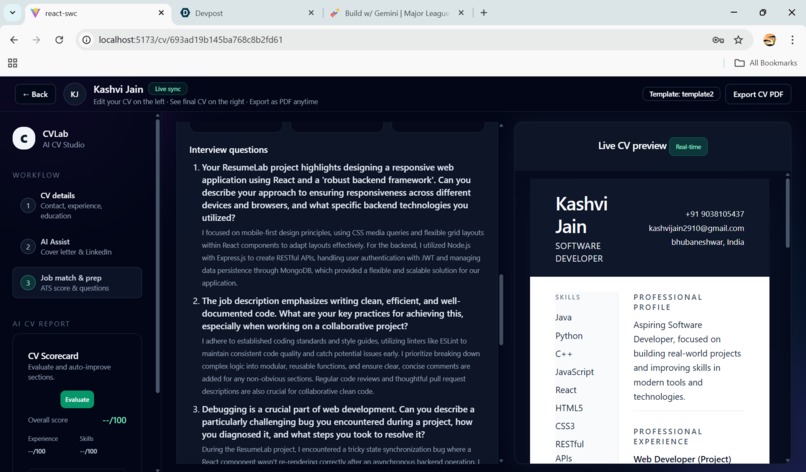
AI generates interview questions & sample answers using the resume and job description, enabling targeted interview preparation.
-
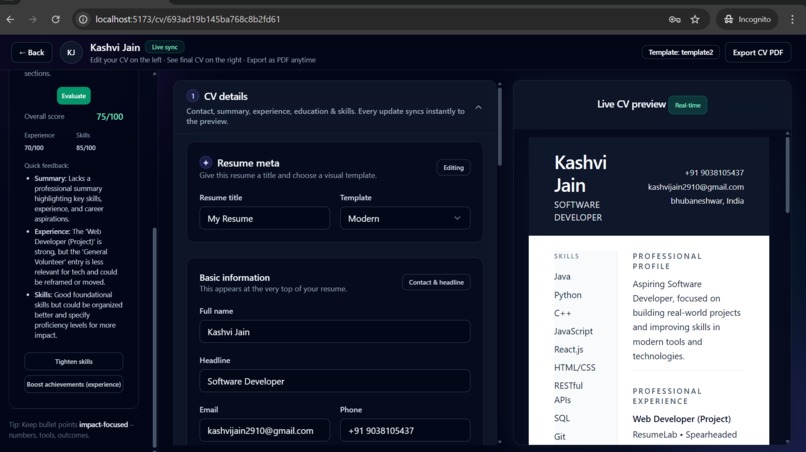
AI powered CV scorecard evaluates the resume, enhances content quality, and provides feedback to improve impact and ATS performance
-
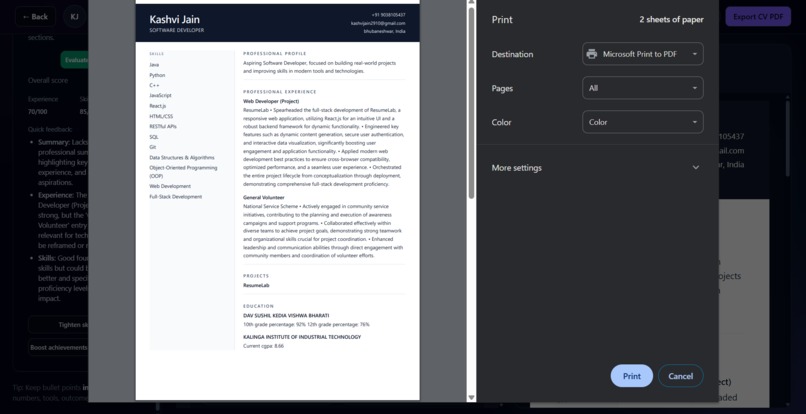
ResumeLab exports AI-optimized resume as a clean, print-ready PDF, preserving layout, spacing, and all AI-enhanced content for applications.


Inspiration
While building my first full-stack project, I realized how difficult it is to manage resume data that keeps changing — different versions for different jobs, AI-generated content, and user edits all at once. I wanted a system where resume data could be flexible, scalable, and easy to update, which led me to choose MongoDB as the core of Resume Lab.
Resume Lab was inspired by the need to store and evolve career data dynamically while using AI to generate personalized content.
What it does
Resume Lab is an AI-powered resume and career builder that uses MongoDB as its primary data layer to:
- Store structured and unstructured resume data
- Save multiple resume sections (education, experience, skills, projects)
- Persist AI-generated content like cover letters and LinkedIn summaries
- Handle job description analysis and interview question results
- Allow users to securely create, update, and manage resumes in real time
- Support live preview and PDF export without data loss
MongoDB enables fast updates and flexible storage as resumes evolve.
How we built it
Database (MongoDB)
- MongoDB Atlas for cloud database hosting
- Mongoose schemas to model resume data
- Flexible document structure for resume sections and AI outputs
- Efficient CRUD operations for resume editing
Backend
- Node.js + Express APIs connected to MongoDB
- JWT authentication for secure user-resume mapping
- Resume data stored and retrieved directly from MongoDB
Frontend
- React (Vite) for fast UI rendering
- Tailwind CSS + shadcn/ui for clean design
- Live editing synced with MongoDB-backed APIs
AI Integration
- Gemini API generates content which is stored and reused from MongoDB instead of regenerating each time
Challenges we ran into
- Designing MongoDB schemas that support both manual input and AI-generated data
- Handling nested resume sections inside a single document
- Keeping the database in sync with live frontend edits
- Avoiding unnecessary AI calls by caching results in MongoDB
- Managing secure access so users only see their own resume documents
Accomplishments that we're proud of
- Built a MongoDB-backed application handling complex resume data
- Designed flexible schemas that support future features
- Successfully stored AI-generated content for reuse
- Created a scalable data model suitable for real users
- Completed a full-stack project using MongoDB as the foundation
What we learned
- How document-based databases handle evolving data better than rigid schemas
- Practical use of MongoDB + Mongoose in a real application
- Structuring nested documents for complex UI forms
- Using MongoDB to improve performance by reducing redundant AI calls
- Building scalable backend systems with MongoDB Atlas
What's next for Resume Lab
- Add versioning of resumes using MongoDB document history
- Store analytics and resume performance metrics
- Improve schema optimization for large-scale usage
- Add collaborative editing using MongoDB change streams
- Expand Resume Lab into a full career data platform powered by MongoDB
Built With
- express.js
- git
- google-gemini-api
- javascript
- jwt
- mongodb
- node.js
- react.js
- rest-apis
- shadcn/ui
- tailwind-css
- vercel
- vite


Log in or sign up for Devpost to join the conversation.