-
-
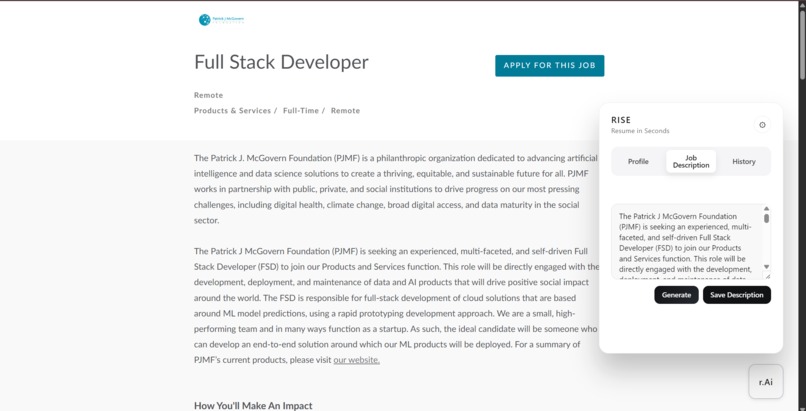
Grabbing relevant parts of the job description
-
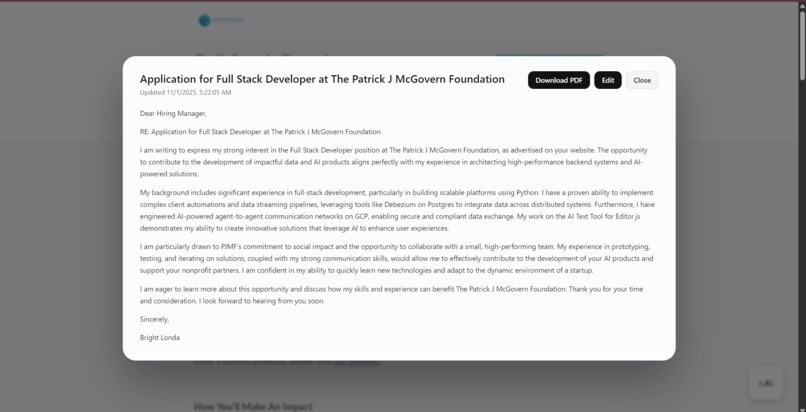
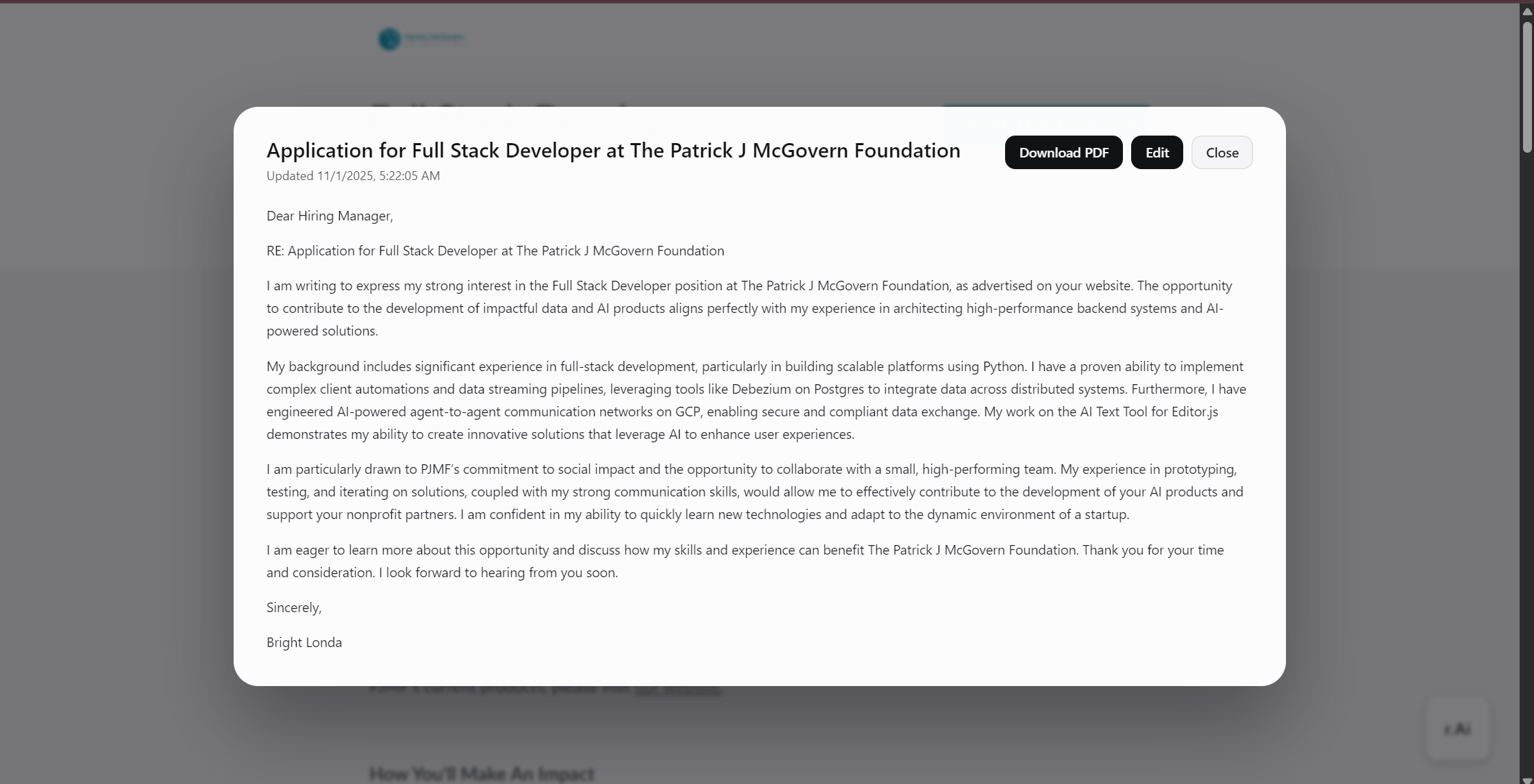
Example Generated Cover Letter
-
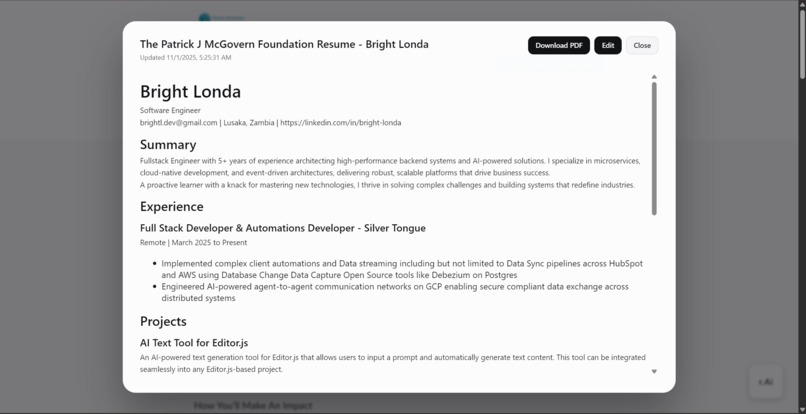
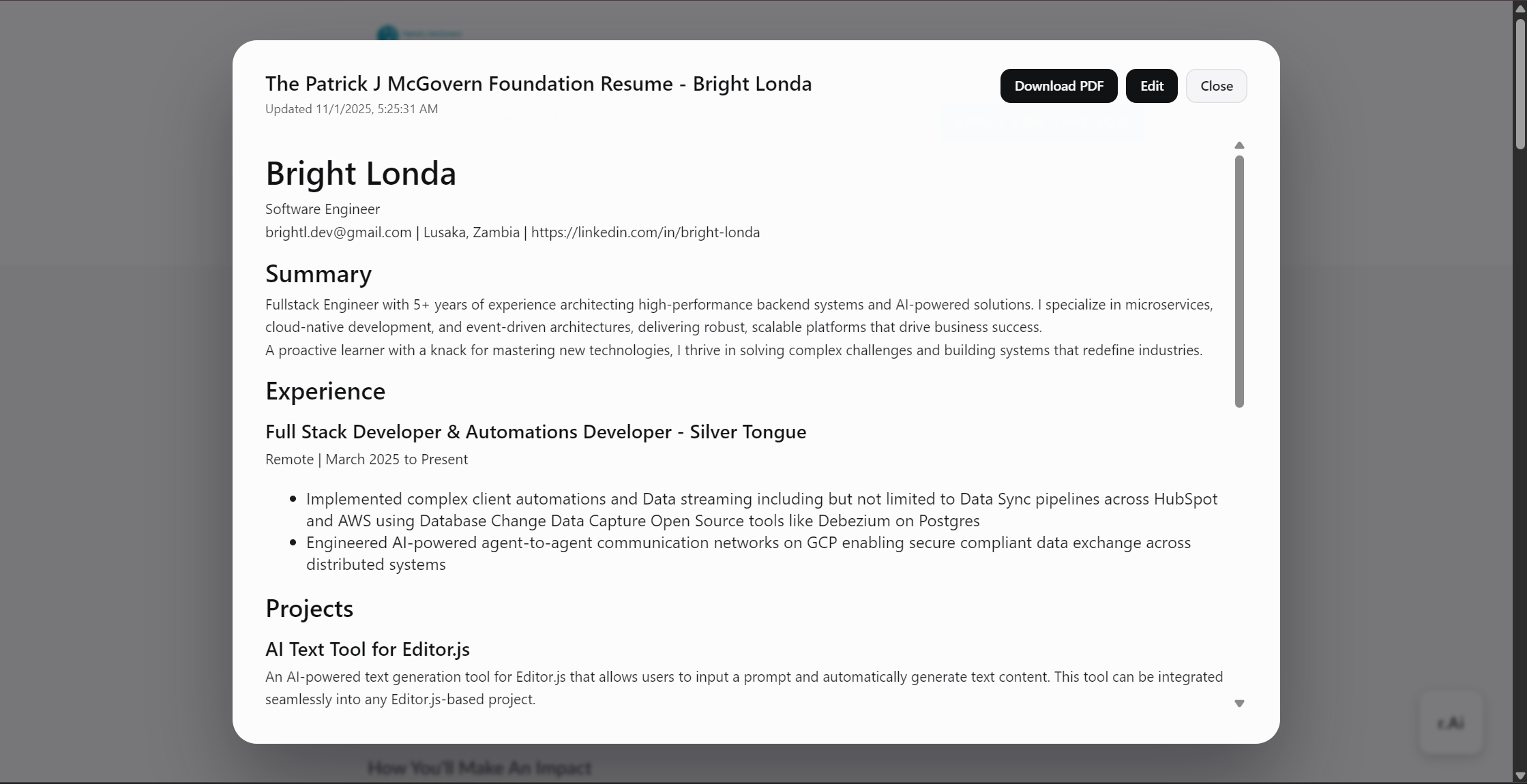
Example Resume Generation
Inspiration
The inspiration for Rise AI came from a LinkedIn post by Dan, a career coach who repeatedly emphasized one crucial truth: tailored resumes get more interviews. After implementing his advice and customizing my resume for each application, I immediately saw results, more callbacks, more interview invitations, more opportunities.
But the process was exhausting. Every job posting meant manually rewriting experience bullets, adjusting my summary, and highlighting different skills. I thought: What if there was a tool that already knew my background and could instantly generate a tailored resume? All I'd need to do is review, make minor edits, and hit send.
That's when I realized the perfect solution. First built using Open AI's API's Resume in Seconds did work pretty well but i couldn't really scale it or offer it for free as I intended to. With Google's Gemini Nano running locally in Chrome, I could build a completely private resume assistant, no servers, no subscriptions, no data leaks. Just instant, personalized resumes for every job opportunity.
What it does
Rise AI transforms job hunting by generating tailored resumes and cover letters in seconds, right from your browser. Here's how it works:
- Browse any job posting on LinkedIn, Indeed, or any career site
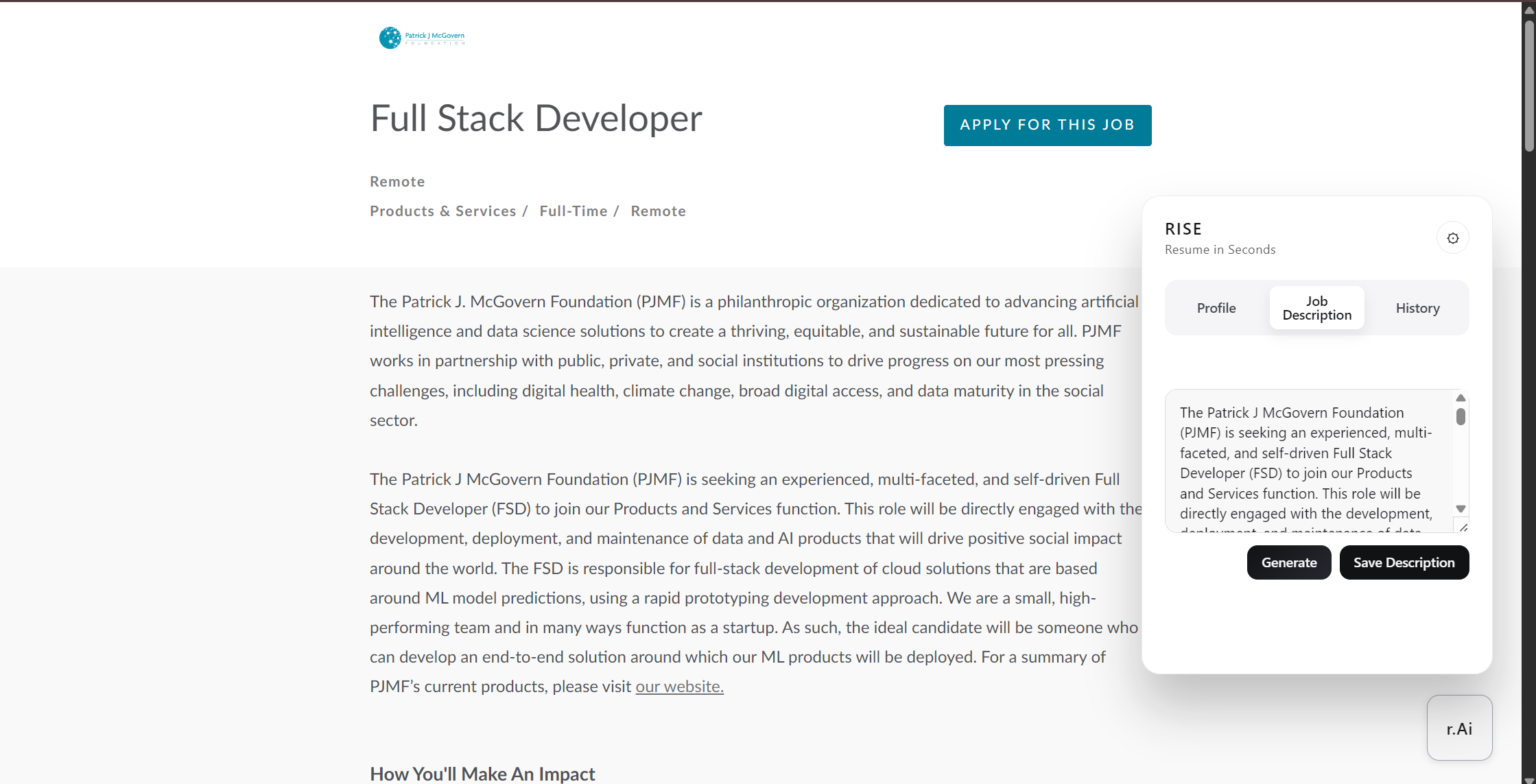
- Click the floating Rise AI button that appears on every page
- Save your profile once: Add your contact info, experience, projects, skills, education, and certifications directly in the extension
- Paste the job description into the Job Description tab
- Generate: Rise AI uses Gemini Nano to create a custom resume or cover letter that highlights your most relevant qualifications for that specific role
- Edit and download: Use the live block-based editor to make any changes, then download as PDF
All processing happens completely offline using Chrome's built-in AI. Your sensitive career information never leaves your device; no cloud uploads, no API costs, no privacy concerns. You can generate unlimited resumes and cover letters for free while keeping complete control over your data.
How we built it
Rise AI is a Chrome extension built on Manifest V3 with a sophisticated multi-layer architecture designed to work around Chrome's security restrictions:
Architecture Overview
Content Scripts (UI Layer)
    ↕ chrome.runtime messaging
Service Worker (Orchestration)
    ↕ sendMessage + retry backoff
Offscreen Document (API Access)
    ↕ window.ai.languageModel
Gemini Nano (On-device AI)
Why three layers? Chrome's security model creates unique challenges:
- Content scripts can inject UI but can't access
window.aiAPIs - Service workers coordinate between components but have no DOM access
- Offscreen documents run in extension context where Gemini Nano APIs are exposed
Key Technical Components
1. Shadow DOM Isolation
We inject the Rise AI panel using Shadow DOM (bootstrap.js) to prevent CSS conflicts with host pages. This ensures our UI looks perfect on every website without breaking existing styles.
2. Gemini Nano Prompt API Integration We use Google's experimental Prompt API with an Origin Trial token. Our implementation handles multiple API variants across Chrome versions:
const factory =
  window.ai?.languageModel?.create ||
  window.ai?.languageModel?.createSession ||
  window.ai?.createTextSession ||
  window.LanguageModel?.createSession
Sessions are configured for deterministic output:
temperature: 0.45(balanced creativity)topK: 40(nucleus sampling)
3. Profile-Based Context Management We built a sophisticated profile data system that uses IndexedDB to store structured user information:
- Profile Normalization: Flattens complex profile objects into plain-text snapshots with clear section headers (Header, Summary, Experience, Projects, Skills, Education, Certifications)
- Direct Profile Access: Resume and cover letter generation now pull directly from the user's saved profile instead of relying on uploaded documents
- No Token Limits: We removed artificial token constraints to let Gemini Nano handle the full profile context
4. Robust Communication Protocol Messaging between layers uses exponential backoff retry for reliability:
// Retry up to 10 times with increasing delays: 150ms, 300ms, 450ms...
for (let attempt = 0; attempt < 10; attempt++) {
  try {
    const response = await sendOffscreenMessage("offscreen:ping");
    break;  // Success
  } catch (error) {
    await new Promise(r => setTimeout(r, 150 * (attempt + 1)));
  }
}
5. IndexedDB Storage We maintain two databases:
rise_ai_context: User profile data, resume history, cover letter historyrise_ai_data: UI-layer copy for instant preview loading
6. EditorJS Integration We integrated EditorJS as a block-based editor for live editing of generated resumes and cover letters:
- Custom CSS to ensure consistent styling within Shadow DOM
- Read-only mode toggle for preview vs. edit states
- Seamless conversion between JSON output and EditorJS blocks
7. JSON Response Parsing with Fallbacks Gemini Nano sometimes wraps JSON in markdown blocks. We built a multi-stage parser:
- Try direct
JSON.parse() - Extract from
json...blocks - Extract from generic
...blocks - Regex match
{...}patterns
Tech Stack
- Chrome Extension Manifest V3
- Gemini Nano Prompt API (Origin Trial)
- IndexedDB for persistent storage
- EditorJS for block-based editing
- jsPDF for PDF generation
- Shadow DOM for UI isolation
- Vanilla JavaScript (no frameworks for minimal bundle size)
Challenges we ran into
1. From Token Limits to Profile-Based Generation Initially, Gemini Nano's 1024-token limit was a major constraint. We had to:
- Implement aggressive text normalization (strip whitespace, cap sections)
- Build a token estimator to validate prompts before sending
- Eventually, we removed all artificial token limits and switched from document-chunk-based context to structured profile data stored in IndexedDB, letting Gemini Nano handle the full context naturally
2. Streaming Formatted Text (Unsolved)
We wanted real-time streaming of resume generation, but Gemini Nano's streaming API (promptStreaming()) doesn't guarantee consistent JSON format. Our current implementation waits for the full response, but we plan to explore:
- Streaming plain text with post-processing
- Progressive JSON parsing with repair algorithms
- Hybrid approach: stream summary, batch-generate structured sections
3. Multi-Window Communication Chaos Rise AI has three UI components that need to stay in sync:
- Configuration panel (edit profile/settings)
- Job description input (paste/capture job text)
- Preview window (show generated resume)
Coordinating state across these windows required:
- Centralized state management in the service worker
- Broadcast notifications using
chrome.tabs.sendMessage() - Message deduplication to prevent infinite update loops
4. Offscreen Document Initialization Race Conditions Chrome's offscreen documents don't signal when they're ready. We encountered "Receiving end does not exist" errors when sending messages too early. Solution: exponential backoff retry with up to 10 attempts (~8.25 seconds total wait time).
5. Service Worker Keepalive Chrome suspends idle service workers after 30 seconds. During long resume generation, the worker would die mid-process. We implemented a keepalive interval:
setInterval(() => {
  console.log("keepalive ping");
}, 20000);  // Every 20 seconds
6. Empty Gemini Responses When prompts exceeded limits or context was too complex, Gemini Nano would return empty strings with cryptic "Other generic failures occurred" errors. We added:
- Detailed logging at every stage (offscreen, service worker, content script)
- Specific error messages explaining why generation failed
- Prompt size guards that prevent submission of oversized requests
7. Preventing Job Description Contamination A critical challenge was ensuring the AI only uses information from the user's profile and doesn't copy content from job descriptions. We had to:
- Add explicit CRITICAL instructions in prompts emphasizing the distinction between reference data (job description) and candidate data (profile)
- Strengthen validation to prevent the model from inventing qualifications
- Remove placeholder fields like "[Platform where you saw the job posting]" from outputs
8. JSON Schema Complexity Constraints Gemini Nano is sensitive to schema complexity beyond just token count:
- Deeply nested schemas (3+ levels) cause failures even when under token limits
- Complex type annotations and verbose property names add processing overhead
- We had to simplify our resume schema to use max 2 levels of nesting and flexible
unknowntypes for content
9. EditorJS Styling in Shadow DOM Integrating EditorJS within Shadow DOM created styling conflicts:
- Inline toolbars appeared vertically instead of horizontally
- Block elements showed unwanted input-like borders
- We resolved this with comprehensive custom CSS targeting EditorJS class system
Accomplishments that we're proud of
1. Making AI-Powered Resume and Cover Letter Generation Free and Private In a world where every AI tool charges monthly subscriptions and requires cloud uploads, Rise AI is completely free and 100% private. Job seekers can generate unlimited resumes and cover letters without worrying about data breaches, API costs, or privacy violations. This levels the playing field, especially for students and early-career professionals who can't afford premium tools.
2. Pushing Gemini Nano to Its Limits We're one of the first extensions to productionize Google's experimental Prompt API. We've learned its quirks, built workarounds for its limitations, and created a template for other developers looking to use on-device AI.
3. Elegant Multi-Layer Architecture Despite Chrome's restrictions, we built a clean, maintainable codebase with clear separation between UI, orchestration, and AI layers. The exponential backoff retry, token budget enforcement, and multi-stage JSON parsing demonstrate production-quality engineering.
4. Real-World Impact Potential In today's brutal job market, every advantage matters. Rise AI increases the quality and quantity of applications job seekers can send. Tailored resumes significantly boost interview rates—if we help even 100 people land jobs, we've changed lives.
5. Solving the "Cold Start" Problem Most resume tools require tedious data entry. Rise AI provides a structured profile form where users input their information once, then generates unlimited resume and cover letter variations instantly. The friction is minimal—exactly what job hunters need when they're already exhausted from applications.
6. Clean, Professional Output with Live Editing Our generated resumes and cover letters look polished and professional. With EditorJS integration, users can make live edits before downloading, ensuring complete control over the final output.
What we learned
1. Chrome Extension Architecture (Manifest V3) Building Rise AI taught us the intricacies of modern Chrome extensions:
- Service workers vs. background pages: MV3 requires service workers that can be suspended, forcing us to design for stateless execution and keepalive patterns
- Content script isolation: Content scripts run in a separate JavaScript world from page scripts—they can inject UI but not access page-context APIs like
window.ai - Offscreen documents: Required for accessing sensitive APIs in MV3, they provide an extension-context iframe for operations that need full API access
- Message passing patterns: Coordinating between content scripts, service workers, and offscreen documents requires careful protocol design with retries and error handling
2. On-Device AI Constraints and Opportunities Working with Gemini Nano revealed both the promise and limitations of browser-based AI:
- Token limits are the primary bottleneck: At 1024 tokens per prompt, every character counts—we learned to build aggressive text normalization and pre-flight validation
- Deterministic configuration matters: Balancing
temperatureandtopKfor consistent JSON output took experimentation - Session lifecycle management: Sessions must be explicitly destroyed to free memory, and session reuse improves latency
- Prompt engineering for structured output: Getting reliable JSON from a language model requires explicit schema documentation, strict instructions, and multi-stage parsing fallbacks
- The future is bright: As Chrome's AI APIs mature and models grow, on-device AI will enable privacy-preserving apps we can't even imagine yet
3. Communication Protocols in Distributed Systems Our three-layer architecture taught us valuable lessons about async coordination:
- Exponential backoff is essential: When dealing with unpredictable initialization times, linear retries waste time while exponential backoff adapts gracefully
- Request/response correlation: Using unique request IDs to match async responses (especially with
postMessage) prevents race conditions - Broadcast vs. unicast messaging: State updates need careful routing—some messages target specific tabs, others broadcast to all content scripts
- Error propagation: Errors must bubble up with context—cryptic failures three layers deep are impossible to debug
4. Profile Data Architecture Building a structured profile system taught us valuable lessons:
- Schema design: Organizing profile data into clear sections (header, summary, experience, projects, skills, education, certifications) makes it easier to generate snapshots for AI prompts
- Data normalization: Converting complex nested objects into plain-text narratives that language models can understand
- Direct access over retrieval: Using structured profile data directly is more reliable than document chunking and retrieval
5. Real-World AI Product Design We learned that production AI apps need far more than just calling an API:
- Graceful degradation: Always provide actionable error messages ("Your job description is too long—try trimming it to under 2000 characters")
- Streaming vs. batch: Streaming improves perceived performance but complicates output parsing—choose based on use case
- Context curation: For retrieval systems, relevance scoring prevents overwhelming the model with noise
- User control: Let users edit prompts, adjust temperature, and retry generation—don't hide the AI behind black-box magic
6. Block-Based Editing with EditorJS Integrating a sophisticated editor taught us about UI composition:
- Shadow DOM isolation: EditorJS needed custom CSS to work properly within Shadow DOM boundaries
- Data conversion: Transforming AI-generated JSON into EditorJS block format and back requires careful mapping
- Read-only modes: Implementing seamless transitions between view and edit states improves UX
7. IndexedDB Best Practices Managing dual databases taught us practical storage patterns:
- Separate concerns: Keep UI-optimized data (flat history) separate from retrieval-optimized data (chunked context)
- Versioning: Plan for schema migrations from day one—IndexedDB version conflicts are painful
- Batch operations: Bulk insert chunks from PDFs in transactions for performance
What's next for Resume in Seconds (Rise AI)
1. Intelligent Form Filling Most job applications require filling tedious online forms (LinkedIn Easy Apply, Workday, Greenhouse). We plan to:
- Detect form fields using semantic analysis (e.g., "What's your experience with React?" → skills section)
- Auto-populate text areas with relevant profile content
- Generate context-aware answers for open-ended questions
- Support multi-page applications with session state preservation
2. Enhanced Cover Letter Generation COMPLETED We successfully implemented cover letter generation:
- Analyzes job description for company values and role requirements
- Extracts relevant stories from user's experience
- Generates 3-4 paragraph letters with proper formatting and RE line
- No placeholder fields - complete, final text only
3. Streaming Resume Generation Improve perceived performance with real-time updates:
- Stream summary section first (quick feedback)
- Progressively render experience bullets as they're generated
- Show loading states per section instead of blocking entire UI
- Implement streaming JSON parser with error recovery
4. Profile-Based Generation COMPLETED Successfully migrated from document chunks to structured profile data:
- Direct IndexedDB profile access for resume and cover letter generation
- Added header section with contact information to resume schema
- Support for certifications and achievements
- Removed artificial token limits
5. Multi-Format Export Expand beyond HTML/PDF:
- Generate LaTeX for academic CVs
- Export to ATS-friendly plain text
- Create LinkedIn profile optimizations
- Support custom templates (modern, classic, minimalist)
6. A/B Testing Insights Help users optimize their applications:
- Track which resume versions get callbacks
- Suggest improvements based on successful patterns
- Highlight overused phrases or weak language
- Compare resume against job description (keyword gap analysis)
7. Collaborative Profiles Enable teams and mentors to help with profiles:
- Share profile templates (e.g., university career centers)
- Import LinkedIn profiles automatically
- Version control for resume iterations
- Comments and suggestions on profile sections
8. Offline-First PWA Companion Extend beyond Chrome extension:
- Standalone Progressive Web App for mobile
- Sync profiles across devices with end-to-end encryption
- Desktop app with native file system access
- Support for other Chromium browsers (Edge, Brave)
9. Enterprise Features Monetization path through B2B:
- University career center licenses (bulk student access)
- Corporate outplacement services (help laid-off employees)
- Resume review teams (collaborate on candidate profiles)
- Analytics dashboard (track application success rates)
10. Expanded AI Capabilities (as Chrome's APIs mature)
- Multimodal input: Analyze company websites, job posting images
- Larger context windows: Support full transcripts, lengthy projects
- Fine-tuning: Let users create custom models trained on their writing style
- Prompt chaining: Break generation into multi-step reasoning (analyze JD → identify gaps → enhance profile → format resume)
The Long-Term Vision Rise AI aims to be the private, free, AI-powered career companion that every job seeker deserves. By keeping everything on-device, we eliminate privacy concerns while democratizing access to tools that were previously behind paywalls. As browser-based AI continues improving, we'll stay at the forefront—proving that powerful, ethical AI applications don't require compromising user data.
Built With
- chrome
- chrome-extenstion
- editor.js
- gemini
- gemini-nano
- javascript

Log in or sign up for Devpost to join the conversation.