-
-
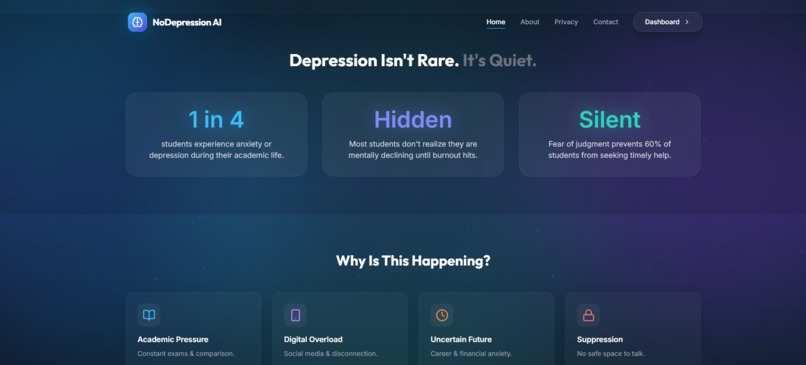
Detail of app
-
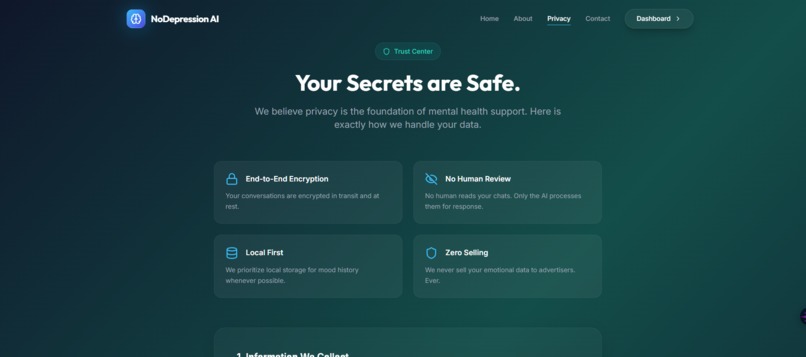
Privacy page
-
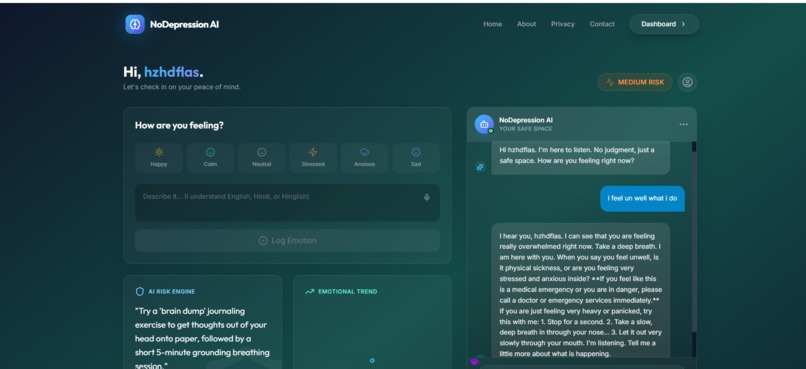
Real AI working for students
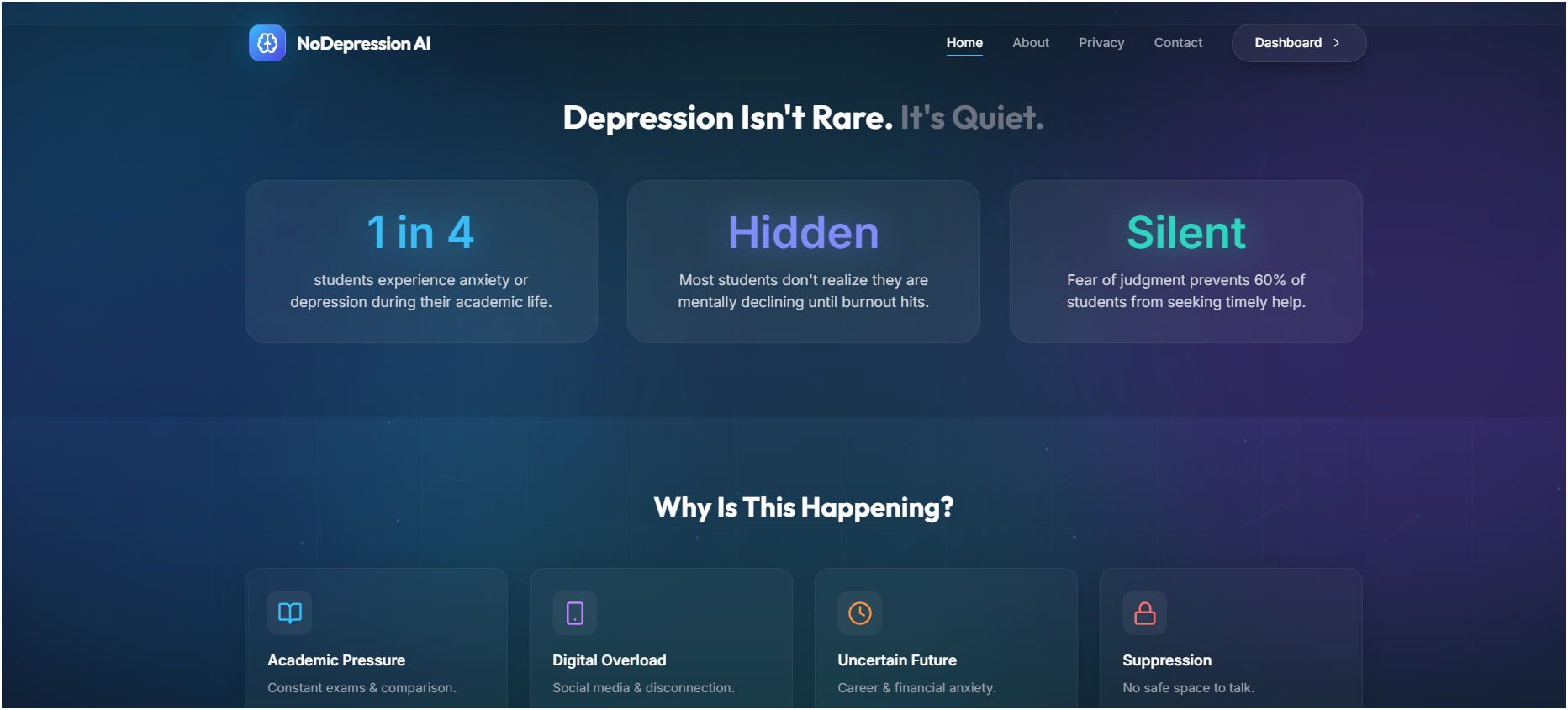
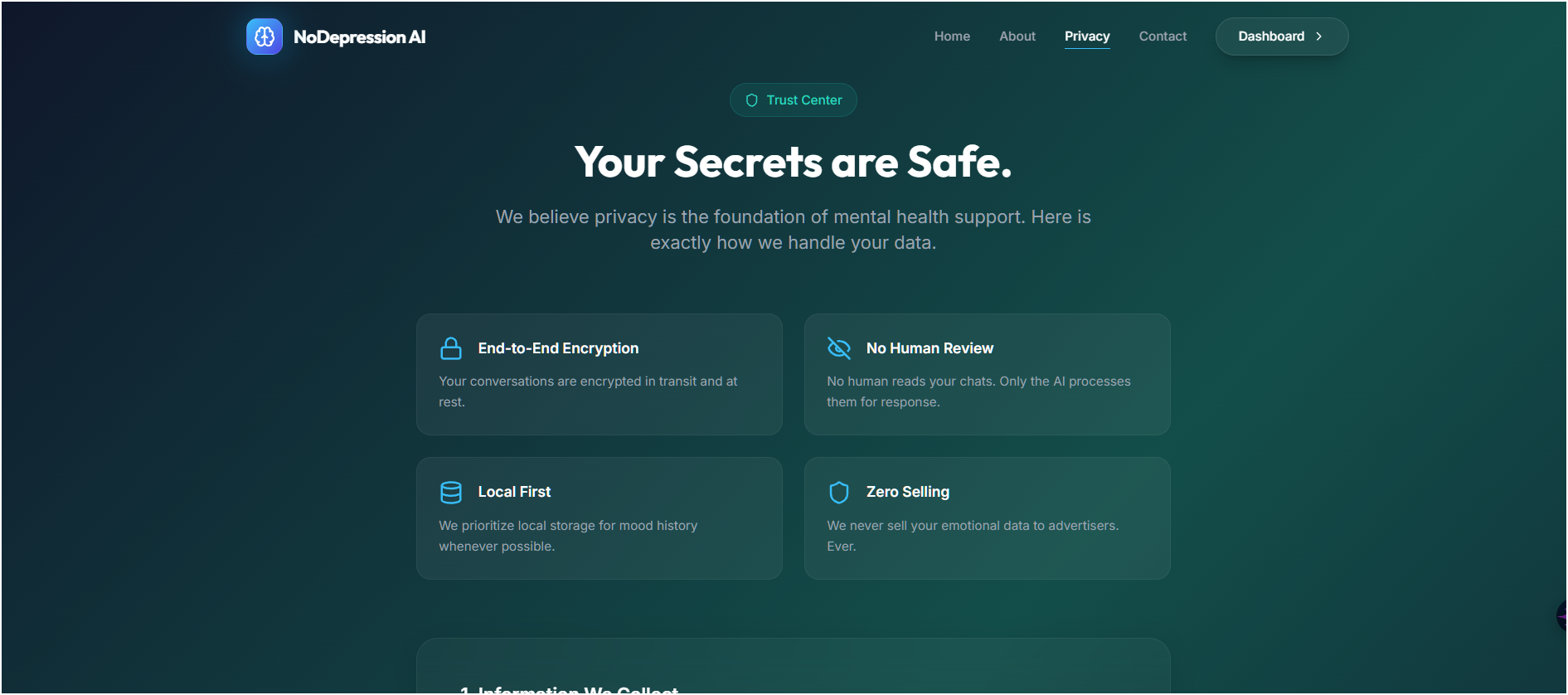
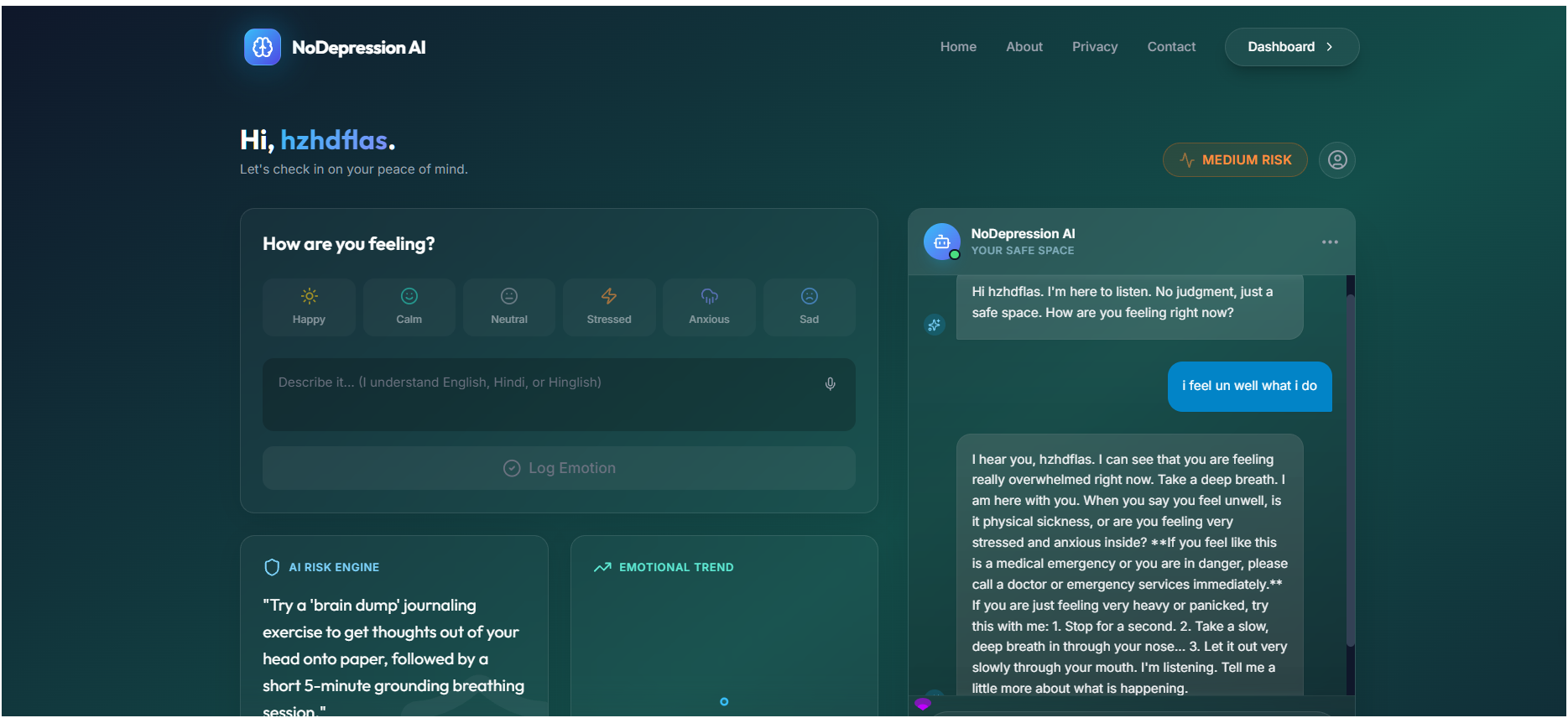
Inspiration The inspiration for NoDepression AI came from a deeply personal observation of the student community. We noticed that in high-pressure academic environments, students often suffer in silence. The stigma surrounding mental health, combined with the fear of judgment, creates a barrier to seeking professional help. We realized that while students might hesitate to talk to a human, they are often comfortable interacting with technology. We wanted to build a bridge—a "zero-judgment" zone that is accessible 24/7. The goal was to move beyond simple chatbots and create an intelligent emotional companion that understands cultural nuances (like Hinglish), detects burnout before it becomes a crisis, and adapts the entire digital environment to soothe the user's mind. What it does NoDepression AI is a privacy-first, multilingual mental wellness platform designed specifically for students. Multilingual Emotional Intelligence: It understands and speaks English, Hindi, and Hinglish (e.g., "Main thoda stressed feel kar raha hoon"). It detects the language automatically and responds in the same style. AI Risk Engine: It analyzes mood logs and journal entries to calculate a "Risk Level" (Low, Medium, High). It identifies contributing factors (e.g., Academic Pressure, Sleep) and suggests non-medical, actionable steps. Emotion-Adaptive UI: The application isn't static. If you are anxious, the theme cools down to calming blues and teals. If you are happy, it warms up. The background animation speed slows down if high stress is detected to subconsciously induce calmness. The "Gift" Corner: Based on the user's emotional state, the AI generates a personalized "micro-gift"—this could be a validating quote, a psychological fact to ground them, or a generated mini-game (like a bubble pop) to break a panic loop. Privacy Shield: It features a robust "Security Guardian" layer that prevents prompt injection and ensures conversations remain private and safe. How we built it We built NoDepression AI using a modern stack focused on performance and aesthetics: Frontend: Built with React 19 and Tailwind CSS. We utilized a "Glassmorphism" design language (backdrop-blur) to create a floating, ethereal feel that reduces visual cognitive load. AI Core: We leveraged Google's Gemini 3.0 Flash & Pro models via the @google/genai SDK. gemini-3-flash-preview handles real-time UI adaptation and security checks for low latency. gemini-3-pro-preview handles the deep conversational therapy and complex risk analysis. Data Visualization: Used Recharts to render emotional trend lines, helping students visualize their mental health journey over the week. Mathematical Modeling: We implemented a custom weighting algorithm for the "Risk Engine" where emotional intensity and sentiment polarity are processed over a time window . Security: We implemented a "Security Guardian" system prompt that pre-scans every user input for malicious intent or self-harm triggers before the main persona responds. Challenges we ran into Hinglish Sentiment Analysis: Standard NLP models struggle with code-mixed languages like Hinglish. We had to carefully prompt engineer Gemini with specific examples (few-shot prompting) to ensure it didn't just translate the text, but understood the emotional subtext of a sentence like "Exam sar pe hai, tension ho rahi hai." Latency vs. Experience: We wanted the UI to change colors immediately as the user typed. Balancing API calls for UI analysis without lagging the typing experience was tricky. We solved this by using the faster Flash model for UI state and the Pro model for conversation. Safety Guardrails: Ensuring the AI acts as a supportive companion and not a doctor was critical. We had to extensively test the system prompts to ensure it always redirects to professional help when high-risk keywords are detected. Accomplishments that we're proud of The "Living" Interface: We are incredibly proud of the analyzeEmotionAndUI function. Seeing the entire website change its color palette, animation speed, and interaction density based on a single sentence from the user feels magical. Local-First Privacy: We managed to build a persistent experience using primarily localStorage for chat history and mood logs, ensuring that sensitive mental health data isn't unnecessarily stored on a central server. The 3D Background: Implementing the Background3D.tsx particle network that reacts to the mouse and "breathes" (expands/contracts) based on the user's stress level was a technical and aesthetic win. What we learned Prompt Engineering is Software Engineering: We learned that system instructions are just as important as code. Writing a robust "Security Guardian" prompt is akin to writing a firewall rule set. The Power of Micro-Interactions: We learned that mental health support isn't just about big conversations; it's about small moments—a calming animation, a color shift, or a validating quote delivered at the exact right moment. What's next for NoDepression AI Wearable Integration: We plan to integrate heart rate variability (HRV) data to detect stress physically before the user even logs it. Therapist Dashboard: A feature for users to voluntarily share their "Risk Assessment" summaries with their campus counselors. Audio Conversations: Implementing the Gemini Live API for full, real-time voice conversations for users who just need to "talk it out" while walking.

Log in or sign up for Devpost to join the conversation.