Inspiration
In today's competitive job market, getting a resume past the initial screening has become a major hurdle. Many companies use Applicant Tracking Systems (ATS) that automatically filter candidates based on keyword relevance. The inspiration for ResuMatch came from the common struggle job seekers face: how do you effectively tailor your resume for each specific role to ensure it gets seen by a human? We wanted to build a simple, accessible tool that demystifies this process and empowers users to optimize their resumes with direct, data-driven feedback.
What it does
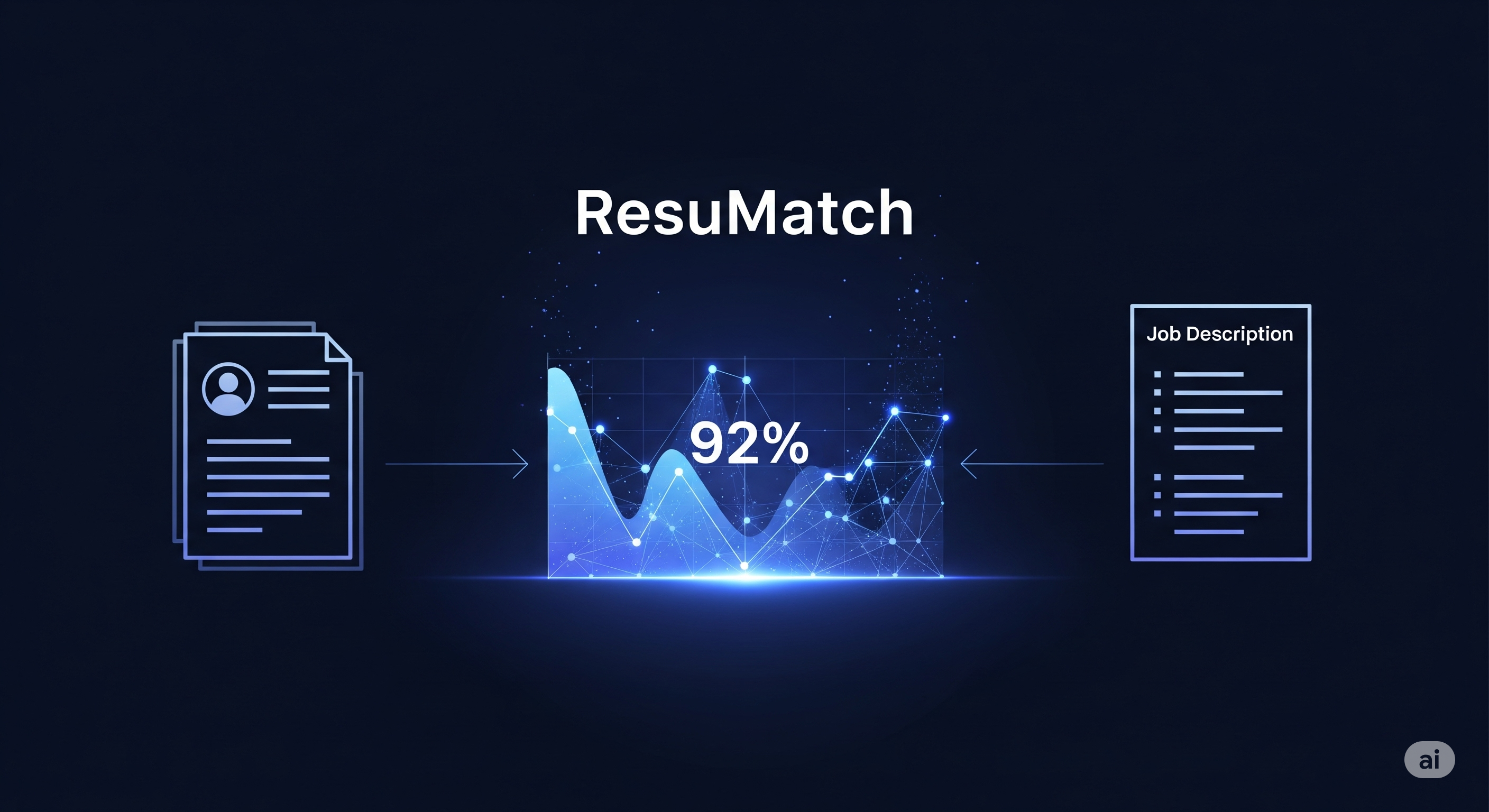
ResuMatch is a full-stack web application designed to help job seekers improve their resumes. Users simply copy and paste their resume content and the text from a job description into two text boxes. With a single click, the application analyzes both documents, calculates a relevance score, and provides two crucial lists: the keywords that match between the documents and, more importantly, the critical keywords from the job description that are missing from the resume. This gives the user an instant, actionable checklist of terms and skills to incorporate.
How we built it
We built ResuMatch with a focus on creating a lightweight but powerful Minimum Viable Product (MVP).
Backend: The core logic is powered by a Python server using the Flask framework. We created a single API endpoint, /analyze, that handles all the natural language processing.
NLP Engine: We used the scikit-learn library for the NLP pipeline. The TfidfVectorizer was the star of the show, allowing us to not only identify keywords but also to understand their importance and capture multi-word phrases (n-grams) like "backend developer" or "data analysis".
Frontend: The user interface is a clean, single-page application built with vanilla HTML, CSS, and JavaScript. We avoided heavy frameworks to keep it fast and simple, using the fetch API to communicate asynchronously with our Flask backend.
Challenges we ran into
We faced two significant challenges that were crucial learning moments.
Frontend Display Bug: Initially, our backend was correctly processing the data and sending a successful response, but nothing would appear on the screen. After some debugging, we realized it was a simple but classic full-stack error: a mismatch between the JSON key name sent by the backend (match_score) and what the JavaScript was trying to access (data.score).
Poor NLP Accuracy: Our first working version produced very low scores and only matched generic words like "experience". We discovered we were processing the job description with the smart TfidfVectorizer but analyzing the resume with a simple word-splitter. This meant we were trying to match multi-word phrases against single words. We solved this by re-engineering the backend logic to process both documents through the same vectorizer instance, ensuring a true "apples-to-apples" comparison and dramatically improving accuracy.
Accomplishments that we're proud of
We're proud of building a functional and useful full-stack application from the ground up. Successfully implementing an end-to-end NLP pipeline that provides real, actionable advice is a major accomplishment. We're also proud of the clean, intuitive user interface we created without relying on a large frontend framework. Overcoming the technical challenges gave us a deeper understanding of both frontend and backend development.
What we learned
This project was a fantastic learning experience. We learned the critical importance of a consistent data processing pipeline in any NLP task—how you clean and analyze one piece of text must be how you treat the one you're comparing it to. We also sharpened our debugging skills, learning to trace a problem from a blank screen all the way back to a subtle logical flaw in the backend analysis.
What's next for ResuMatch
This MVP is just the beginning. We have a clear roadmap for the future:
Enhance the User Experience: Our top priority is to allow users to upload PDF or DOCX files instead of copy-pasting text.
Improve the Analysis: We plan to move beyond a simple score to a weighted system that values critical technical skills more than soft skills.
Add Advanced Features: In the long term, we want to add features like saving analysis history, providing AI-generated suggestions for how to incorporate missing keywords, and creating pre-built templates for common job roles.


Log in or sign up for Devpost to join the conversation.