-
-
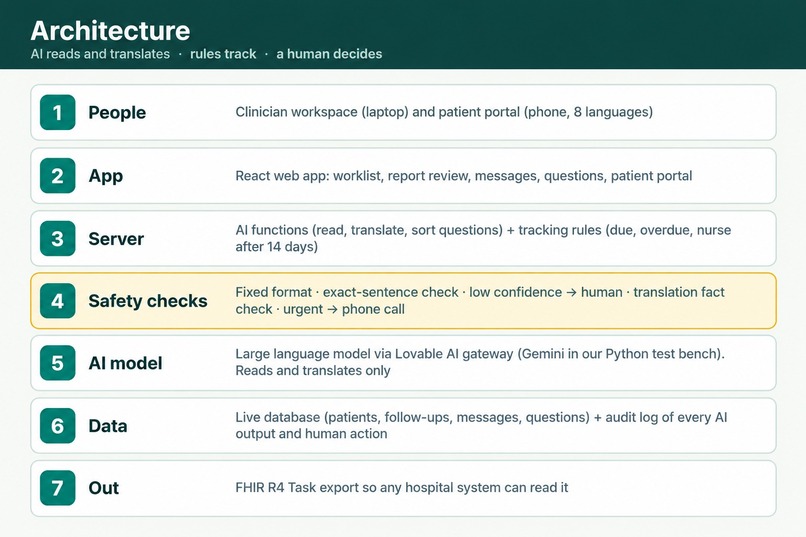
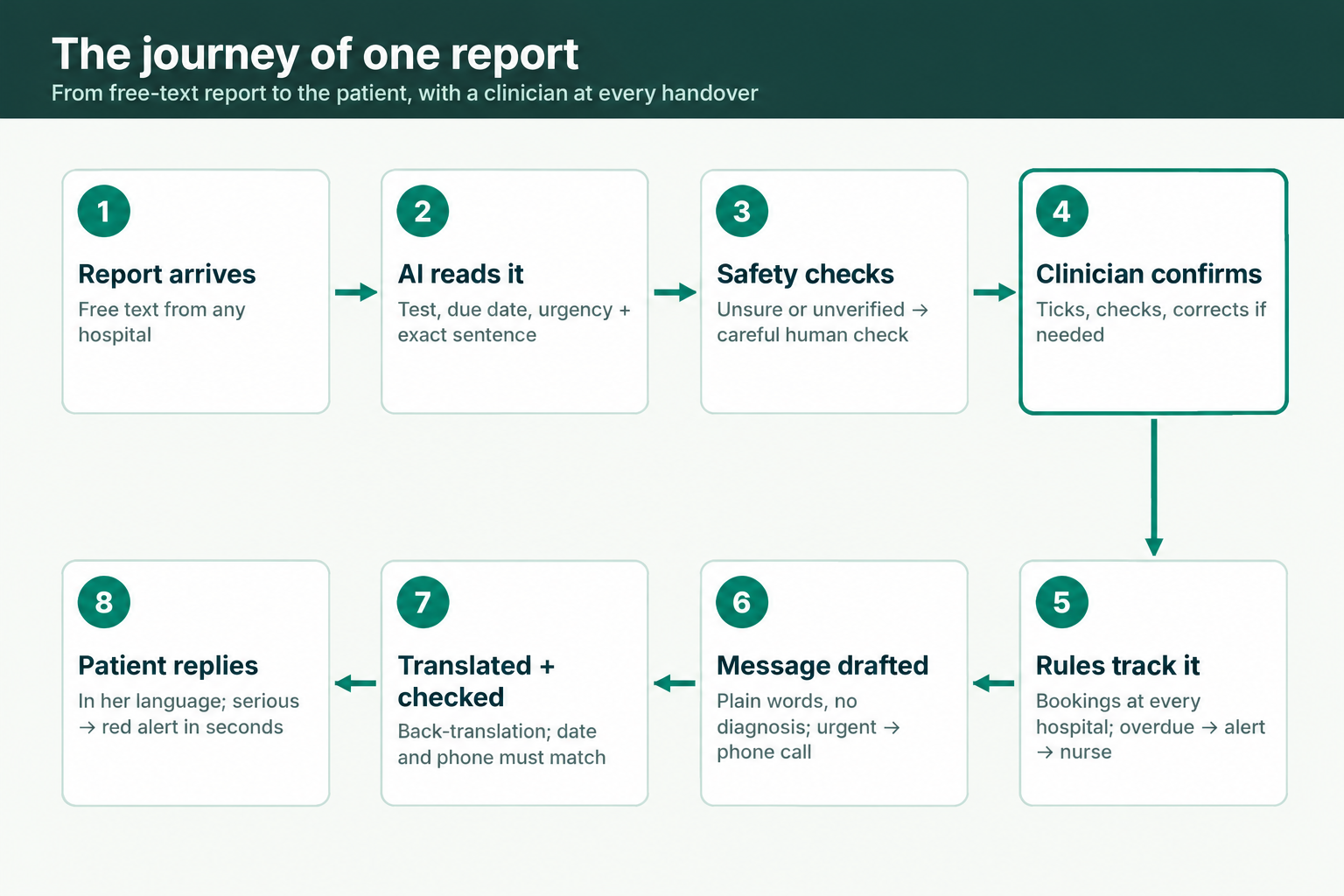
Resultwise architecture: AI reads and translates, rules track follow-ups, and clinicians approve every step.
-
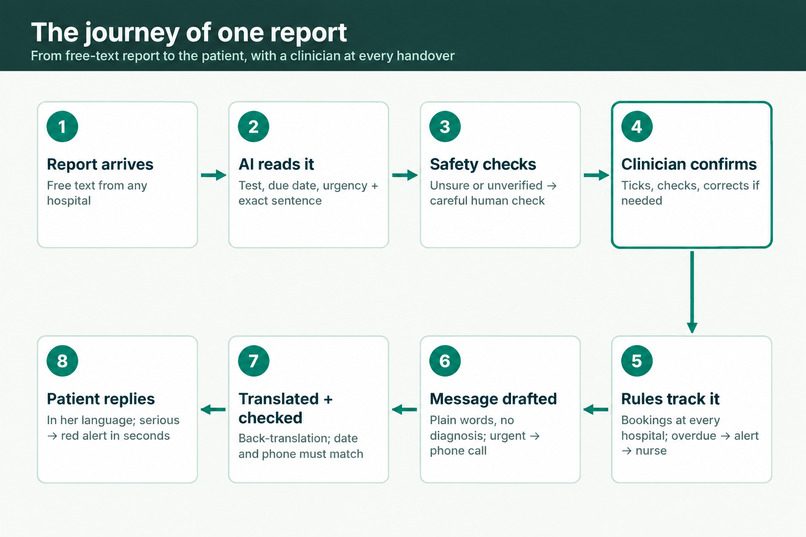
From report to patient reply: Resultwise tracks follow-ups across hospitals, with clinician review at every key step.
-
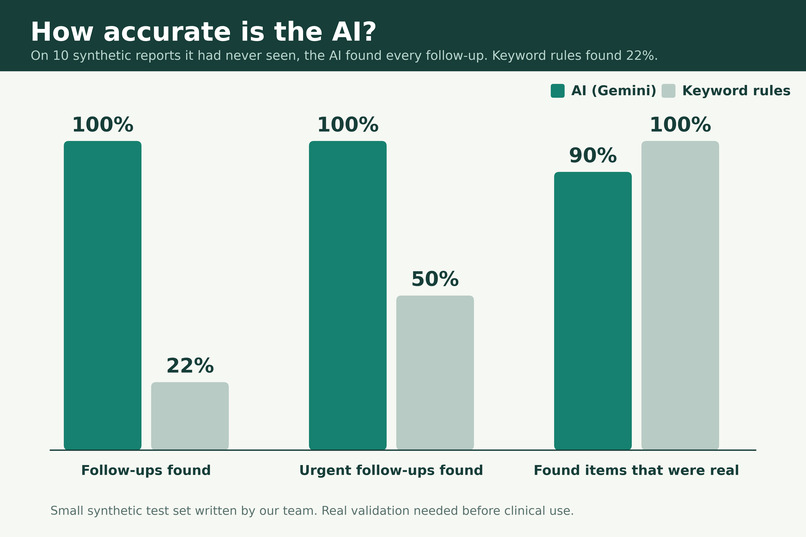
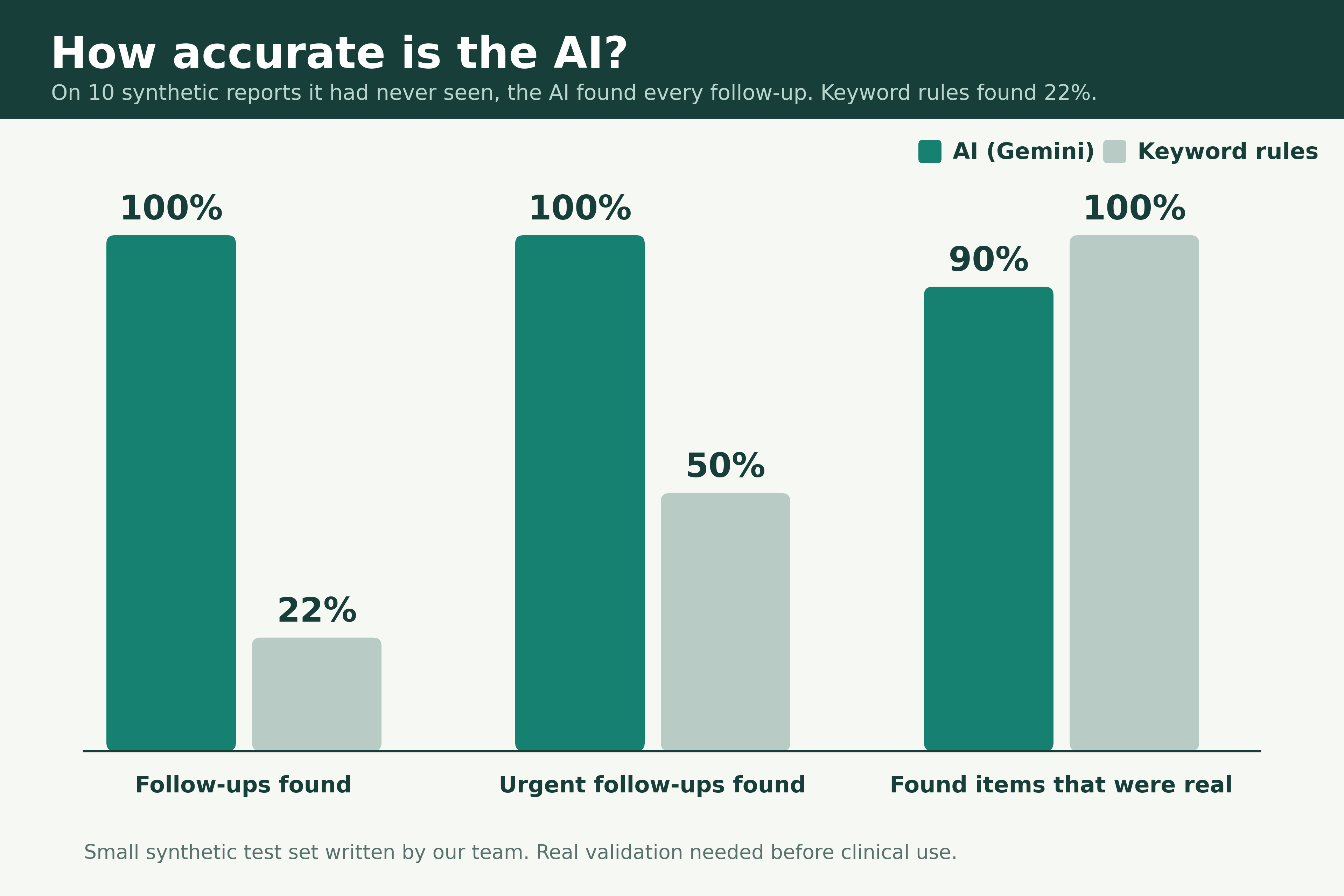
On 10 synthetic test reports, AI found 100% of follow-ups versus 22% with keyword rules. Clinical validation is still needed.
Inspiration
As a team, we began by researching NHS waiting times and the difficulties faced by both patients and staff. We explored how patients receive information, how staff manage follow-ups, and where communication can break down.
This gradually led us to breast cancer care, where patients may need repeated tests across different teams and hospitals. We focused on one question: how can we help ensure a recommended follow-up is understood, tracked and not overlooked?
That became ResultWise: a prototype that helps staff coordinate follow-ups and gives patients clear information in their own language.
What it does
ResultWise reads scan reports and identifies recommended follow-ups, including the test, timeframe and exact supporting sentence. A clinician checks each recommendation before tracking begins.
The prototype compares booking information across two fictional hospitals and flags missing or overdue appointments. It drafts patient-friendly messages, supports translation and requires clinician approval before sending.
Patients can ask questions in their own language. Accessibility features include large text, high contrast, easy-read content and read aloud, alongside carer support and SMS pathways for people without the app.
How we built it
We built the main app using React, TanStack Start and Lovable, with Supabase for data storage and live updates between patient and clinician views.
AI assists with reading reports, translating messages and categorising questions. Fixed rules handle deadlines and escalation, while clinicians control patient communication.
We also built a Python and Streamlit test bench using Gemini to evaluate extraction. Our synthetic dataset includes 104 reports, 60 patients and 900 historical follow-ups. No real patient data was used.
Challenges we ran into
- Understanding varied reports: Recommendations appeared in shorthand, uncertain wording and unexpected sections. Simple keyword rules struggled with unfamiliar examples.
- Checking translations: A fluent translation could still change a date or important detail. We added fact checks and back-translations to support review.
- Tracking the right stage: A follow-up being recommended, booked and completed are different events. We had to keep these distinctions clear.
- Keeping AI focused: We limited AI to specific tasks and kept deadlines, escalation rules and communication approval under human control.
Accomplishments that we're proud of
- Demonstrating a complete workflow from report review to patient reply across two devices.
- Showing missing bookings across two simulated hospitals.
- Linking extracted recommendations to their source text.
- Including accessibility and language support from the start.
- Building more than 90 automated tests across both codebases.
On 10 held-out synthetic reports, Gemini achieved 100% follow-up recall and 90% precision. These are encouraging early results, but the sample is too small to establish clinical reliability.
What we learned
Finding a recommendation is only the first step. It also needs clear ownership, a deadline and confirmation of what happened.
Strong results on familiar examples do not guarantee performance on unseen reports. Independent testing matters.
We also learned to keep AI's role focused. Human review, transparent sources and clear rules are essential safeguards, although none removes the need for clinical validation.
What's next for RESULTWISE
- Expand evaluation using clinician-reviewed reports.
- Co-design the experience with patients and carers.
- Professionally review translations.
- Benchmark a smaller, locally hosted model.
- Explore authorised hospital-system connections through FHIR and HL7.
- Develop clinical safety, privacy and information-governance arrangements with an NHS partner.
Our proposed first pilot would focus on one pathway: heart-monitoring follow-ups during HER2 breast cancer treatment.
ResultWise currently uses synthetic data and is a research prototype, not for clinical use.
Built With
- fhir
- google-gemini
- lovable
- openai
- postgresql
- python
- react
- streamlit
- supabase
- typescript
- web-speech-api

Log in or sign up for Devpost to join the conversation.