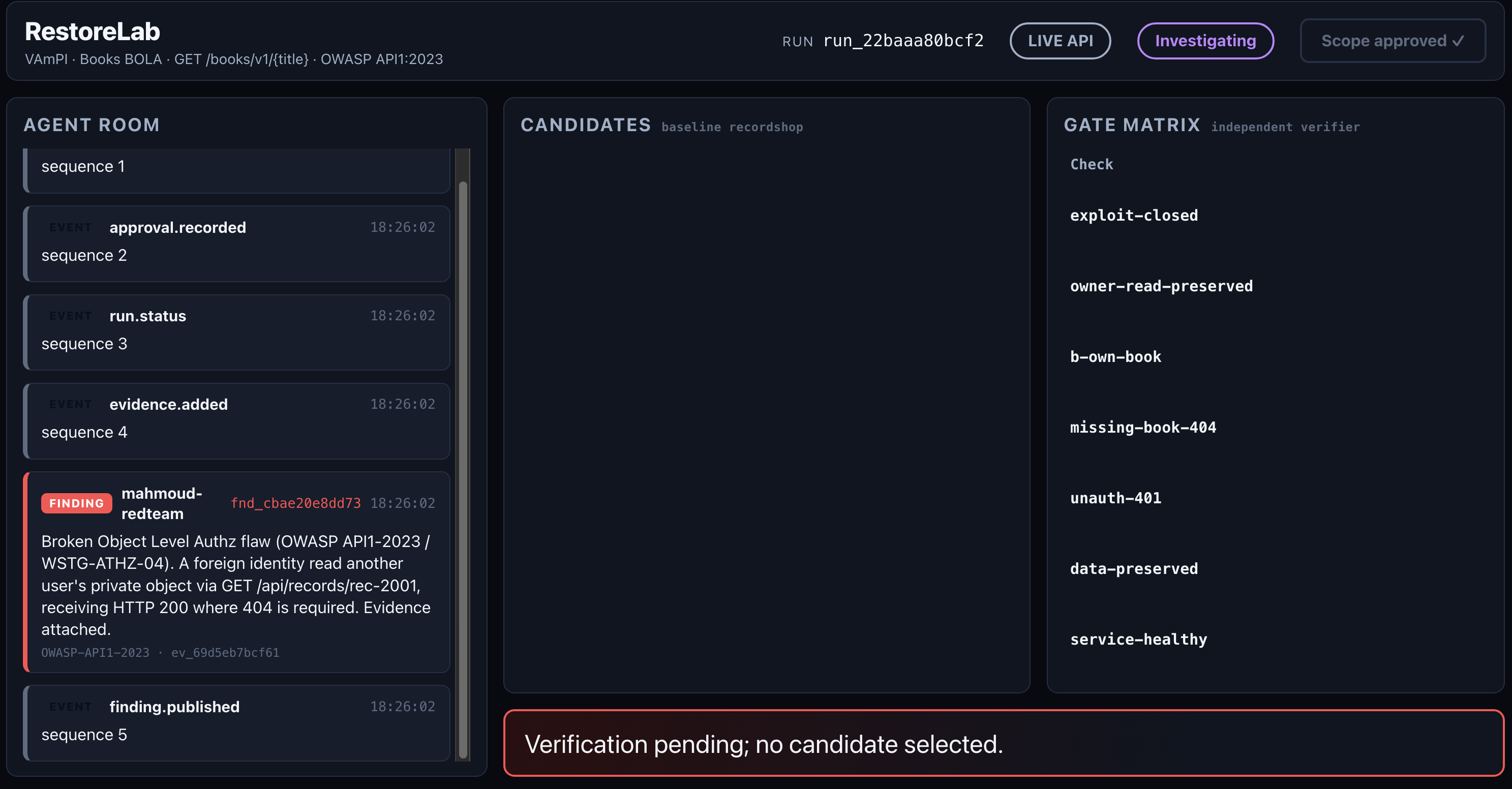
RestoreLab
RestoreLab breaks a safe copy of your app, has AI agents collaborate to restore it in parallel sandboxes, and independently verifies which fix actually works — so you know your disaster plan works before the real disaster.
Inspiration
In 2017, GitLab.com accidentally deleted production data — then discovered their backups didn't work. They had backups; nobody had ever proven the recovery worked until they urgently needed it. Every team has this blind spot: a disaster plan on paper that's never been run end-to-end against the real product. We wanted to catch that before the real disaster.
What it does
RestoreLab breaks a safe copy of your app, has AI agents collaborate to restore it in parallel sandboxes, and independently verifies which fix actually works — so you know your disaster plan works before the real disaster.
Our MVP scopes this to one authorized scenario: a BOLA flaw (OWASP API1:2023) in a team-owned, synthetic multi-tenant API where one tenant can read another's records.
- A red-team agent proves the weakness on a running target with real HTTP evidence.
- Recovery agents start from the same broken baseline and race two fix strategies in isolated sandboxes, sharing findings but never credentials.
- An independent verifier tests the restored product: foreign-tenant read denied, owner's read preserved, admin behavior intact, data unchanged, exploit no longer reproduces.
- Only fixes passing every gate are eligible; the fastest verified one wins. An over-restrictive "fix" that breaks legitimate access is correctly rejected.
The key idea: an agent cannot mark its own fix successful. Only the independent verifier can call a recovery proven.
How we built it
A TypeScript/Node monorepo with clear ownership boundaries:
- API + collective intelligence — a Hono server that is the single source of truth for runs, approvals, evidence, findings, verdicts and a gap-free event feed. It enforces the rules: no writes until human scope approval, findings must cite stored evidence, credentials are rejected, verdicts are immutable and verifier-only. Backed by SurrealDB with a provenance graph.
- Target + red team — VAmPI (an OWASP-catalogued vulnerable API) as primary target, scope-guarded to owned URLs.
- Execution — Daytona sandboxes give each candidate an equivalent, isolated baseline.
- Verification + observability — a deterministic verifier returns PASS/FAIL/UNKNOWN with evidence; Arize AX traces every step.
Challenges we ran into
- Making agent collaboration real without being unsafe — share evidence, never credentials or blind "apply my fix" recipes.
- Building a verifier that trusts nothing, and correctly rejects an over-restrictive fix that passes the exploit test but breaks legitimate access.
- Separating the API's own SurrealDB from hosted Agent Memory (different auth, different endpoints).
- Scope discipline: proving one verified remediation loop honestly, rather than claiming "full disaster recovery."
Accomplishments that we're proud of
- A working end-to-end loop: proven weakness → competing fixes in sandboxes → independent verification → evidence-backed recommendation.
- A verifier that rejects a bad fix — the thing that makes "proven recovery" mean something.
- A real agent-to-agent handoff that changes another agent's plan, without sharing secrets.
- Clean integration of Daytona, SurrealDB and Arize, each doing a real job.
What we learned
- Verification is the product — the independent verifier is what turns a plausible fix into trustworthy evidence.
- Shared knowledge needs provenance, and must be revalidated in each new run, never blindly trusted.
- Guardrails made the demo more convincing, not less.
- Narrow and real beats broad and hand-wavy.
What's next for RestoreLab
- Expand beyond authorization flaws to database-loss restores, corrupt backups and full application recovery.
- Add an Anchor Browser end-user journey so verification covers the real user experience.
- Generate human-reviewable runbooks and suggested PRs, behind human approval.
- Deepen cross-run recovery knowledge that future trials reuse and re-validate.

Log in or sign up for Devpost to join the conversation.