-
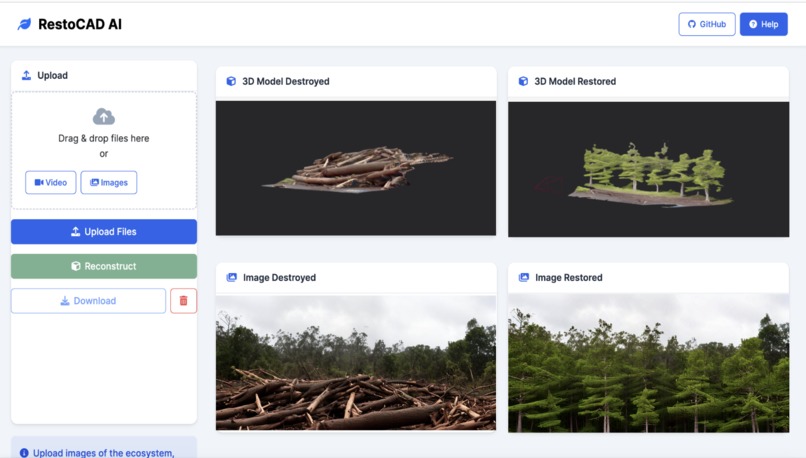
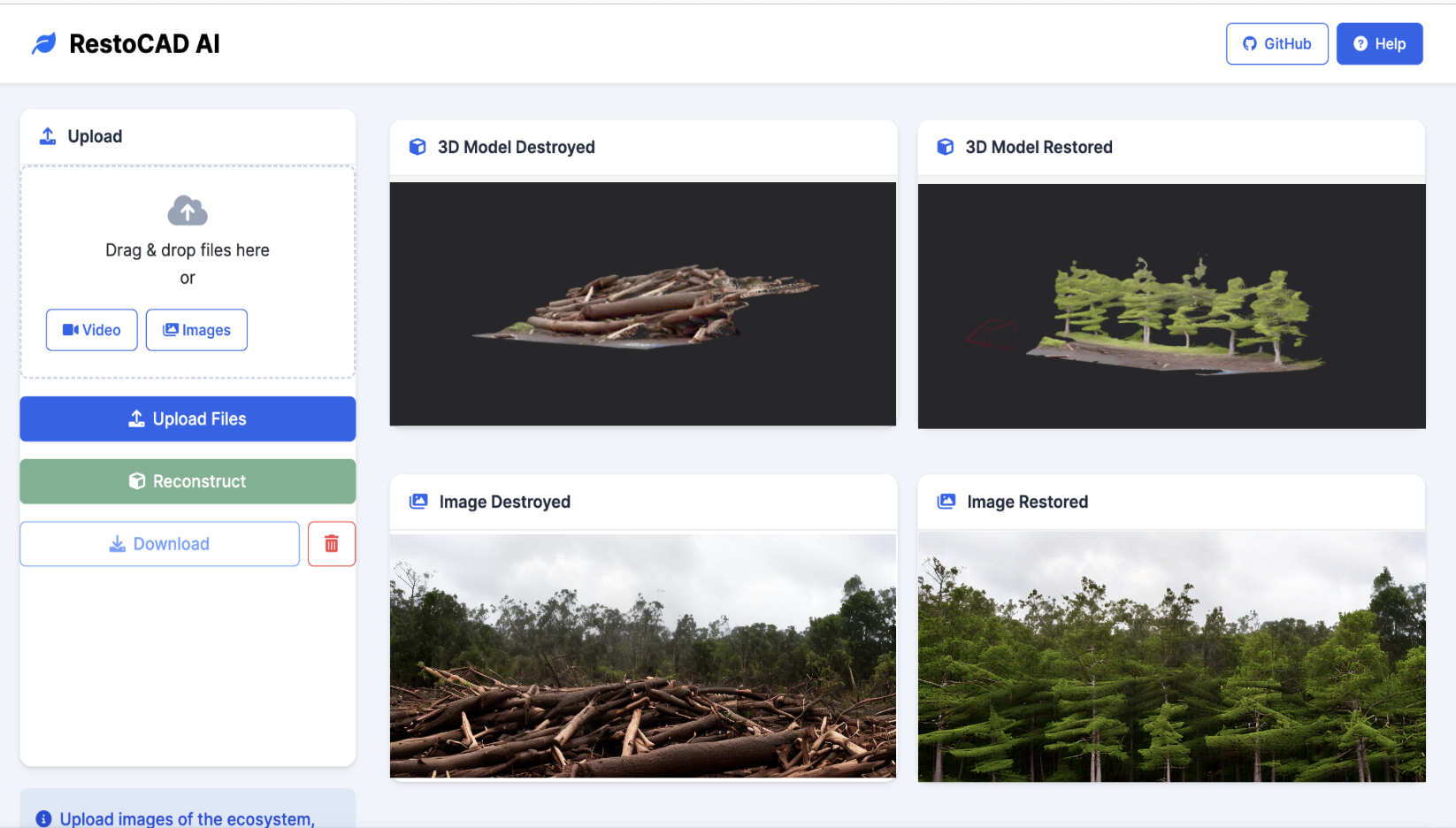
A simple example with a destroyed forest ecosystem.
Inspiration
Ecosystems are brutally destroyed, day by day. It is essential for humans and even the animals living there to restore these damages as soon as possible. There is an urgent need to support ecosystem restoration processes, and the model we created has tremendous capabilities to support restoration efforts.This would give researchers and environmental planners a better way to visualize the damage and experiment with potential ways to restore the ecosystem in a 3d environment.
What it does
It takes an image of a destroyed ecosystem, and it provides a GLB-formatted CAD file to allow the user to export a 3D model of the area. It also provides the user with an example of what a potential restoration looks like only using the given image. The 3D Model Generator utilizes a depth prediction model, which predicts the depth of each pixel on the image. It then uses this data to provide a 3D rendering in a GLB CAD file format.
How we built it
We built a Flask application that utilized a Hugging Face model and a Models Lab API to generate 3D Models and to predict potential restoration states. It is all integrated in a user-friendly app.
Challenges we ran into
It was a big challenge figuring out how to generate the 3D model from a 2D image, considering none of the API's and models worked. We also faced many challenges with architecture and computing power.
Accomplishments that we're proud of
We are proud of completing this app, even though we ran into many hardships. At times, we believed it was impossible to find a working model that converts 2D images to 3D CADs. With a small break and a little more tinkering around, we prevailed and accomplished the task.
What we learned
We learned the importance of solving current problems while leveraging existing solutions. In our case, we utilized existing modeling solutions to a problem that would benefit many when solved.
What's next for RestoCadAI
In the future, we could optimize this task to further fit the needs of only for the environment. We can do this by using CycleGANs to predict potential restoration states. We could also implement a fine-tuned 3D model generator. Furthermore, The web application could be expanded by having a built in CAD editor, allowing the user to directly manipulate the generated files.

Log in or sign up for Devpost to join the conversation.