-
-
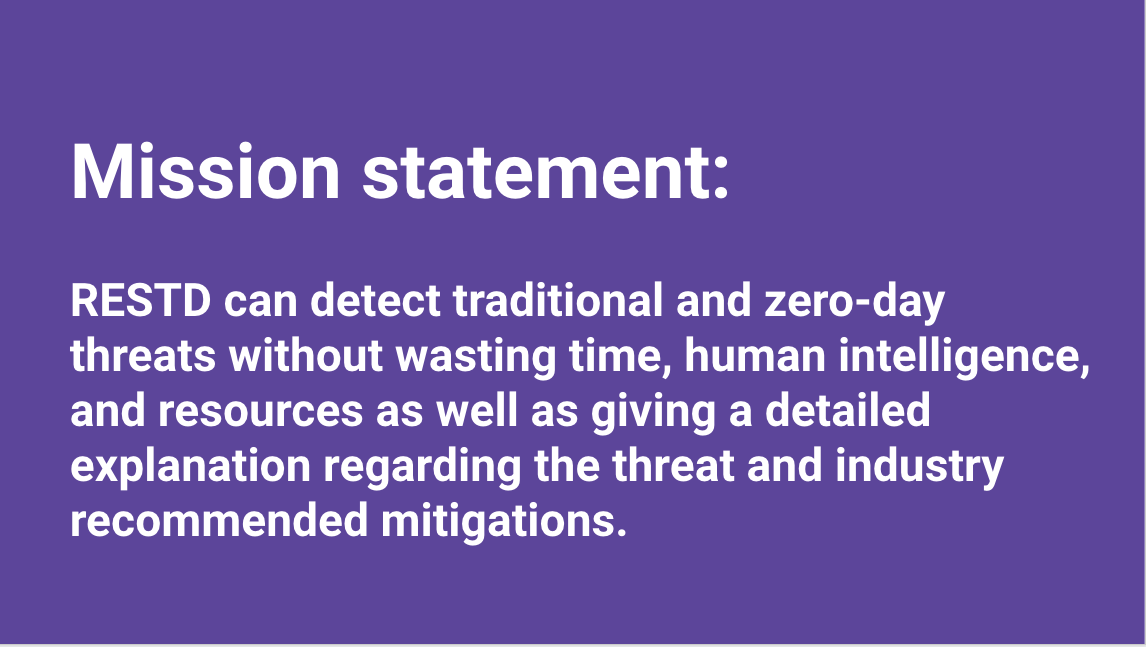
RESTD: mission statement
-
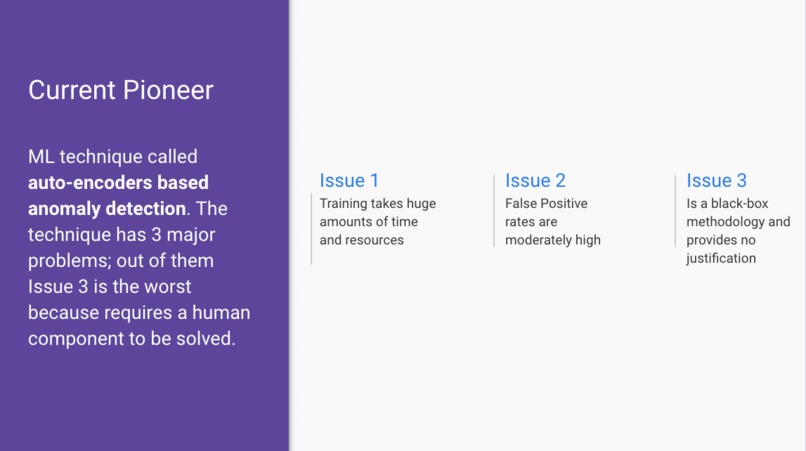
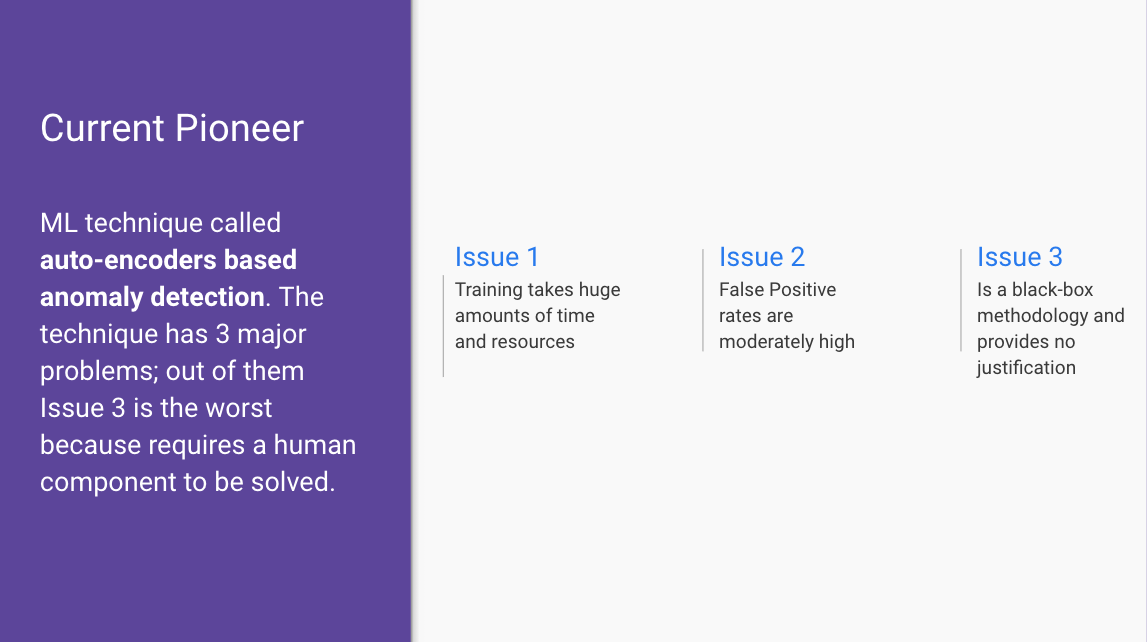
Issues with ML based approach
-
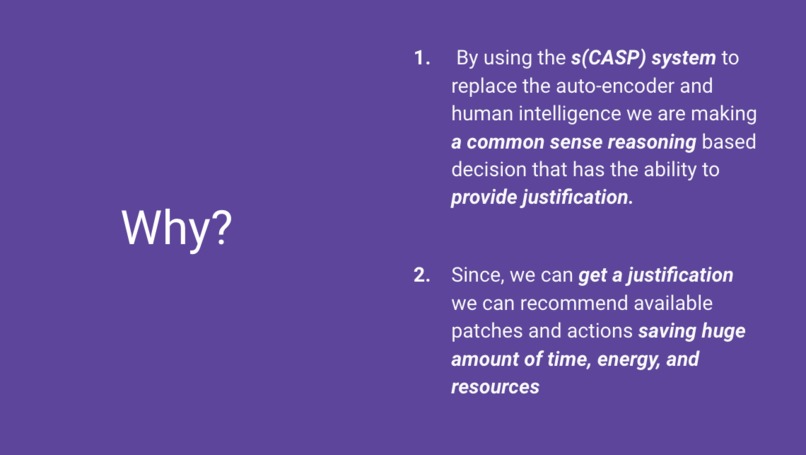
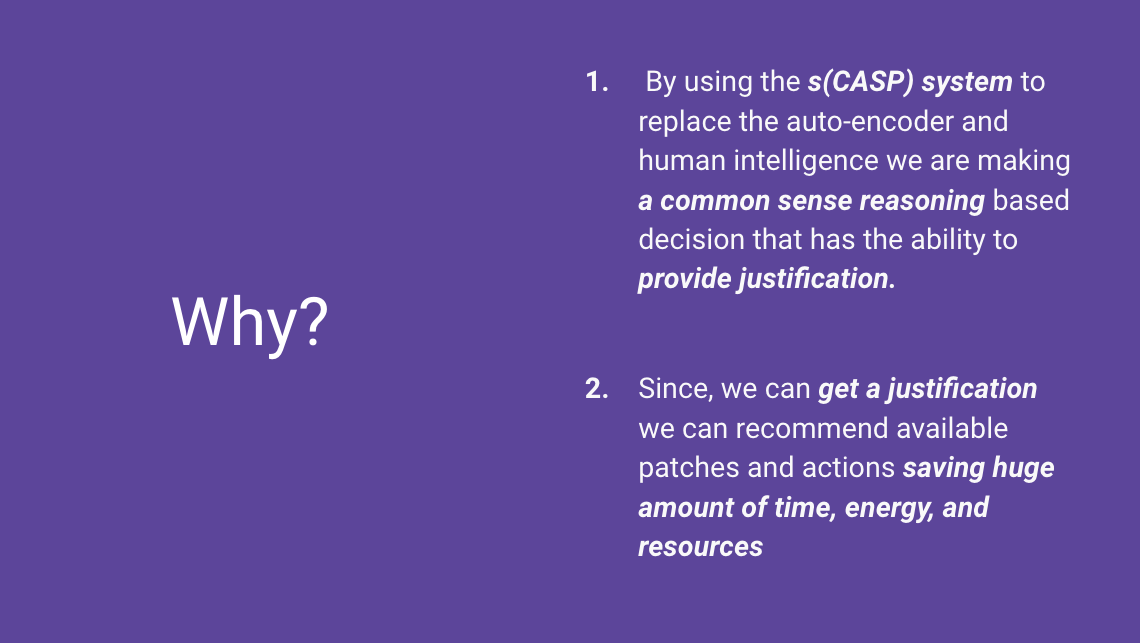
Why chose RESTD?
-
Our Solution
Inspiration
Traditional defenses such as signature-based and network-based FAIL against stealthy attacks such as zero-day vulnerability and malware mutants. Recent methods of stealthy attacks happen by impersonating or abusing well-trusted programs, where the malicious behavior is blended with benign behaviors of the targeted program. Signature based defenses fail because they have not seen the source code/activity signature before for the zero day attacks and malware mutants. Network based defense fails because firewall and intrusion detection system do not guard well trusted programs as well as user specified exceptions.
Current on-going work is using an ML technique called auto-encoders based anomaly detection. They are first training a model with benign system activity and then uses it to classify system activities with the goal that regular process that have been hijacked by malware will show abnormal system activity that can be identified. There are three BIG issues with the ML based threat detection approach that was highlighted by Dr. Gupta during his talk as well, first, the training takes an huge amount of time as well as resources and second, the false positive rates is moderately high. Thus, a human has to be looped into the deployment pipeline so that they can monitor and release benign processes. But, they can be easily solved if we have some on-ground intelligence as well as using ASP and common sense reasoning. On ground intelligence is well established, and for this project I am using the s(CASP) system to replace the auto-encoder and human intelligence. So, that rather than making a statical decision, we are making a common sense reasoning based decision that has the ability to provide justification. Since, we can get a justification as to why some event was classified as benign or malicious, we can recommend available patches and actions that the human can take, and if the justification is wrong they can simply grant exceptions or modify a rule. Since, there is no need to re-train a NN model(Auto-encoder), they are saving huge amount of time, energy, and resources (such as money and human intelligence).
The third problem and the most critical issue is that ML based detection is a black-box methodology and we get no justification as to why a system event was classified as malicious. Since, we get no justification we cannot recommend an action: to patch the vulnerability or to mitigate the threat. Also, we have to rely on the human intelligence to decipher why the system event was marked as malicious and in a false positive scenario, either we will have to tune an hyperparameter or re-train the model. In either case, we are demanding huge time, energy and resources in terms of processing power, memory, money and additional human intelligence from a different domain (ML).
Security domain specific aspect regarding the third problem is that when one vulnerability is detected, there is a possibility that there exists another or multiple similar kind of vulnerability that is already being or can be exploited. Since, we get no justification regarding the detection a security researcher has to manually hunt them down and patch it. Even then, there is no guarantee that he has tracked down all the similar vulnerability.
The project goal is that by using our system RESTD the user will be well RESTED in an unfortunate scenario of zero day threat (new malware mutant attack), as they will have the industry certified recommendation(patches and actions) on how to mitigate the threat. Since, a justification is provided, the job of finding similar vulnerabilities is made simpler and a patch can be added to all of them. Thus, we are stopping future exploits and making the system secure and robust.
What it does
A system event is made up of system entities and its corresponding relation, which is interactions with other entities. A chain of system events is known as a causal path. Causal path can be used detected if the path is benign or anomalous and using the causal path, we can find the malicious processes. Because of time constraint, we selected only 3 types of system entities: processes, files, and socket(network connection). Each system entity has a relation with other entities. Again due to time constraint, I selected a subset of relation between entities. The system entity and relations we considered are:
- Process - Process: start, end
- Process - File: read, write and execute
- Process - Socket: read, write
Example of correctly detected benign system causal path by both RESTD and Auto-encoder:
winword.exe -writes-> t1.txt -read-> outlook.exe -write-> 168.x.x.x
winword.exe -writes-> f1.doc
Example of correctly detected malicious system causal path both RESTD and Auto-encoder:
winword.exe -start-> cmd.exe -start-> powershell.exe -write-> x.x.x.x
winword.exe -writes-> f2.doc
Example of incorrectly detected malicious system causal path by Auto-encoder, but correctly detected malicious system causal path by RESTD:
apt-get -start-> bash -start-> wget -read-> 192.x.x.x -write-> /tmp/yy.dat
apt-get -start-> bash -execute-> /tmp/yy.dat
The auto-encoder will detect the above causal path as malicious as apt-get shows the typical behavior of a malicious executable as it is connecting to a command&control center, downloading a payload and executing it: "apt-get starts bash to get a payload from 192.x.x.x and then execute it". But, using two ground truth apt-get is one of the most trusted and secure process and 192.x.x.x is a trusted linux domain as well as using common sense reasoning makes it clear that it is a benign a system event: "(secure process) apt-get starts bash to get a payload from a (trusted domain) 192.x.x.x and then execute it".
Security domain (https://www.sans.org/security-resources/malwarefaq) has some well defined ground truth regarding what kinds of domain and processes are considered secure and what programs have been previously utilized to exploit a system. RESTD program used the domain specific ground truth to define facts and rules that would be used to detect if a system event is benign or malicious. Security domain also has some universally accepted recommendations and endorsed patches and actions (https://linuxhint.com/linux_malware_analysis/) in case of an attack, because we will get justification in RESTD we will recommend an patch and/or action based on the on-ground threat mitigation recommendation as well as reasoning behind the given recommendation; something that an auto-encoder based detection cannot provide without using other intelligent system or human in the loop.
How we built it
- first we defined our chosen system entity and relation
% entities
system_entity(process).
system_entity(file).
system_entity(socket).

% relation
system_relation(write).
system_relation(read).
system_relation(execute).
system_relation(start).
system_relation(end).

% process and entity relation definition
system_process_relation(X,Y) :- process(X), process(Y).
system_process_relation(X,Y) :- process(X), file(Y).
system_process_relation(X,Y) :- process(X), socket(Y).
- we used ground intelligence to code some facts such as what is a secure socket and process
trusted_process("apt-get").
untrusted_process("winword.exe").
trusted_socket("192.x.x.x").
untrusted_socket("168.x.x.x").
- then we quantized our ground recommendation and justification
% message as to why secure
message_trusted_process:-write('Trusted process is in a relation with a trusted process'),nl,fail.
message_trusted_file:-write('Trusted process is in a relation with a file'),nl,fail.
message_trusted_socket:-write('Trusted process is in a relation with a trusted socket'),nl,fail.

% message as to why insecure
message_mal_process:-write('Unknown process found!'),nl,fail.
message_unauth_file:-write('Unauthorized file access!'),nl,fail.
message_unauth_network:-write('Unauthorized network access!'),nl,fail.

% message for different actions
message_old_browser:-write('Update your browser!'),nl,fail.
message_old_signature_db:-write('Update your signature database!'),nl,fail.
message_network_misuse:-write('Network interface needs to be closed down!'),nl,fail.

% message for different patches
message_patch_1:-write('use patch KB4462137'),nl,fail.
message_patch_2:-write('use patch KB4474419'),nl,fail.
message_patch_3:-write('use patch KB4508433'),nl,fail.
- then we added the rules as to when can we consider a system event safe
% trusted system process relation
trusted_system_process_process_relation(X,Y) :-
    system_process_relation(X,Y), trusted_process(X), trusted_process(Y),nl.

trusted_system_process_file_relation(X,Y) :- system_process_relation(X,Y), trusted_process(X), file(Y),nl.

trusted_system_process_network_relation(X,Y) :- system_process_relation(X,Y), trusted_process(X), trusted_socket(Y),nl.
- then finally we put the checking predicate and print out the appropriate reasoning and the recommendation
% check a system process relation and provide appropriate message
% a unknown/malicious process found
check_system_event(X,Y):-trusted_system_process_process_relation(X,Y)->message_trusted_process; message_mal_process;message_patch_1;message_patch_2.

% check trusted program and file relation
check_system_event(X,Y):-trusted_system_process_file_relation(X,Y)->message_trusted_file; message_unauth_file; message_patch_3.

% check trusted program and socket relation
check_system_event(X,Y):-trusted_system_process_network_relation(X,Y)->message_trusted_socket; message_network_misuse; message_old_browser.
query and output
?- check_system_event("apt-get", "apt-get").

Trusted process is in a relation with a trusted process
false.

?- check_system_event("apt-get", "yy.dat").

Trusted process is in a relation with a file
false.

?- check_system_event("apt-get", "192.x.x.x").

Trusted process is in a relation with a trusted socket
false.

?- check_system_event("apt-get", "bash").
Unknown process found!
use patch KB4462137
use patch KB4474419
false.

?- check_system_event("apt-get", "241.x.x.x").
Network interface needs to be closed down!
Update your browser!
false.

?- check_system_event("curl", "t1.txt").
Unauthorized file access!
use patch KB4508433
false.
Challenges we ran into
- there are lot of entities and relationships in a system. And defining the rules for them will take a long time. So, we used ground truth to select a sub-set of entities and relations, so that we can build a robust and working solution
- how to define good rules based on established ground truth as well as trying to stay away from circular logic
- how to define rules that have priority, so that one rule supersedes another
- implementing the rules that can be used for detection, so that an ML technique auto-encoder can be replaced
Accomplishments that we are proud of and what we learned
- how we were able to better perform than a ML technique using ASP
- show statical detection can be bested by common sense reasoning if we are able to define the facts and rules in a proper way
- we learned s(CASP) system as well as prolog
- how common sense answer set programming can be used to cut human from a pipeline and streamline the process
- how ground truths can be used to better establish facts and constants
What's next for RESTD - Reasoning Engine for Smart Threat Detection
- generalize the entities, because of lack of time, we could not generalize the entities very well
- we want to define more entities and relationships such as virtual network, virtual interface, and virtual broadcast address handling
- host the RESTD engine on AWS so that anyone can use it to classify their system event or use it for detection
Built With
- prolog
- s(casp)


Log in or sign up for Devpost to join the conversation.