Inspiration Every night at 11 PM, restaurant owners across America are doing the same thing: switching between eight different browser tabs. DoorDash for sales. UberEats for reviews. Sysco for inventory. The list goes on.
As a Regional Manager at a restaurant SaaS company, I’ve watched this hundreds of times. One owner told me: “I spend more time managing apps than managing my restaurant.”
That’s when the core question hit me: What if the restaurant could manage itself?
From Insight to Iteration My initial hypothesis was SMS—meet owners where they already are. But through customer discovery, we learned something crucial: owners don’t just want easier access to data. They want automated action. The real pain isn’t checking numbers. It’s: “I see the problem, now I have to manually fix it across four different platforms.”
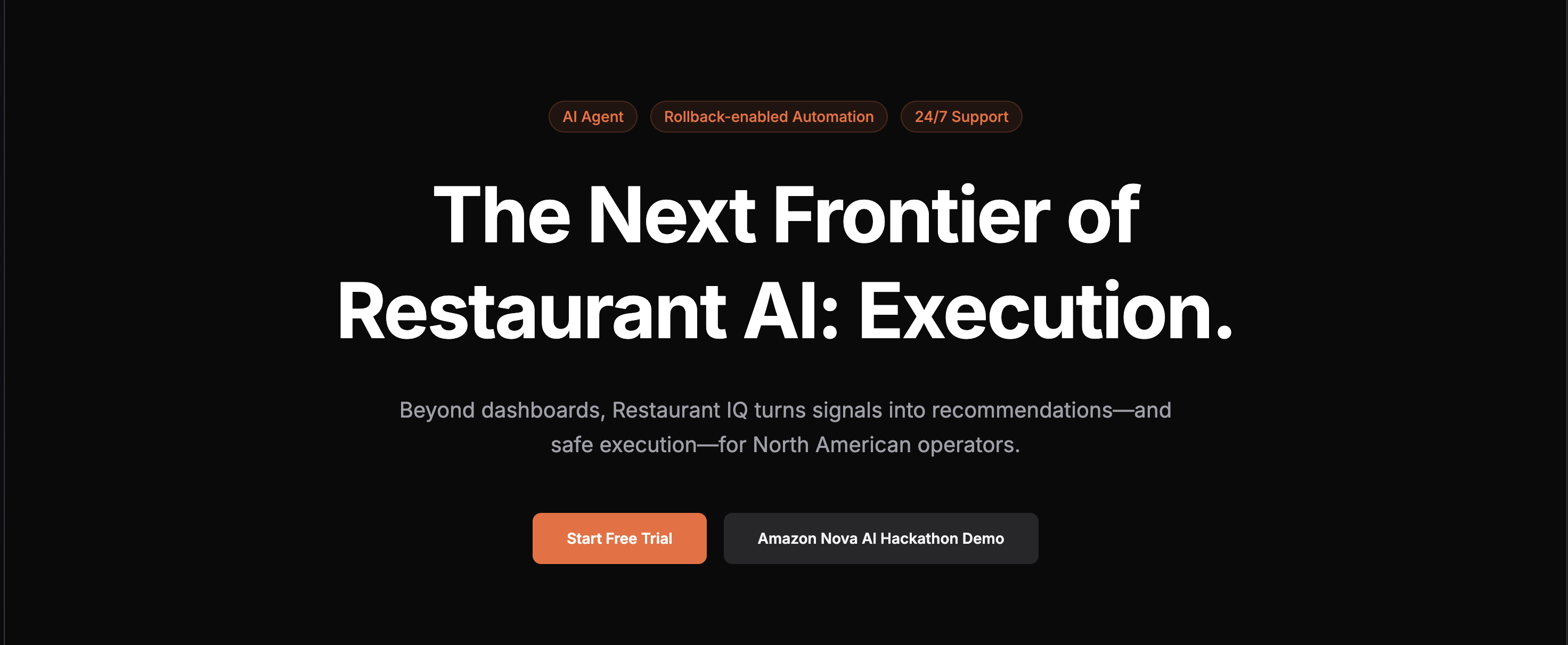
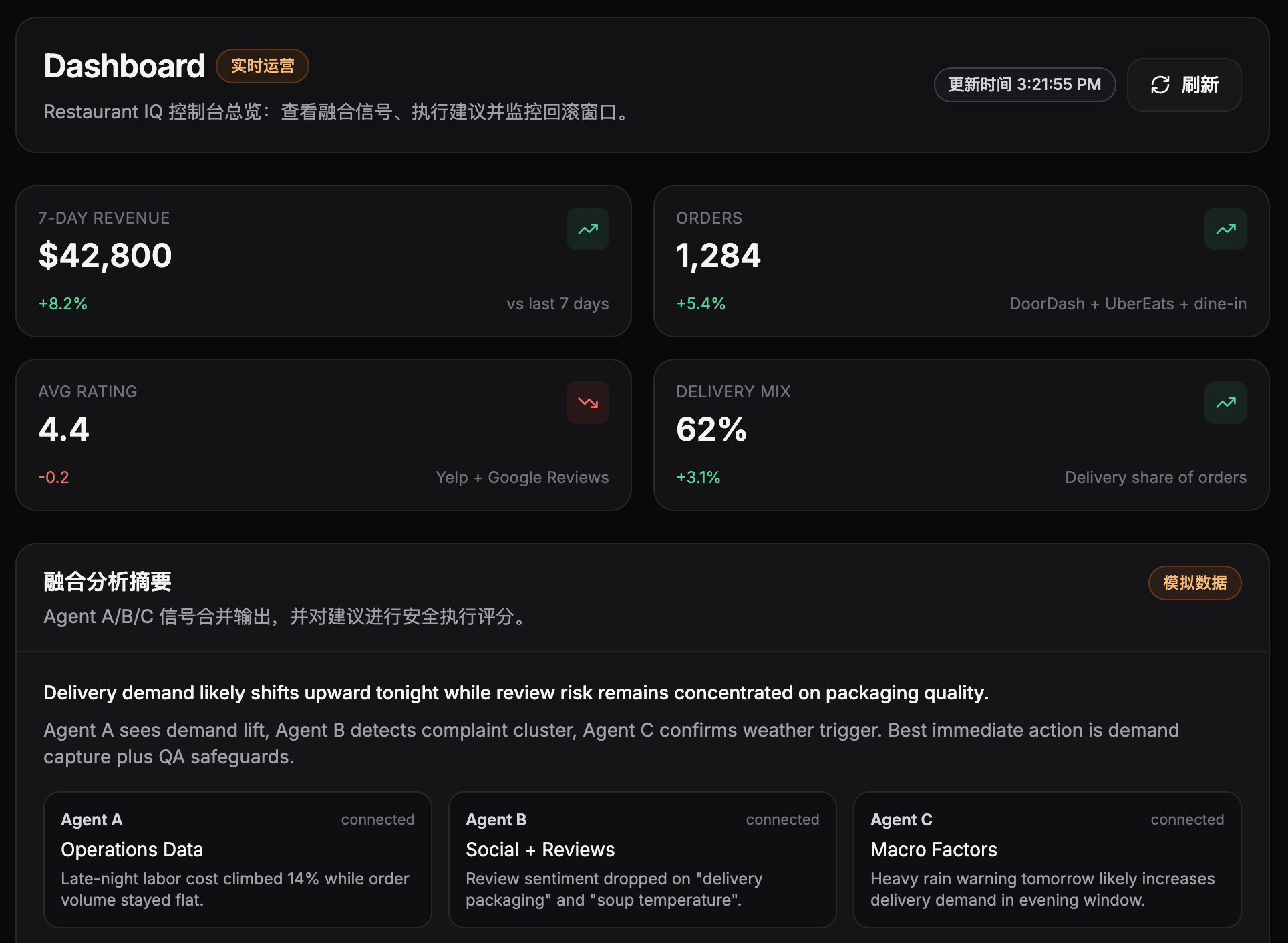
What I Built RestaurantIQ is an AI-powered operations platform that doesn’t just analyze—it executes.
Core Features Unified data layer: Connects delivery platforms (DoorDash, UberEats, Fantuan) and POS systems into one real-time view
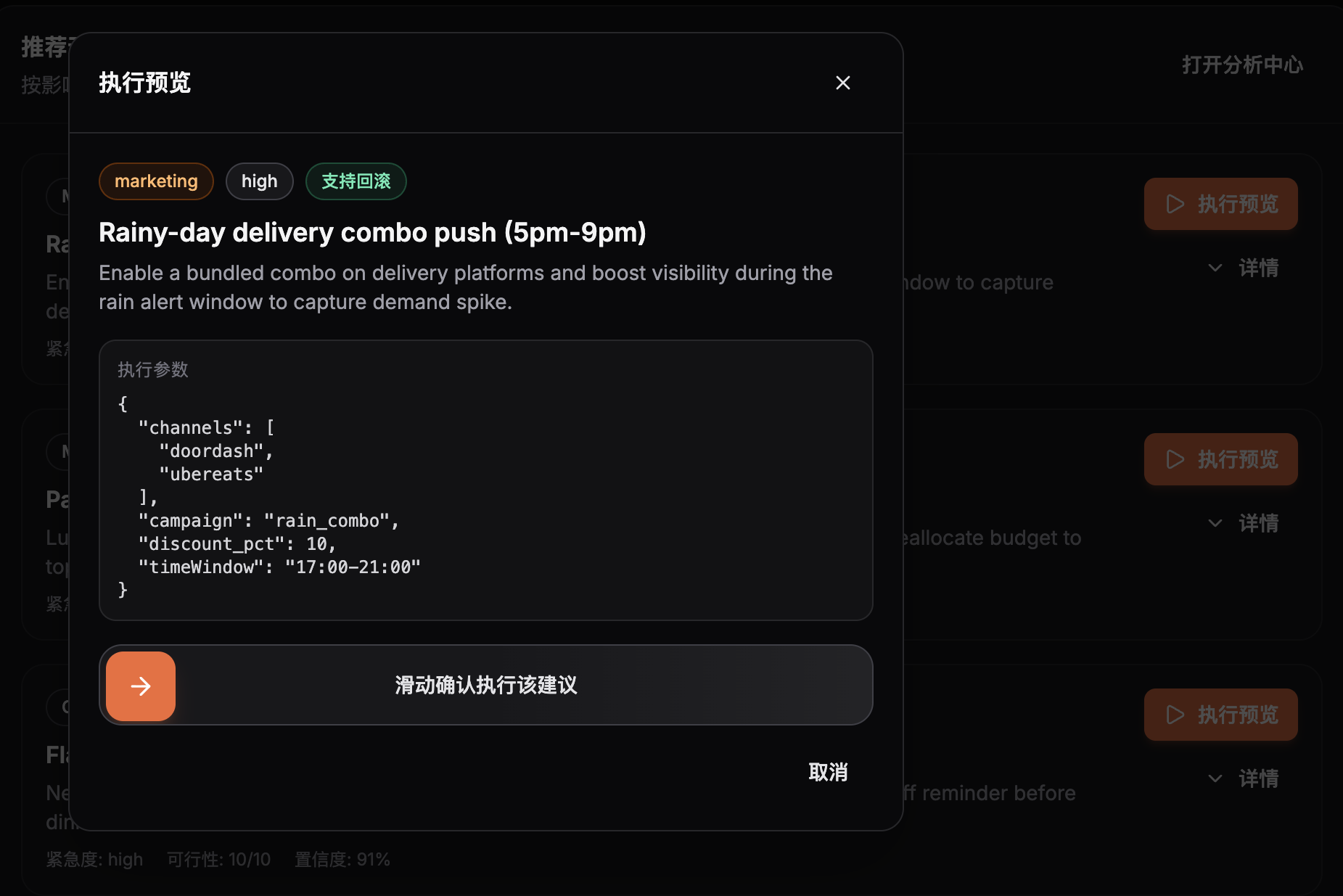
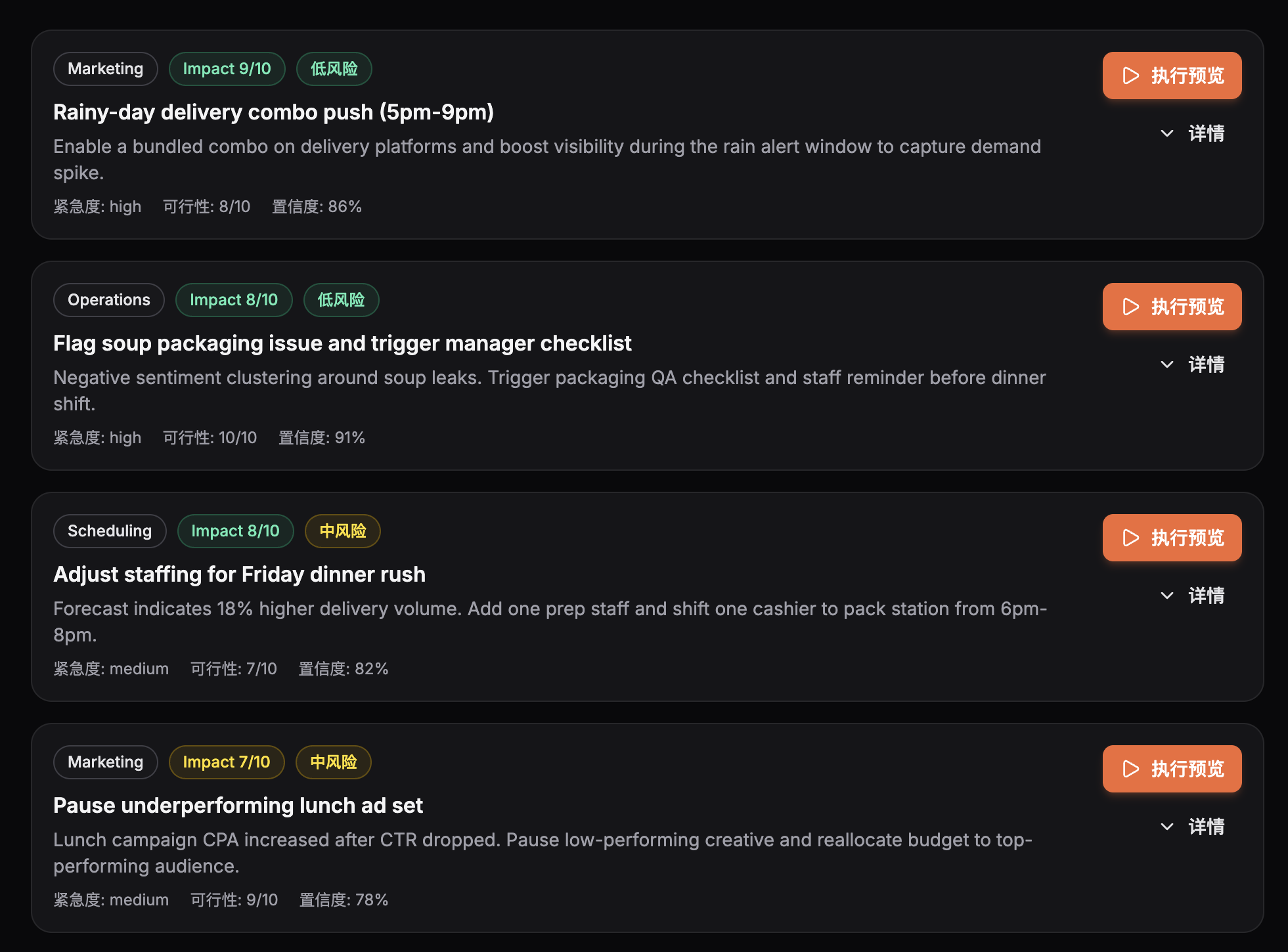
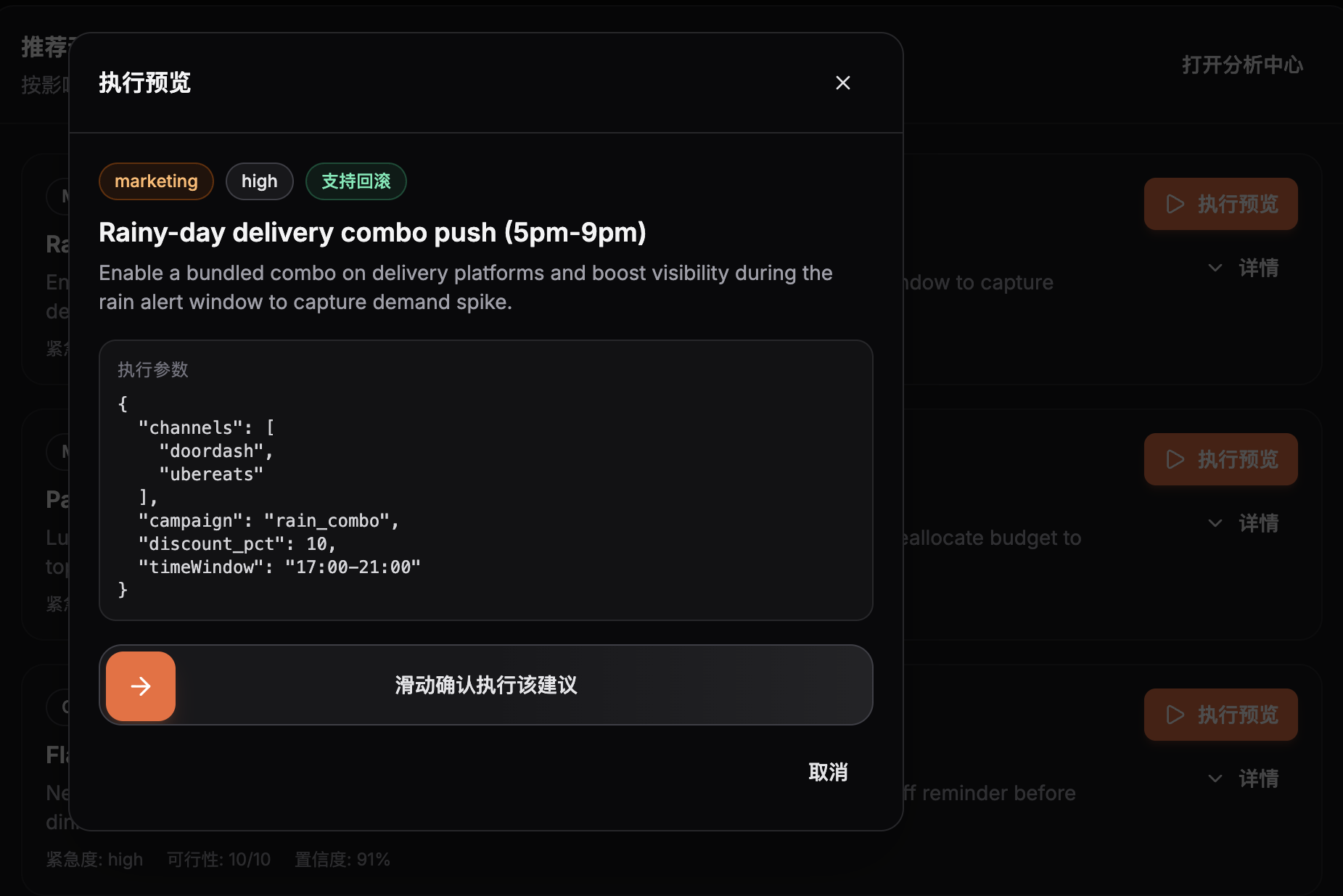
AI analysis engine: LLM-powered insights on operations, trends, and competitor pricing One-click execution: Recommendation cards with slider confirmation; changes sync via API to connected platforms
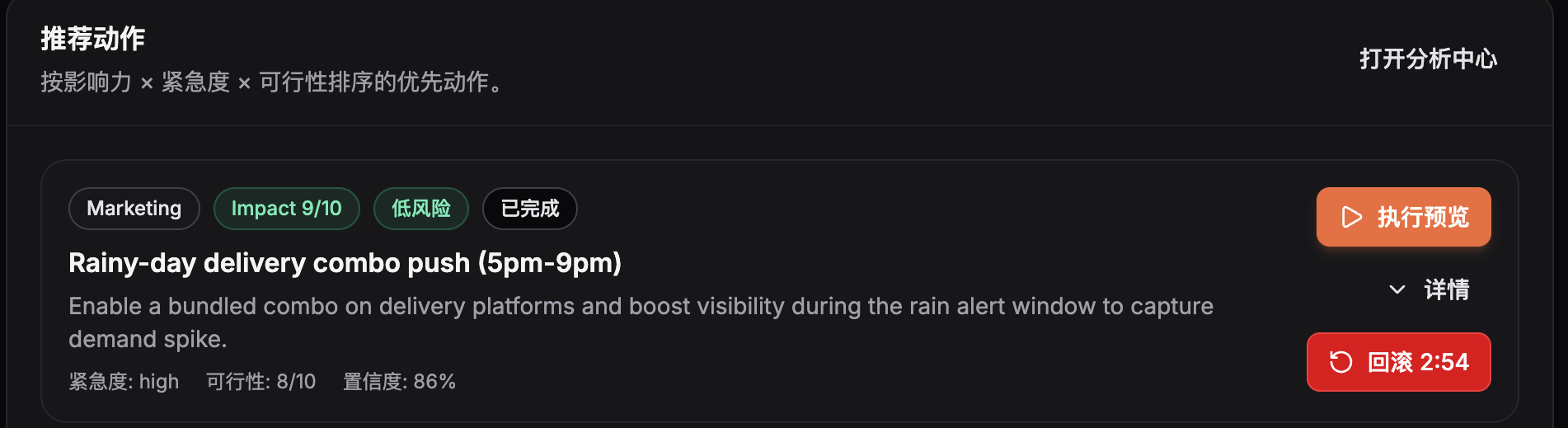
Rollback safety: Every action is reversible with one click
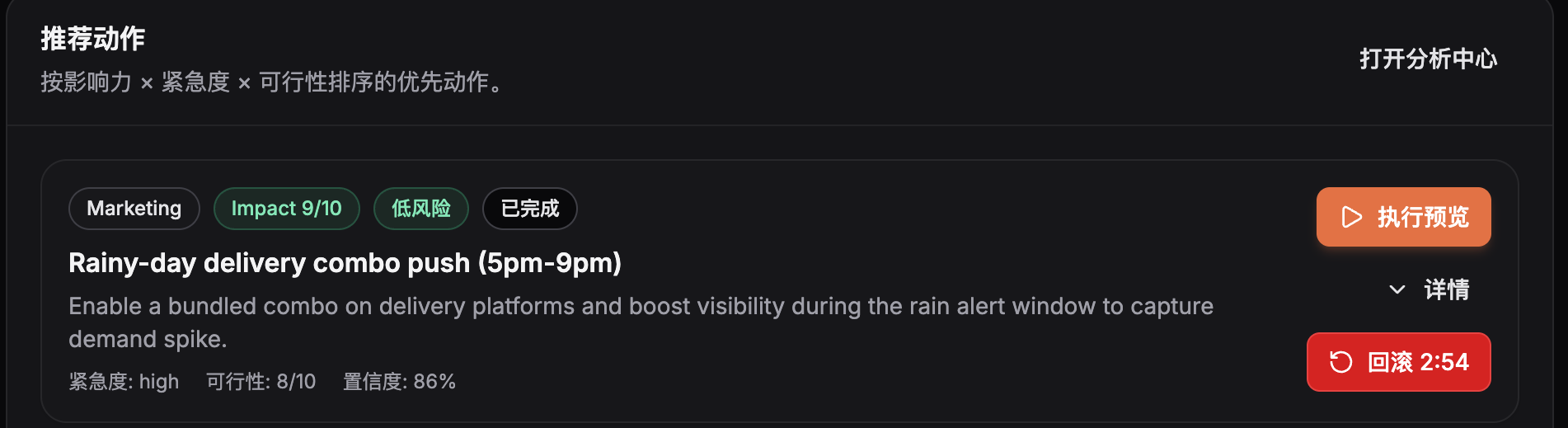
Example Flow System detects: “Your Kung Pao Chicken is priced 18% below competitors with no sales lift.” Then: A recommendation card appears with a pricing slider The owner confirms Prices update across DoorDash, UberEats, and Fantuan simultaneously If results are poor, the owner can roll back with one click
Why This Matters Most restaurant BI tools stop at “here’s what you should do.” We close the loop: insight → confirmation → execution → rollback.
For the 25,000+ Chinese restaurants in North America—often underserved by English-only tools—we’re building this bilingual, with cultural context built in.
How I Built It RestaurantIQ is built on the Amazon Nova ecosystem, using a three-tier model routing strategy for cost and performance.
Model Architecture Tier 1: Nova Micro Data cleaning and entity extraction Fast and low cost for high-throughput tasks
Tier 2: Nova Lite Real-time analysis and anomaly detection Sub-500ms latency for live dashboards
Tier 3: Nova Pro Strategic recommendations and competitor image analysis Multimodal capability for menu photo extraction
Nova-Specific Advantages Multimodal Extraction (Nova Pro) Upload a photo of a competitor's menu; Nova Pro extracts dish names, prices, and promotions in a single inference call. This reduced our competitor analysis pipeline from 200+ lines of regex/OCR code to ~20 lines.
Bedrock Knowledge Bases (RAG Grounding) We store industry benchmarks — average ticket sizes, labor/food cost ratios by cuisine type, seasonal demand patterns — in Bedrock Knowledge Bases. Recommendations are grounded in real data, not model hallucinations.
Bedrock Guardrails Restaurant financial data is sensitive. Guardrails prevent PII leakage and keep AI-generated recommendations professional. No accidental disclosure of revenue numbers in social media responses.
Three-Tier Cost Optimization By routing ~70% of requests to Nova Micro, 25% to Nova Lite, and only 5% to Nova Pro, we achieve 60%+ cost savings versus using a single premium model for everything. This matters for a SaaS targeting independent restaurants with tight margins.
Infrastructure Stack
Frontend:Next.js (App Router) + TypeScript + Tailwind CSS Auth:Clerk Compute:AWS Lambda Storage:DynamoDB (operations data, action snapshots) Files:S3 (menu images, uploaded documents) API:API Gateway AI:Amazon Bedrock (Nova Micro/Lite/Pro),Chatgpt, Claude Hosting:CloudFront
Challenges I Ran Into 1) I’m Not a Developer—and That Was the Point Here’s my confession: I don’t write code. My background is in restaurant operations, not software engineering. This entire project was built through what I call “vibe coding”—using AI coding assistants (Chatgpt, Perplexity, Gemini CLI, Cursor, Claude, Dyad) to translate product vision into working code. I’d describe what I wanted, iterate on the output, and slowly learn what questions to ask. The challenge: switching between four different AI IDEs and three app builders to find the right workflow. Each tool had different strengths, and each switch meant re-learning. Some nights I spent more time debugging my environment than building features. What I learned: not knowing how to code forced me to think in systems, not syntax. I had to articulate what I wanted clearly enough for an AI to execute it. That clarity now lives in the product—every feature exists because I could explain why a restaurant owner would need it.
2) I Knew What APIs Could Do—I Just Had No Idea How to Actually Use Them I understood the concept: APIs let apps talk to each other. DoorDash has one. UberEats has one. Connect them, and data flows into my system. The gap between “understanding APIs” and “actually implementing them” turned out to be enormous: OAuth 2.0 authentication flows Webhook configurations Rate limiting Sandbox vs. production environments Error codes and documentation written for engineers The real story by platform: DoorDash: Partner API pipeline was paused when I applied. No timeline. UberEats: Accessible API, but turning documentation into working code took weeks of trial and error. HungryPanda: No public API; requires a private relationship. Fantuan (饭团): I found the real approval process through work connections, but I’m not there yet. The lesson: the moat in this space isn’t AI models—everyone has access to those. The moat is integrations. Every API connection is a relationship and a gate passed through.
3) Building Rollback When You Don’t Know Databases I knew owners would never trust a system that couldn’t undo mistakes. “Rollback” sounded terrifying—transactions, state management, data consistency. Through dozens of conversations with AI assistants, I learned rollback can be implemented as “save before, restore if needed.” We store snapshots in DynamoDB before every action. It’s not elegant by traditional standards, but it works—and owners trust it.
4) The Loneliness of Solo Building The hardest challenge wasn’t technical. It was the 2 AM moments wondering if this would ever work. No co-founder to sanity-check ideas. No engineering team to catch mistakes. What kept me going: every time I showed a restaurant owner the prototype, they’d say, “I’ve been waiting for something like this.”
Accomplishments We’re Proud Of Built a working product without writing code myself Six months ago, I had a product vision but no engineering skills. Today, I have a functional MVP that connects restaurant data, generates AI-powered recommendations, and can execute actions across platforms. Every line of code came from conversations with AI assistants. That's not a shortcut — that's the future of building.
Designed a product architecture that engineers validated When I showed the three-tier Nova model routing (Micro → Lite → Pro) to developer friends, they didn't ask "did an AI help you?" They asked "how did you think of this?" Turns out, not knowing how to code forced me to think in systems and user outcomes, not implementation details.
Created the "executable card" interaction pattern Every BI tool shows dashboards. We show action cards with sliders. This wasn't in any tutorial — it came from watching restaurant owners and realizing they don't want more information, they want fewer decisions. Confirm with a slider, execute with one click, rollback if needed.
Cracked the code on platform relationships (partially) I now have a clear path to Fantuan API access and understand exactly what DoorDash, UberEats, and HungryPanda require. Six months ago, I didn't know where to start. The knowledge of how to get through these gates — even before fully getting through them — is a real asset.
Stayed in the game as a solo non-technical founder No co-founder. No funding. No engineering background. Just a problem I understood deeply and AI tools that met me halfway. Still here. Still building.
What I Learned
- AI doesn't replace skills — it changes which skills matter**
I can't write a function from scratch. But I can describe exactly what a restaurant owner needs at 11 PM when they're exhausted and staring at DoorDash analytics. AI coding assistants turned that product intuition into working software. The skill that mattered wasn't syntax — it was clarity of thought.
Platform integration is a relationship game, not a technical one** I spent weeks trying to "figure out" APIs through documentation. The real unlock came from a 15-minute conversation with someone who'd been through the process. In this industry, knowing the right person saves more time than knowing the right code.
"Recommend" is a feature. "Execute" is a product.** Every restaurant tool says "you should raise prices" or "your Tuesday sales are low." Owners already know this. What they need is someone to actually do something about it. The gap between insight and action is where real value lives.
Model routing isn't optimization — it's architecture** Using Nova Micro for data cleaning, Nova Lite for real-time analysis, and Nova Pro for strategic decisions isn't about saving money (though we do — 60%+). It's about matching the right tool to the right job. This principle applies beyond AI: do the simplest thing that works at each layer.
Honesty builds better products** I don't pretend to be a technical founder. That honesty forced me to build for people like me — restaurant operators who don't want to learn new systems, they just want results. If I can use it, they can use it.
What’s Next for Restaurant IQ
This is still Day 1 I'm not going to pretend I have a 3-year roadmap figured out. Here's what I actually plan to do next:
- Finish what I started
The platform API integrations aren't complete yet. Fantuan, UberEats, DoorDash — I now understand what each one requires, but understanding and doing are different things. The next step is simple: keep pushing until they're connected.
- Find a few restaurants willing to try it for free
I don't need 100 users. I need 3-5 restaurant owners who'll actually use this, tell me what's broken, and help me make it better. I'll offer it for free — their feedback is worth more than any payment right now.
- Find a technical co-founder
I built this MVP with AI tools and pure stubbornness. But I know my limits. To take RestaurantIQ from prototype to product, I need a technical partner who:
- Sees the same opportunity in restaurant tech
- Is comfortable with AI-assisted development
- Wants to build something real for an underserved market
If that sounds like you (or someone you know), I'd love to talk.
That's it. No grand vision deck. Just: finish the integrations, get real users, find the right partner.
The rest will figure itself out.
Built With
- amazon-bedrock
- amazon-dynamodb
- amazon-nova-lite
- amazon-nova-micro
- amazon-nova-pro
- amazon-web-services
- api-gateway
- aws-lambda
- python
- react
- tailwindcss


Log in or sign up for Devpost to join the conversation.