Inspiration
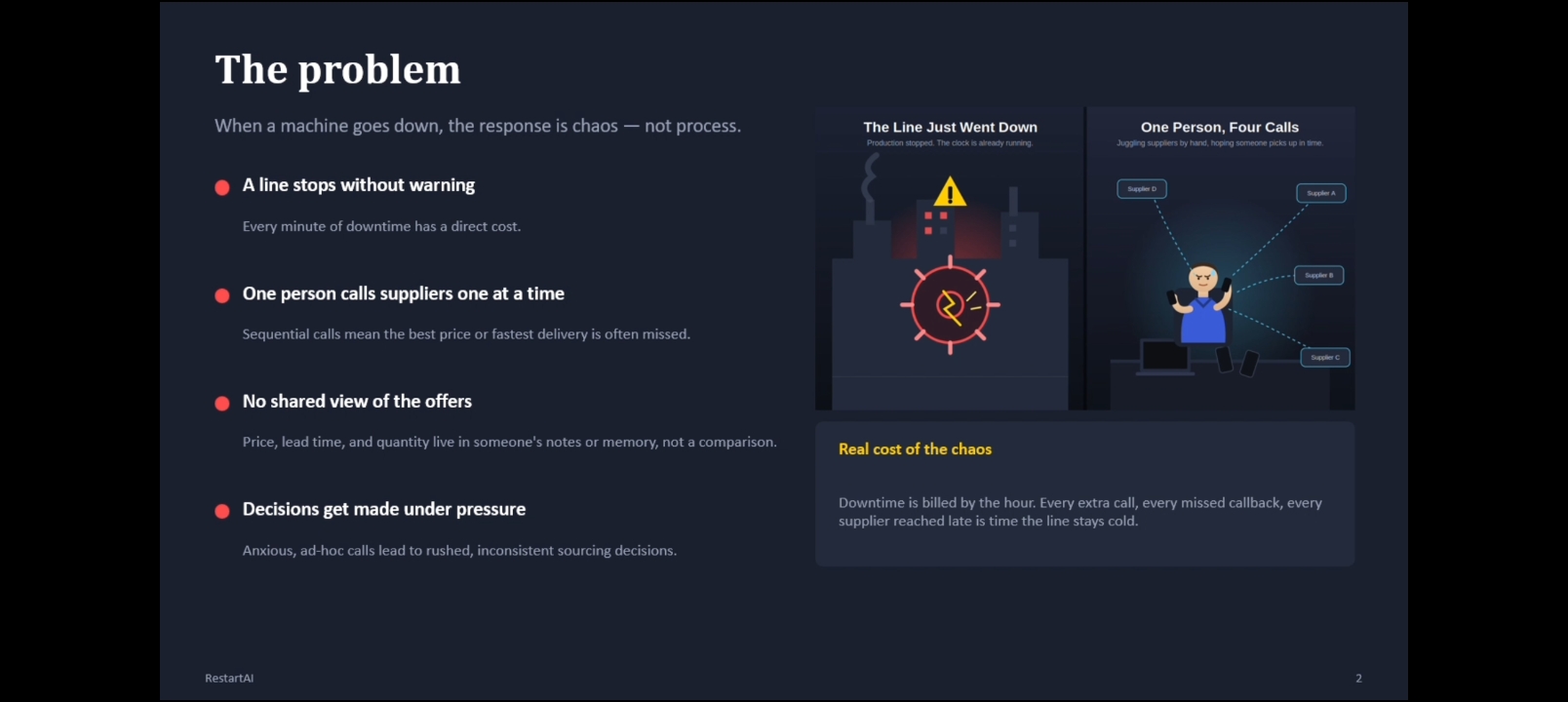
A factory machine going down can cost thousands of dollars every hour. In an emergency, the problem is not simply finding the cheapest replacement part — it is finding a feasible way to restart production as quickly as possible.
Real suppliers may have fragmented inventory, different delivery times, and no APIs or structured inventory systems. A factory employee may need to make several phone calls, compare incomplete information, handle partial availability, and make a decision while production is already losing money.
We built RestartAI to act as an emergency recovery agent that can handle this coordination through phone conversations.
What it does
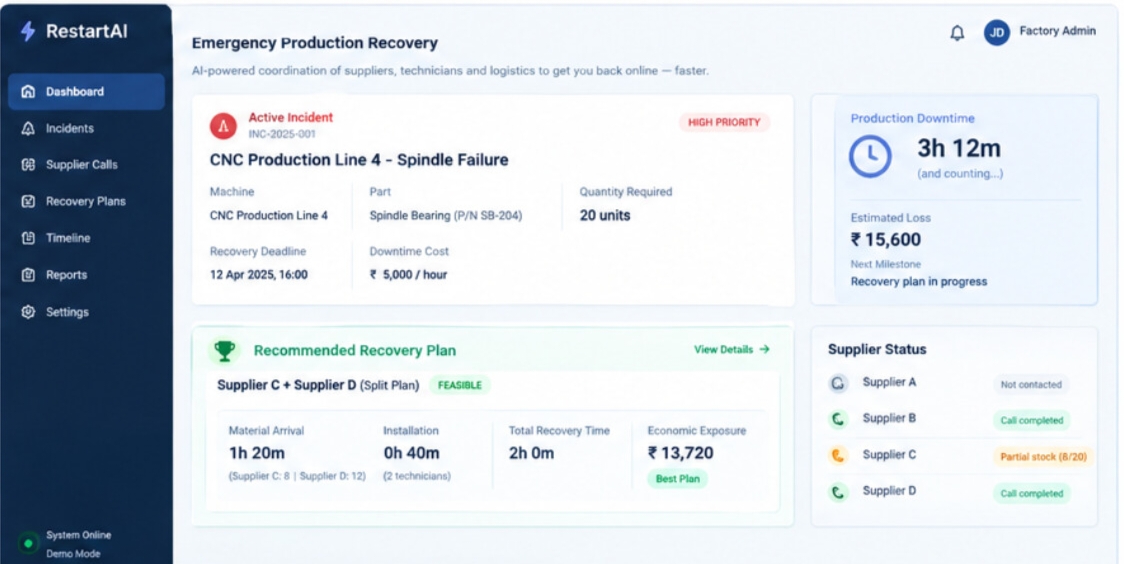
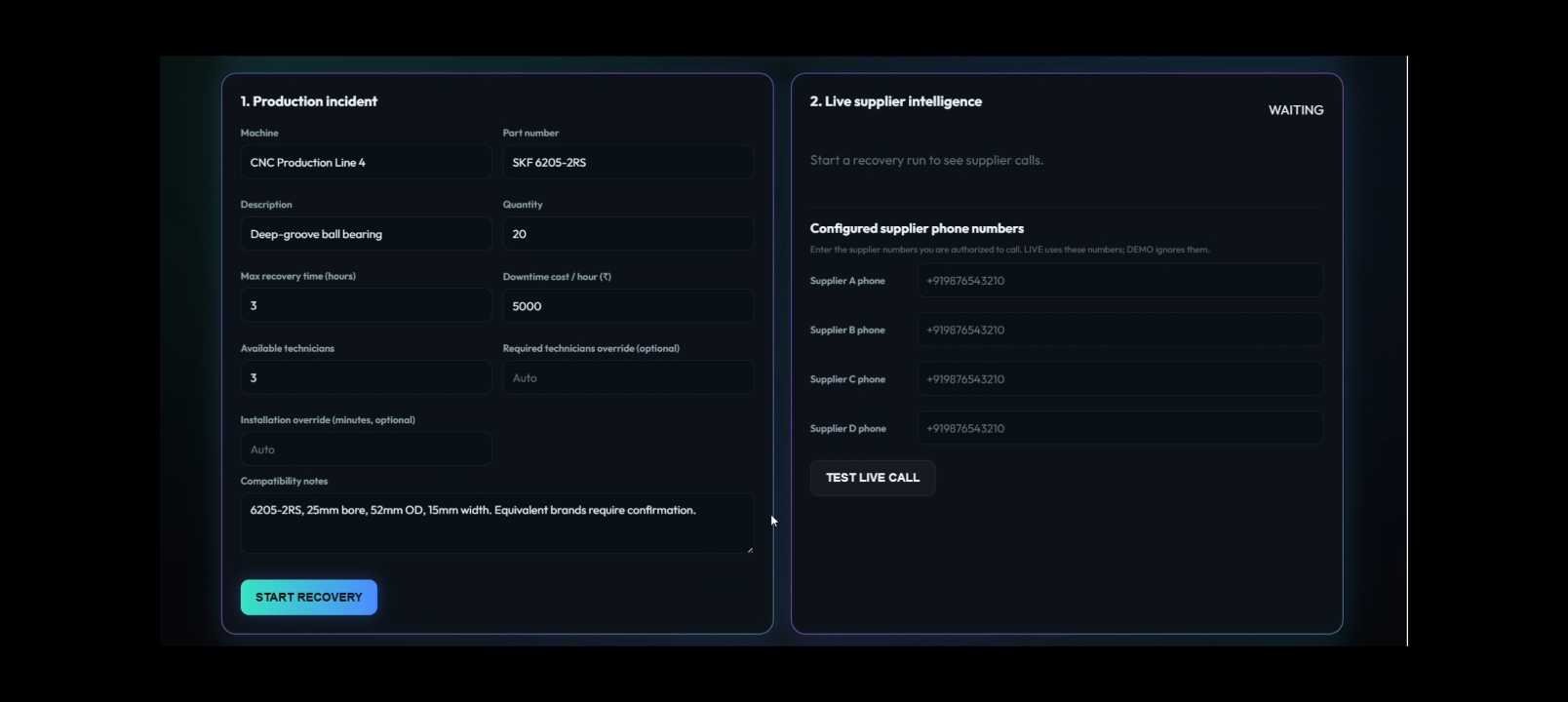
RestartAI takes a production failure and turns it into a recovery plan.
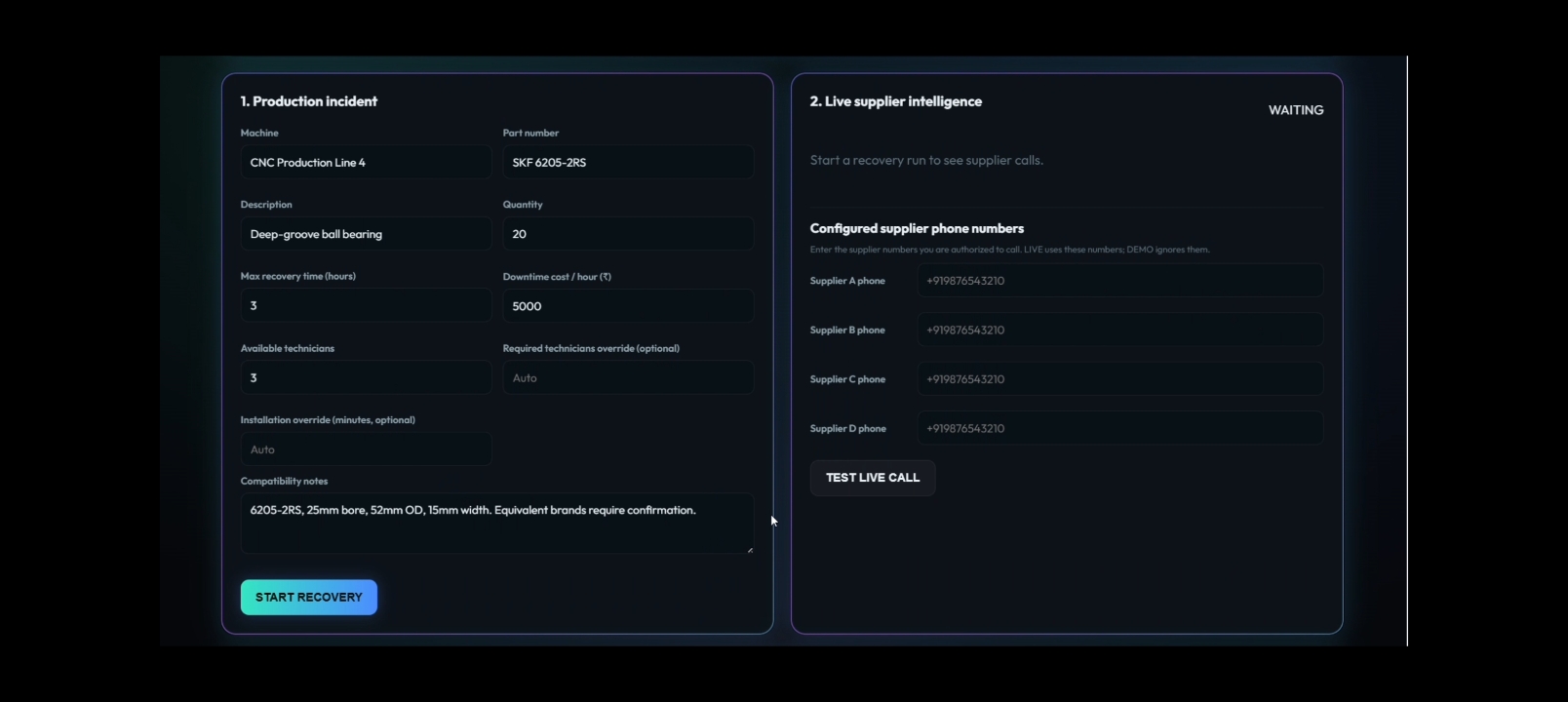
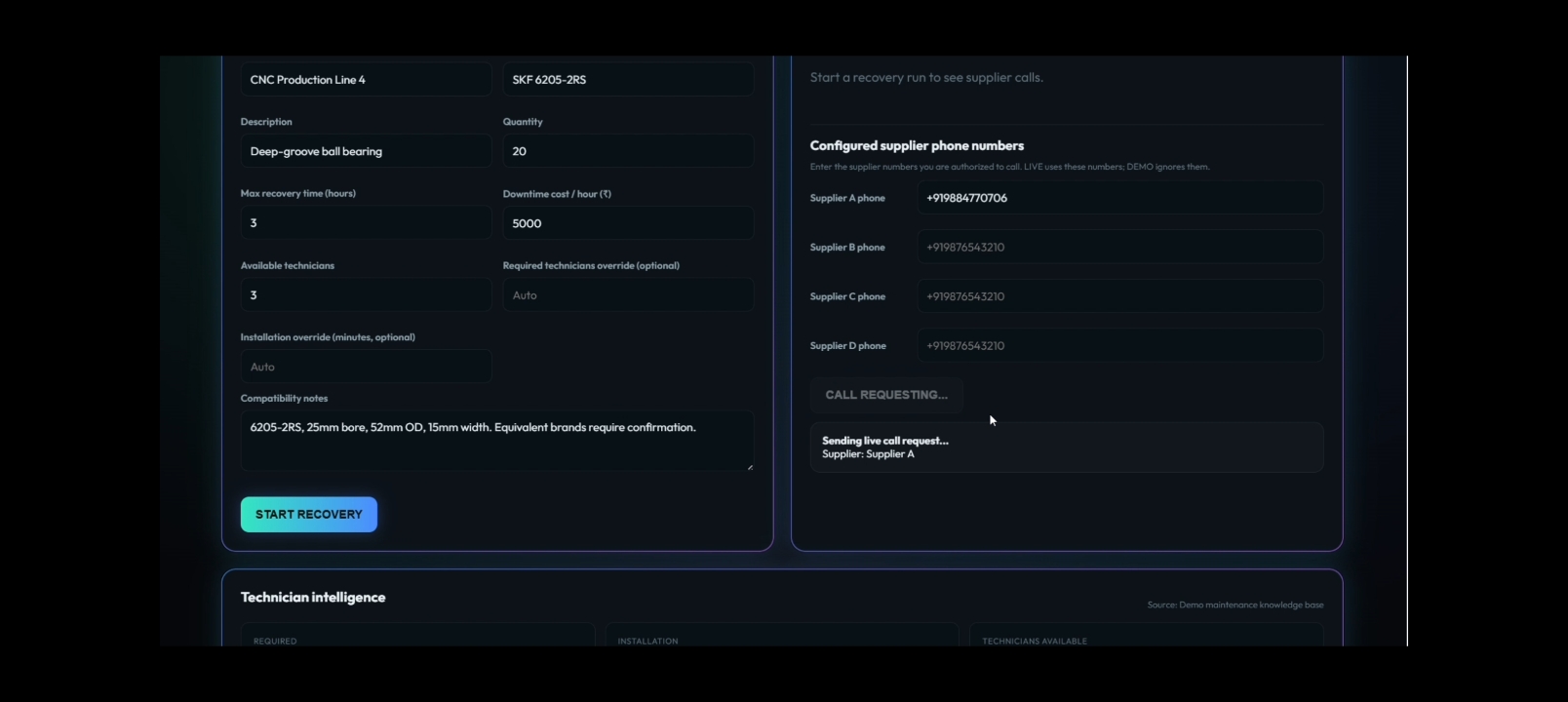
The factory provides:
- Failed machine
- Required replacement part
- Required quantity
- Maximum acceptable recovery time
- Downtime cost per hour
- Available technicians
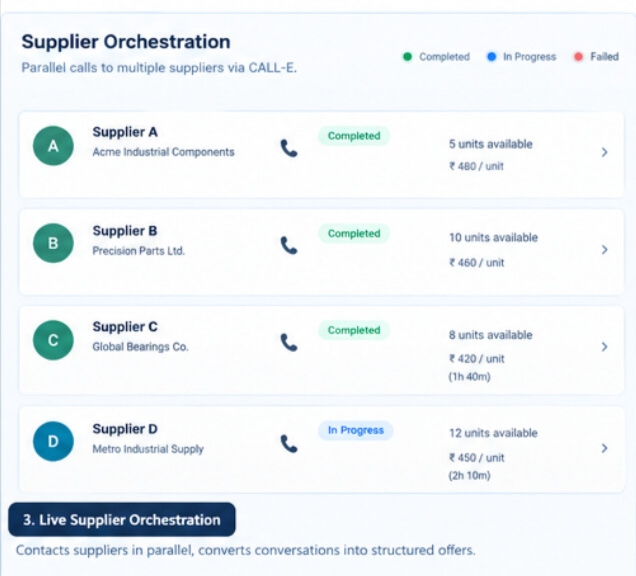
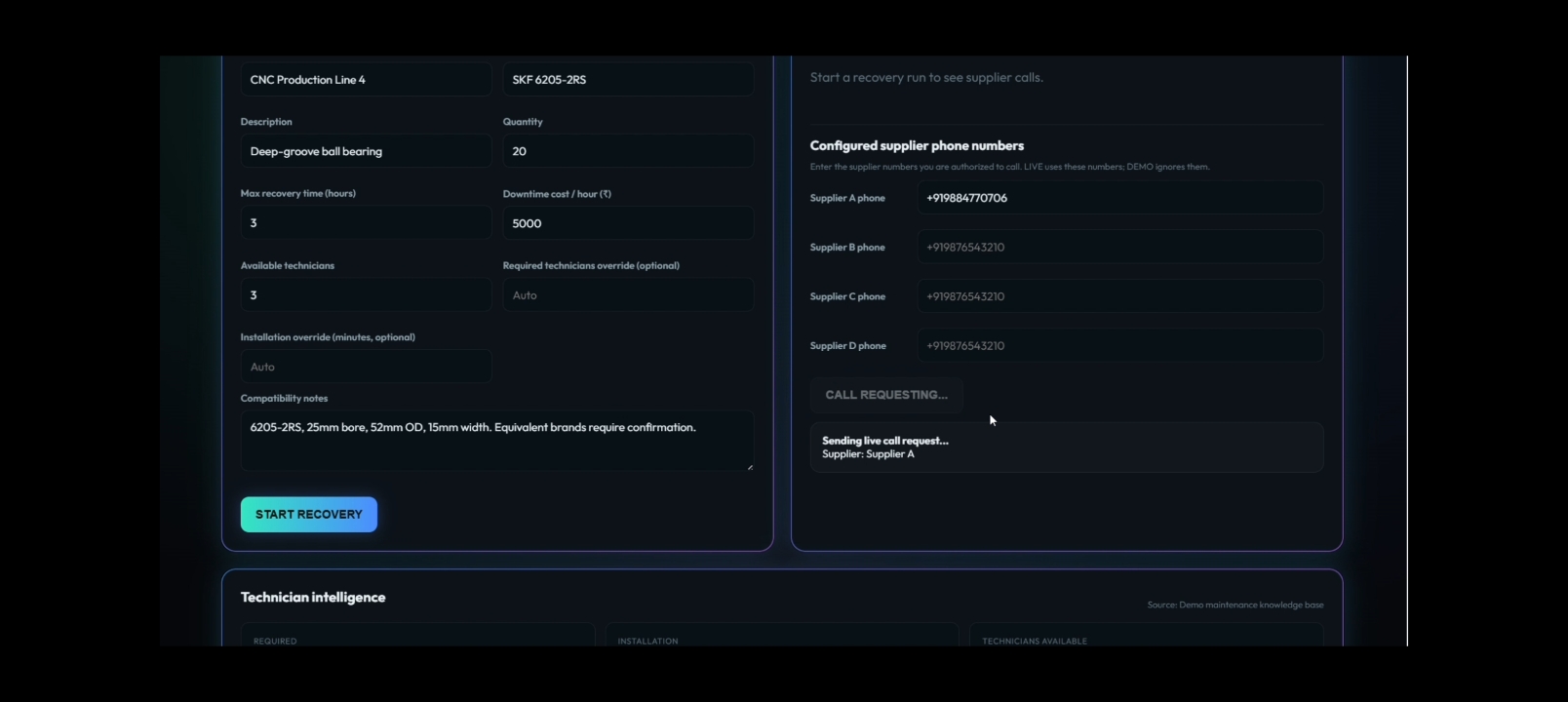
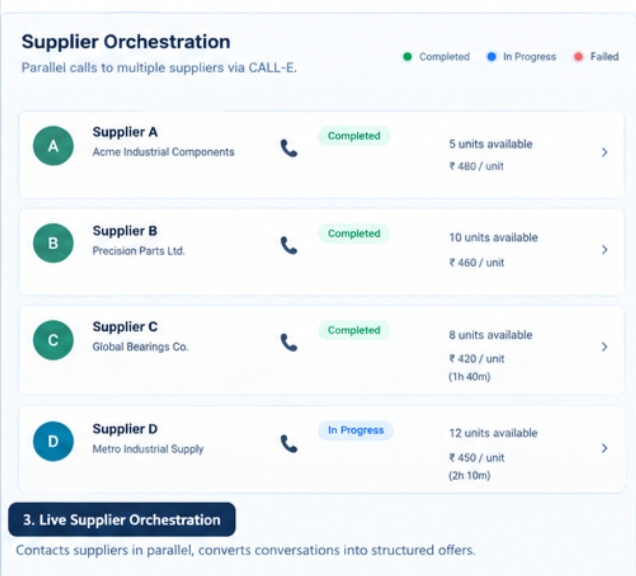
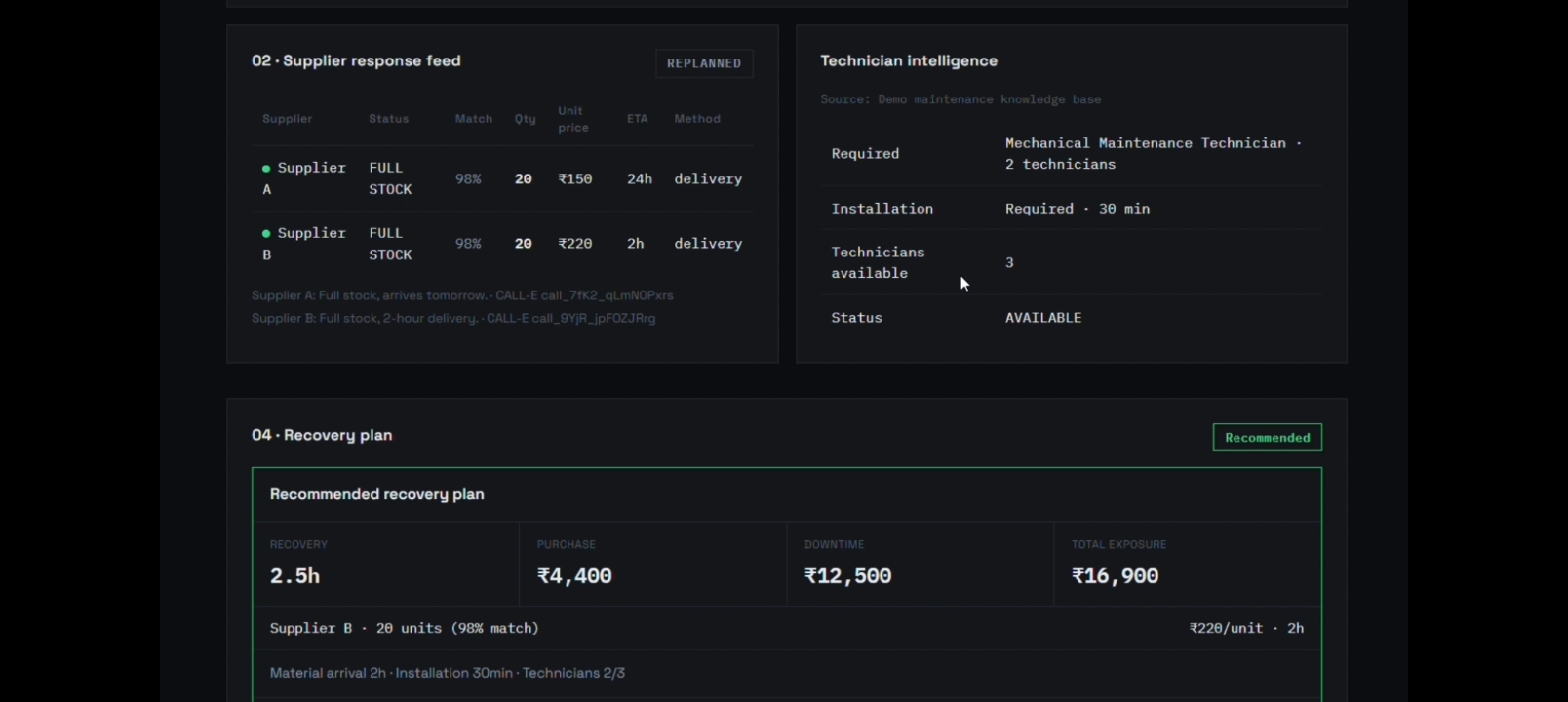
RestartAI then uses CALL-E to contact suppliers and collect live information about:
- Available quantity
- Unit price
- Earliest pickup or delivery
- Delivery method
- Commitment to the requested quantity
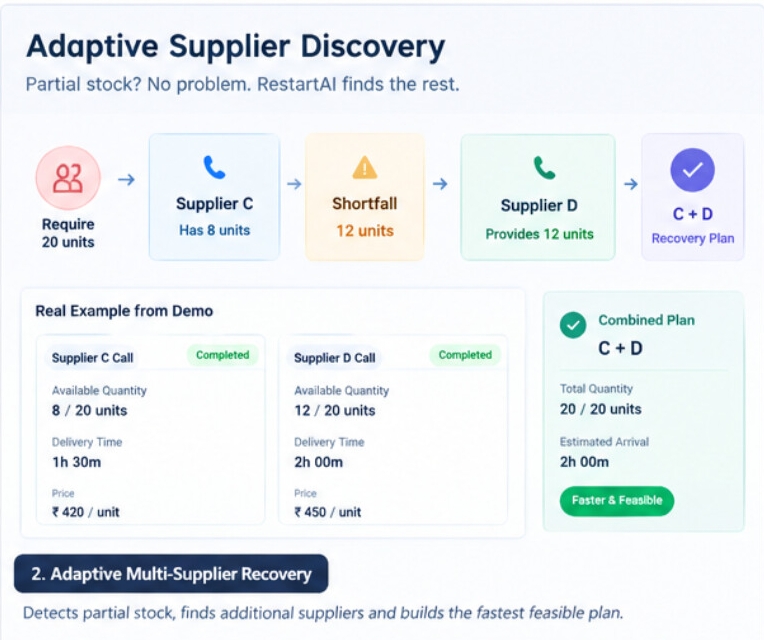
The important part is what happens when a supplier cannot fulfill the complete requirement.
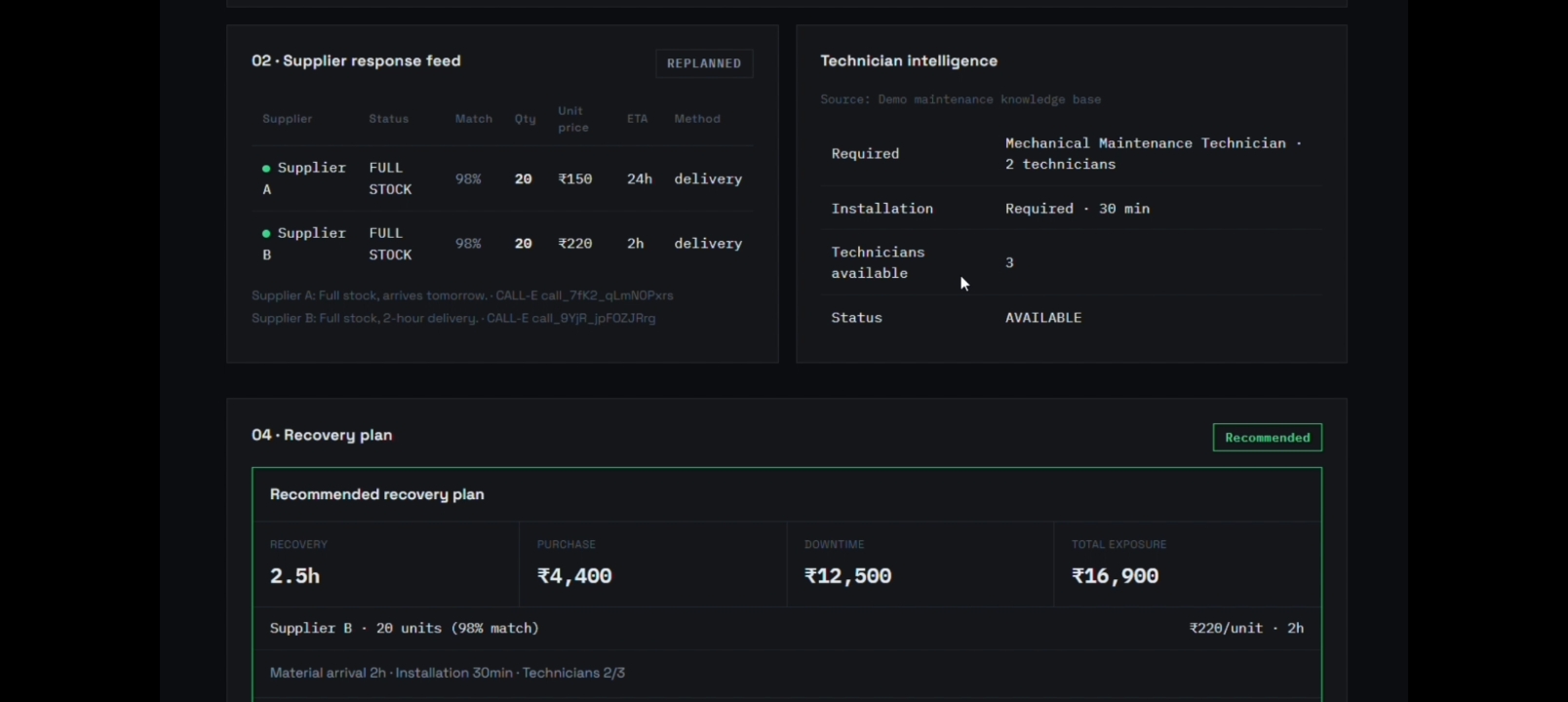
For example, if the factory needs 20 bearings but one supplier has only 8, RestartAI does not simply reject that supplier. It calculates the remaining shortage and dynamically contacts another supplier for the remaining 12 units.
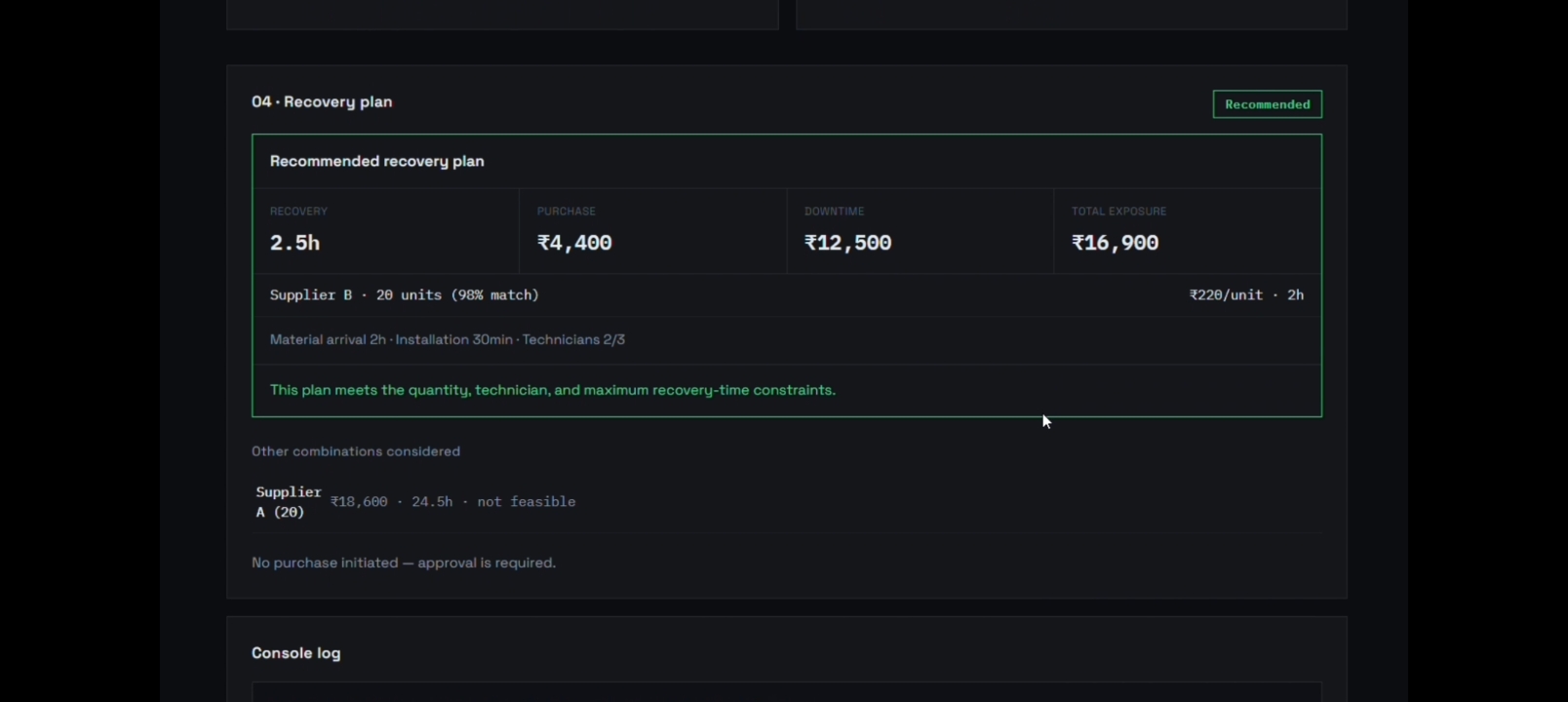
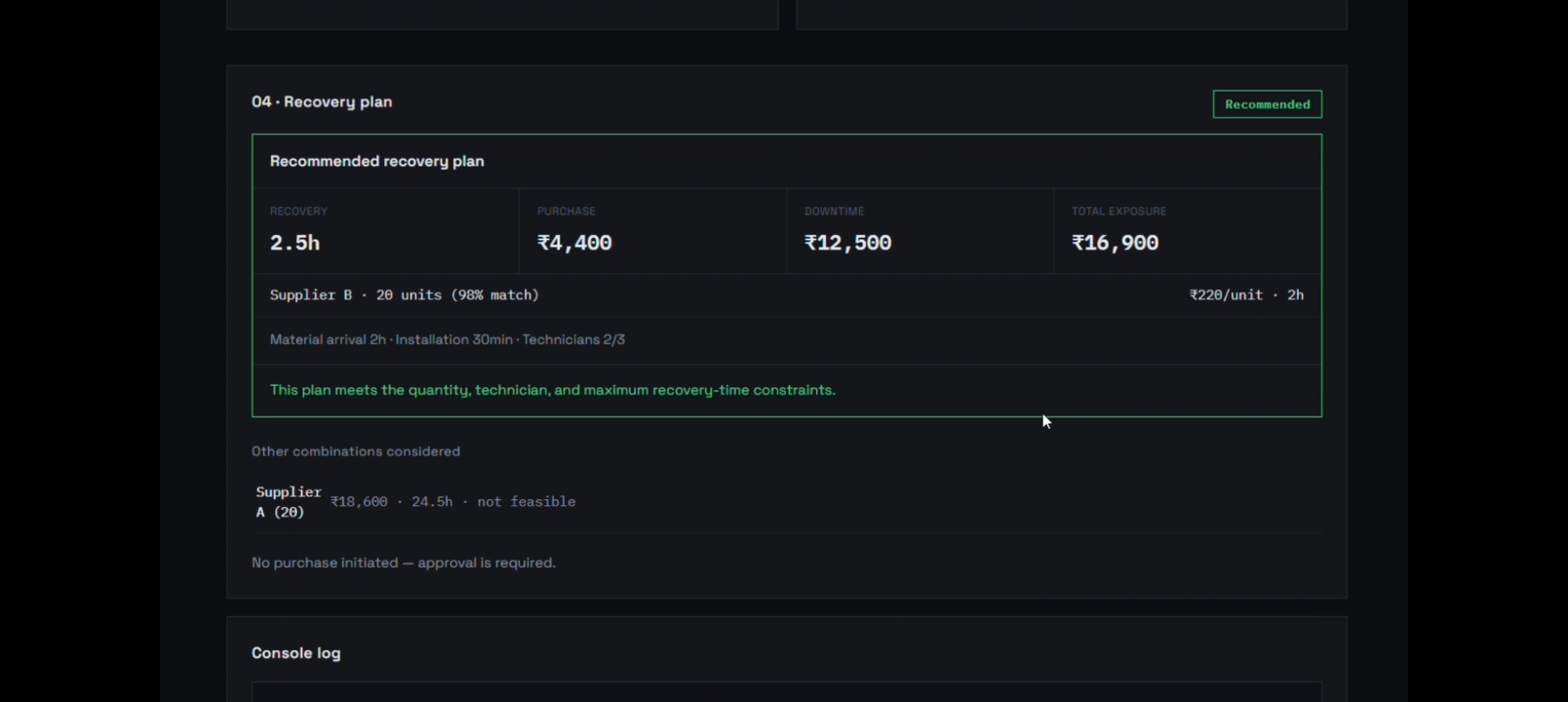
It then combines the available offers and calculates:
$$
\text{Total Recovery Time}
\text{Material Arrival Time} + \text{Installation Time} $$
The economic impact is calculated as:
$$
\text{Economic Exposure}
\text{Purchase Cost} + \left( \text{Downtime Cost/Hour} \times \text{Recovery Time} \right) $$
This allows RestartAI to compare complete recovery strategies rather than simply choosing the cheapest supplier.
The final recommendation is presented to a human for approval. RestartAI does not automatically purchase anything.
How we built it
RestartAI is built as a lightweight full-stack application using:
- Python
- FastAPI
- CALL-E Python SDK
- Pydantic
- Jinja2
- JavaScript
- HTML/CSS
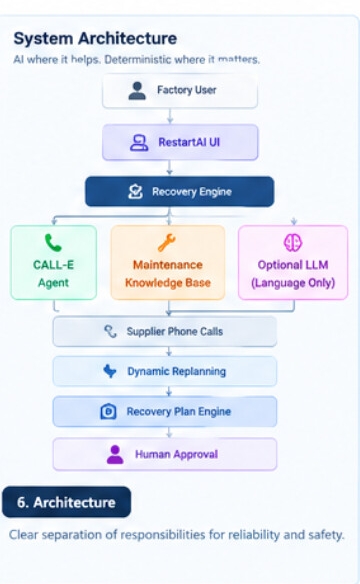
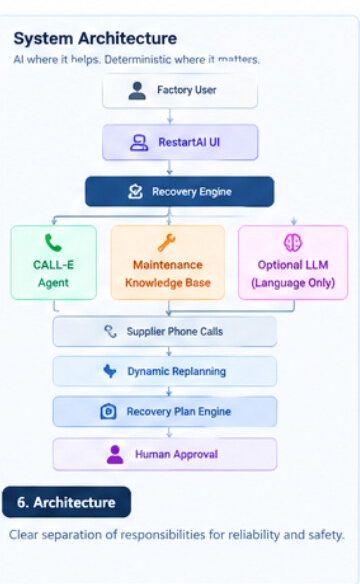
The architecture separates communication, reasoning, and decision-making:
Factory User
     |
     v
RestartAI UI
     |
     v
Recovery Engine
     |
     +--------> CALL-E
     |             |
     |             v
     |        Supplier Calls
     |             |
     |             v
     |        Structured Offers
     |
     +--------> Maintenance Knowledge Base
     |
     v
Dynamic Recovery Planner
     |
     v
Economic + Time Optimization
     |
     v
Human Approval
CALL-E handles the real-world phone interaction.
The recovery engine performs deterministic calculations and planning.
A local maintenance knowledge base provides task-specific technician requirements and installation estimates. These values are editable and can be overridden by the factory rather than being invented by an AI model.
The application also includes a deterministic demo mode so the complete workflow can be tested without making real phone calls.
Challenges we ran into
The biggest challenge was designing an agent that could react to information discovered during the supplier calls.
A traditional procurement workflow can search suppliers and return a list of prices. That is not enough during a production emergency.
The agent needs to answer questions such as:
What if no supplier has the full quantity?
Should a partial-stock supplier still be used?
Is a faster but more expensive supplier actually cheaper when downtime is considered?
Can the factory complete the repair with the available technicians?
What should the agent do next after learning that 12 units are still missing?
This led us to design RestartAI around dynamic replanning rather than simple supplier ranking.
Another challenge was handling real phone calls safely. Live calls are external side effects, so RestartAI keeps API credentials server-side, uses explicit user initiation, validates phone numbers, and keeps the final purchase decision under human control.
Accomplishments we're proud of
We are proud that RestartAI goes beyond a static supplier comparison dashboard.
Its core workflow is:
Machine Failure
      ↓
Supplier Calls
      ↓
Live Availability
      ↓
Shortage Detection
      ↓
Adaptive Supplier Call
      ↓
Multi-Supplier Recovery Plan
      ↓
Technician Check
      ↓
Recovery Time
      ↓
Economic Exposure
      ↓
Human Approval
The key insight is that partial inventory is still useful information.
Instead of asking:
"Which supplier has everything?"
RestartAI asks:
"What combination of available resources can restart production within the required time and at the lowest economic exposure?"
What we learned
We learned that building an AI agent for a real operational problem is different from building a chatbot.
The most important part is not simply generating a response. The system must:
- Observe the current situation
- Take an action
- Receive new information
- Update its understanding
- Decide what action should happen next
- Recalculate the plan
- Keep humans in control of consequential decisions
We also learned that deterministic software is important around an AI agent. Language models and voice systems are useful for communication and information extraction, while critical calculations such as quantities, recovery time, feasibility, and economic exposure should remain deterministic and verifiable.
What's next for RestartAI
The next version could connect RestartAI to real factory systems such as:
- CMMS / maintenance management systems
- ERP and procurement systems
- Inventory databases
- Supplier databases
- Logistics and shipment tracking
- Technician scheduling systems
We also want to expand the recovery planner beyond replacement parts to include alternative compatible parts, multiple repair teams, local inventory, logistics constraints, and emergency maintenance scheduling.
The long-term vision is to make RestartAI an emergency operations agent for manufacturing — one that can coordinate the resources required to get a production line running again while keeping humans in control of the final decision.
Built With
- agents
- ai
- call-e
- fastapi
- html
- javascript
- jinja
- llm
- pydantic
- python
- voice

Log in or sign up for Devpost to join the conversation.