Inspiration
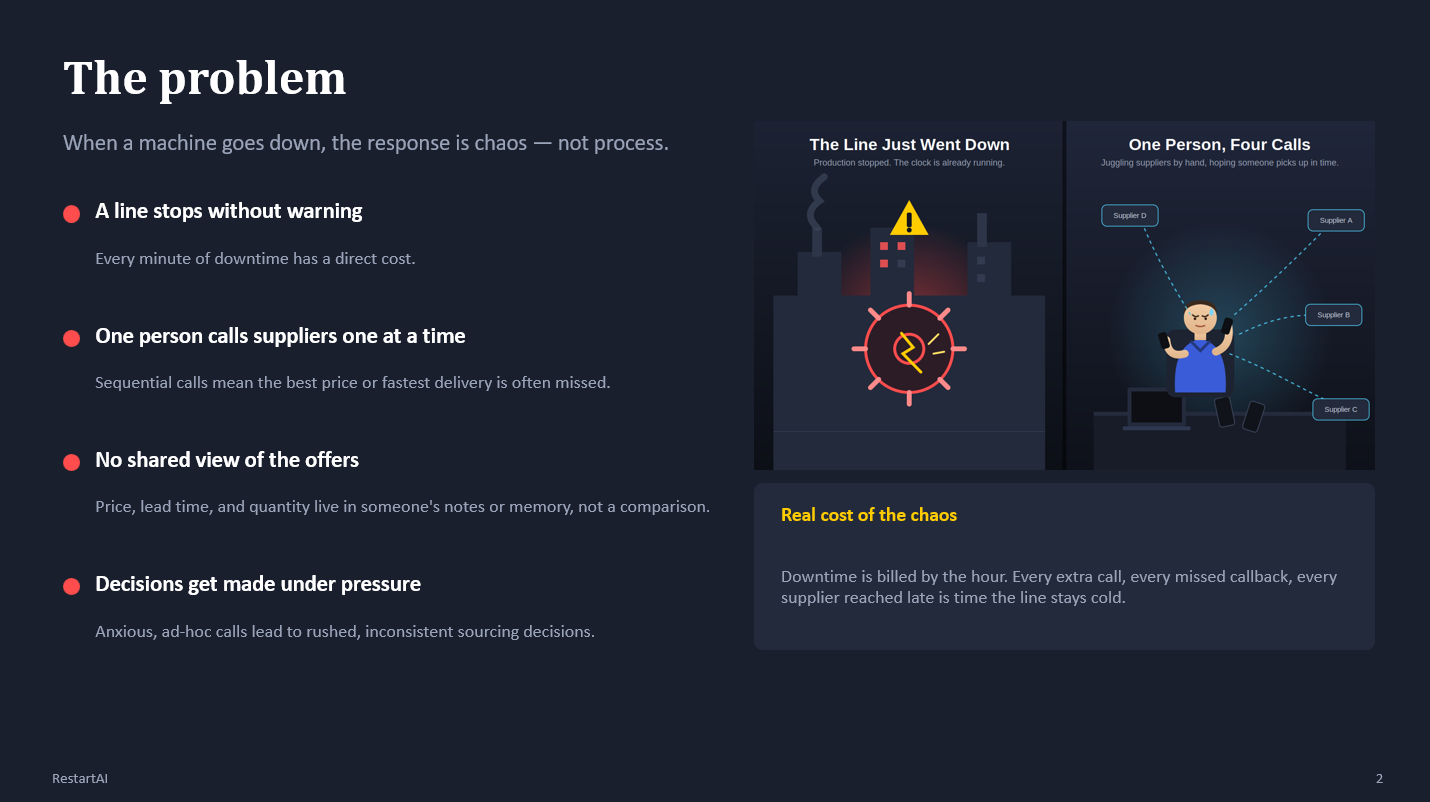
A factory machine failure can turn into a serious business problem within minutes. Every hour of downtime can mean lost production, delayed orders, and increased operational costs.
We wanted to explore a simple question:
What if AI could help a factory recover from a breakdown instead of simply helping with routine tasks?
The idea behind RestartAI came from the observation that emergency procurement is often highly manual. Teams have to call suppliers, check availability, compare prices and delivery times, find replacement parts, and coordinate technicians — all while production is already losing money.
We built RestartAI to act as an AI-powered emergency production recovery agent that focuses on one goal: finding the fastest feasible way to restart production, rather than simply choosing the cheapest supplier.
What it does
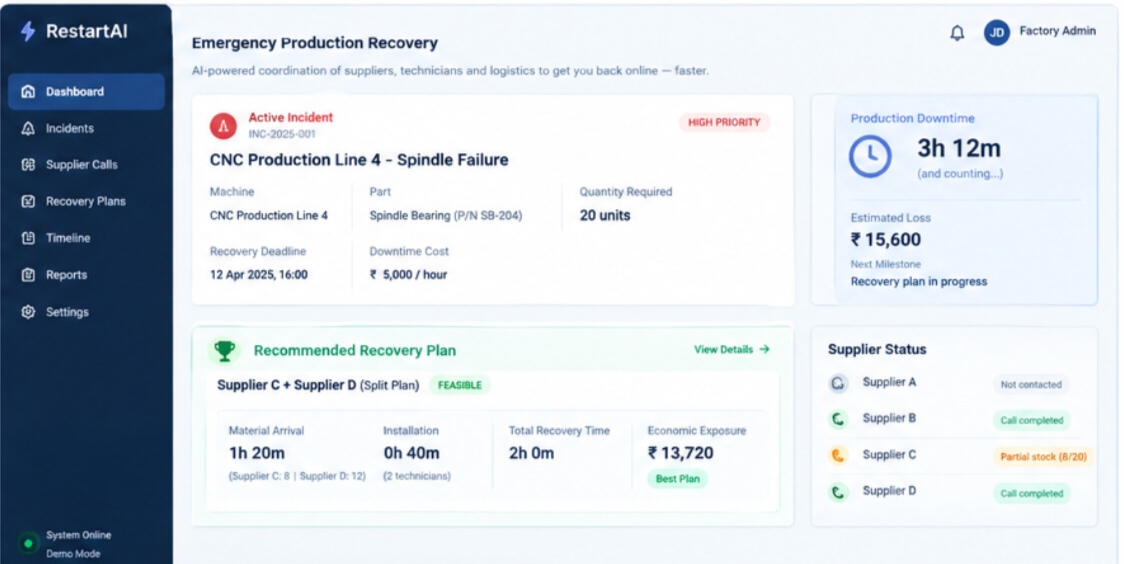
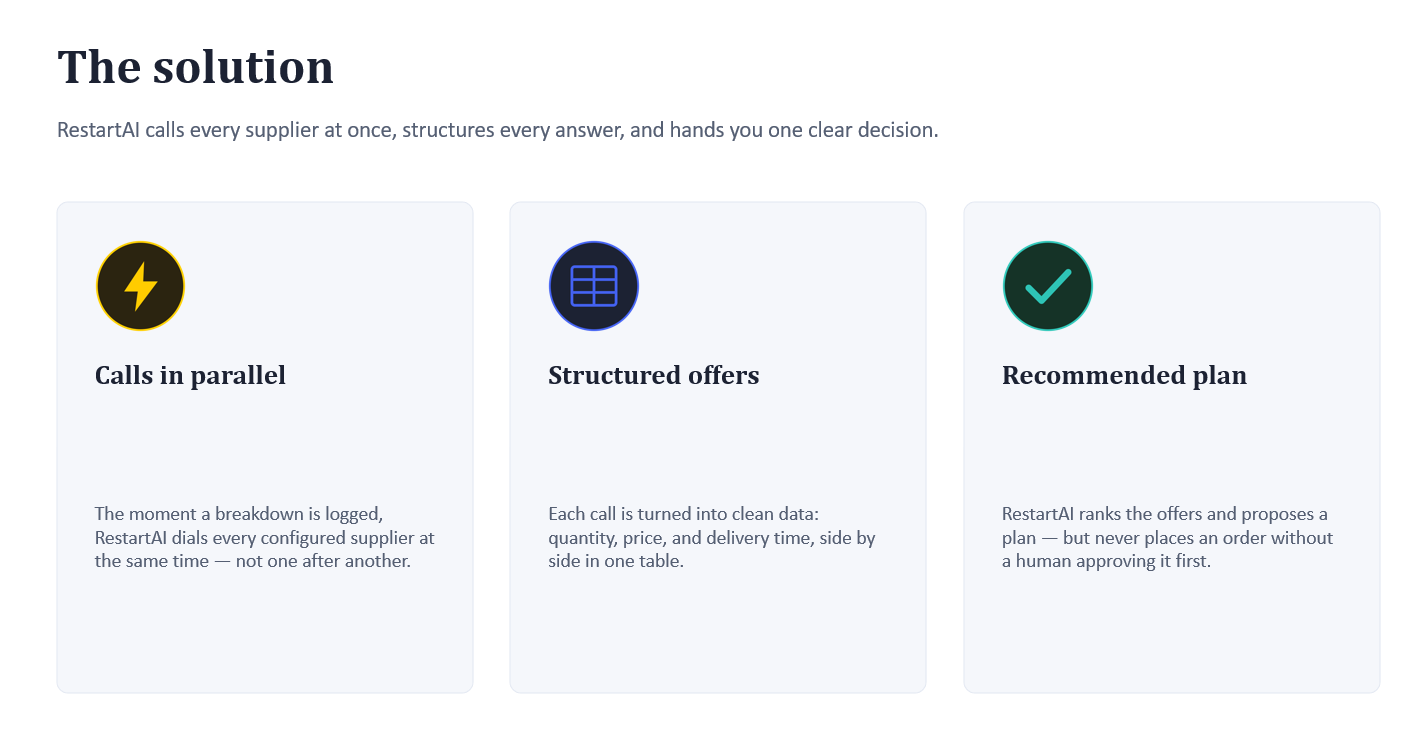
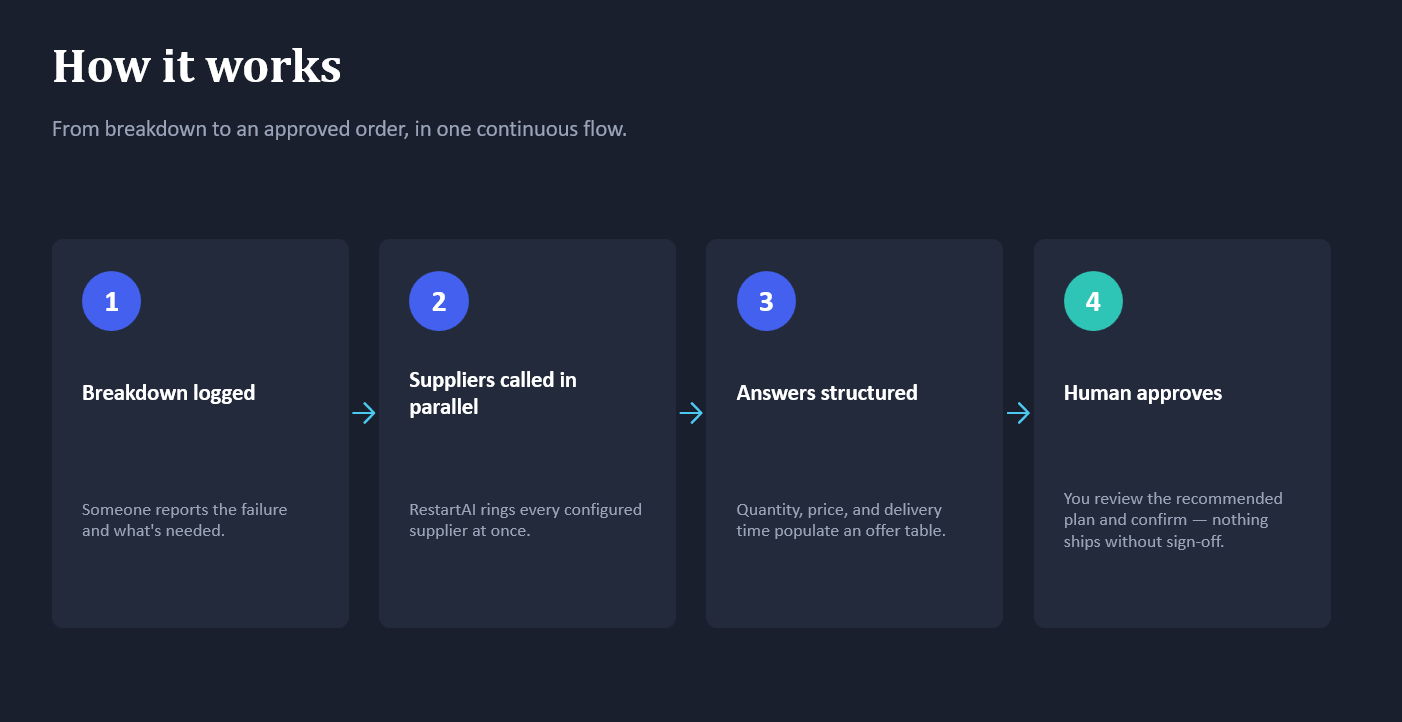
RestartAI takes a factory's emergency situation — such as a failed machine, required part, quantity, recovery deadline, available technicians, and downtime cost — and builds a recovery plan.
The system can:
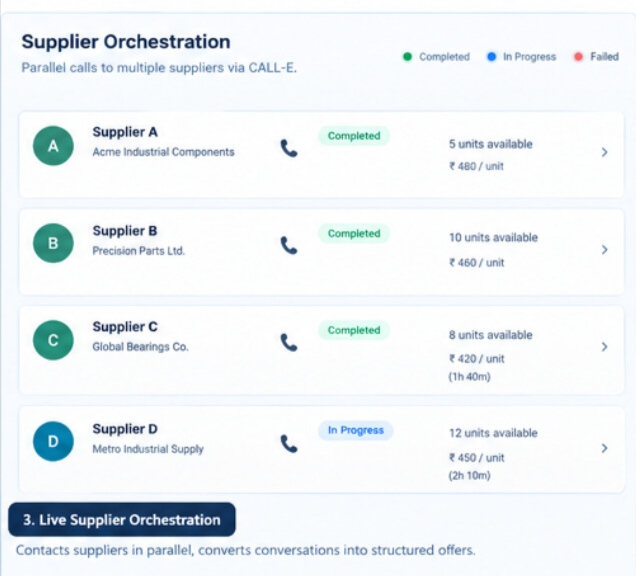
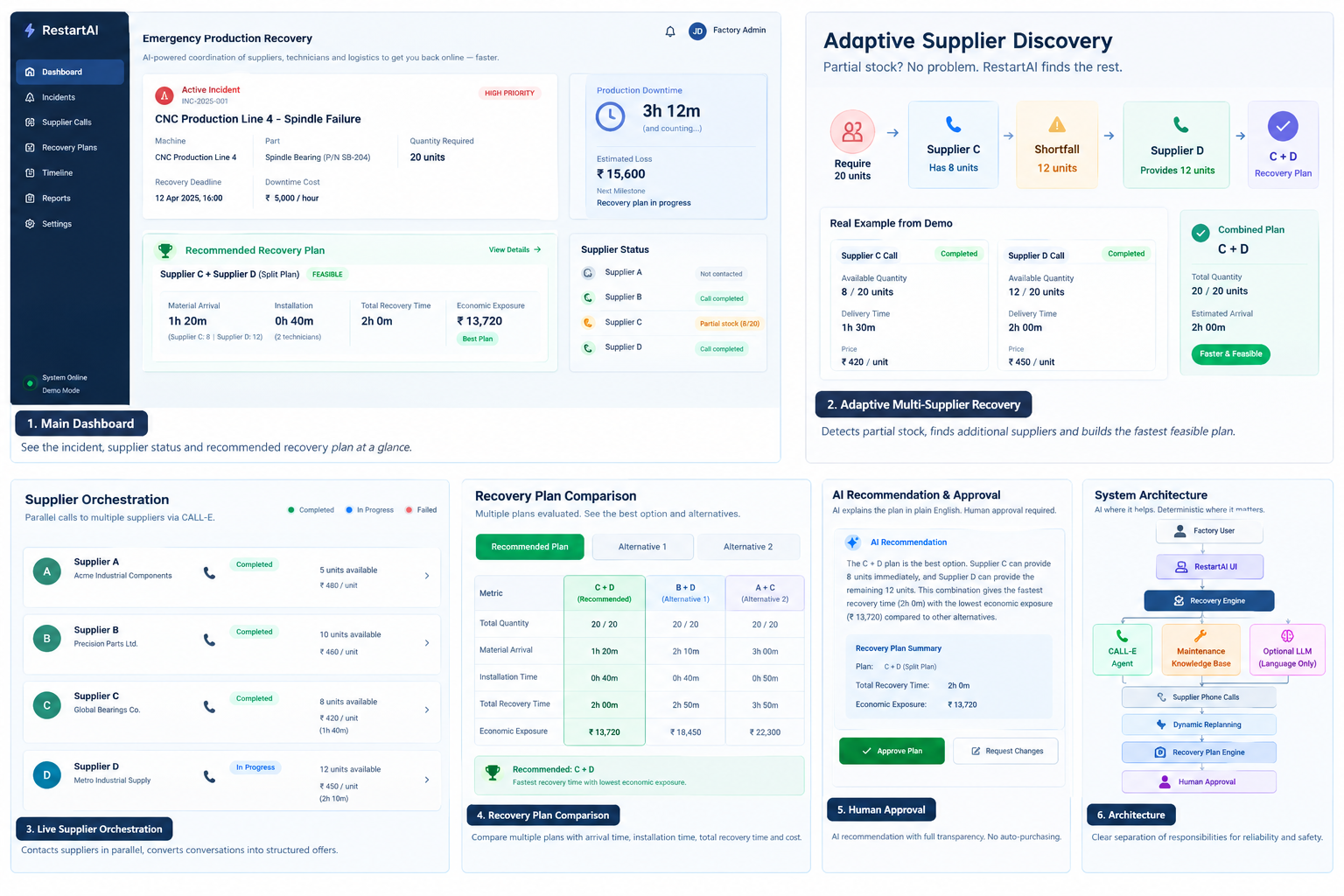
- Contact suppliers through CALL-E
- Convert supplier conversations into structured offers
- Handle partial supplier availability
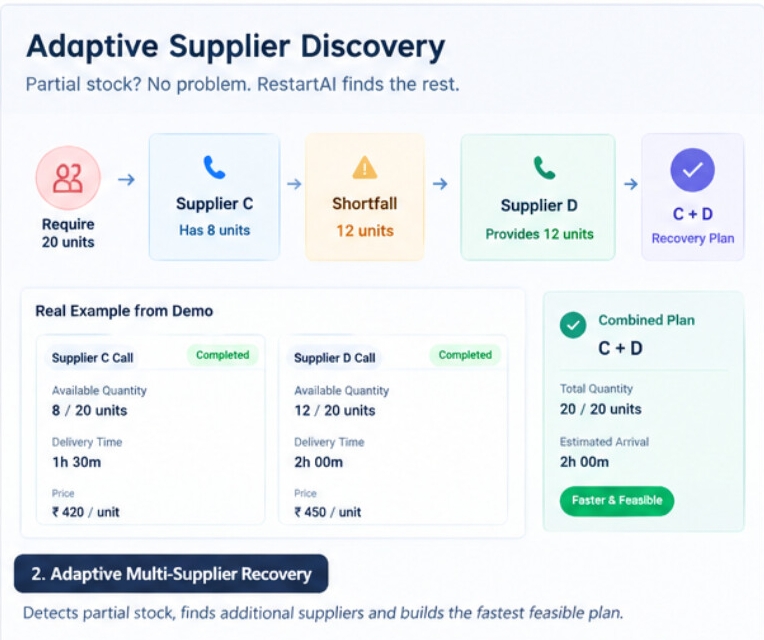
- Dynamically search for additional suppliers when there is a shortfall
- Combine multiple supplier legs when necessary
- Determine technician requirements and installation time
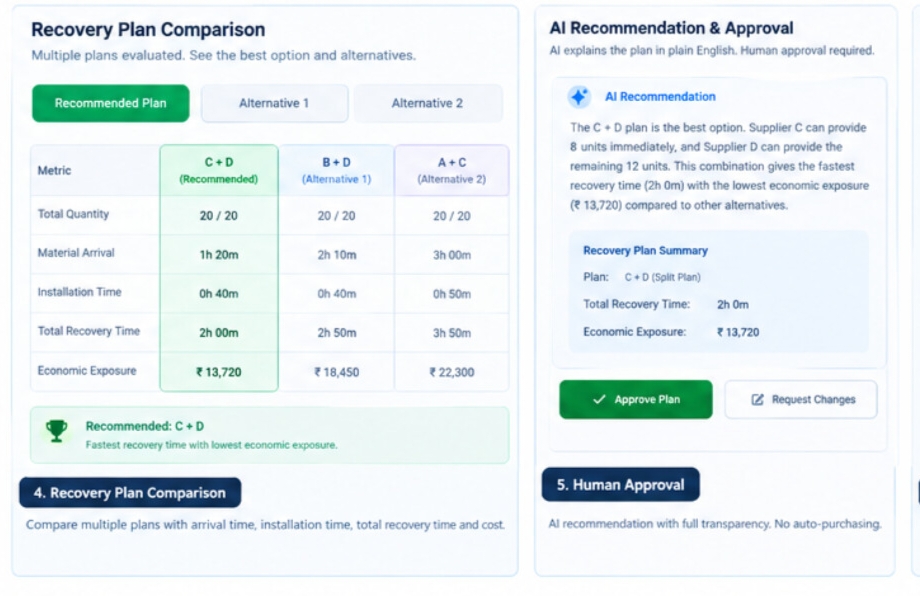
- Calculate material arrival time, recovery time, and economic exposure
- Compare feasible recovery plans
- Recommend the best recovery plan
- Show alternative plans for transparency
- Require human approval before any plan is approved
A key part of our system is adaptive replanning.
For example, if a supplier has only 8 of the 20 required parts, RestartAI does not simply reject that supplier. It identifies the remaining 12-unit shortfall, contacts another supplier, and evaluates whether combining both suppliers produces a faster and economically better recovery plan.
How we built it
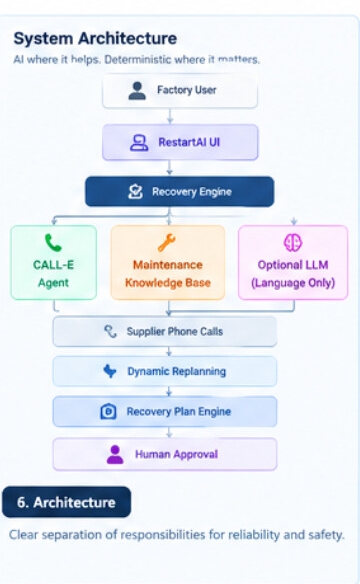
We built RestartAI as a combination of AI, deterministic planning, supplier communication, and human oversight.
The architecture separates responsibilities so that the AI is not responsible for critical calculations.
- CALL-E handles real-world supplier phone communication.
- An optional LLM handles language understanding, extraction, and explanation.
- A local maintenance knowledge base provides technician and task information.
- Python performs deterministic calculations for recovery time, economic exposure, feasibility, and plan selection.
- The RestartAI UI presents the incident, supplier responses, recovery plans, alternatives, and approval workflow.
- A human approval gate controls the final decision.
This separation was intentional. The LLM is not allowed to independently calculate costs, determine feasibility, decide technician requirements, or override the deterministic recovery engine.
We also created a deterministic DEMO mode, allowing the complete workflow to be demonstrated without API keys, internet access, or real phone calls.
Challenges we ran into
One of our biggest challenges was designing the system so that AI could be useful without making critical decisions unreliably.
We had to decide which tasks should be handled by AI and which should remain deterministic.
Another challenge was partial inventory.
Initially, it is tempting to simply choose the supplier that can provide the required quantity. However, real emergency procurement may involve multiple suppliers. We therefore designed RestartAI to recognize shortages and dynamically replan.
We also had to handle the difference between a simulated call and a real CALL-E call. The system supports both DEMO and LIVE modes, with explicit confirmation required before a live call is dispatched.
Finally, we needed to make the workflow reliable enough to handle edge cases such as technician shortages, unavailable suppliers, recovery-time limits, and duplicate call requests.
Accomplishments that we're proud of
We are proud that RestartAI goes beyond a simple AI chatbot or supplier search interface.
Our system can take a production emergency and turn it into a complete, explainable recovery plan.
Some features we are particularly proud of are:
- ⚡ Adaptive supplier discovery
- 🔀 Multi-supplier recovery planning
- 📞 Real supplier communication through CALL-E
- 🧮 Deterministic recovery-time and economic calculations
- 👨🔧 Maintenance and technician constraints
- 🏆 Multiple recovery plans with alternatives
- 👤 Human-in-the-loop approval
- 📝 Activity timeline and audit trail
- 📄 Downloadable recovery reports
- 🧪 Comprehensive testing of important edge cases
- 🔐 Server-side API credentials and explicit live-call confirmation
Our demo scenario demonstrates the system's core idea particularly well: a supplier initially has only 8 of the required 20 parts, so RestartAI discovers the remaining 12 through another supplier and constructs a faster feasible recovery plan.
What we learned
We learned that building a useful AI product is not only about choosing a powerful model.
The most important lesson was knowing where AI should and should not make decisions.
For RestartAI, we found that language understanding and supplier communication benefit from AI, while critical calculations and constraints are better handled deterministically.
We also learned the importance of designing for failure. A real-world system cannot assume that every supplier has full inventory, every call succeeds, or every recovery plan is feasible.
Most importantly, we learned that AI can be much more useful when it is designed as part of a complete workflow rather than as a standalone chatbot.
What's next for RESTART-AI
RestartAI is currently an MVP focused on emergency production recovery.
Our next steps would be to make it more production-ready by adding:
- Persistent incident and recovery history
- Automatic supplier discovery
- More simultaneous supplier interactions
- Email and messaging-based supplier communication
- ERP and inventory-system integrations
- Purchase-order generation after human approval
- Historical supplier reliability scoring
- Multi-language supplier communication
- Advanced procurement analytics
- Enterprise-scale orchestration
Our long-term vision is to make RestartAI an AI recovery operations layer for businesses, helping organizations respond to unexpected production disruptions faster while keeping humans in control of critical decisions.

Log in or sign up for Devpost to join the conversation.