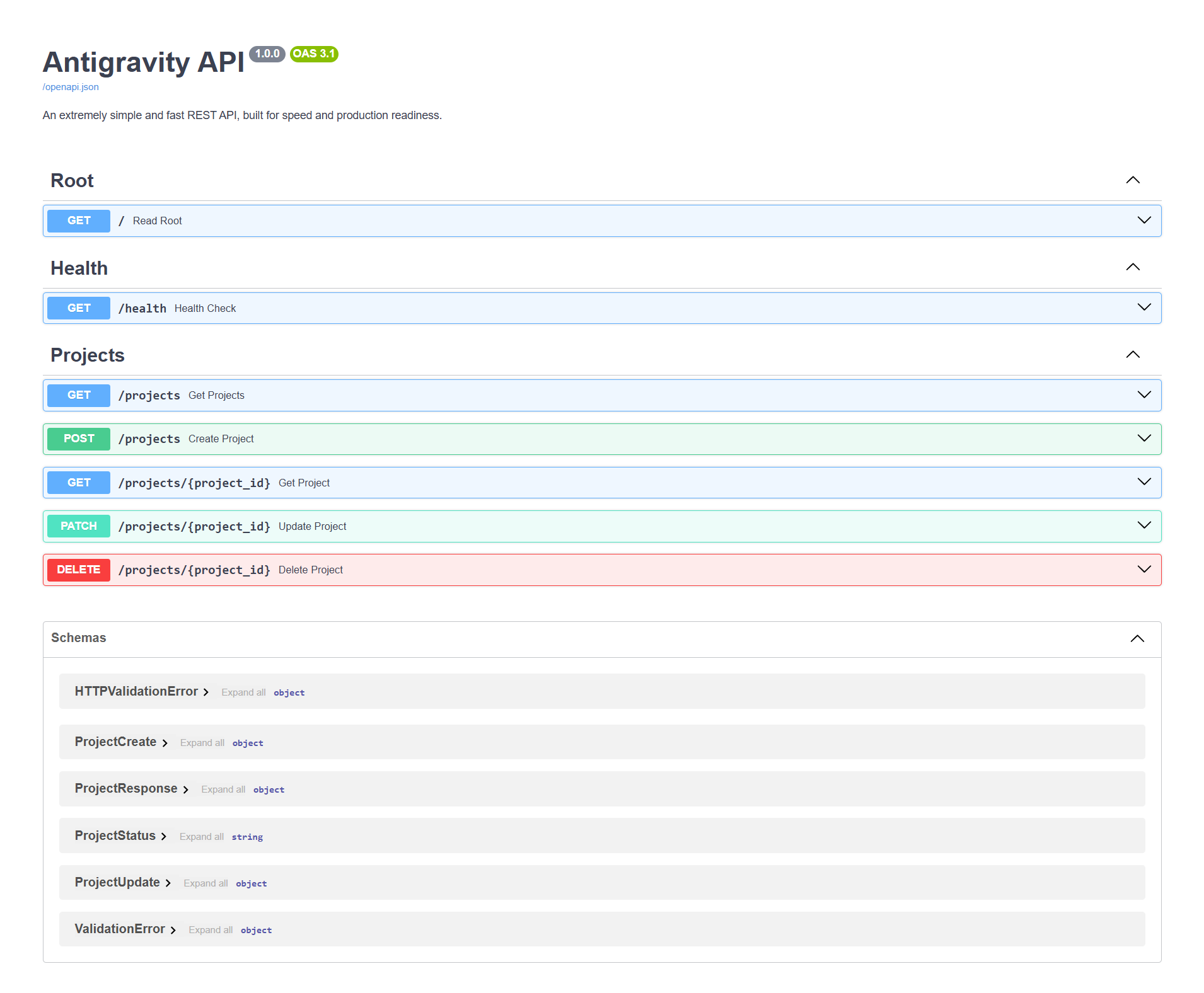
Inspiration The "antigravity" concept in Python—where complex tasks become weightless. I wanted to build a REST API that strips away the boilerplate and focuses on what matters: clean code, instant documentation, and one-click deployment. I was inspired to create a project that serves as a high-performance blueprint for modern backend development.
What it does This is a production-ready RESTful API designed for high concurrency and developer ergonomics. It provides a robust interface for managing resources (CRUD operations), featuring:
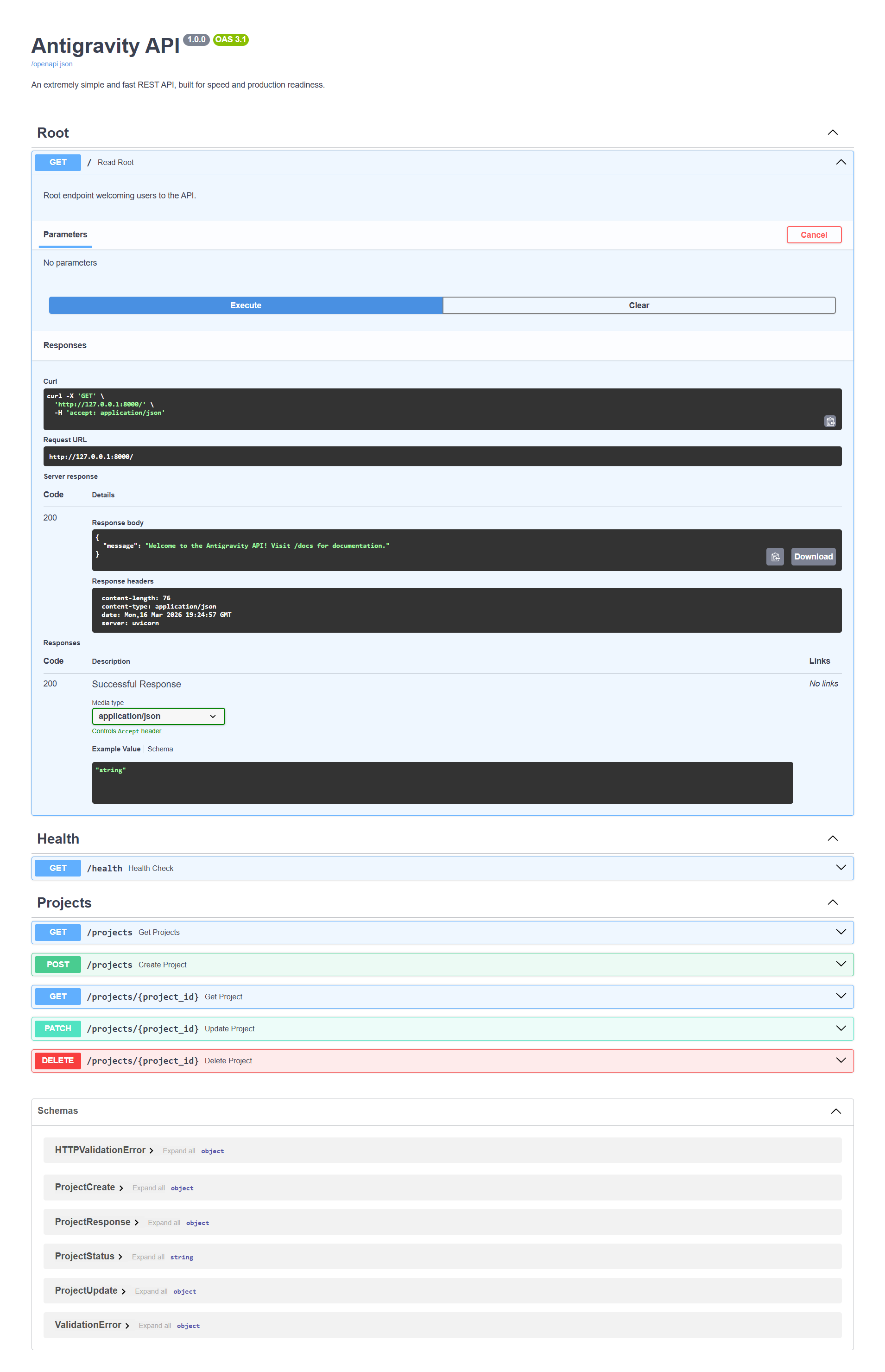
Automatic Interactive Docs: A live Swagger UI for instant testing.
Data Validation: Strict schema enforcement using Pydantic to ensure zero "bad data" entries.
Containerization: A pre-configured Docker setup for environment-agnostic execution.
How I built it I chose FastAPI (Python) for its asynchronous capabilities and speed. The architecture follows a clean separation of concerns:
Logic: Asynchronous Python functions for non-blocking I/O.
Infrastructure: Defined via a multi-stage Dockerfile to keep production images slim.
CI/CD: Integrated with GitHub and Render for an automated "push-to-deploy" workflow.
Challenges I ran into The biggest hurdle was fine-tuning the Docker image size and environment variables to ensure the API remained "lightweight" enough for free-tier cloud hosting without sacrificing performance. I also focused on resolving CORS (Cross-Origin Resource Sharing) issues to ensure the API could be easily consumed by various frontend frameworks.
Accomplishments that I'm proud of I am particularly proud of the 100% automated documentation setup. Seeing a fully interactive UI (Swagger) generate itself from just a few lines of Python type-hints felt like true "antigravity." I also achieved a seamless deployment pipeline where a simple git push updates the live API in minutes.
What I learned This project deepened my understanding of ASGI (Asynchronous Server Gateway Interface) and the nuances of Uvicorn. I learned how to leverage Python's type-hinting system not just for readability, but as a functional tool for data serialization and validation within a web framework.
What's next for REST API The next phase is adding JWT (JSON Web Token) authentication to secure the endpoints. I also plan to integrate a PostgreSQL database using SQLAlchemy or Tortoise ORM to transform this from a stateless blueprint into a fully persistent data-driven platform.

Log in or sign up for Devpost to join the conversation.