
AIResQTransfer — AI-Powered Emergency Patient Transfer System 💡 Inspiration
Our inspiration comes from a stark reality of urban life in cities like Hyderabad — the golden hour. We've all seen an ambulance, siren blaring, stuck in the gridlock of evening traffic. In those critical moments, a life hangs in the balance, and the biggest enemy is time.
Every minute lost to traffic, hospital unavailability, or delayed ER handover is a minute that can’t be recovered.
We were driven by the frustration of knowing that while medical expertise exists, the logistical chain connecting the patient to that expertise is often fragmented. The paramedic, the driver, and the ER doctor — all heroes — work in silos.
We asked ourselves: What if AI could orchestrate the entire emergency response in real-time — not just find the fastest route, but coordinate the right hospital, the right care, and the right moment?
🚑 What It Does
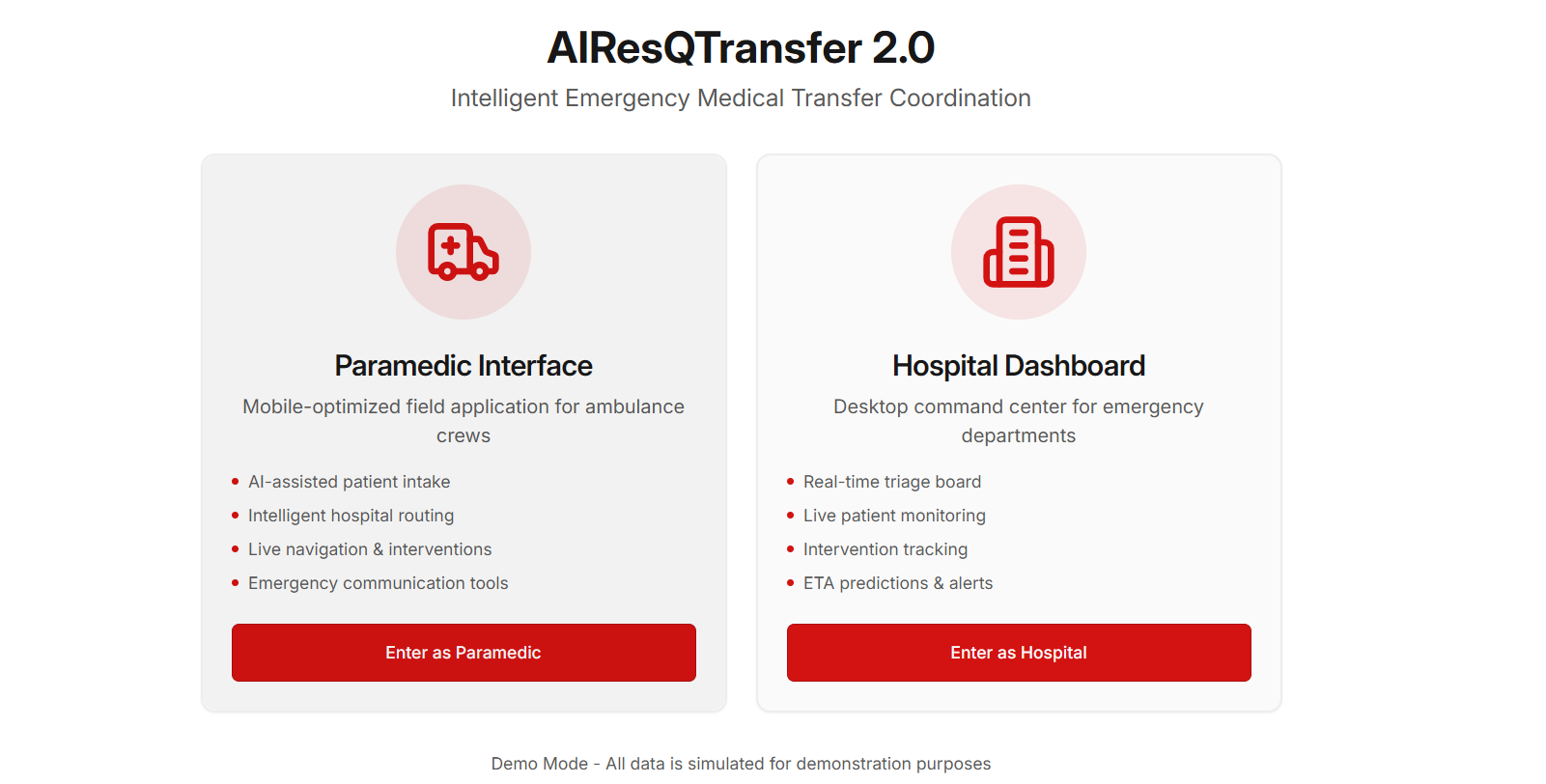
AIResQTransfer is an intelligent, AI-powered emergency logistics platform that acts as:
a co-pilot for ambulance crews
a pre-arrival command center for hospitals
It ensures every patient reaches the optimal hospital in the shortest possible time.
⚙️ Core Features 🧠 AI-Assisted Triage
Paramedics can use the AI Listening Mode to capture patient details through natural conversation.
The AI automatically transcribes, extracts, and categorizes key information.
For noisy environments, a manual high-contrast UI and OCR ID scanner are available.
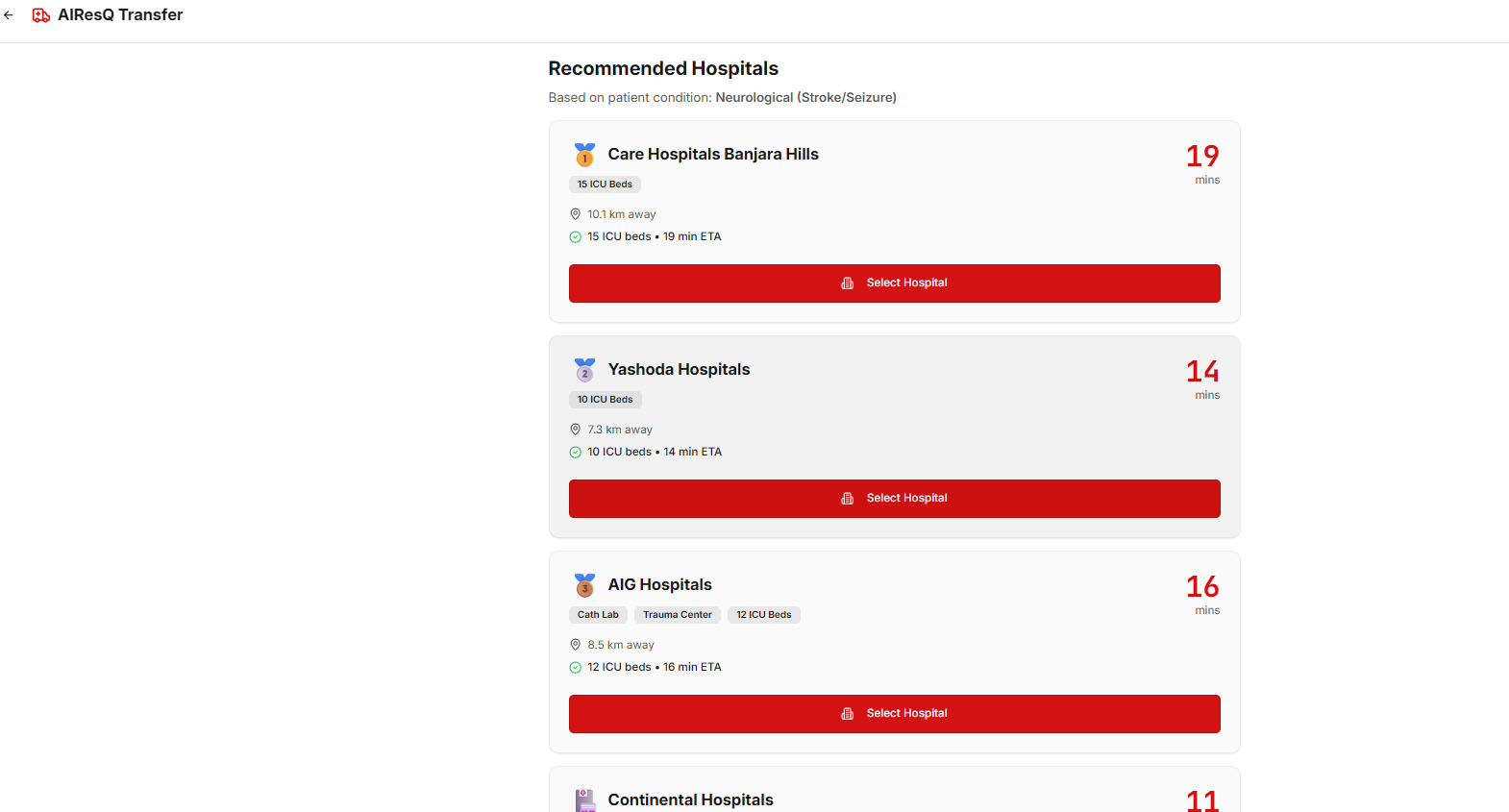
🏥 Predictive Routing & Hospital Recommendation
Goes beyond the nearest hospital.
AI analyzes:
Patient condition
Live traffic
Real-time hospital resource availability (ICU beds, cath labs, specialists)
Recommends the best facility for definitive care, not just the closest one.
📊 Live Coordination Dashboard
Once a hospital is chosen:
The ER dashboard activates instantly.
Staff can view:
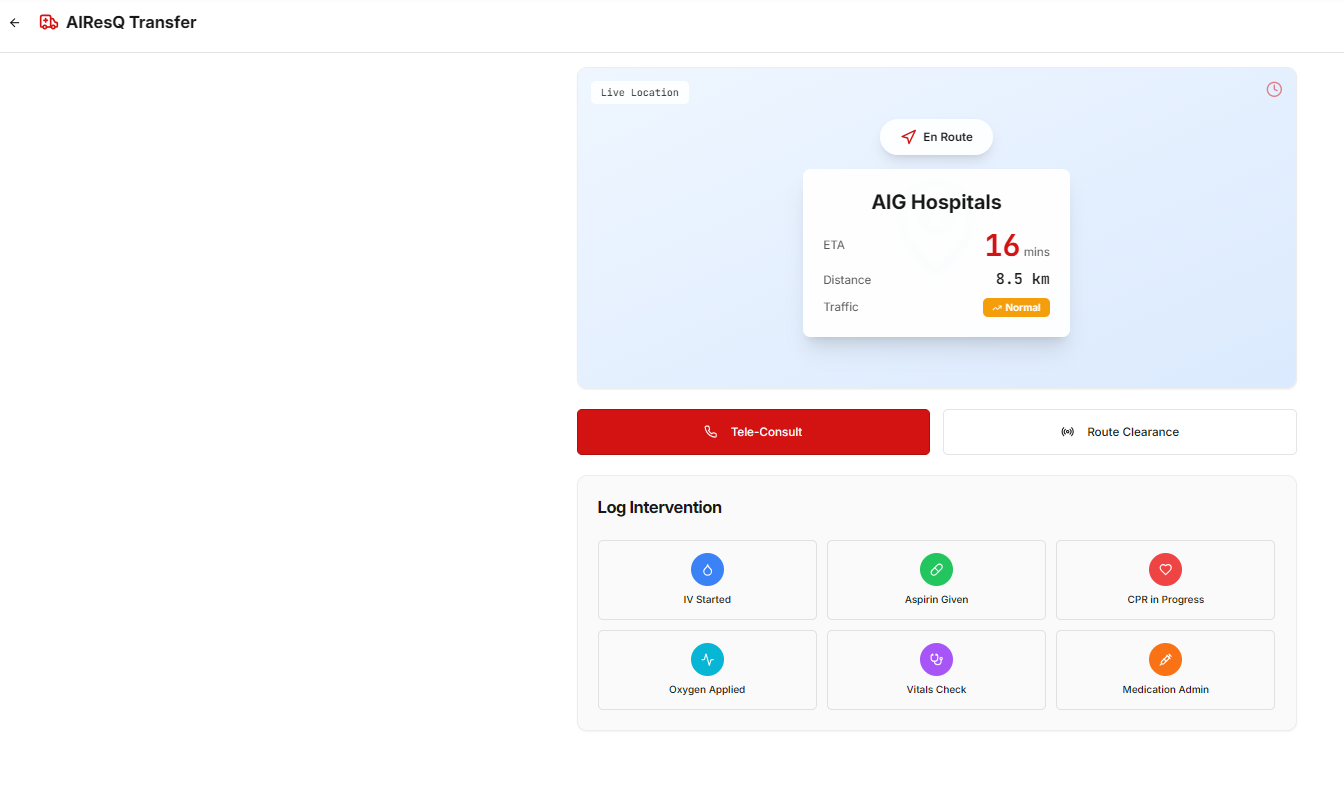
🚑 Ambulance live location and ETA
💓 Patient vitals stream in real-time
📝 Intervention logs (e.g., “Aspirin Given”, “IV Started”)
This closes the communication gap between the ambulance and hospital, transforming chaos into coordination.
🏗️ How We Built It
We built AIResQTransfer using a modern, real-time tech stack optimized for emergency response.
Component Technology Frontend React.js (Progressive Web App) Backend FastAPI (Python, async architecture) Database Firebase Realtime Database AI & ML GPT-4o, Scikit-learn APIs Google Maps, Twilio, WebRTC Vision Google Cloud Vision API Hosting Vercel / Render 🧩 Highlights
Frontend: Built with React.js for responsive mobile-first design.
Backend: FastAPI provides high-speed async processing for multiple data streams.
Database: Firebase enables live GPS and vitals sync with near-zero latency.
AI Models:
GPT-4o → Conversational AI for triage
Scikit-learn → Hospital resource forecasting
Google Cloud Vision → Instant ID OCR
⚠️ Challenges We Ran Into
Balancing AI with real-world chaos: Initially, the voice interface failed in noisy environments.
Solution: Developed a dual-mode interface (Voice + Manual + OCR) for flexibility.
Handling multiple async data streams: Managing GPS, vitals, and routing APIs created latency.
Solution: Used FastAPI’s async/await for real-time performance.
🏆 Accomplishments We're Proud Of
Created an AI that explains its recommendations:
“Optimal Cath Lab Availability — +3 min longer route, but faster care.”
Built a real-time hospital dashboard that syncs live ambulance vitals and logs.
Achieved seamless coordination between field and hospital teams — a true “connected emergency ecosystem.”
📚 What We Learned
In emergency tech, the best innovation is invisible. The goal is not to add screens but to reduce cognitive load for first responders.
We learned to design for humans, not just for data.
Created one-touch workflows to minimize stress in critical moments.
Realized that the best AI helps people act faster, not think harder.
“Technology should fade into the background and let the heroes take the lead.”
🚀 What’s Next for AIResQTransfer
We envision AIResQTransfer evolving into a city-wide emergency response nervous system.
🔮 Next Steps
Smart City Integration: Automatically turn traffic lights green for approaching ambulances.
Wearable Alerts: Integrate Apple Watch / Fitbit to auto-trigger emergency alerts for cardiac or fall events.
Disaster Management Mode: Coordinate multiple ambulances and hospitals during mass-casualty incidents.
🧮 Example LaTeX Math Usage
We even integrated predictive analytics, such as estimating response efficiency:
Inline: The estimated time saved is ( T = \frac{D}{S_{AI}} - \frac{D}{S_{manual}} )
Display:
Efficiency Gain
𝑇 𝑚 𝑎 𝑛 𝑢 𝑎 𝑙 − 𝑇 𝐴 𝐼 𝑇 𝑚 𝑎 𝑛 𝑢 𝑎 𝑙 × 100 % Efficiency Gain= T manual
T manual
−T AI
×100% 🧑💻 Team & Roles Name Role Responsibilities Harsha Reddy Team Lead / AI Engineer System design, AI integration, coordination,Frontend Developer PWA, real-time UI,Backend Developer API & database optimization,Data Analyst Predictive hospital availability model ✅ Task List
Build AI-assisted triage
Create predictive routing engine
Deploy real-time hospital dashboard
Integrate traffic signal control
Launch city-wide pilot program
💬 Tagline
“AIResQTransfer — Because every second matters when life is on the line.” ❤️
🎉 Emoji Summary
🚑 + 🤖 + 🏥 = 💓 Saving Lives Smarter
Built With
- apis
- database
- fastapi
- firebase
- javascript
- openai
- platform
- python
- react.js
- replit
- scikit-learn
- twilio

Log in or sign up for Devpost to join the conversation.