-
-
-
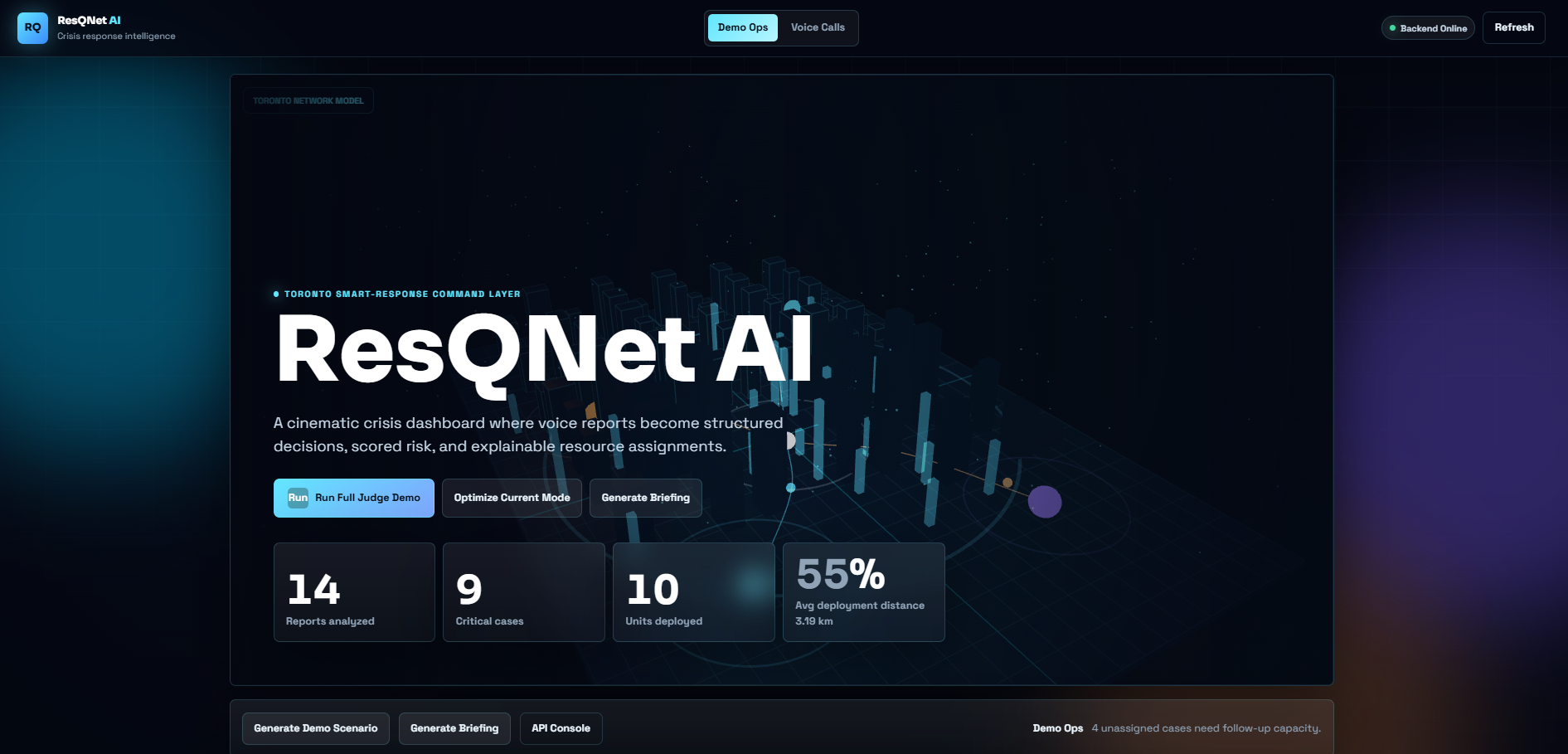
Main
-
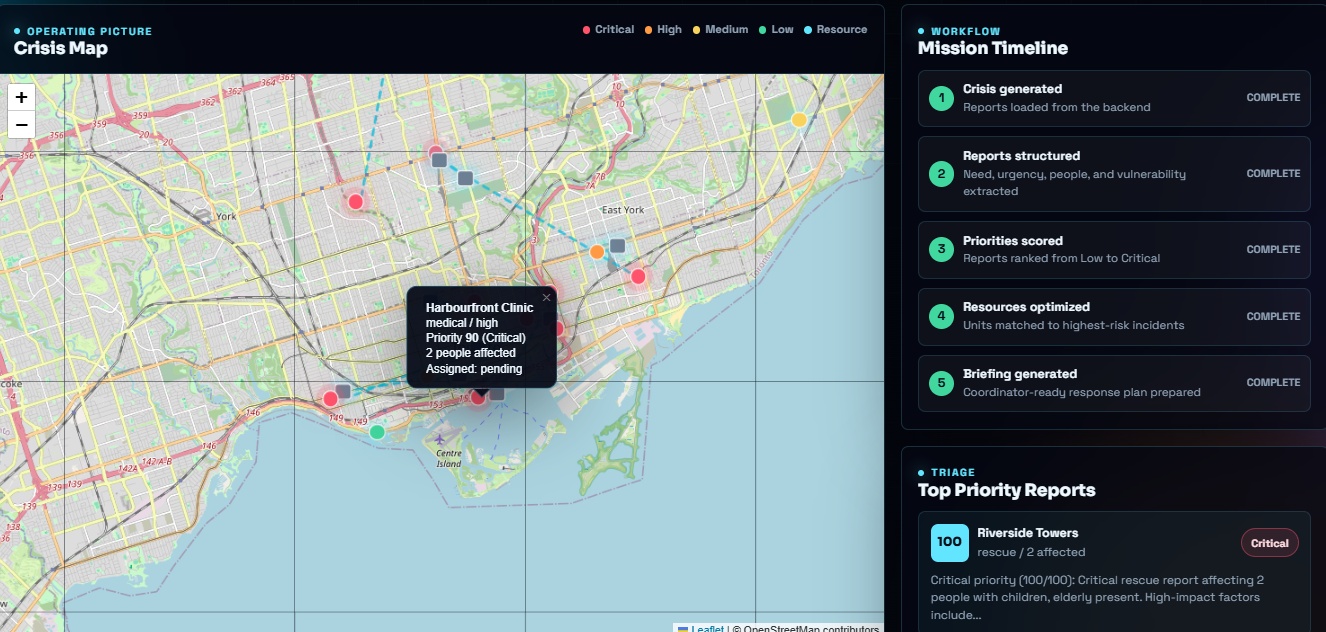
Map
-
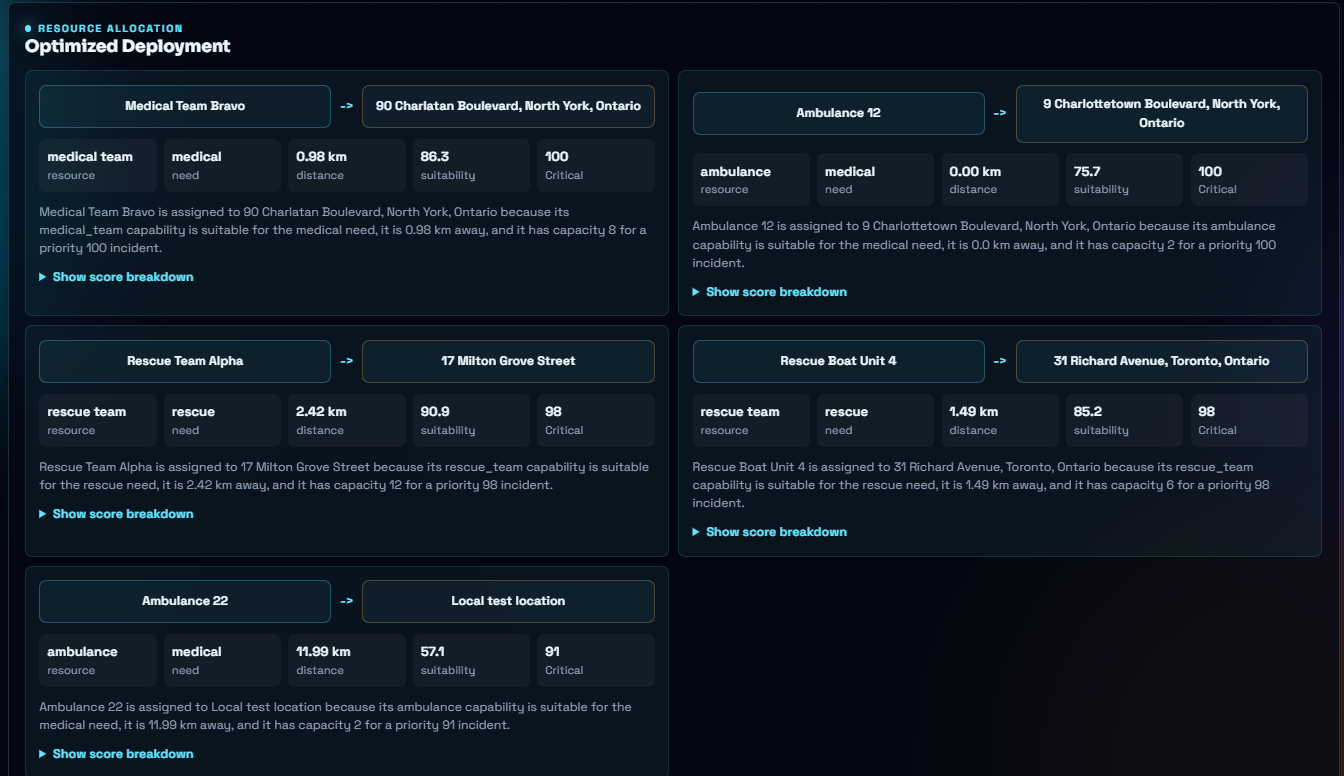
Optimized Deployment
-
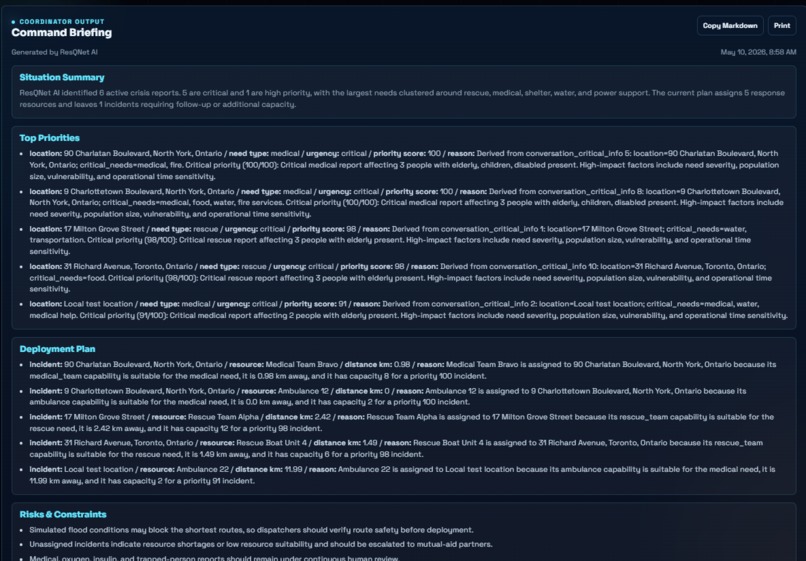
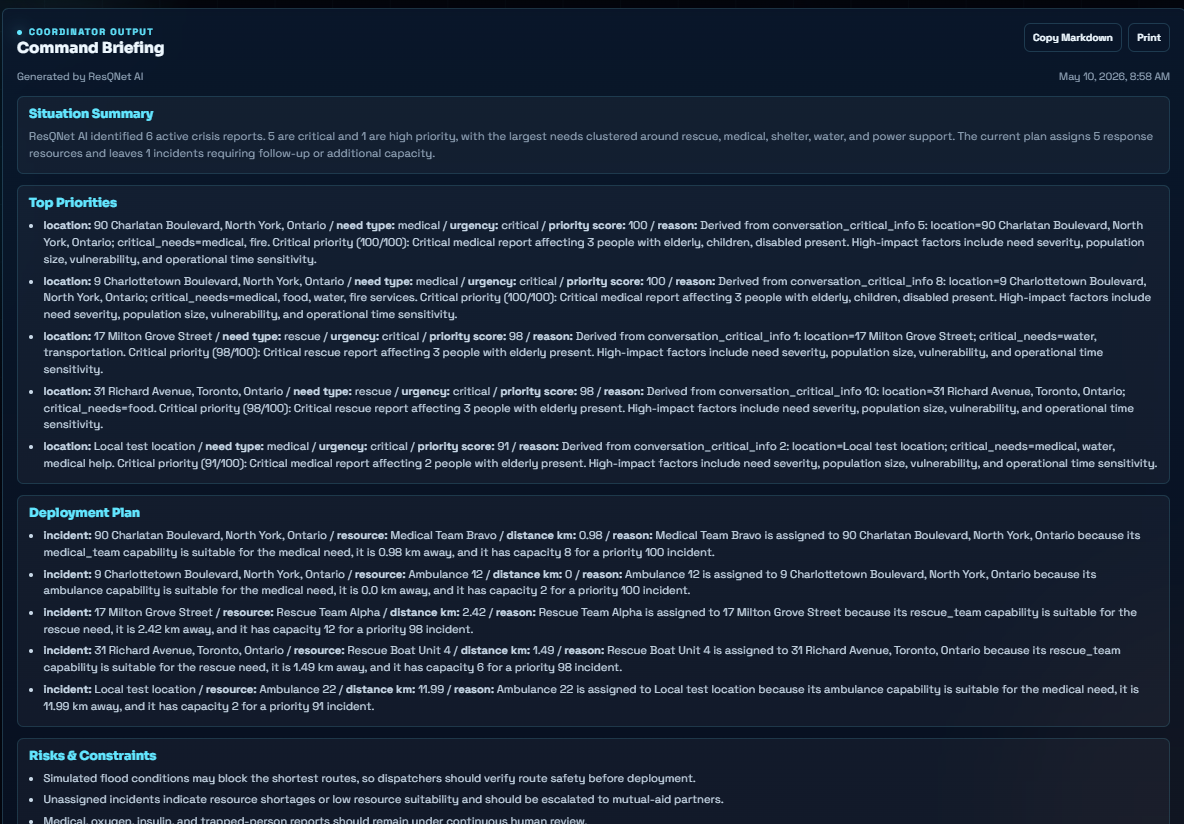
Command Briefing
-
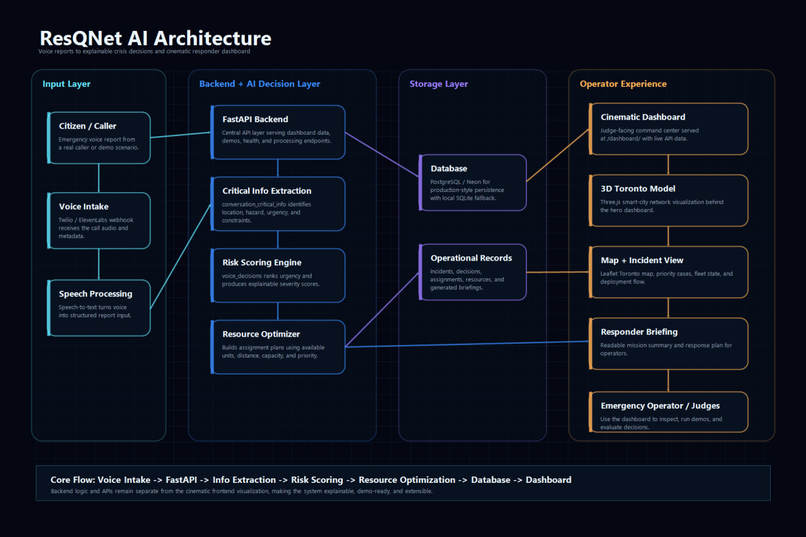
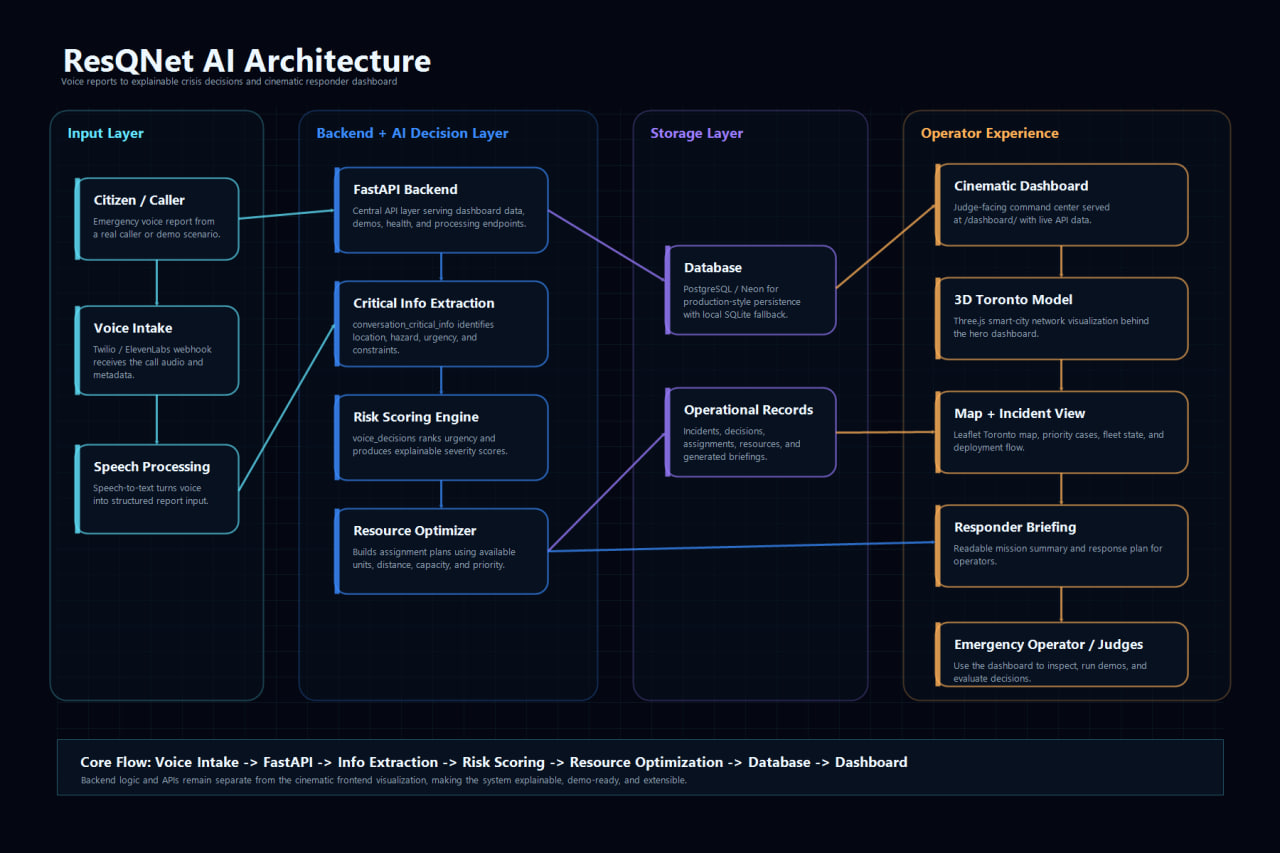
Architecture diagram
-
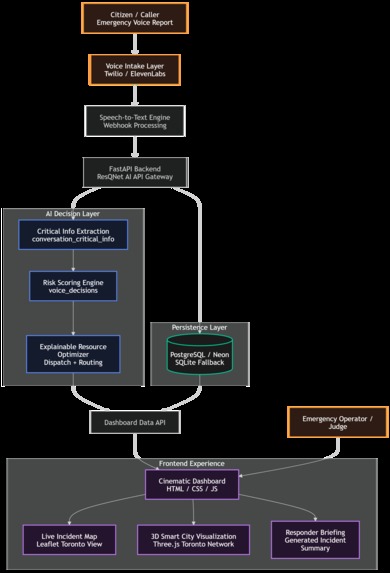
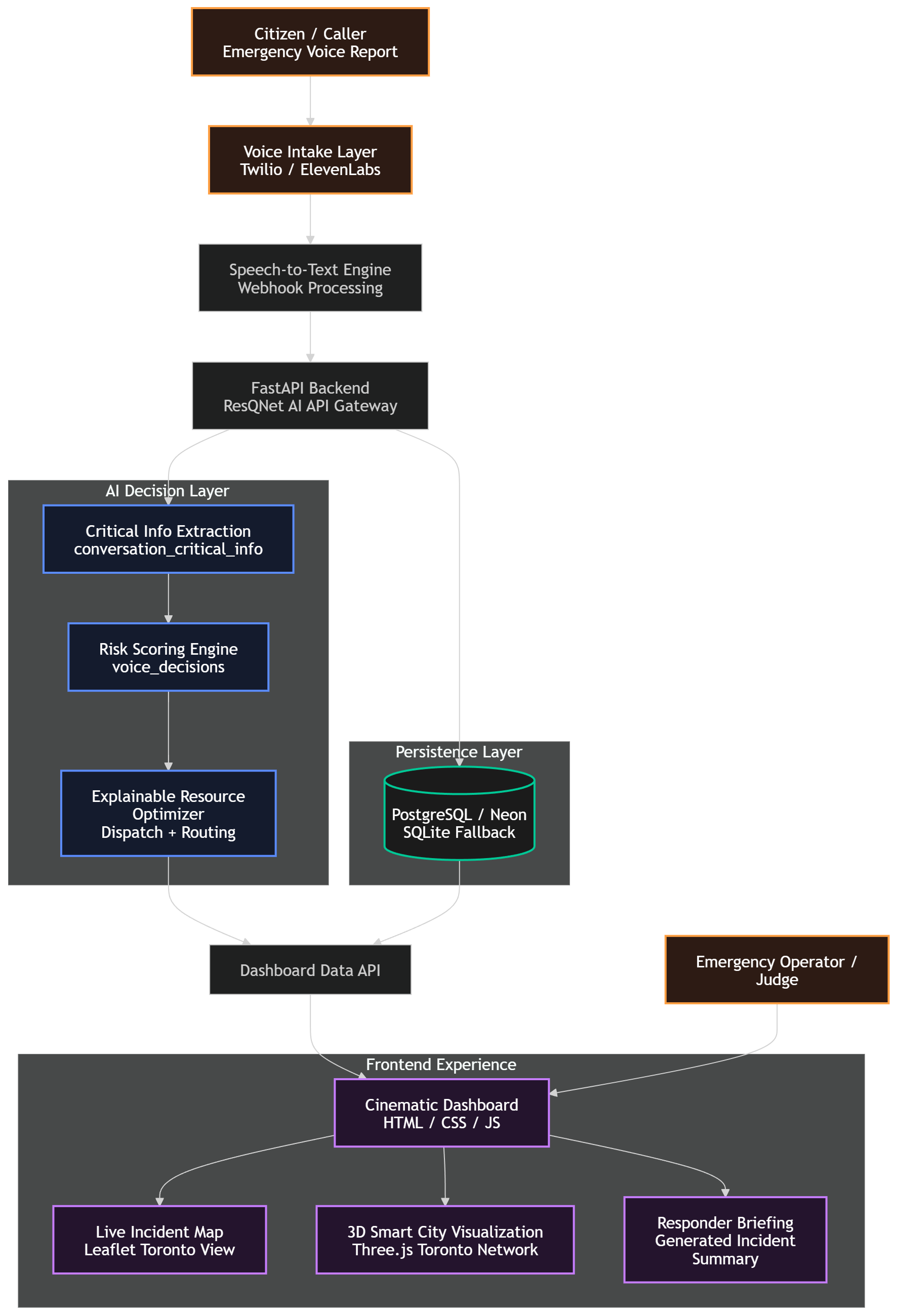
Architecture diagram 2
Inspiration
In a crisis, responders do not fail because they lack data. They fail because the data is scattered, incomplete, duplicated, and arriving faster than teams can process it.
Emergency reports can come from citizens, field teams, shelters, clinics, volunteers, agencies, and sensors. Some reports are urgent. Some are vague. Some are duplicated. Some arrive too late.
The real challenge is not just knowing what happened.
The real challenge is deciding what to do first when people are at risk and resources are limited.
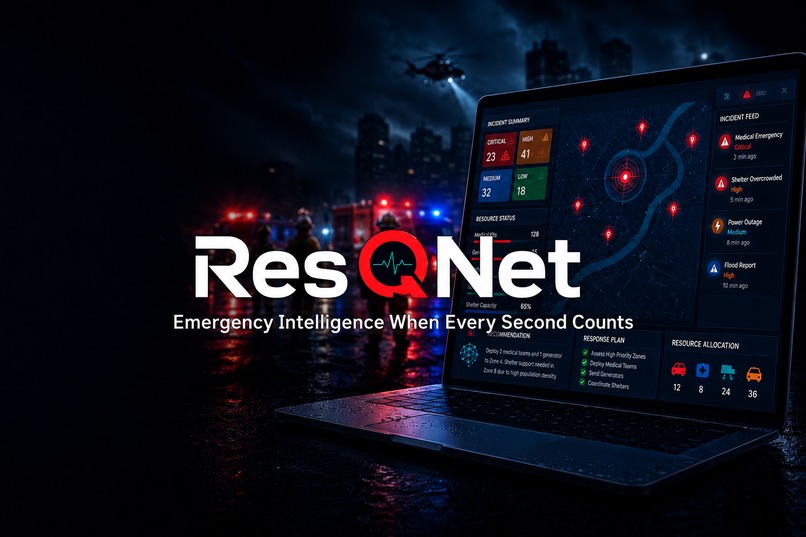
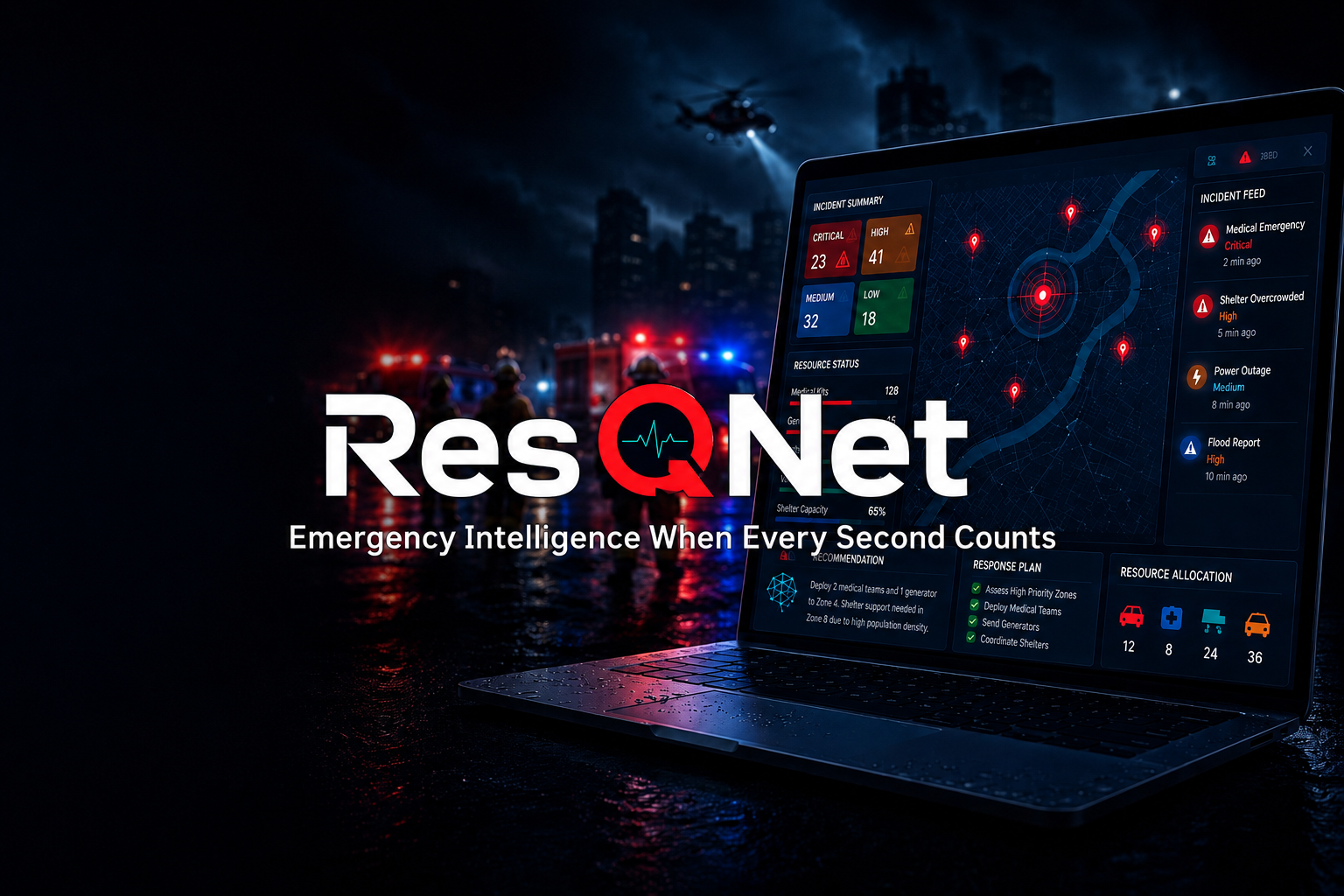
That is why we built ResQNet AI: an AI-powered emergency coordination platform that turns chaotic crisis reports into prioritized, explainable response actions.
What It Does
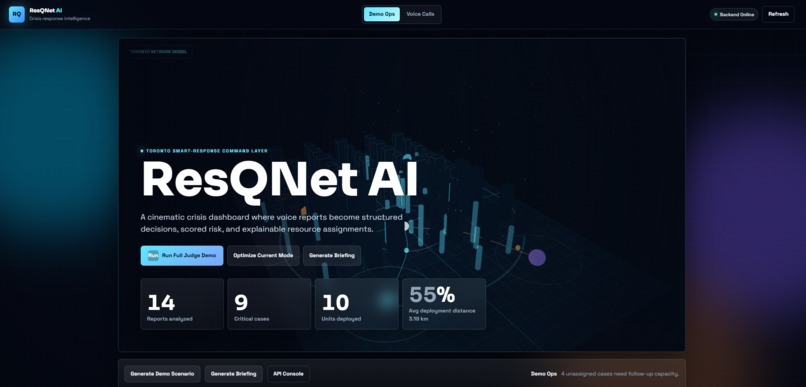
ResQNet AI is an emergency response command center for any crisis scenario: medical emergencies, shelter overload, power outages, evacuations, infrastructure failures, floods, wildfires, and multi-incident disasters.
The platform helps responders:
- Classify incoming emergency reports
- Detect urgency and vulnerability indicators
- Estimate how many people are affected
- Score and prioritize incidents
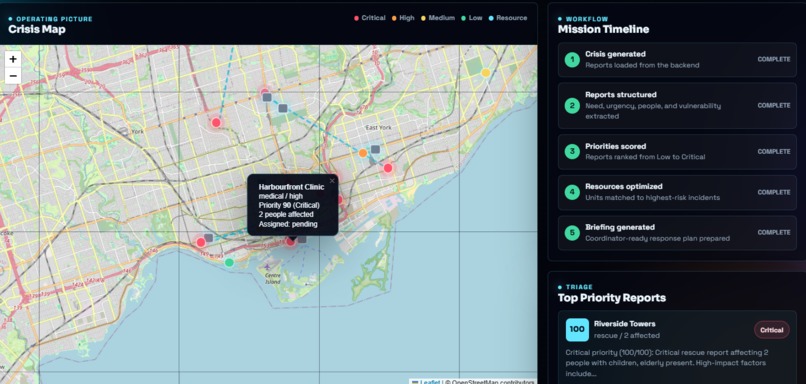
- Visualize affected zones on an interactive crisis map
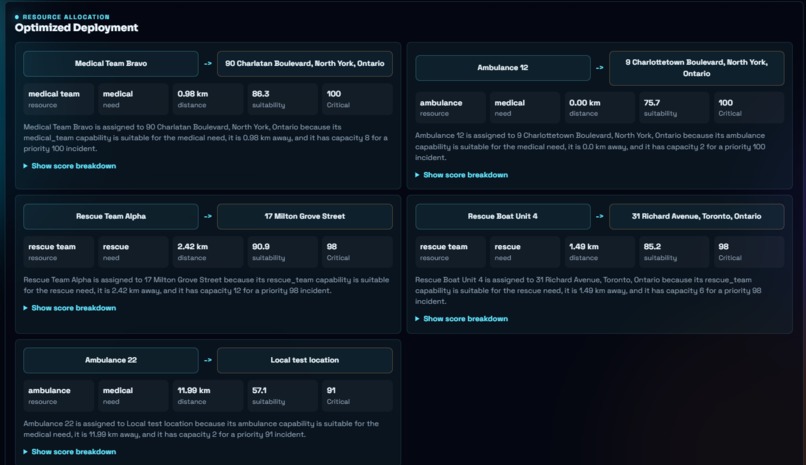
- Match limited resources to high-priority needs
- Generate explainable response plans
- Produce coordinator-ready command briefings
Example resources include:
- Medical kits
- Food and water supplies
- Generators
- Ambulances
- Shelter capacity
- Volunteers
- Transportation support
Instead of only showing responders what happened, ResQNet AI helps them decide what to do next.
Example recommendation:
Send medical support and a generator to Shelter B because the report mentions vulnerable patients, power loss, and urgent medical needs.
How We Built It
We built ResQNet AI as a full-stack emergency intelligence platform focused on speed, reliability, and explainability.
Frontend
- React
- TypeScript
- Tailwind CSS
- Framer Motion
- Recharts
- Leaflet.js
The frontend acts as an emergency operations dashboard with:
- Real-time crisis reports
- Interactive maps
- Resource monitoring
- Incident prioritization
- Optimization results
- Emergency response plans
Backend
- FastAPI
- Python
- REST APIs
- SQLite with PostgreSQL-compatible structure
The backend handles:
- Emergency report intake
- Crisis simulation
- Report processing
- Resource management
- Priority scoring
- Resource matching
- Response plan generation
- Dashboard API workflows
AI and Decision Layer
The AI layer extracts key details from incoming emergency reports, including:
- Need type
- Urgency level
- People affected
- Vulnerability indicators
- Recommended resources
- Human-readable summaries
We designed the system so the most important decisions remain explainable. ResQNet AI does not blindly allow a generative model to decide who gets help first.
Instead, it uses structured triage logic, scoring rules, and resource optimization to support human responders.
Generative AI is used where it is strongest: turning structured outputs into clear command briefings that coordinators can actually use.
Best Use of IBM Tech
For the IBM technology track, we integrated an IBM watsonx.ai-style command briefing layer.
The system first uses deterministic emergency logic to classify incidents, calculate priority scores, identify vulnerable groups, and recommend resource allocation.
Then IBM watsonx.ai can transform those structured results into an operational briefing for emergency coordinators.
This matters because emergency teams do not only need raw predictions. They need clear communication.
The IBM-powered briefing can summarize:
- Top-priority incidents
- Recommended deployments
- Resource gaps
- Vulnerability risks
- Operational next steps
- Human-readable reasoning
Our approach keeps safety-critical decisions explainable while using IBM AI for command-level communication and decision support.
Optimization Engine
The core technical challenge was resource allocation.
In a crisis, there are never enough resources for every request at the same time. The system needs to decide where support can create the most urgent impact.
ResQNet AI evaluates incidents using factors such as:
- Severity
- Urgency
- Number of people affected
- Vulnerable populations
- Distance
- Resource availability
- Shelter or clinic capacity
- Type of support required
The system attempts to maximize:
People helped + Medical priority + Vulnerability score
while minimizing:
Travel time + Resource waste + Shelter overload
This makes ResQNet AI more than a dashboard. It is a decision-support system for emergency coordination.
Challenges We Faced
The hardest part was balancing fairness, speed, and efficiency.
Optimizing for only one metric can create bad outcomes.
If the system only prioritizes distance, vulnerable communities farther away may be ignored.
If the system only prioritizes the largest incidents, smaller but medically urgent cases may be missed.
If the system only prioritizes speed, resources may be deployed inefficiently.
We also had to make the system explainable. In emergency response, a black-box recommendation is not enough. Responders need to understand why an incident was prioritized and why a resource was assigned.
Other challenges included:
- Designing realistic crisis simulations
- Handling incomplete and duplicated reports
- Creating priority scoring under hackathon time limits
- Matching limited resources to changing needs
- Building fallback logic for demo reliability
- Making complex decision logic understandable through the UI
What We Learned
This project taught us that emergency response is not just a data problem. It is a decision problem.
We learned that:
- AI in high-stakes environments must be explainable
- Resource optimization matters most when supply is limited
- Dashboards are stronger when they recommend actions, not just display information
- Fairness and vulnerability must be part of prioritization logic
- Human responders should stay in control of final decisions
The best use of AI in emergency response is not replacing humans.
It is helping them see clearly, prioritize faster, and coordinate better when every minute matters.
What’s Next
Future versions of ResQNet AI could include:
- SMS and WhatsApp citizen reporting
- Real-time emergency data feeds
- Hospital, shelter, and NGO integrations
- Multi-city crisis simulations
- Advanced optimization models
- IBM Cloud deployment
- Deeper IBM watsonx.ai command briefings
- Live responder mobile workflows
- Multi-agency coordination tools
Our long-term vision is to build a scalable AI-assisted emergency coordination platform for municipalities, NGOs, healthcare systems, shelters, and disaster relief organizations.
Final Thought
Most emergency tools tell responders what happened.
ResQNet AI helps them decide what to do next.
Built With
- ai
- ai-powered-report-classification
- and
- crisis-simulation-systems
- explainable
- fastapi
- framer-motion
- granite
- ibm-cloud
- ibm-watsonx.ai
- leaflet.js
- linuxone
- optimization-algorithms
- or-tools
- postgresql
- python
- qaoa
- qiskit
- react
- recharts
- rest-apis
- scipy
- sqlite
- tailwind-css
- typescript


Log in or sign up for Devpost to join the conversation.