Inspiration
In 2072 B.S. (2015 A.D.), Nepal was struck by a massive earthquake. I still remember the panic and fear as buildings shook and people ran for safety. But what I remember most clearly was the silence — not just in the air, but across all communication. Mobile networks were down, the internet was inaccessible, and I had no way of knowing if my friends and family were safe. That helplessness — the inability to connect when it mattered the most — stayed with me.
This painful experience planted the seed for ResQNet AI.
Nepal’s geography makes it highly vulnerable to natural disasters. From the towering Himalayas to the mid-hills and flat Terai region, we face frequent earthquakes, landslides, and floods. Yet, in the face of all this, our communication systems remain fragile and centralized.
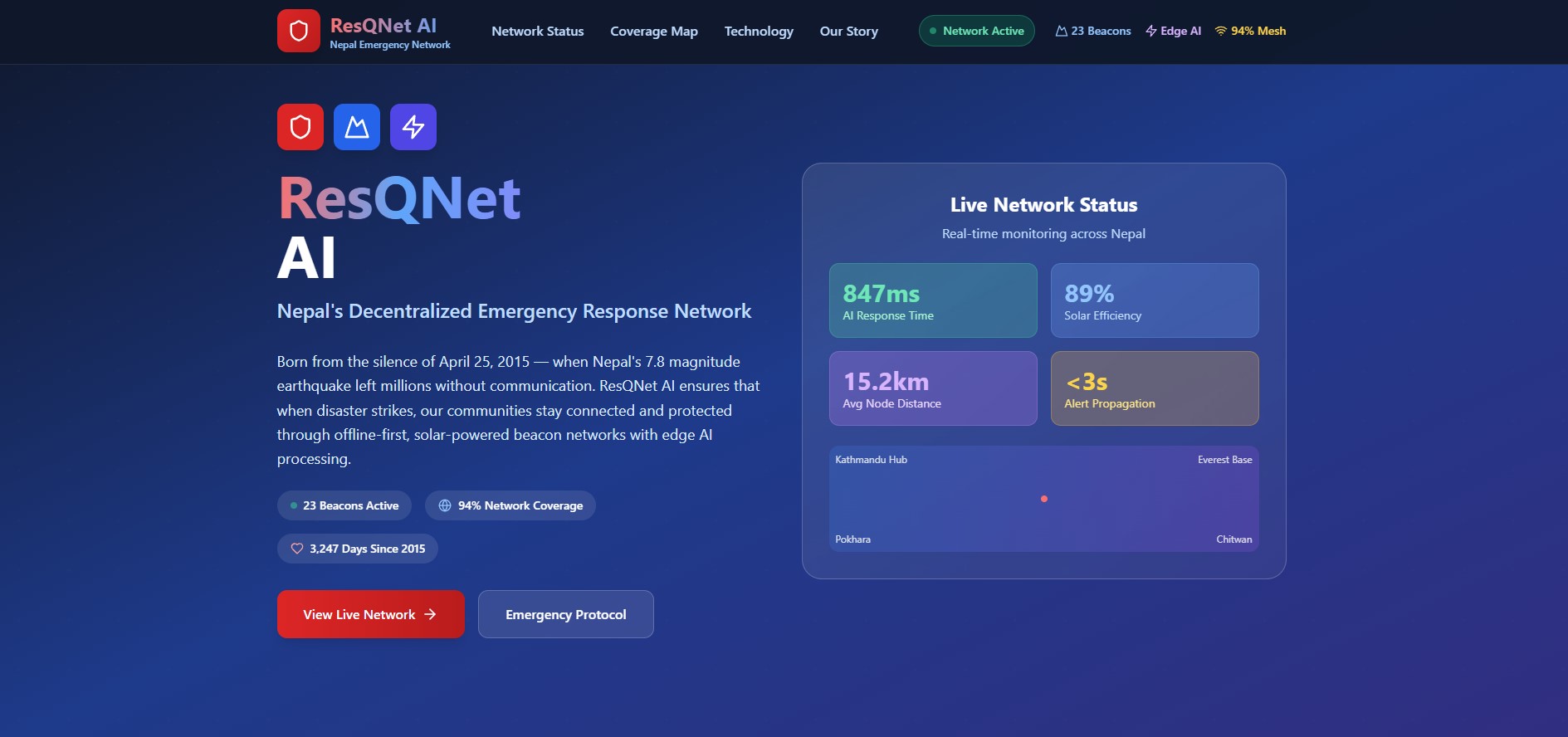
That’s why we set out to build ResQNet AI — a decentralized, solar-powered emergency beacon network that uses Bolt AI to detect disasters and send alerts, even when all other networks are down.
What it does
ResQNet AI is a smart, AI-powered emergency response system designed to work completely offline. It consists of a network of beacon nodes, each equipped with sensors and powered by solar energy.
Each ResQNet node can:
Detect earthquakes, floods, explosions, and abnormal vibrations using edge sensors. Process sensor data using Bolt AI locally — no internet or cloud required. Send alerts or relay signals via a decentralized mesh network. Operate independently for days thanks to solar charging and battery backup. Be deployed quickly in rural or high-risk areas. The result is a resilient alert system that continues to function even when traditional infrastructure collapses.
How we built it
We started with the Bolt IoT module, connecting it to a set of environmental and disaster-detection sensors:
Vibration sensor (earthquake detection) Water level sensor (flood detection) Sound sensor (to detect loud impacts or explosions) DHT11 sensor (for humidity and temperature tracking) We trained a lightweight machine learning model to detect anomalies in vibration and sound patterns — simulating earthquake-like and disaster-like conditions. The model runs entirely on the Bolt device using local AI processing.
We added:
A solar panel with a battery to ensure 24/7 power in remote areas A buzzer and LED indicators for immediate local alerts Optional LoRa module (in future roadmap) to create a mesh network across a region We also built a basic dashboard for demo purposes, showing sensor data and alert history in real time.
Challenges we ran into
Offline intelligence: Training and optimizing a model that could work entirely on-device with Bolt's memory constraints was a real challenge. Disaster simulation: We had to carefully simulate earthquake and flood conditions in a safe and controlled way to test the model. Power balance: Solar charging and power-efficient polling had to be tuned precisely to avoid battery drain. Mesh communication testing: Without multiple devices, we simulated some mesh functionality to test theoretical node-to-node interaction.
Accomplishments that we're proud of
Creating a working prototype of an AI-powered emergency beacon that operates completely offline Using Bolt AI for real-time, on-device inference to detect disaster conditions Building a system that could realistically save lives in high-risk disaster zones like rural Nepal Designing a solar-powered and scalable hardware setup that’s easy to deploy in remote areas Combining edge AI, sustainability, and social impact in one cohesive solution
What we learned
How to train and optimize AI models for edge deployment The real-world limitations of centralized infrastructure in disaster zones The importance of decentralization and local intelligence during emergencies That even low-cost hardware, when used creatively, can solve life-saving problems
What's next for ResQNet AI
We’re excited to keep building on this momentum. Our next steps include:
Expanding to a multi-node mesh network using LoRa communication for long-range, low-power alerts Integrating GPS tracking and personal SOS features for individuals in danger Partnering with local disaster response agencies and NGOs in Nepal for field testing Developing a mobile app for responders to receive beacon alerts even without internet Packaging the beacon into a rugged, field-ready enclosure for real deployment We believe that ResQNet AI has the potential to become a core tool in disaster preparedness and response, especially in vulnerable countries like Nepal — and beyond.


Log in or sign up for Devpost to join the conversation.