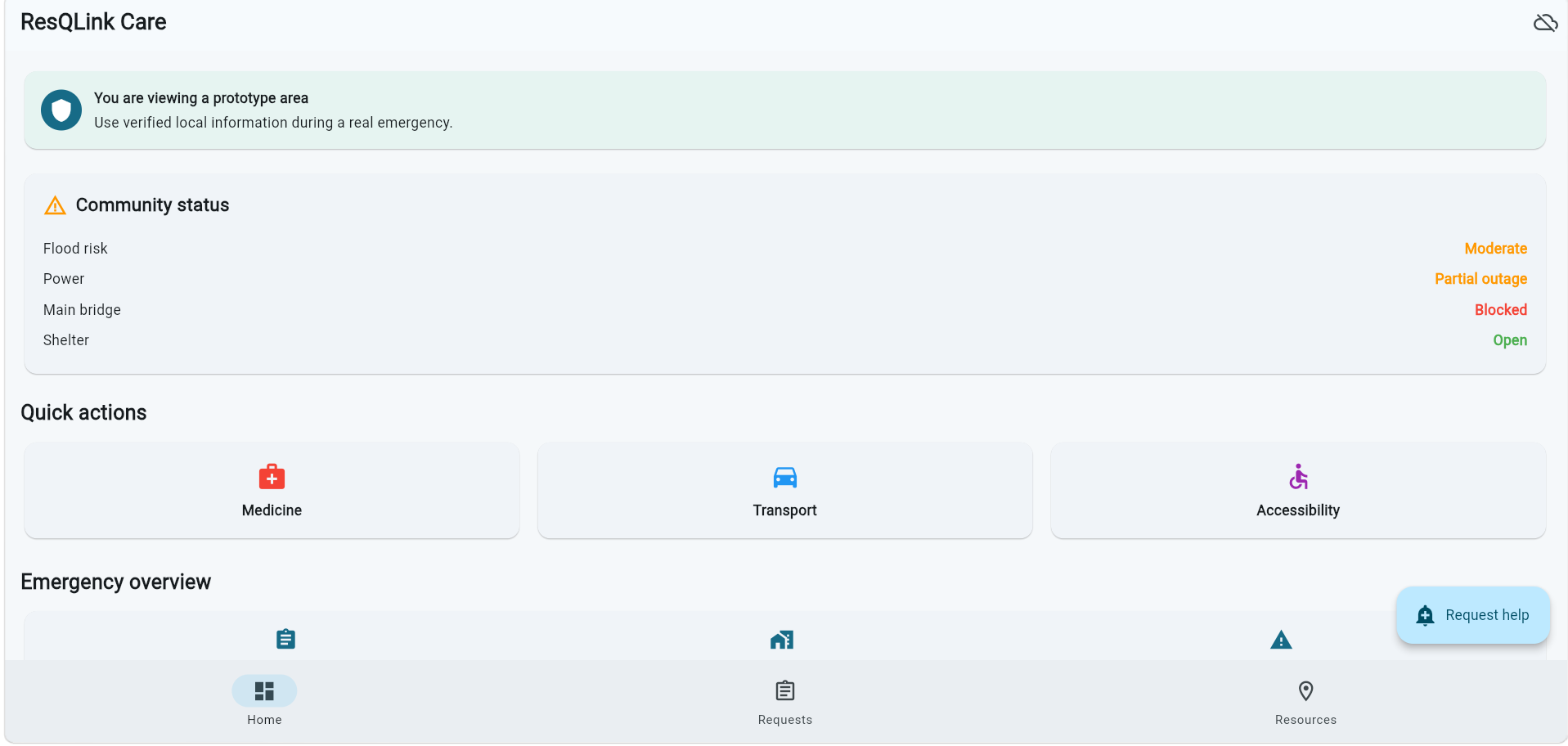
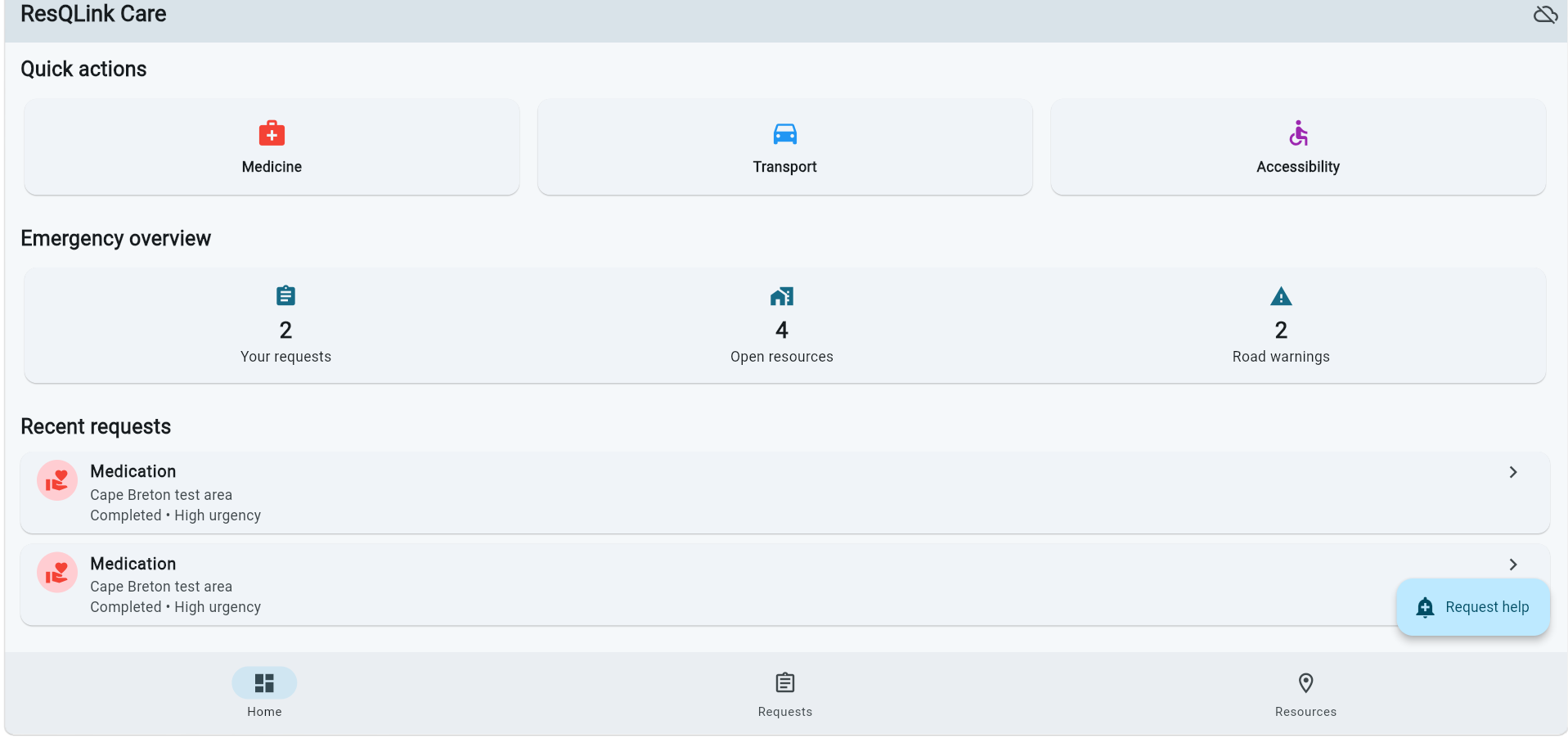
Inspiration Floods, storms, and power outages can interrupt access to essential healthcare. Vulnerable people may be unable to reach a pharmacy, clinic, shelter, or hospital when they urgently need medicine, transport, or accessibility support.
This inspired us to build ResQLink Care, an offline-first platform that connects people with healthcare resources and verified volunteers during emergencies.
What it does ResQLink Care allows users to:
Request medicine, food, transport, shelter, or accessibility support.
Save requests locally when internet access is unavailable.
View emergency resources on a map.
Find pharmacies, shelters, charging points, and blocked roads.
View request details and urgency.
Assign a volunteer to a request.
Mark a request as completed.
For example, an elderly patient who needs insulin can create a high-priority request. A coordinator can view the request, assign a volunteer, and mark it completed after support is provided.
How we built it We built the application using:
Flutter.
Dart.
Material 3.
SharedPreferences for offline storage.
flutter_map for the emergency map.
latlong2 for map coordinates.
OpenStreetMap for map tiles.
UUID for unique request IDs.
Git and GitHub for version control.
The prototype uses demo emergency data for shelters, pharmacies, blocked roads, charging points, volunteers, and help requests.
Challenges we ran into Designing an emergency interface that is simple and easy to understand.
Making help requests available without internet access.
Managing request status changes from Waiting for sync to Assigned and Completed.
Displaying emergency resources clearly on a map.
Avoiding outdated or unverified emergency information.
Fixing Flutter package and analyzer warnings.
Connecting the local project to GitHub for submission.
Accomplishments that we're proud of Built a working Flutter healthcare-support prototype.
Implemented offline request storage.
Created a complete request workflow.
Added an emergency resource map.
Included accessibility requirements in the request form.
Added request priority and status information.
Published the project source code on GitHub.
Created a practical demo flow for disaster healthcare support.
What we learned We learned how to:
Build a cross-platform application with Flutter.
Store and retrieve structured data locally.
Use state management with StatefulWidget and setState.
Create forms and validate user input.
Display maps and location markers.
Handle request status updates.
Use Git and GitHub for version control.
Design technology for users with limited connectivity.
Protect users by treating emergency and healthcare information carefully.
What's next for ResQLink Care Future improvements include:
Supabase backend synchronization.
Official healthcare and emergency-service data.
SMS support for low-connectivity areas.
Real volunteer authentication.
Live pharmacy and clinic availability.
Secure patient profiles.
Multilingual support.
Voice-based assistance.
Real-time flood and water-level sensors.
Integration with hospitals, pharmacies, shelters, and local authorities.
ResQLink Care is currently a prototype using demo data. It does not replace doctors, hospitals, emergency services, or official medical advice.
Built With
- 3.
- and
- dart.
- flutter-map.
- flutter.
- git
- latlong2.
- material
- openstreetmap.
- preferences.
- shared
- uuid.

Log in or sign up for Devpost to join the conversation.