-
-
Resqio title card
-
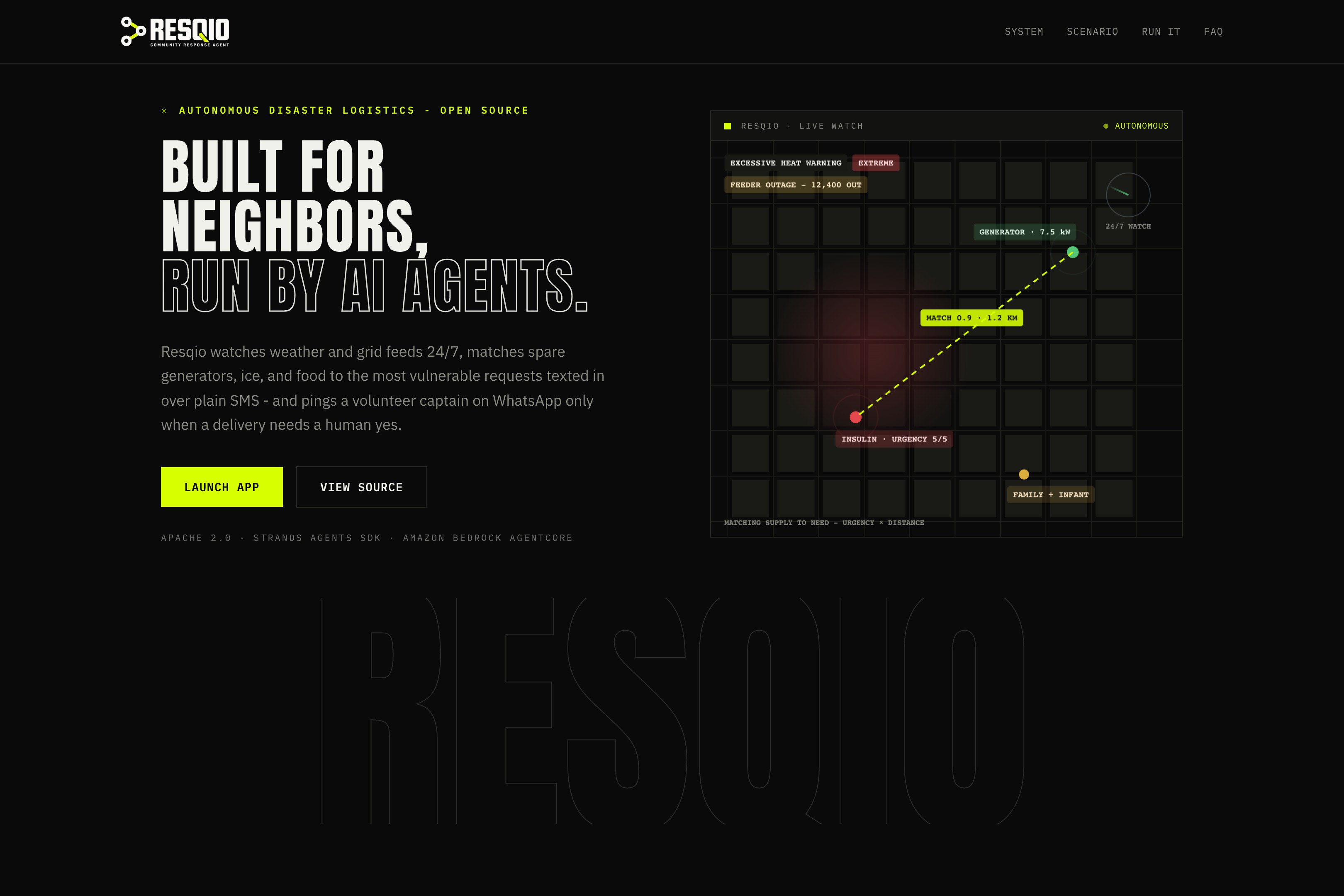
Landing page hero
-
The grid fails when the heat peaks
-
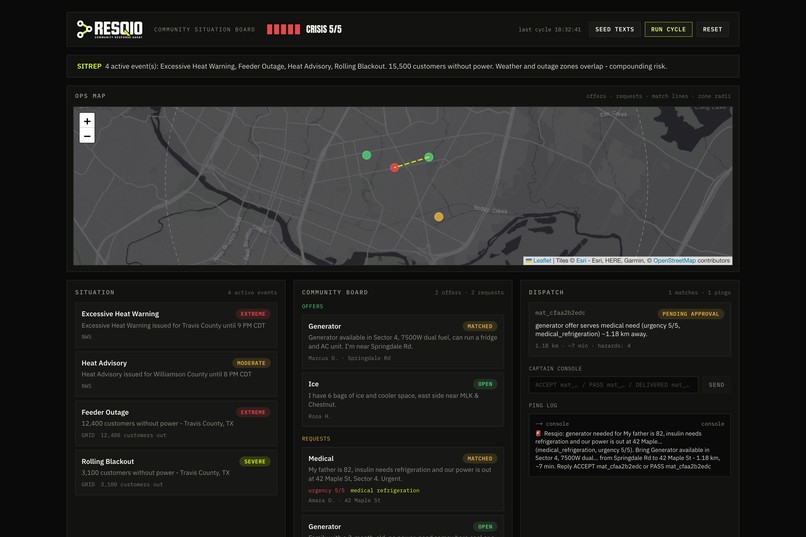
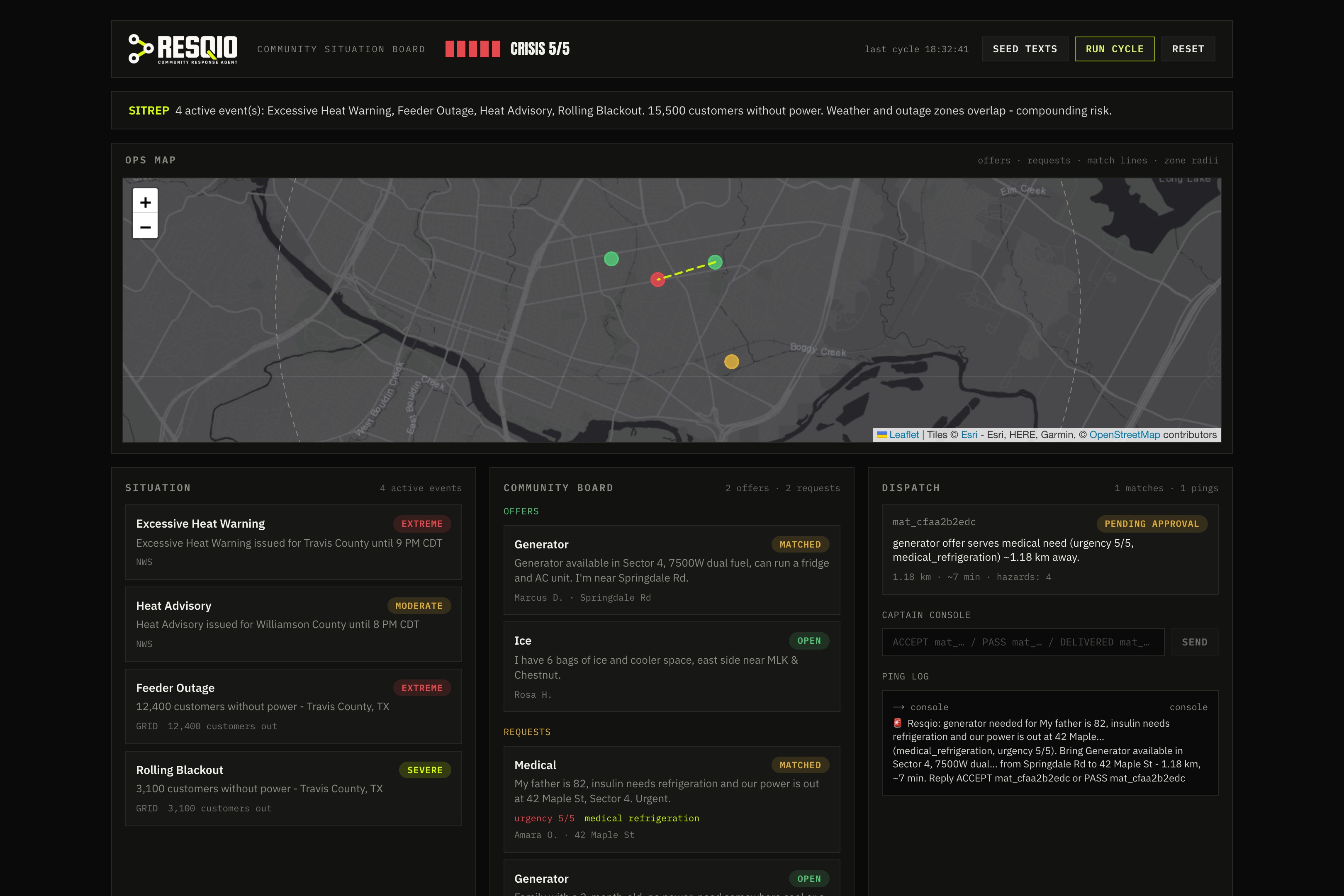
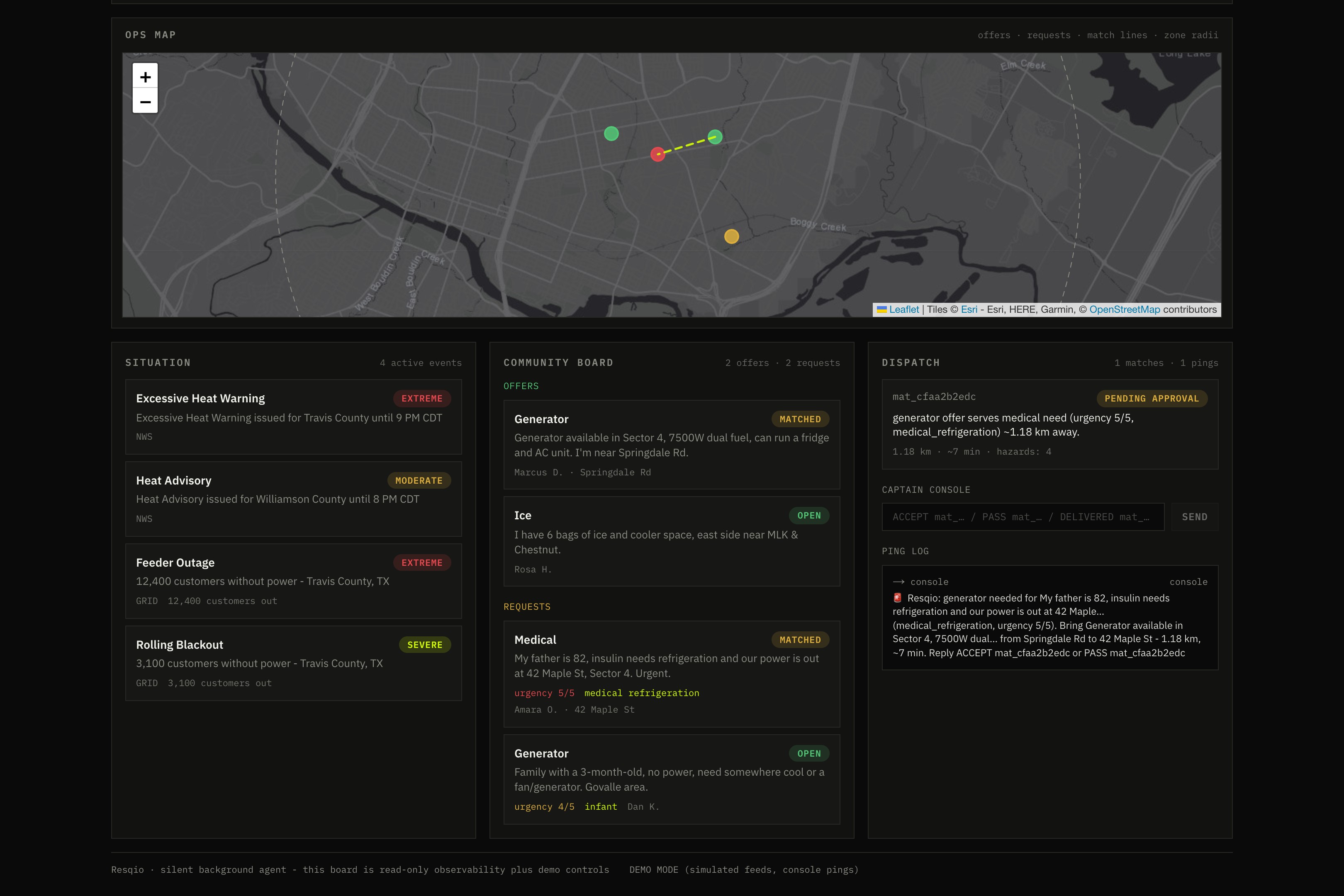
Live board at crisis 5/5 with the generator-to-insulin match on the map
-
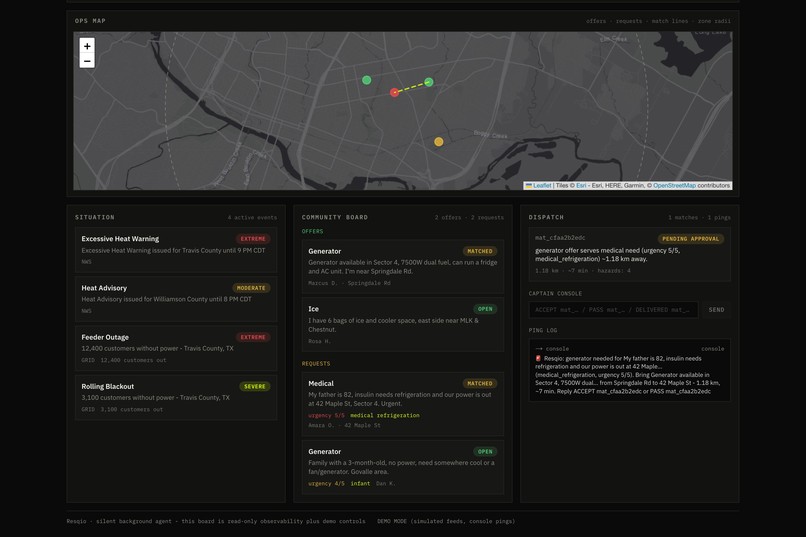
Approval ping for the volunteer captain
-
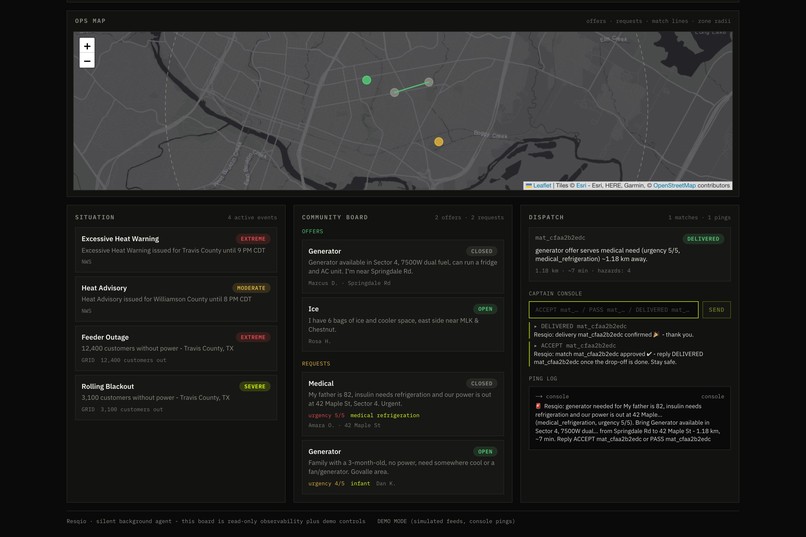
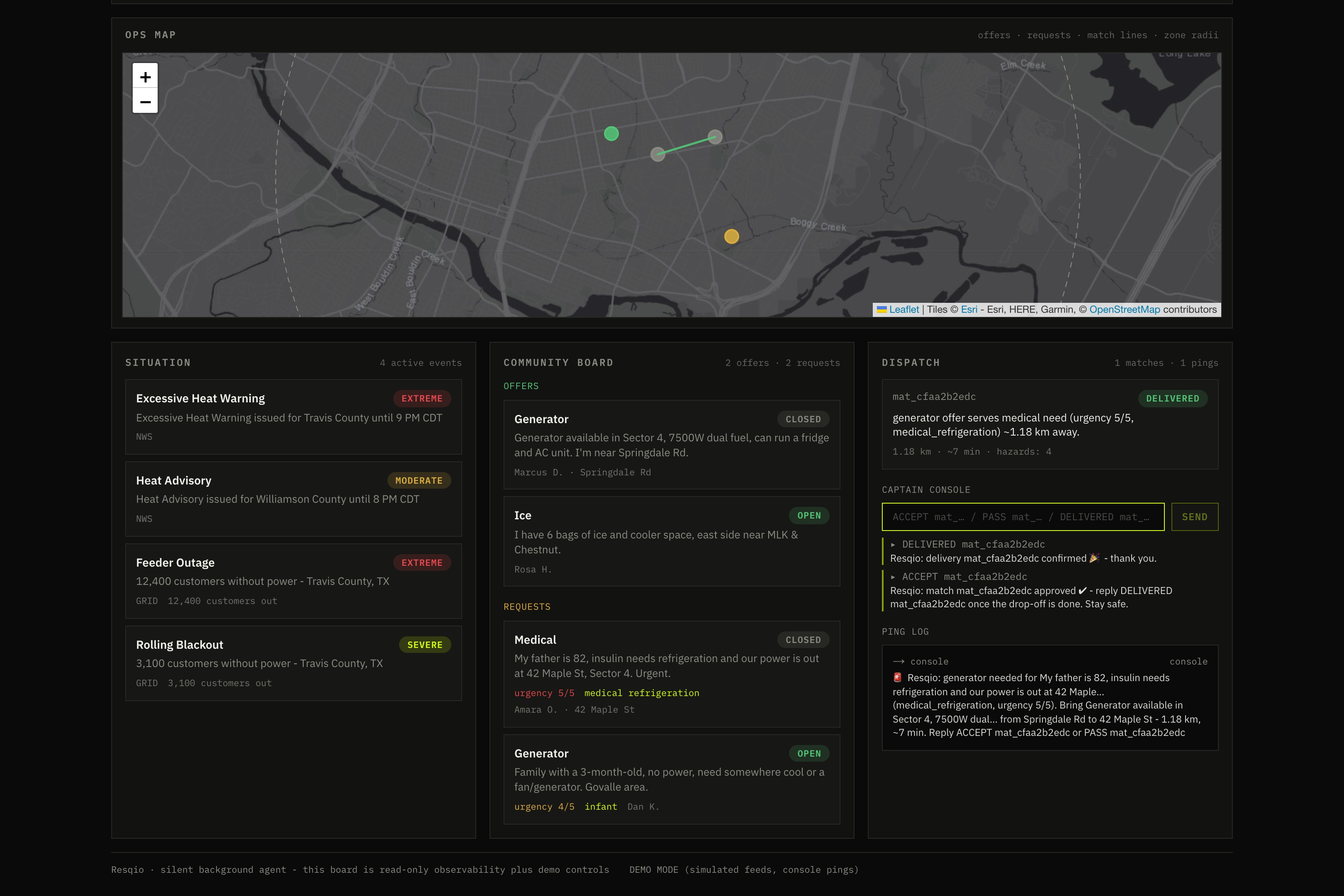
Captain console: ACCEPT, then DELIVERED, loop closed
-
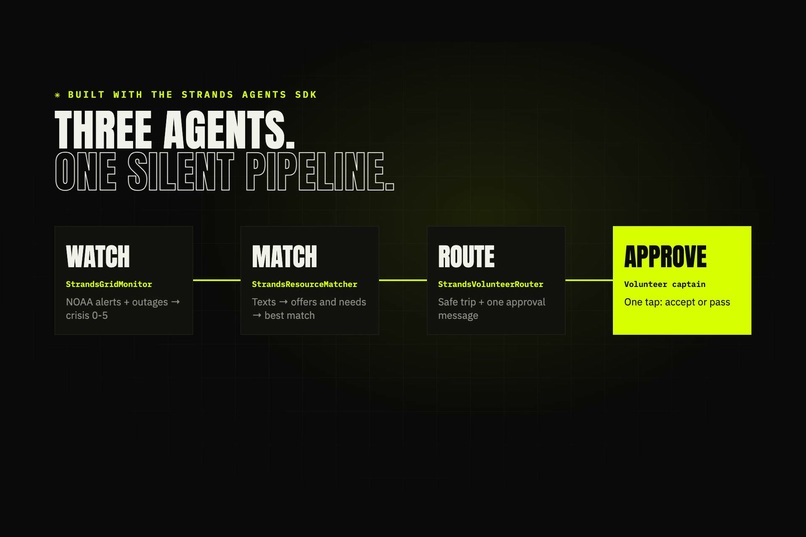
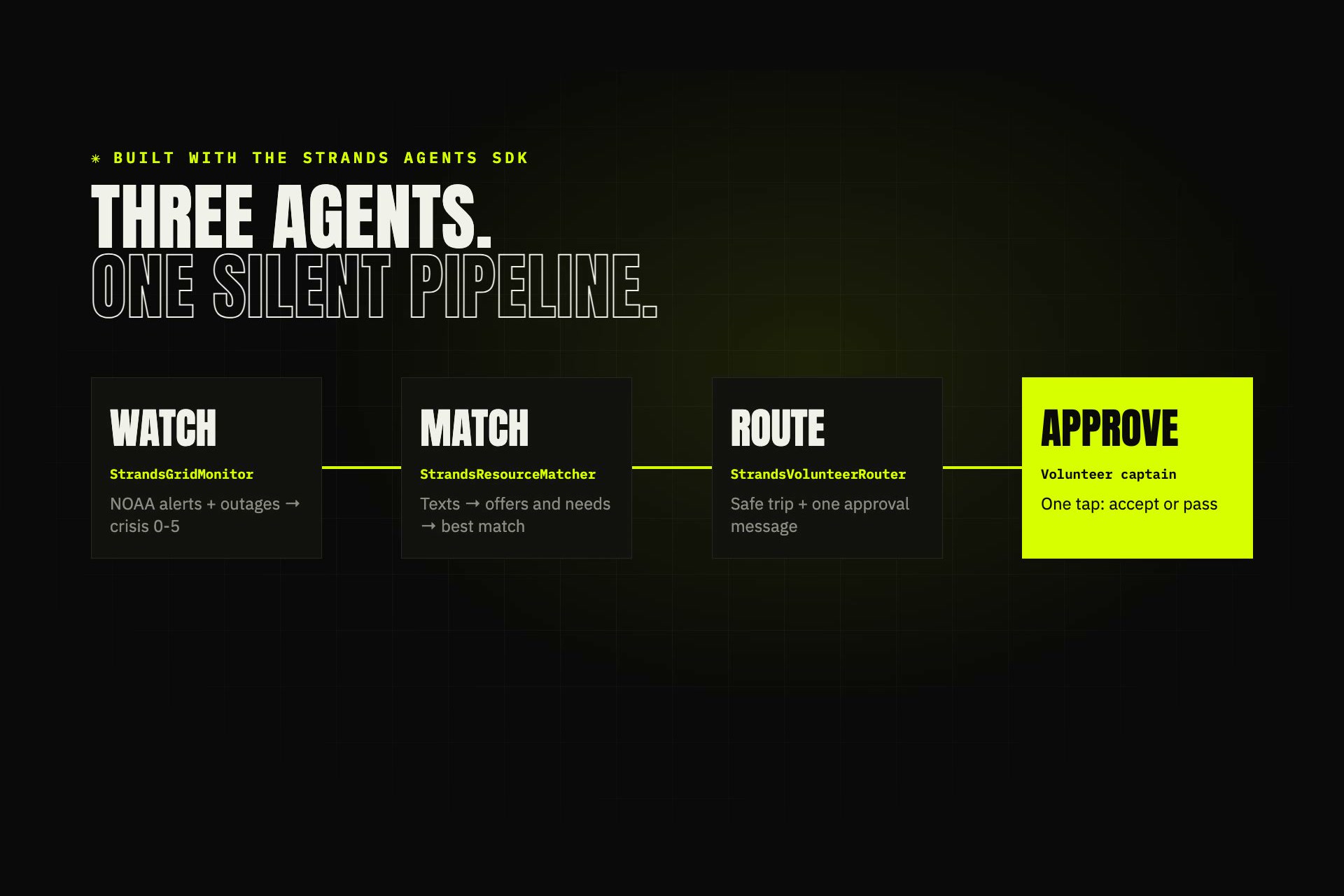
Three agents pipeline
-
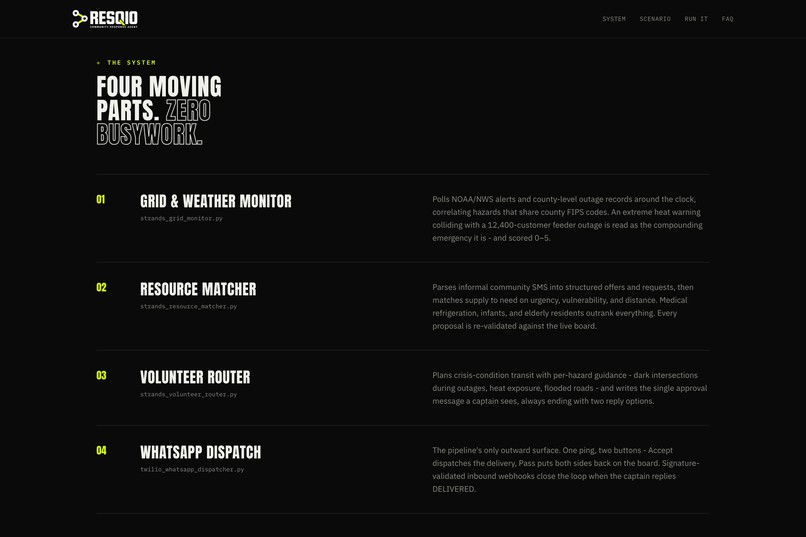
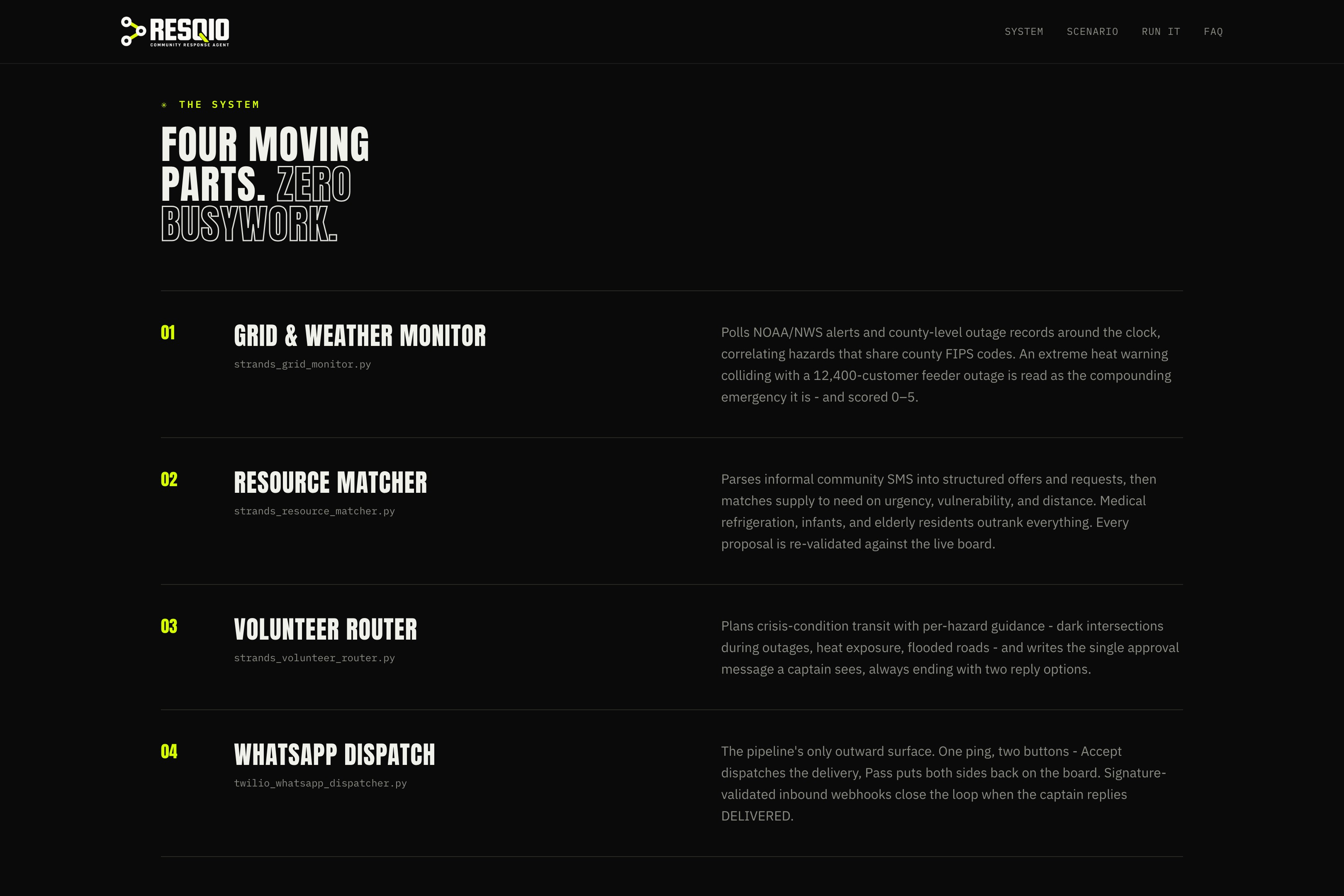
Landing page "Four moving parts" section
-
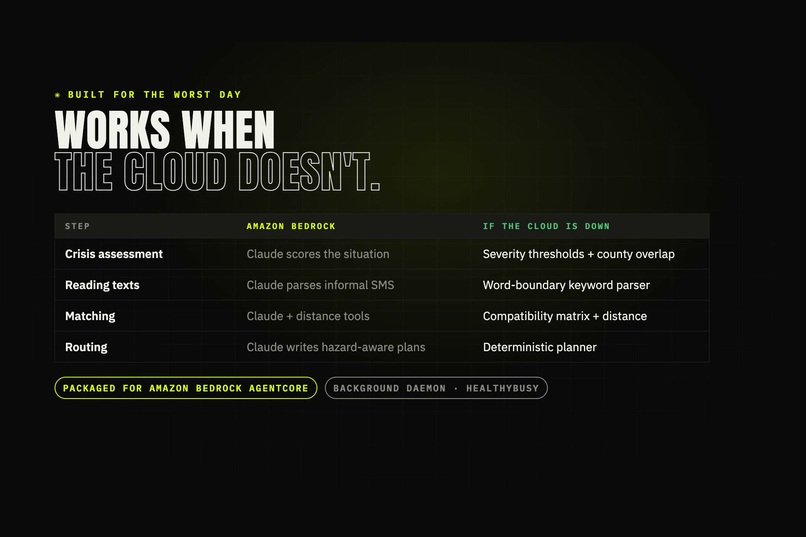
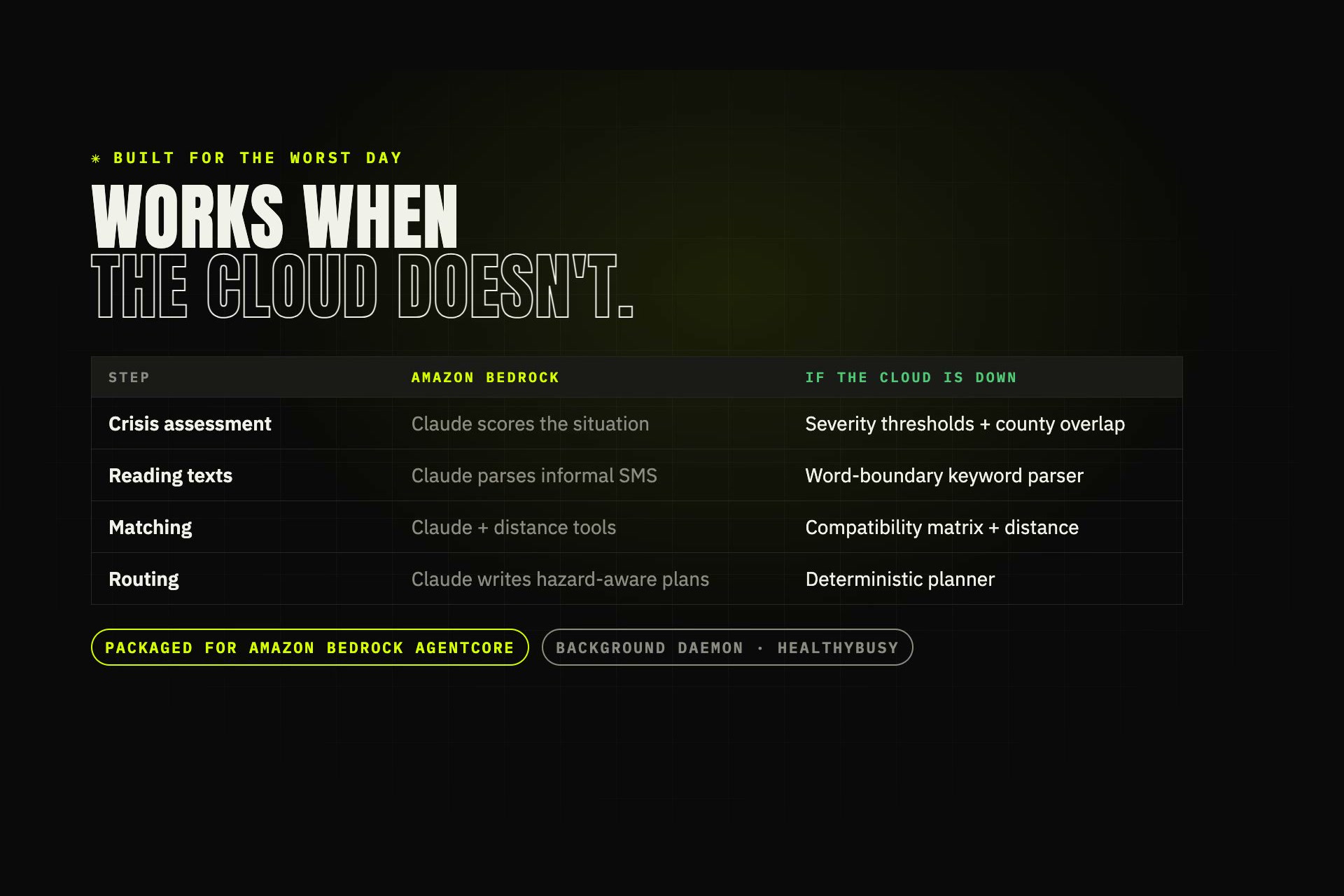
"Works when the cloud doesn't" fallback table
-
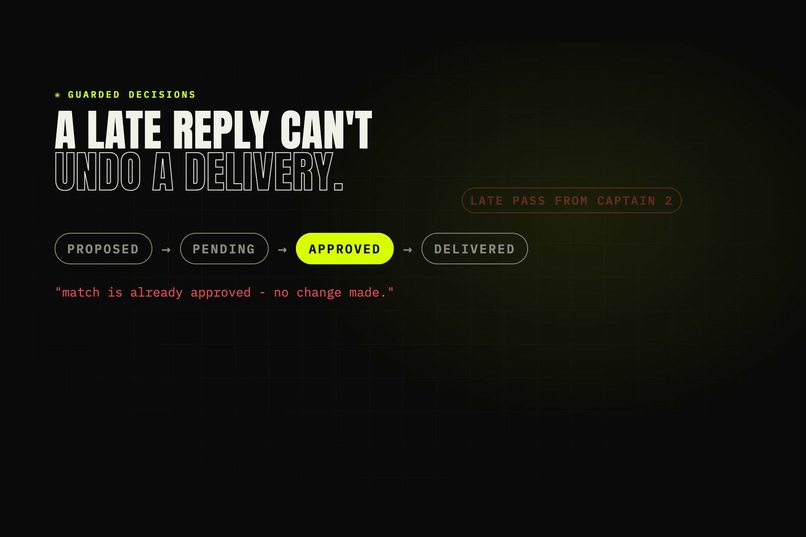
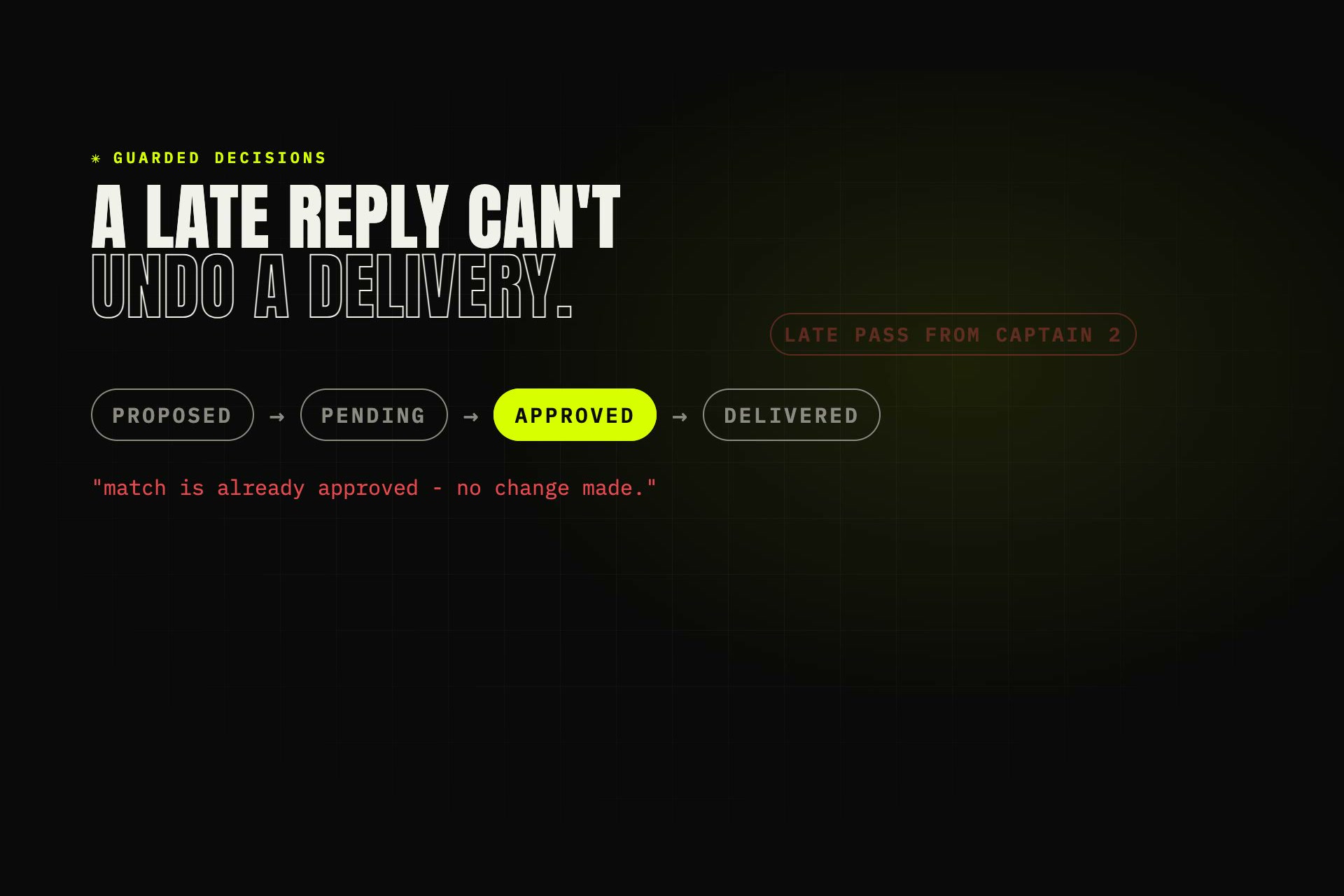
"A late reply can't undo a delivery"
Inspiration
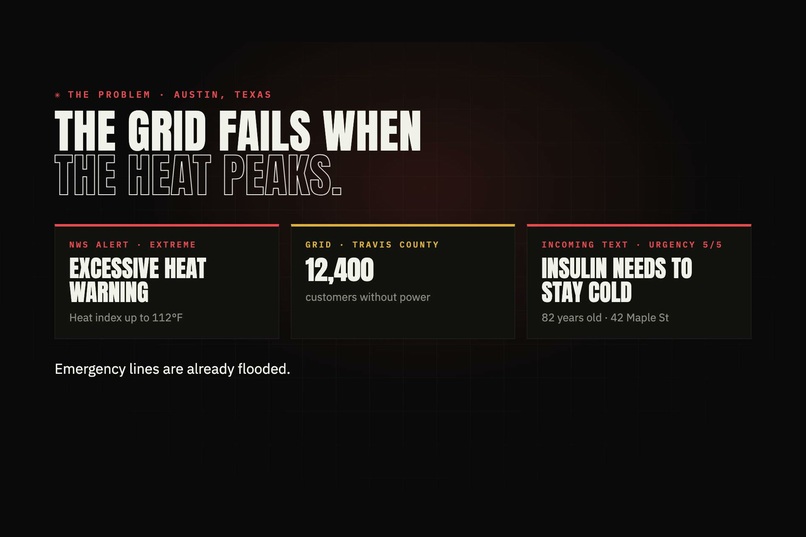
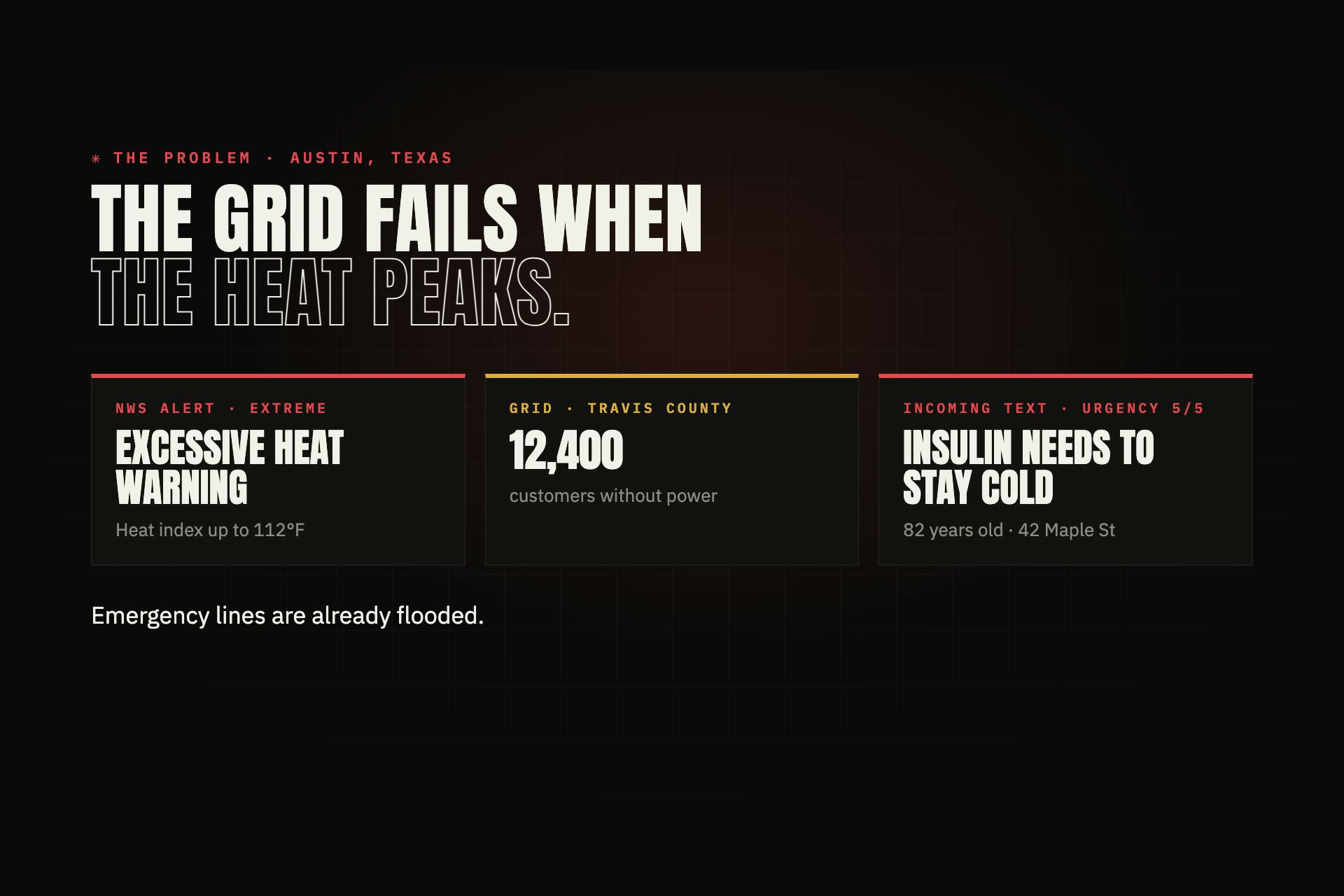
When a heatwave knocks out the grid, the people at greatest risk can't wait in an emergency-line queue: an 82-year-old whose insulin is spoiling, a family with a newborn and no cooling. The help usually already exists a few blocks away - a neighbor with a generator, a freezer full of ice. What's missing is coordination, at the exact moment nobody has time to coordinate. Heat is the deadliest weather hazard in the United States, and coordinating help is relentlessly repetitive work: watching alerts, reading texts, figuring out who can help whom, and writing the same dispatch messages over and over.
What it does
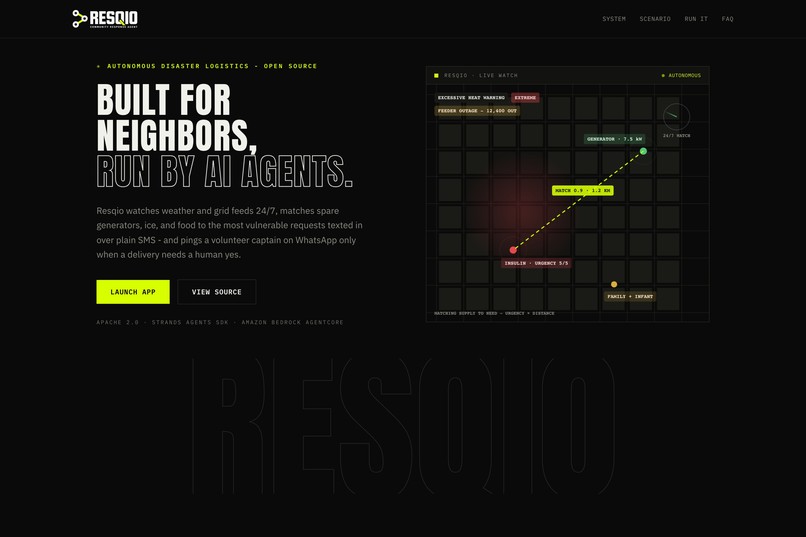
Resqio is a background agent for block captains, mutual-aid groups, food banks, and shelters - the small local organizations that end up coordinating help when official services are overwhelmed. It handles the whole loop:
- Watches NOAA / National Weather Service alerts and county-level power outage data around the clock, and scores crisis severity from 0 to 5. It recognizes compounding emergencies, such as extreme heat plus a 12,400-customer outage in the same county.
- Listens to plain texts from neighbors ("OFFER: generator available in Sector 4", "HELP: insulin needs refrigeration at 42 Maple St"). No app, no account.
- Matches supply to need by urgency, vulnerability, and distance - medical refrigeration, infants, and elderly residents first. It never double-books an offer, and it keeps volunteers inside their own service zone.
- Asks a human only when a real-world delivery needs a decision: one WhatsApp message to a volunteer captain with the route, the hazards, and two replies, ACCEPT or PASS. Requests nobody answers expire and are re-matched automatically.
No crisis, no messages. A situation board with an ops map lets organizers see everything at a glance, but nobody has to watch it.
How we built it
- Strands Agents SDK powers three specialized agents:
StrandsGridMonitor(crisis detection),StrandsResourceMatcher(text parsing and supply-to-need matching), andStrandsVolunteerRouter(hazard-aware routing and the approval message). Each has its own custom@tools and returns validated structured output (Pydantic models viastructured_output_model). - Claude on Amazon Bedrock is the reasoning model.
- Amazon Bedrock AgentCore Runtime: the pipeline is packaged as a
BedrockAgentCoreApp. Its polling daemon runs as a tracked async task, so the runtime keeps the session alive (HealthyBusy) between cycles. - Twilio WhatsApp and SMS for inbound texts and approval pings, with signature-validated webhooks.
- NOAA api.weather.gov for live weather alerts. Power outages come through a pluggable feed that uses the EAGLE-I county outage schema.
- Next.js 14, Tailwind CSS, and Leaflet for the landing page and the situation board with its ops map, deployed on Vercel with the agent runtime on a VPS.
- Python 3.11, an 82-test offline suite, GitHub Actions CI, Apache 2.0 license.
Challenges we ran into
- A disaster tool can't assume the cloud is up. Every AI step has a deterministic fallback (severity thresholds, a compatibility matrix, a distance-based route planner), so the loop keeps running if Bedrock is unreachable. That design saved us during the build: our new AWS account was still waiting on Bedrock access verification, and Resqio kept working end to end. The demo you see runs on those fallbacks, and anyone can run it offline with zero credentials.
- Real crises are messy. Several captains reply to the same ping, and webhooks get retried. So the match lifecycle is a guarded state machine: a late PASS can never undo a delivery someone already accepted.
- There is no free real-time power outage feed in the US, so the grid source is a pluggable interface that any utility API can implement.
Accomplishments that we're proud of
- The full loop - detection, intake, matching, routing, human approval, and delivery confirmation - works end to end, live at tryresqio.vercel.app.
- The codebase went through an adversarial multi-agent code review, and all 20 confirmed findings were fixed, including a double-booking race.
- Multi-county service zones with per-zone volunteer rosters, and a live NOAA integration validated against production alerts.
What we learned
The most valuable thing an agent can do for a stressed community is stay quiet. Designing around "only surface when a human must decide" shaped every part of the system, from how approval messages are written to how failures degrade.
What's next for Resqio
Running live on Claude through Amazon Bedrock and deployed to AgentCore Runtime, a pilot with a neighborhood mutual-aid network, playbooks for winter freezes and hurricanes, and Spanish-language texts.
Built With
- amazon-bedrock
- amazon-bedrock-agentcore
- claude
- httpx
- next.js
- noaa-weather-api
- pydantic
- python
- react
- strands-agents
- twilio
- typescript

Log in or sign up for Devpost to join the conversation.