-
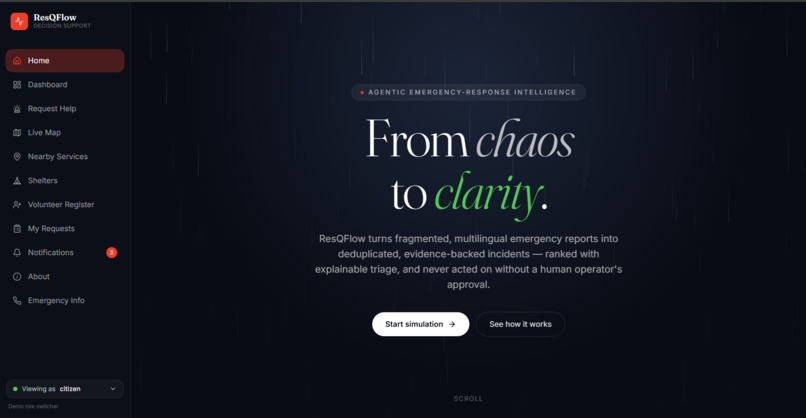
RESQFLOW: AI-powered emergency intelligence for faster rescue and coordinated disaster relief.
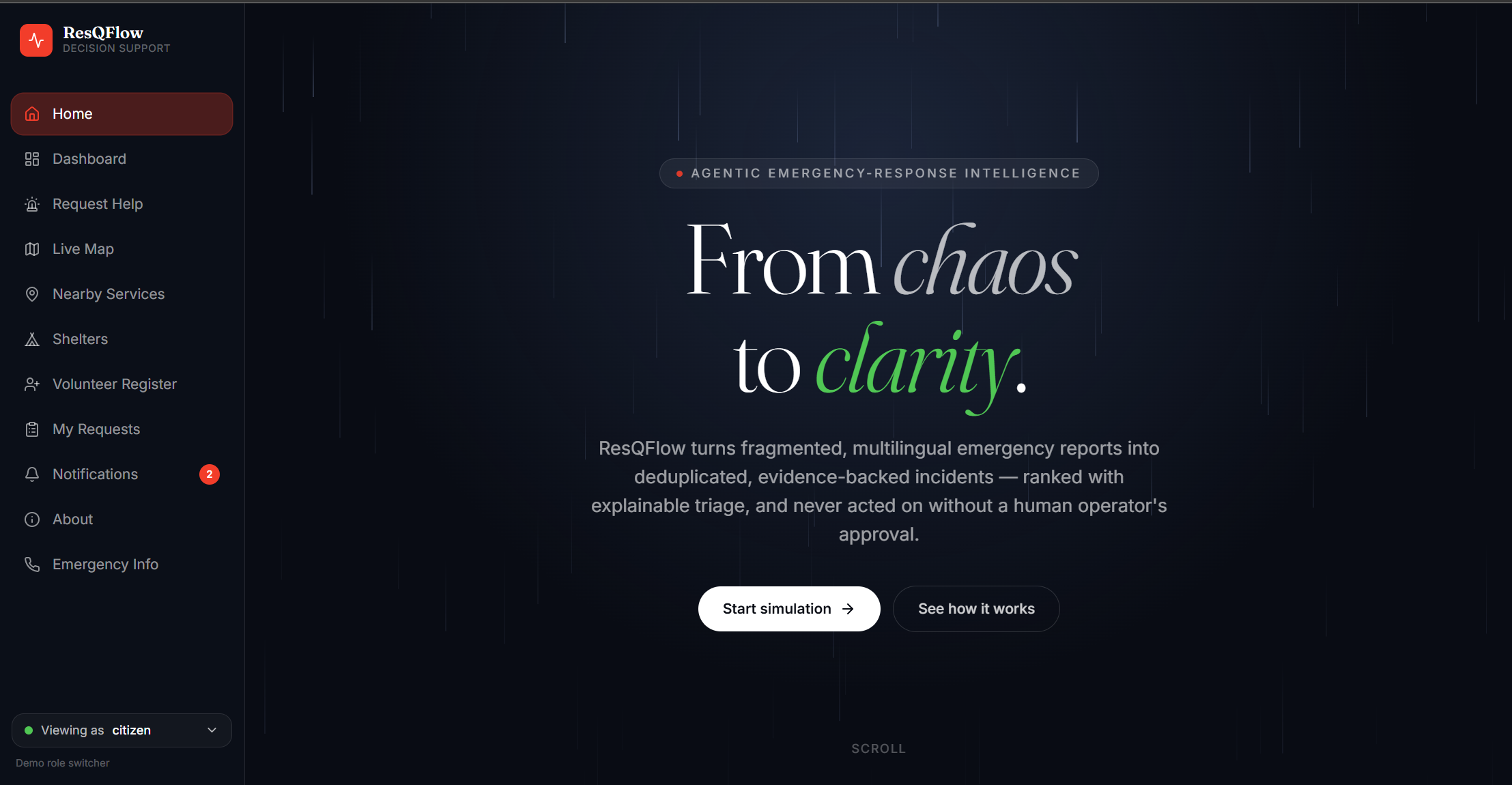
RESQFLOW — Agentic AI Emergency Intelligence Platform
1. Inspiration
During disasters such as floods, earthquakes, and cyclones, people often struggle to communicate their needs, while emergency authorities face the challenge of processing scattered information and coordinating limited resources. Distress reports may arrive through phone calls, text messages, photographs, and different regional languages. Some reports may describe the same incident, while others may contain incomplete locations or urgent requests for help. In such situations, valuable time can be lost between reporting an emergency and getting the right assistance to the right people.
This inspired me to develop RESQFLOW, an Agentic AI Emergency Intelligence Platform designed to transform chaotic, multilingual emergency reports into structured, actionable information. My vision is not simply to build another emergency-reporting website, but to create a system that helps connect people in distress with the responders, resources, and essential services they need.
2. The Problem
Emergency response involves more than identifying that a disaster has occurred. Authorities must understand where people are stranded, how many people require assistance, which incidents are most urgent, and what resources are available nearby. When information arrives from multiple channels, duplicate reports, language barriers, inaccurate locations, and fragmented communication can complicate decision-making.
Another critical challenge is network failure. During severe disasters, electricity, mobile connectivity, and internet infrastructure may become unavailable precisely when people need emergency assistance the most. Even when a person successfully reports an emergency, they may still struggle to find a rescue team, a safe shelter, food, drinking water, or medical assistance.
RESQFLOW addresses these challenges through a unified emergency intelligence and coordination approach, with a long-term goal of supporting resilient communication and access to essential services even when conventional infrastructure is disrupted.
3. Our Solution
RESQFLOW is designed to collect emergency reports through voice, text, and images, including multilingual and code-mixed communication. Its AI-powered workflow extracts essential information such as the type of emergency, location, number of people affected, immediate needs, and urgency.
The system is intended to identify potentially duplicate reports, consolidate related information, and organize incidents according to their severity. Geospatial processing can help identify nearby response resources, while a centralized dashboard can provide emergency coordinators with a clearer picture of developing situations.
Rather than leaving people with a report number and no further direction, RESQFLOW aims to support the entire assistance journey: from reporting an emergency to identifying available help and coordinating a response. Critical dispatch decisions would remain subject to appropriate human oversight and verification.
4. How It Works
RESQFLOW follows a structured emergency-response workflow.
Step 1 — Collect emergency reports: People can report distress through supported voice, text, or image-based channels. Multilingual processing helps make the reporting experience more accessible to people who do not communicate in English.
Step 2 — Extract essential information: AI processes the available information to identify the incident type, location, number of people affected, and assistance required. Missing or uncertain details can be flagged for clarification rather than treated as confirmed facts.
Step 3 — Consolidate and prioritize incidents: Duplicate-detection logic helps identify reports that may refer to the same event. A structured severity-assessment process helps coordinators prioritize incidents using factors such as immediate danger, people at risk, and urgency.
Step 4 — Identify available resources: Geospatial matching can help locate relevant rescue teams, volunteers, shelters, and other services in the vicinity. Resource availability and suitability would need to be verified before dispatch.
Step 5 — Coordinate assistance: A centralized dashboard and real-time updates are intended to help authorized coordinators review incidents, approve response actions, and communicate with relevant responders.
Step 6 — Support continued monitoring: A live incident map and a planned simulation mode can help visualize emergencies and explore how response resources might be coordinated under different disaster scenarios.
5. Technology and Development Approach
RESQFLOW is designed around a modular full-stack architecture that brings together AI, geospatial processing, communication services, and a centralized user interface.
The proposed technology stack includes React with Vite for the frontend, Node.js and Express for backend services, MongoDB for incident data, and Socket.IO for real-time updates. Twilio can support phone-based reporting, while Sarvam AI's Saaras speech-recognition and Bulbul text-to-speech technologies can support multilingual voice interactions. Geospatial calculations, including distance-based matching, can help identify nearby resources.
Each component has a specific role: communication services receive reports, AI structures the information, backend logic manages incidents and matching, and the interface helps coordinators understand the situation and take action.
The development approach prioritizes modularity, explainable decisions, reliable data handling, and human oversight. The final implementation and integration of each feature must be validated through functional testing and realistic disaster scenarios.
6. Challenges and How I Approach Them
One of the most important challenges is handling incomplete, ambiguous, or inaccurate emergency information. A person under stress may not know their exact location or may provide only a few words describing their situation. RESQFLOW therefore needs to distinguish confirmed information from assumptions and request clarification when necessary.
Another challenge is duplicate reporting. Multiple people may report the same stranded family or flooded location through different channels. Combining related reports without accidentally merging separate emergencies requires careful matching based on location, time, incident details, and supporting evidence.
Prioritizing incidents also requires caution. AI-generated severity assessments should assist human decision-making rather than become unquestionable decisions. Similarly, resource matching must account for actual availability, accessibility, and the safety of responders.
Finally, the platform must be designed with privacy, security, reliability, and accessibility in mind because emergency reports can contain sensitive personal information. These challenges have shaped the way I approach RESQFLOW: as a coordinated operational system rather than an AI model working in isolation.
7. What I Learned
Developing RESQFLOW has helped me understand how AI can be integrated into a real-world problem that requires much more than generating text. An effective emergency-response platform must combine information extraction, backend systems, geospatial reasoning, real-time communication, and an interface that supports decisions under pressure.
The project has also highlighted the importance of responsible AI design. In high-stakes situations, a system must communicate uncertainty, preserve human oversight, and avoid presenting unverified information as fact. Most importantly, I learned that a useful technology solution should be evaluated not only by its technical capabilities but also by whether it can help people access assistance when they need it most.
8. What's Next — The Long
Built With
- ai-agents
- bulbul-text-to-speech
- express.js
- geospatial-processing
- javascript
- mongodb
- node.js
- react
- rest
- saaras-speech-recognition
- sarvam-ai
- socket.io
- twilio
- vite


Log in or sign up for Devpost to join the conversation.