Inspiration
Our inspiration came from witnessing the contrast between surplus food in restaurants and people struggling with hunger. According to the UN, nearly one-third of global food production is wasted every year — that’s about 1.3 billion tonnes, while millions go hungry daily. We realized that the problem isn’t food scarcity, but inefficient redistribution. This inspired us to create ResQ Bites, a platform that bridges this gap by connecting restaurants with volunteers who can deliver surplus food to those in need.
What it does
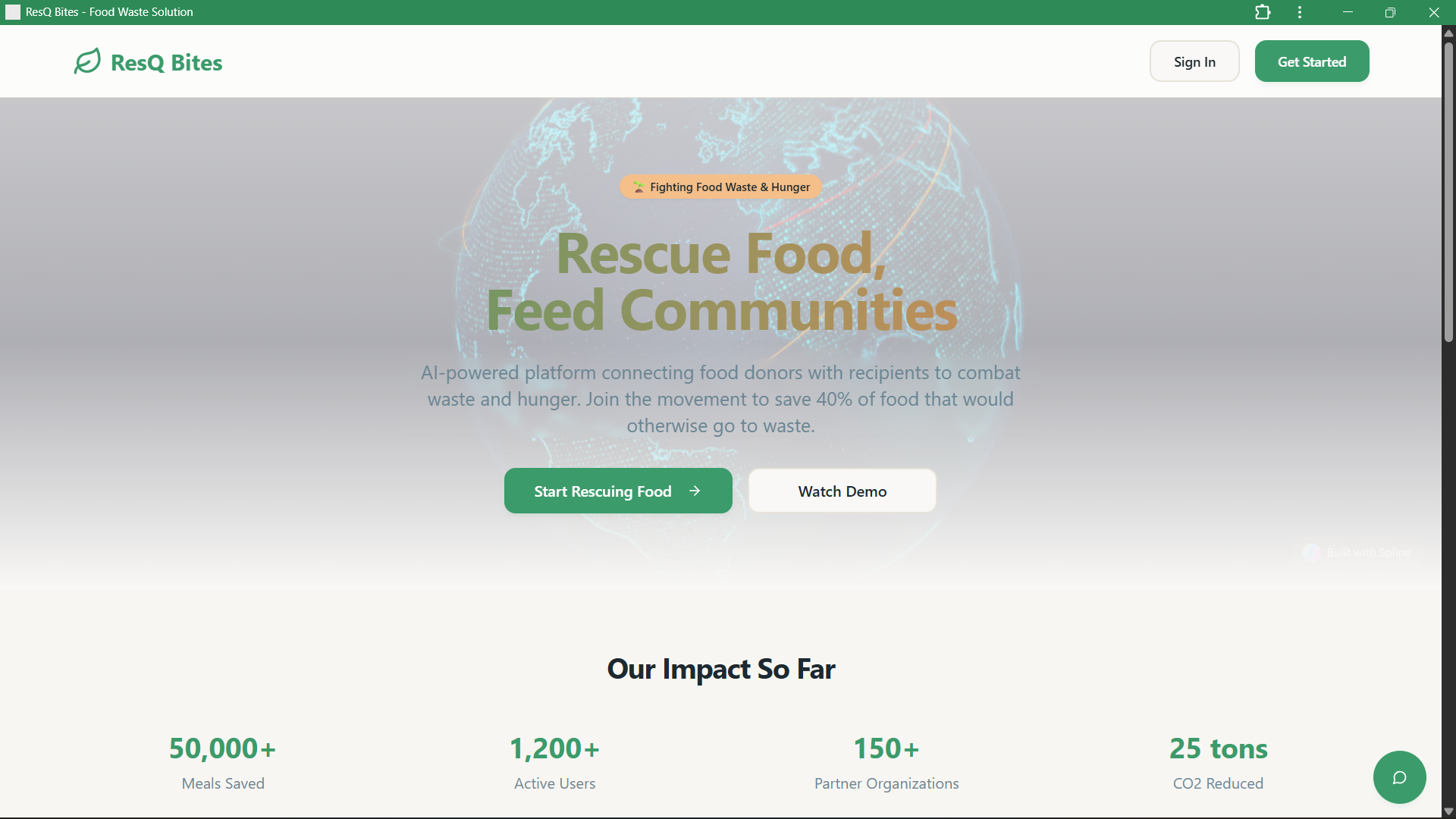
ResQ Bites is a social helping mobile application designed to reduce food waste and fight hunger by connecting restaurants with surplus food to volunteers who can deliver it to people in need.
The app acts as a bridge between food surplus and food scarcity, ensuring that leftover food from restaurants, cafés, or events doesn’t go to waste but instead reaches the hungry in time.
How we built it
ResQ Bites was built using a modern, scalable tech stack:
Frontend: React Native — for a smooth, cross-platform mobile experience.
Backend: Node.js — to handle requests and coordinate data efficiently.
Database & Auth: Firebase — for real-time updates, secure authentication, and push notifications.
Maps & Tracking: Google Maps API — to enable live location tracking and smart volunteer-restaurant pairing.
We designed a clean, intuitive UI that allows restaurants to list food quickly, and volunteers to find and deliver it easily — ensuring the flow from kitchen to community remains seamless.
Challenges we ran into
Real-Time Synchronization: Maintaining live data updates between restaurants, volunteers, and backend servers was tricky. Firebase helped, but optimizing data flow required tuning listeners and caching.
Location Accuracy: Integrating Google Maps for precise pickup and drop-off points required handling API limits and permissions on different devices.
Scalability: We had to ensure the system could handle multiple simultaneous listings and volunteer actions without lag.
User Experience: Designing an interface that works for both tech-savvy users and small restaurant owners was a learning curve in UX design.
Accomplishments that we're proud of
Built a Functional End-to-End App: Successfully developed a fully functional mobile application that connects restaurants, volunteers, and the hungry — from listing surplus food to live delivery tracking.
Created Real Social Impact Potential: Designed a solution that can directly reduce food waste and feed people in need, addressing both environmental and humanitarian challenges.
Seamless Real-Time System: Integrated Firebase and Google Maps API to enable real-time notifications, live tracking, and efficient volunteer-food matching.
What we learned
Throughout the project, we learned how technology can make social good scalable and efficient. We explored real-time data handling, geo-tracking, and volunteer coordination systems, discovering how digital solutions can reduce waste and maximize impact.
We also applied optimization logic similar to minimizing a cost function in algorithms:
Minimize: C=f(d,t,v)
where, d = distance between restaurant and receiver, t = delivery time, v = available volunteer capacity.
Our goal was to minimize this cost while maximizing food delivery efficiency.
What's next for ResQbites
We plan to integrate NGOs, use AI-based demand prediction, and introduce gamified rewards to keep volunteers engaged in ResQ Bites

Log in or sign up for Devpost to join the conversation.