-
-
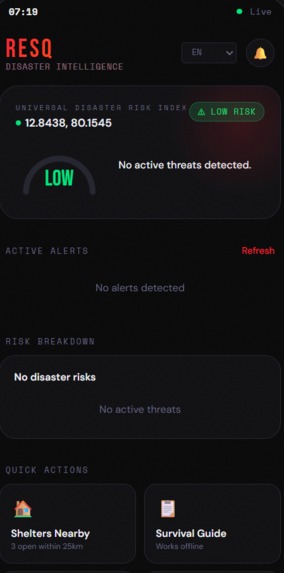
Interface
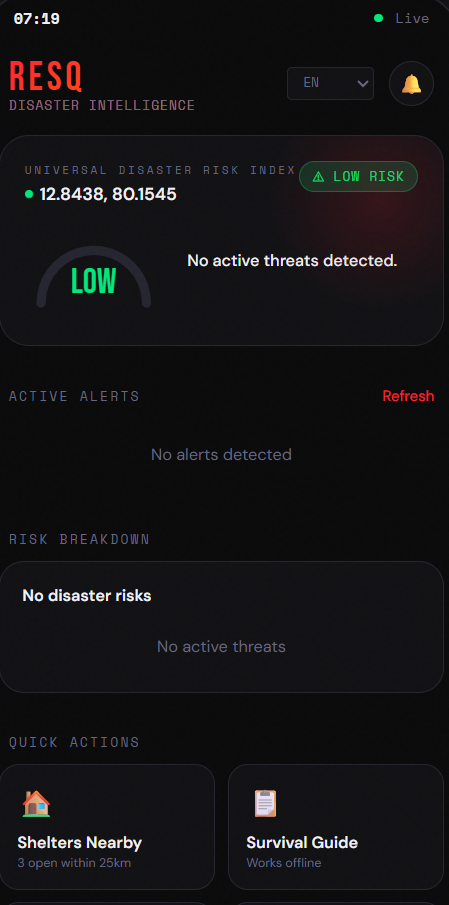
Inspiration
Disasters often escalate faster than information spreads. During floods, cyclones, and earthquakes, people rely on scattered news sources, social media rumors, and delayed government alerts. This gap between real danger and reliable information can cost lives.
We built ResQ to bridge that gap — a real-time disaster intelligence system that combines risk scoring, verified alerts, AI-powered assistance, and emergency tools into a single mobile experience.
Our goal was simple: Make disaster response proactive instead of reactive.
What it does
ResQ is a real-time disaster intelligence and emergency response platform.
It:
Calculates a Universal Disaster Risk Index (UDRI) for a user’s location
Aggregates and verifies disaster alerts
Shows nearest shelters dynamically
Provides an AI-powered disaster safety assistant
Includes an SOS distress system with GPS sharing
Works partially offline with cached survival guides
Automatically triggers periodic safety check-ins during high-risk situations
UDRI=f(weather,source agreement,verification, escalation score) The result is a clear, understandable LOW / MODERATE / HIGH / CRITICAL risk level.
How we built it
ResQ consists of:
Backend FastAPI (Python)
Risk scoring engine
Alert aggregation system
Shelter proximity calculation
Chat API endpoint
SOS distress endpoint
Frontend Custom mobile UI (HTML/CSS/JS)
Risk gauge visualization
Dynamic alert cards
Pop-up survival guides
Chat assistant interface
Cloud Deployment GitHub for version control
Render for backend deployment
The system fetches location-based alerts, calculates risk scores, and updates the UI in real-time.
Challenges we ran into
Handling backend deployment issues (Python version conflicts, build errors)
Preventing API keys from being exposed in GitHub (secret scanning blocks)
Designing a mobile UI that feels native without using React or Flutter
Managing pop-up overlays without breaking layout
Ensuring the app gracefully handles offline states
Deploying a FastAPI app on a free cloud tier with strict constraints
Accomplishments that we're proud of
Successfully built a full-stack disaster intelligence system
Designed a professional mobile-style UI from scratch
Integrated AI-based disaster assistance
Created a real-time risk index (UDRI)
Implemented a GPS-based distress alert system
Deployed the backend live to the cloud
Most importantly, we built something that could genuinely help people during emergencies.
What we learned
Cloud deployment requires strict version control (Python, dependencies)
Security (API keys, environment variables) is critical
UI layering (z-index, overlays, modals) can make or break UX
Risk modeling requires balancing multiple confidence signals
Handling failure states (offline mode) is as important as success states
We also learned how to collaborate efficiently under pressure.
What's next for ResQ
Push notifications for live alerts
Integration with official disaster management APIs
SMS-based fallback system for rural users
Machine learning-based risk prediction
Android/iOS native app release
Multi-language support expansion
Real-time map visualization
Our vision is to make ResQ a globally deployable disaster intelligence system.
Built With
- apscheduler
- css
- fastapi
- github
- google-generative-ai-api
- html
- javascript
- openweather-api
- python
- render
- rest
- uvicorn

Log in or sign up for Devpost to join the conversation.