
Inspiration In Pakistan, motorcycle accidents are an everyday event, and the first problem is rarely treatment. It is identity. An unconscious rider cannot say his name, his blood group, or who to call. His phone is locked. The golden hour is spent finding out who he is. ResQ exists to close that gap with the cheapest technology there is: a printed sticker.
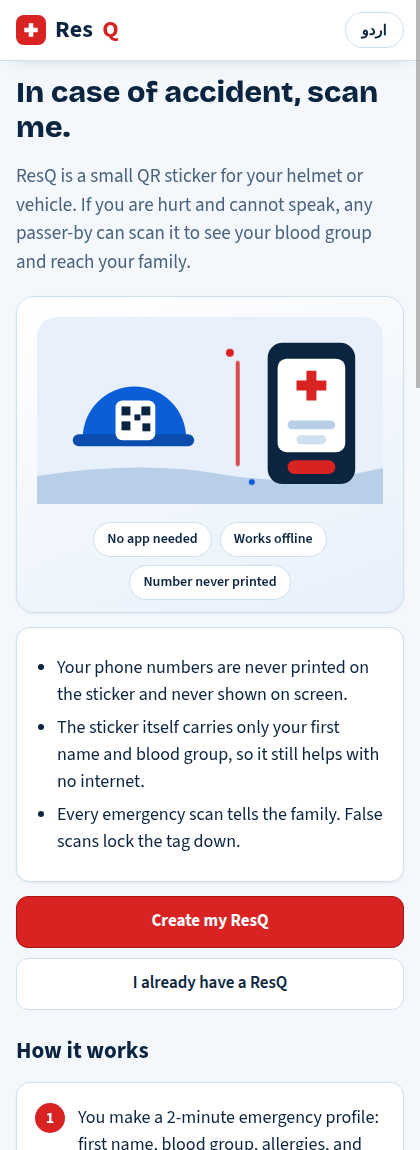
What it does ResQ is a small QR sticker for a motorcycle helmet or vehicle. If the rider is hurt and cannot speak, a bystander scans it to see the rider's blood group and call the family or 1122 in one tap. Family numbers are never printed and never shown on screen; they sit behind an emergency gate, and every scan is reported to the owner.
- A rider creates a 2-minute emergency profile: first name, blood group, allergies, conditions, regular medicines, and up to two family contacts. No national ID, no home address, nothing else is ever asked.
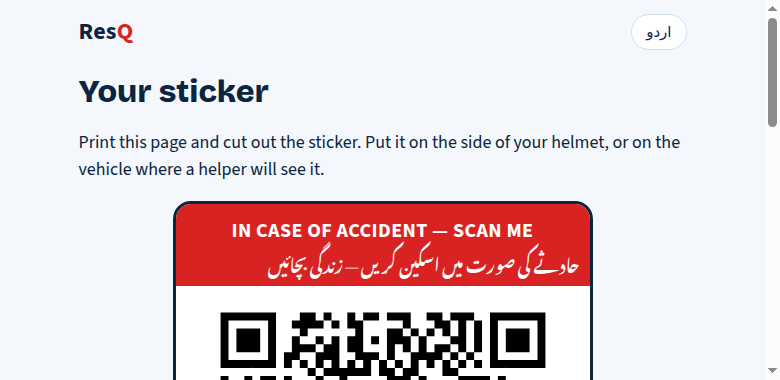
- The rider prints a sticker. The QR carries the scan link plus, as plain text, only the rider's first name and blood group, so the two most vital facts still work with no internet and no server.
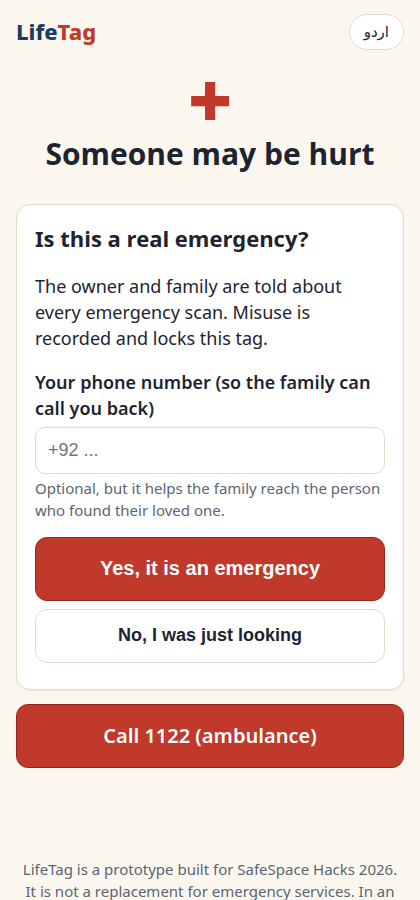
- A bystander who scans meets an emergency gate first: "Is this a real emergency?" The owner is told about every emergency scan, and misuse is logged.
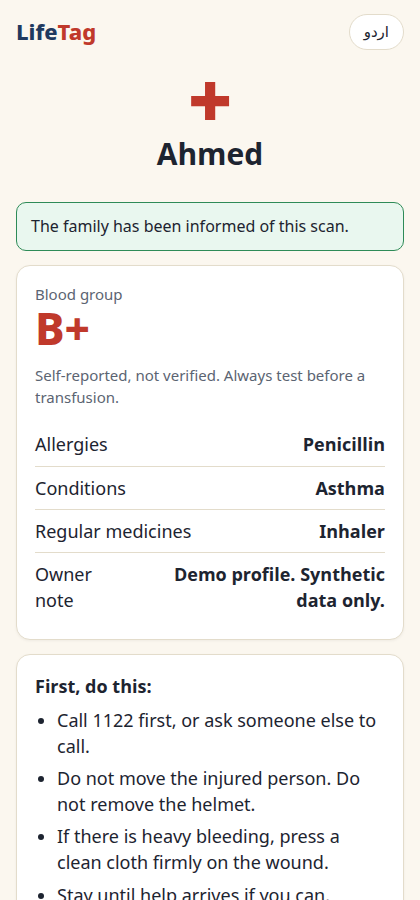
- Behind the gate: blood group in large type (labelled self-reported: always test before a transfusion), allergies, conditions, medicines, one-tap Call 1122 and Call family buttons, recorded spoken instructions in Urdu that play on any phone, and an "already informed" state so a crowd does not call the family twenty times.
- A family contact becomes reachable only after personally accepting through their own consent link. They can decline, or revoke later from the same link, without asking the owner.
- Owners can set "today's rider" (borrowed bikes are normal), deactivate a lost tag in one tap, regenerate the code, review every scan, and download all of their data.
How we built it Plain HTML, CSS and JavaScript with no framework and no build step. Firebase Authentication and Firestore hold accounts and tag records under strict rules: public tag data is readable only by its unguessable 12-character code, listing is denied everywhere, contact numbers live in a separate record fetched only after the emergency gate, consent decisions live in their own token-keyed records, and the scan log is append-only for the public and readable only by the owner. Lockdown is enforced with a counter on the tag itself: three "just looking" reports in 24 hours and the emergency path requires a deliberate 3-second hold. A service worker keeps the shell available offline, and fonts and the Urdu guidance audio are self-hosted so nothing depends on a CDN. The visual design ("Rescue Red, Blue and White") uses self-hosted Source Sans 3 and Bricolage Grotesque. The QR library is vendored (MIT).
Challenges we ran into The hardest part was not the code. Before building, we red-teamed our own idea and wrote down 40 ways it could fail or be misused. The design that survived is a different product from the naive one: no numbers on the sticker, no numbers on screen, contact consent before a number becomes reachable, empty medical fields rendered as "not provided, treat as unknown" instead of "none", and a lockdown mode after repeated non-emergency scans. Risks we found and answered: (1) a photo of the sticker could power "your son had an accident, send money" scams - the sticker carries no phone number at all; (2) numbers could leak or be harvested - never printed, never displayed, random 12-character codes, no listing; (3) prank scans could panic families - the gate, scan logging, calm alert wording, and lockdown; (4) a wrong self-reported blood group could harm - prominent "self-reported, always test" labelling; (5) bystanders may not scan, or may fear police involvement - bilingual sticker text, no name or statement required to scan, Urdu voice guidance (partly unsolved, and we say so); (6) borrowed bikes and stolen helmets - today's-rider mode, one-tap deactivation, code regeneration; (7) if the service dies, stickers die - name and blood group live inside the QR itself, and owners can export all their data. Honest remainder: ResQ is a prototype, not a replacement for emergency services.
What we learned That safety products fail on trust before they fail on technology. Every feature in ResQ is shaped by an abuse case, and stating the limitations plainly turned out to be a feature, not a weakness.
Try it Live app: https://daimx1214.github.io/resq/ Demo tag (synthetic demo profile "Ahmed", blood group B+; scan or open it to see the full bystander flow; all demo data is synthetic): https://daimx1214.github.io/resq/#/t/KUWZCBA2H8WQ Demo video (72 seconds): https://www.youtube.com/watch?v=BARg5Nn6-Io
