-
-
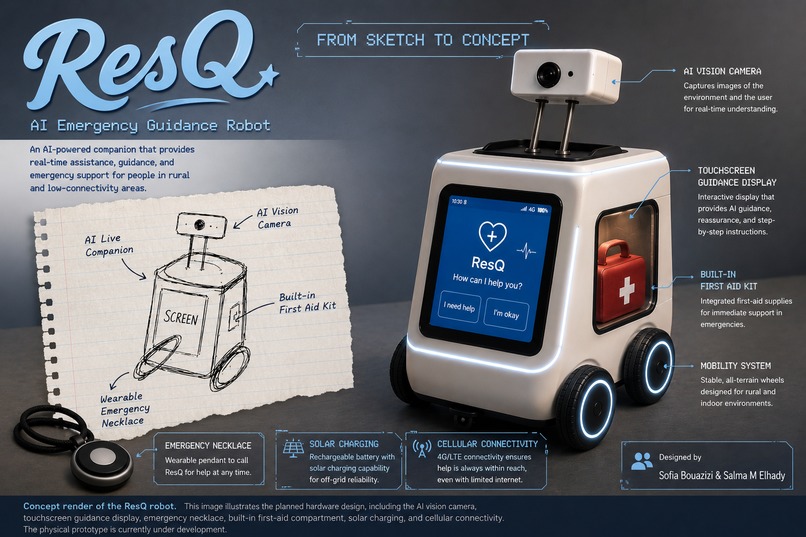
Advertisement: Our first sketch to a real project
-
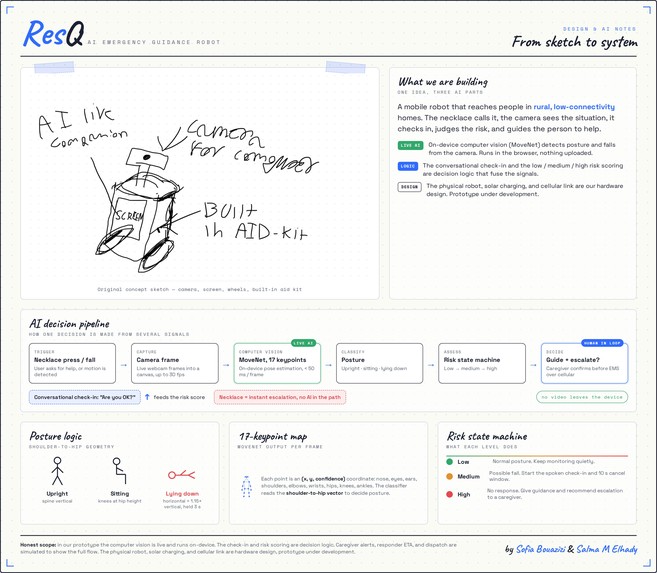
documentation of the AI implementation
-
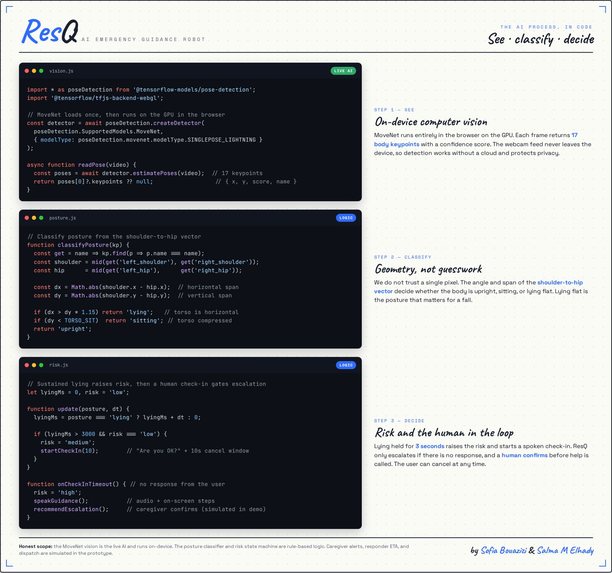
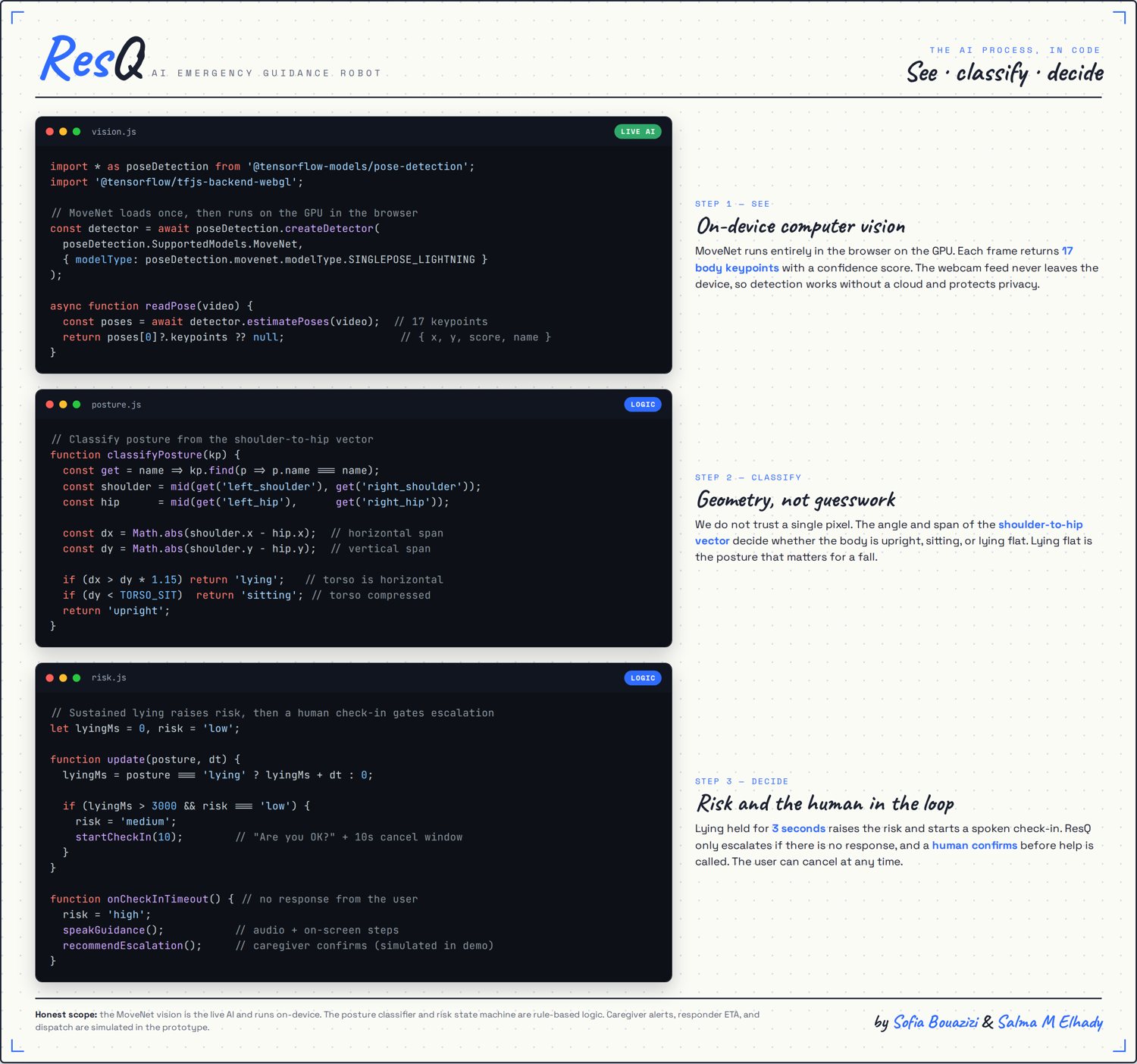
Essential chunks of code pulled from ResQ
-
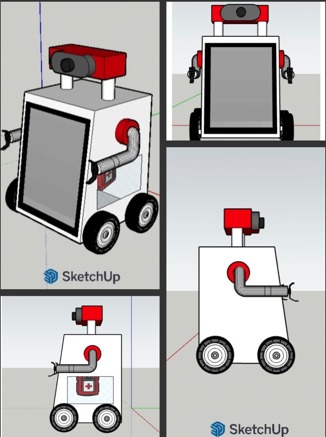
Sktech
What it does and why it matters
My grandmother lives alone in a rural village in Tunisia, where reliable internet, power, and emergency help are not always available. If she fell or had a medical emergency, getting help could take hours. Her phone might be dead, there might be no signal, and she might not be able to call for help at all. That worry is what led my teammate and me to build ResQ.
ResQ is an AI-powered emergency guidance robot for people who live alone or are cut off by the digital divide. It sits in the home and comes with a wearable emergency necklace. The necklace is a direct lifeline: press it and ResQ instantly sends your location and calls for help. But a button only works if you can press it, and a hard fall, a stroke, or a faint can leave you unable to. That is where the AI comes in.
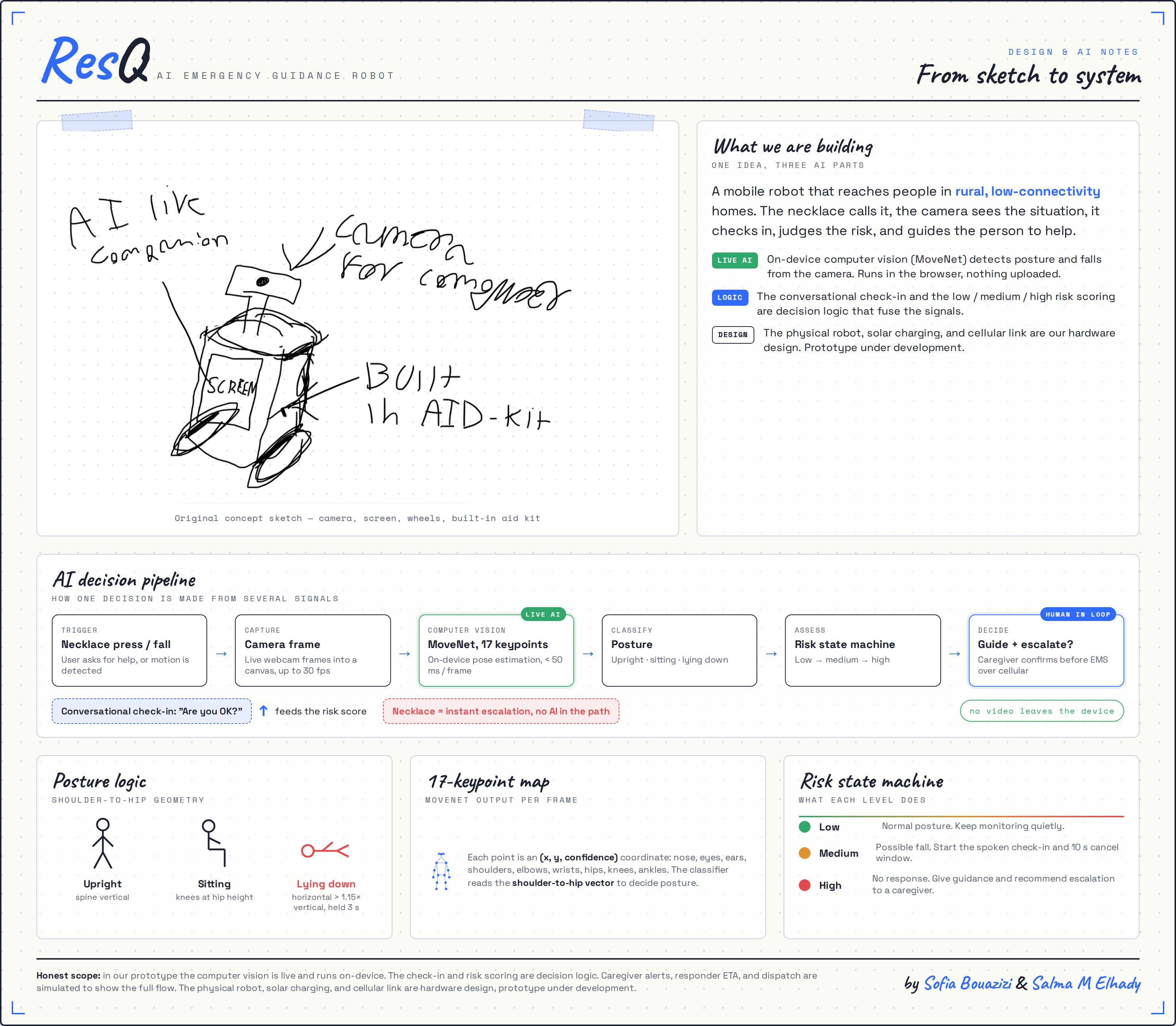
ResQ’s computer vision watches for an injuries and uses the information to classify risk. The moment it sees one, it starts an AI pipeline: computer vision reads posture and movement, a conversational AI asks the questions a camera can’t answer, such as whether the user is conscious, hurt, or able to move, and a risk-assessment AI fuses what it sees with what it hears to decide whether the situation is low, medium, or high risk. If the risk is high and the user doesn’t answer a safety check-in, ResQ escalates to caregivers and emergency services.
This is what makes ResQ different from a traditional alert button. A button only sends a signal. A simple sensor can tell that something happened but not whether it’s a real fall or someone resting on the floor. Only AI can detect an emergency without a press, understand the person, and decide what help is actually needed, and it does this on-device, where there may be no signal at all.
How we built it
We built a working browser-based prototype on Replit using HTML, CSS, JavaScript, TensorFlow.js, and Google’s MoveNet model. The computer vision runs entirely on-device, so video never leaves the device, which protects privacy inside someone’s home. MoveNet tracks body posture in real time and flags a possible fall. That signal feeds a conversational AI that checks in on the user, and a risk-assessment layer combines both into a single severity estimate that drives ResQ’s response.
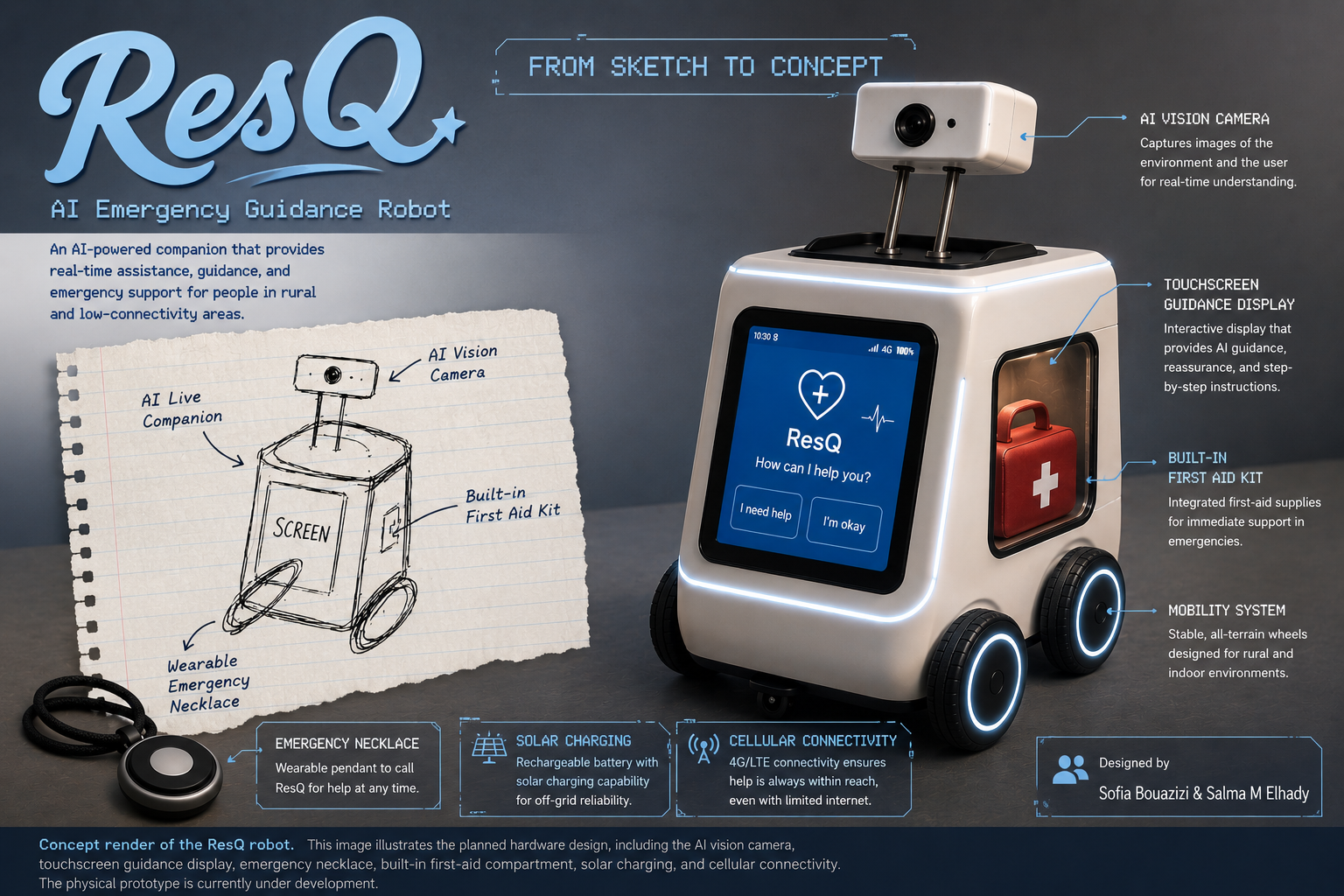
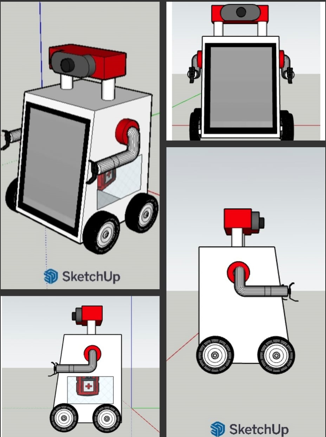
In the demo, the fall detection is real AI running live on a real camera. The caregiver and emergency-service notifications are simulated to show the full workflow. We also designed the physical system: a solar-powered mobile robot, a Raspberry Pi camera, the wearable emergency necklace, a touchscreen, and a satellite communication module, so ResQ keeps working where electricity and internet are unreliable.
Challenges we ran into
The biggest challenge was context. A camera can detect that someone is on the floor, but it cannot know whether they are resting, exercising, or experiencing a real emergency. A traditional emergency button has the opposite problem: it only works if the user is able to press it. To solve this, we combined multiple AI systems into one decision-making pipeline. Computer vision analyzes posture and possible falls, conversational AI gathers information the camera cannot see, and risk assessment combines those signals to estimate the severity of the situation. Building a system that could fuse those inputs into a single recommendation was the most difficult technical challenge.
We also had to design for the digital divide. Most existing solutions assume reliable internet, power, and a smartphone. ResQ is built for the opposite, with satellite connectivity and solar charging so it keeps running when those assumptions break down.
Accomplishments we're proud of
We're proud that ResQ uses AI to do more than detect emergencies. It helps understand situations, assess risk, and guide users through stressful moments.
We're also proud that the project came from a real problem affecting my grandmother and many others who live alone with limited access to technology.
Finally, we're proud that ResQ keeps humans involved in important decisions and prioritizes privacy by processing data locally whenever possible.
What we learned
We learned that responsible AI is about more than accuracy. It is about understanding the limitations of each AI component and building safeguards around them.
Developing ResQ taught us the importance of human oversight, privacy, explainable recommendations, and designing systems that continue working when connectivity is limited.
What's next
Next, we plan to build the physical prototype and connect the AI system to real hardware, including the emergency necklace, solar charging system, Raspberry Pi camera, and satellite communication module.
We also plan to improve the conversational AI, add multilingual support, and test ResQ with real users and caregivers to measure how effectively it helps people understand emergencies and access support.
Built With
- accessibility
- ai
- canvas-api
- claude
- computer-vision
- css
- getusermedia
- github
- html
- iot
- javascript
- movenet
- on-device-ai
- openai
- pose-estimation
- replit
- robotics
- tensorflow.js
- web-speech-api
- webrtc


Log in or sign up for Devpost to join the conversation.